What Does MSS Mean in Piping Industry? Complete List of MSS Standards (2026)
Understanding MSS Standards in Piping is fundamental for ensuring the mechanical integrity, safety, and interchangeability of valves, fittings, and flanges across global industrial infrastructure.
What are MSS Standards?
MSS stands for the Manufacturers Standardization Society. In the piping industry, MSS Standards in Piping provide specialized technical specifications for the design, manufacturing, and marking of valves, pipe fittings, flanges, and seals, filling critical gaps not covered by ASME or API codes.
“While ASME provides the broad framework, MSS Standards in Piping offer the granular detail needed for niche component manufacturing. In 2026, compliance with SP-25 remains the gold standard for global traceability.”
— Atul Singla, Founder of Epcland

Engineering Knowledge Check
Question 1 of 5Technical Assessment Complete
Complete Course on
Piping Engineering
Check Now
Key Features
- 125+ Hours Content
- 500+ Recorded Lectures
- 20+ Years Exp.
- Lifetime Access
Coverage
- Codes & Standards
- Layouts & Design
- Material Eng.
- Stress Analysis
Understanding the Manufacturers Standardization Society (MSS)
The Manufacturers Standardization Society (MSS) of the Valve and Fittings Industry is a non-profit technical association organized for the development and improvement of industry, national, and international codes and standards. Since its inception, the society has been the backbone of technical uniformity, ensuring that MSS Standards in Piping address the specific needs of manufacturers and end-users alike.
In the 2026 engineering landscape, MSS remains unique because it is the only organization dedicated exclusively to the technical needs of the valve and fittings industry. Unlike broader organizations, MSS focus ensures that every Manufacturers Standardization Society publication provides high-resolution technical detail for component interchangeability.
Why MSS Standards in Piping are Critical for Global Engineering
The integration of MSS Standards in Piping into project specifications is not merely a preference but a safety necessity. These standards cover a vast range of products including valves, actuators, pipe hangers, flanges, and associated seals. Without these protocols, the global supply chain would face catastrophic compatibility issues.
- Material Traceability: Ensuring that every fitting can be traced back to its chemical and physical heat batch.
- Dimensional Consistency: Standardizing Piping Component Dimensions so that a valve from one manufacturer fits perfectly into a piping spool fabricated elsewhere.
- Safety Margins: Defining pressure-temperature ratings that exceed minimum safety requirements for hazardous fluid service.
Furthermore, Quality Certification for Valves is often predicated on the manufacturer's ability to demonstrate strict adherence to MSS Standard Practices (SP). This provides a baseline for third-party inspectors to verify the integrity of the equipment before it arrives at the construction site.
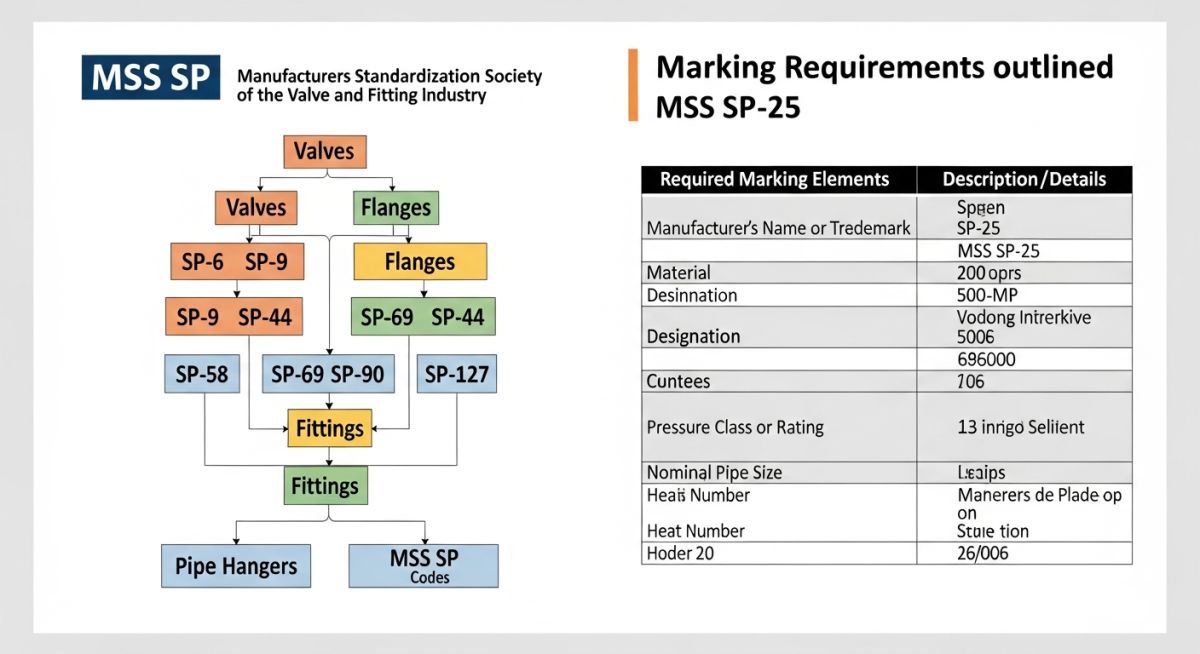
Comprehensive List of MSS Standards in Piping: SP-6 to SP-154
The library of MSS Standards in Piping is expansive, covering everything from surface finishes to high-pressure bolting. Below are the most frequently utilized standards in modern EPC (Engineering, Procurement, and Construction) projects as of 2026.
Critical Valve Marking with MSS SP-25
The MSS SP-25 Marking System is perhaps the most widely recognized standard in the world of piping. It stipulates the mandatory markings required on valve bodies, including the manufacturer's name, pressure rating, material designation, and trim identification.
In 2026, automated laser etching and RFID tagging systems are increasingly mapped directly to the requirements of MSS SP-25 to ensure that field operators can instantly identify the specifications of a valve in an emergency situation.
MSS SP-44: High-Test Steel Pipeline Flanges
For large-diameter pipelines, MSS SP-44 Steel Pipeline Flanges provides the definitive dimensions and material requirements for flanges ranging from NPS 12 to NPS 60. This standard bridges the gap where ASME B16.5 ends, providing critical data for high-pressure midstream assets.
Compliance with SP-44 ensures that flanges can withstand the high-yield stresses typical in natural gas transmission lines and carbon capture pipelines, which have become more prevalent in 2026.
Difference Between ASME and MSS Standards in Piping
A common point of confusion for junior engineers is the overlap between ASME (American Society of Mechanical Engineers) and MSS Standards in Piping. While ASME codes like B16.34 or B31.3 provide the overarching "Rules of the Game" for pressure piping and power piping, the Manufacturers Standardization Society provides the specific "Manufacturing Playbook."
| Feature | ASME Standards | MSS Standards in Piping |
|---|---|---|
| Primary Scope | System Design & Pressure Integrity | Component Manufacturing & Details |
| Granularity | Broad (Systems/Main Components) | High (Specific Finishes/Markings) |
| Example Usage | B16.5 (Flange Dimensions) | SP-6 (Flange Face Surface Finish) |
| Compliance Role | Regulatory/Safety Requirement | Manufacturing/Quality Consistency |
Other MSS Standards for Heavy Industrial Applications
Beyond valves and flanges, MSS Standards in Piping extend into niche but critical areas such as pipe supports, bypasses, and high-pressure fittings. In 2026, the industry has seen a heavy reliance on the following specialized codes:
- MSS SP-58: Pipe Hangers and Supports - Materials, Design, and Manufacture. This is the global benchmark for pipe support integrity in high-vibration 2026 energy plants.
- MSS SP-75: High-Test, Wrought, Butt-Welding Fittings. Crucial for materials with yield strengths matching API 5L line pipe grades.
- MSS SP-97: Integrally Reinforced Forged Branch Outlet Fittings. Essential for ensuring Piping Component Dimensions are maintained in branch connections.
Engineering Math: Stress & Yield in MSS Compliance
When specifying MSS Standards in Piping for high-test fittings (like SP-75), engineers must calculate the minimum wall thickness based on the yield strength of the material. The design pressure P is determined using the Barlow formula:
P = (2 * S * t * F) / D
Where: S = Minimum Yield Strength; t = Nominal Wall Thickness; F = Design Factor; D = Outside Diameter.
For MSS SP-75 compliance, the actual yield strength Sy must exceed the specified minimum yield strength (SMYS) by a margin defined in the standard to account for heat treatment variations. In 2026, many alloys utilized in hydrogen service require a tmin calculation that includes a 0.5 inch corrosion/erosion allowance.
Selection Criteria for MSS Standards in Piping Projects
Selecting the correct MSS Standards in Piping involves a multi-step verification process. Engineers must cross-reference the project's Fluid Service Category (Normal, Category M, or High Pressure) against the specific Standard Practice.
Key factors include:
- Service Temperature: Ensuring SP-58 supports can handle thermal expansion ΔL.
- Visual Integrity: Utilizing SP-55 for surface quality on all critical castings.
- Interface Compatibility: Checking that SP-6 surface finishes match the gasket requirements for the specified flange.
EPCLand YouTube Channel
2,500+ Videos • Daily Updates
MSS Standards in Piping: Wall Thickness Calculator
Calculate the required wall thickness (t) for MSS SP-75 High-Test Fittings based on 2026 design parameters.
Calculated Nominal Thickness (t)
0.000 in
*Note: This calculation uses the Barlow Formula as referenced in MSS Standards in Piping. Always include a corrosion allowance per project specs.
MSS Standards in Piping Failure Case Study: Casting Integrity

Project Data
- Facility: LNG Export Terminal (Operational Year: 2026)
- Component: 24-inch Cryogenic Gate Valve
- Material: ASTM A351 CF8M Stainless Steel
- Issue: Severe weeping through the valve body during hydro-testing.
Failure Analysis
Post-incident analysis revealed microscopic "shrinkage" and "gas porosity" within the casting. The manufacturer had self-certified the valve but failed to perform the visual examinations stipulated by MSS Standards in Piping, specifically the visual comparison benchmarks found in MSS SP-55.
The Engineering Fix
The engineering team implemented a mandatory hold point for all future valve procurements requiring a Visual Surface Inspection per MSS SP-55. This involved comparing the casting surfaces against the 40 standard photographs provided in the MSS reference manual to identify "Type A" through "Type L" defects.
Additionally, the MSS Standards in Piping compliance for the marking system (SP-25) was audited to ensure that material heat numbers were correctly linked to the MTRs (Material Test Reports), preventing future traceability gaps.
Lessons Learned
- Visual inspection is non-negotiable: Even if NDT (Non-Destructive Testing) like Radiography is performed, MSS SP-55 provides the baseline for external casting quality.
- Standard Practice Integration: Project specifications must explicitly call out MSS Standards in Piping as a supplement to ASME B16.34.
- Supplier Audits: In 2026, high-reliability organizations must verify that manufacturers own the physical MSS standard reference manuals and use them in the QA/QC process.
Frequently Asked Questions: MSS Standards in Piping
What is the most critical Manufacturers Standardization Society code for valve identification?
The MSS SP-25 Marking System is the most critical standard. It provides a uniform method for marking valves, fittings, flanges, and unions, ensuring that field engineers can verify pressure ratings, materials, and manufacturer data instantly.
How does MSS SP-44 Steel Pipeline Flanges differ from ASME B16.5?
While ASME B16.5 covers flanges up to NPS 24, MSS SP-44 Steel Pipeline Flanges extends the size range up to NPS 60 and includes specific high-test materials compatible with pipeline grades like API 5L, making it essential for midstream infrastructure in 2026.
Can piping component dimensions be verified using only MSS standards?
Yes, for specific components like integrally reinforced branch outlets (SP-97) or socket-welding and threaded fittings (SP-83), Piping Component Dimensions are exclusively defined by MSS standard practices to ensure interchangeability between manufacturers.
What quality certification for valves is required for casting visual inspection?
The Quality Certification for Valves regarding surface finishes is governed by MSS SP-55. This standard provides visual benchmarks for acceptable and unacceptable casting irregularities, ensuring mechanical integrity before the valve enters service.
Conclusion: The Future of MSS Standards in Piping (2026)
As we move through 2026, the complexity of global infrastructure demands more than just general codes. MSS Standards in Piping provide the surgical precision required for advanced valve design, flange integrity, and piping support manufacturing. By adhering to the Manufacturers Standardization Society guidelines, engineering firms ensure that their projects remain compliant, safe, and interoperable across international borders.
Whether you are calculating wall thickness for high-test fittings or auditing a supplier's marking system, the MSS Standards in Piping remain the definitive resource for mechanical excellence in the piping industry.
Author: Atul Singla
Piping Design Expert & Founder of Epcland
📚 Recommended Resources: Piping Engineering
Read these Guides
🎓 Advanced Training