What is TEMA and Why are TEMA Heat Exchangers Critical in Engineering?
In the world of thermal process engineering, TEMA Heat Exchangers represent the global benchmark for mechanical integrity, safety, and standardized design. Established by the Tubular Exchanger Manufacturers Association, these standards ensure that shell and tube equipment can withstand the rigorous demands of chemical, petroleum, and power generation facilities.
Defining TEMA Standards
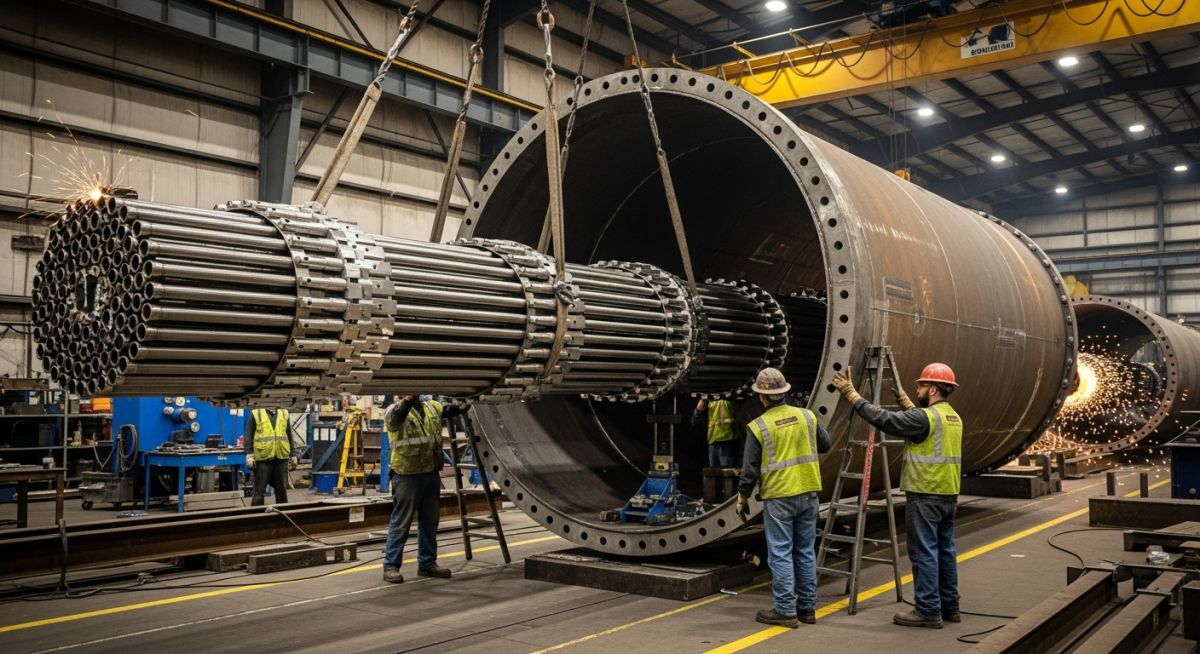
TEMA Heat Exchangers are shell and tube exchangers designed according to the Tubular Exchanger Manufacturers Association standards. These rules supplement ASME codes by defining mechanical tolerances, clearance requirements, and structural classifications (Class R, C, or B) to ensure reliable thermal performance and long-term durability in high-pressure industrial environments.
Engineering Knowledge Check: TEMA Standards
Question 1 of 5
Complete Course on
Piping Engineering
Check Now
Key Features
- 125+ Hours Content
- 500+ Recorded Lectures
- 20+ Years Exp.
- Lifetime Access
Coverage
- Codes & Standards
- Layouts & Design
- Material Eng.
- Stress Analysis
The Industrial Importance of TEMA Heat Exchangers in 2026
In modern industrial processing, the efficiency of thermal transfer directly correlates with operational profitability and safety. TEMA Heat Exchangers provide a standardized framework that allows engineers to specify equipment that is globally interchangeable and rigorously tested. Without these standards, the mechanical design of shell and tube exchangers would lack the consistency required for high-risk environments like offshore oil platforms or nuclear cooling loops.
The importance of TEMA Heat Exchangers extends beyond simple fluid cooling. They are designed to handle:
- Thermal Expansion Management: Standardized configurations for floating heads and U-tubes.
- Maintenance Accessibility: Defined clearances for bundle removal and cleaning.
- Vibration Mitigation: Specific support plate spacing to prevent tube fatigue.
Understanding TEMA Standards and Mechanical Design
The mechanical design of TEMA Heat Exchangers is governed by specific rules that dictate everything from tube pitch to shell thickness. These standards are widely recognized for complementing the ASME Section VIII Division 1 code. While ASME ensures the vessel will not burst under pressure, TEMA ensures the internal components function correctly and survive the intended service life.
Core Components of TEMA Standards
Engineers must adhere to precise formulas for calculating the Tube Sheet Thickness and baffle dimensions. These calculations account for differential thermal expansion between the tubes and the shell, which can exert massive force on the structural integrity of the unit.

Standardized Nomenclature for Shell and Tube Exchangers
One of the greatest contributions of the TEMA association is the three-letter designation system. This system identifies the front head type, the shell type, and the rear head type. For example, a BEM unit signifies a Bonnet front head, an E-type (one-pass) shell, and a Fixed Tubesheet rear head. This shorthand allows engineers across the globe to immediately understand the mechanical configuration of TEMA Heat Exchangers without reviewing hundreds of pages of drawings.
What is New in the TEMA Latest Edition (10th Edition)?
The TEMA Latest Edition (10th Edition) introduced critical updates to address the evolving needs of the process industry in 2026. Significant changes were made to the calculation methods for flow-induced vibration and the minimum thickness requirements for various metallurgy types.
| Update Category | Key Change in 10th Edition |
|---|---|
| Vibration Analysis | Enhanced damping factors for high-viscosity fluids in TEMA Heat Exchangers. |
| Tubesheet Formulas | Revised stress concentration factors for thin-walled expansion joints. |
| Material Allowances | Expanded tables for Duplex Stainless Steel and exotic alloys. |
By staying current with the TEMA Latest Edition, EPC contractors and plant owners ensure that their TEMA Heat Exchangers meet the most modern safety criteria, reducing the risk of unplanned shutdowns and environmental incidents.
Comprehensive Classification of TEMA Heat Exchangers
To ensure cost-effectiveness and mechanical suitability, the association divides TEMA Heat Exchangers into three distinct classes. Each class defines the manufacturing tolerances and material thicknesses required for specific industrial environments.
| Classification | Application Scope | Design Philosophy |
|---|---|---|
| Class R | Petroleum and Related Processing | Severe requirements; highest safety factors and thickest corrosion allowances. |
| Class C | General Commercial Service | Standard applications; emphasizes economy and efficiency for moderate services. |
| Class B | Chemical Process Service | Tailored for chemical plant operations where corrosive fluids are prevalent. |
Operational Advantages of Specifying TEMA Heat Exchangers
Specifying TEMA Heat Exchangers in a 2026 project tender provides immediate mechanical and logistical benefits. Because the Mechanical Design of Heat Exchangers is so tightly standardized, procurement and maintenance become predictable.
- Ease of Maintenance Standard clearances for Shell and Tube Exchangers ensure that cleaning tools and bundle pullers can operate without obstructing other plant equipment.
- Long-Term Reliability TEMA formulas for Tube Sheet Thickness protect the unit against vibration-induced fatigue and thermal cycling stresses.
TEMA vs ASME: Key Differences in Design and Jurisdiction
A common point of confusion for junior engineers is the relationship between TEMA vs ASME. It is essential to understand that these are not competing standards, but rather complementary ones.
The Mathematical Distinction
While ASME Section VIII provides the formulas for pressure boundary integrity, TEMA dictates the specific geometry of the exchanger internals. For example, the calculation for the minimum thickness of a flange might follow ASME, but the Heat Exchanger Nomenclature and baffle cut percentage follow TEMA.
// Conceptual thickness comparison for 2026 compliance
ASME_Min_Thickness = (P * R) / (S * E – 0.6 * P)
TEMA_Total_Thickness = ASME_Min_Thickness + TEMA_Corrosion_Allowance + 0.125 inches
Note: In the hierarchy of engineering codes, the ASME code is legally mandatory in many jurisdictions for pressure safety, whereas TEMA is a contractual requirement between the purchaser and the manufacturer to ensure functional longevity.
TEMA Heat Exchangers Surface Area Calculator
Quickly estimate the required heat transfer area for preliminary Mechanical Design of Heat Exchangers according to 2026 standards.
Formula Used: Area (A) = Q / (U × LMTD)
Don’t miss this video related to TEMA Heat Exchangers
Summary: Master Piping Engineering with our complete 125+ hour Certification Course: ……
Engineering Case Study: Optimizing TEMA Heat Exchangers for High-Pressure Service
Project Data & Scenario
A major petrochemical facility in 2026 reported recurring seal failures on a standard shell and tube unit in a high-temperature naphtha hydrotreater. The original unit was built to a generic commercial specification, failing to account for the cyclical thermal stresses of the 24/7 operation.
- Equipment Tag: E-402 Feed Effluent Exchanger
- Original Design: Non-Standardized Shell and Tube
- Reported Issue: Tubesheet warping and gasket leakage at the girth flange.
Failure Analysis
A mechanical audit revealed that the Tube Sheet Thickness was calculated using only internal pressure variables, ignoring the longitudinal stay-bolt stresses and differential expansion required by TEMA Standards.
Calculated Deflection (TEMA R): Max 0.8mm

The Engineering Fix
The engineering team replaced the unit with a TEMA Class R certified exchanger featuring a Floating Head (Type AES). By utilizing TEMA-specified reinforced tubesheet thickness and increased baffle support density, the unit achieved superior structural rigidity.
Lessons Learned
Specifying TEMA Heat Exchangers during the initial procurement phase is significantly cheaper than post-failure retrofitting. Class R provides the necessary safety margin for refining services that generic ASME-only vessels may lack.
Frequently Asked Questions about TEMA Standards
What is the minimum tube pitch for Shell and Tube Exchangers?
How does TEMA Class R, C, and B affect the Tube Sheet Thickness?
Can TEMA Heat Exchangers be used for high-vibration services?
Is the Heat Exchanger Nomenclature uniform across all manufacturers?
Final Overview: The Future of Thermal Design
As industrial processes become more complex and safety regulations tighten in 2026, the reliance on TEMA Heat Exchangers will only increase. These standards provide the essential bridge between theoretical thermal design and practical mechanical longevity. By adhering to TEMA’s rigorous classifications and updated formulas, engineering teams can ensure that their shell and tube equipment remains a reliable asset for decades to come.
Whether you are designing for high-pressure refinery service or simple commercial cooling, understanding TEMA Heat Exchangers is non-negotiable for the modern mechanical architect.
📚 Recommended Resources: TEMA Heat Exchangers
Read these Guides
- 📄 Parts of a Heat Exchanger: Engineering Functions, Problems, and Solutions (2026)
- 📄 Heat Exchanger Tube Plugging: Types of Plugs and Steps (2026 Guide)
- 📄 Heat Exchanger Fouling Factor: Significance, Calculation & 2026 Standards
- 📄 Overcoming the Tight Squeeze: Achieving Hydrocracker Inter-Distance Compliance in Brownfield Refineries