Zero Velocity Valves for Water Hammer Prevention

Imagine a sudden power trip at your main pumping station. Within milliseconds, a massive column of water reverses direction, slamming into your check valves with the force of a freight train. This “water hammer” doesn’t just make noise; it shatters pipe joints, destroys pumps, and leads to catastrophic infrastructure failure. Zero Velocity Valves are engineered specifically to stop this nightmare before it starts by ensuring closure at the exact moment flow hits a standstill.
Key Engineering Takeaways
- Instantaneous Response: Unlike standard swing checks, these valves close exactly when fluid velocity reaches zero, eliminating slam.
- Infrastructure Longevity: By mitigating surge pressure, you extend the fatigue life of downstream piping and rotating equipment.
- Maintenance Efficiency: Modern 2026 designs focus on internal accessibility, reducing downtime during mandatory inspections.
What is a Zero Velocity Valve?
A Zero Velocity Valve is a specialized non-slam check valve designed to close the moment fluid velocity reaches zero, before flow reversal begins. By utilizing spring-assisted or counter-weight mechanisms, it prevents water hammer by dissipating kinetic energy and preventing the high-impact “slam” common in conventional valves during hydraulic transients.
“In over two decades of pipeline design, I’ve seen standard valves fail under transient loads they were never built to handle. A Zero Velocity Valve isn’t just a component; it’s the ultimate insurance policy for your hydraulic network’s integrity.”
— Atul Singla, Founder of EPCLand
Complete Course on
Piping Engineering
Check Now
Key Features
- 125+ Hours Content
- 500+ Recorded Lectures
- 20+ Years Exp.
- Lifetime Access
Coverage
- Codes & Standards
- Layouts & Design
- Material Eng.
- Stress Analysis
5 Engineering Challenge: Zero Velocity Valves Quiz
Question 1 of 5
What is the primary mechanism that allows a Zero Velocity Valve to prevent “slam”?
The Physics of Surge: Why Zero Velocity Valves are Essential
Understanding the necessity of Zero Velocity Valves begins with the Joukowsky Equation, which defines the pressure change in a pipeline when fluid velocity changes abruptly. When a pump stops, the kinetic energy of the moving fluid must be dissipated. In a system equipped with conventional check valves, the disc remains open as the water column slows down, eventually closing only after the flow has already reversed. This delay allows the reverse flow to reach high velocities, resulting in a high-impact “slam” against the valve seat. This impact generates a shockwave that travels at the speed of sound through the medium, often exceeding the pressure rating of the pipe material.
The Zero Velocity Valve addresses this by utilizing a spring-assisted design that overcomes the inertia of the disc. By applying a constant closing force, the valve ensures that the disc travels toward the seat as the forward flow decelerates. The engineering objective is to achieve full closure at the precise millisecond when the fluid velocity is 0 m/s. This prevents the fluid from ever gaining reverse momentum, thereby eliminating the source of the pressure surge. For comprehensive standards on surge control devices, engineers often consult the American Water Works Association (AWWA) technical manuals.
Technical Working Principle of Zero Velocity Valves
The internal architecture of a Zero Velocity Valve usually consists of a central hub, a diffuser, and a disc (or multiple discs) loaded with high-tension springs. During normal operation, the pressure of the forward flow compresses the springs and holds the disc in the open position. As the pump trips and the pressure differential begins to equalize, the springs start to push the disc back. Because the distance the disc must travel is minimized and the spring force is optimized, the valve is fully seated before the gravitational or elastic forces of the water column can initiate backflow.

Unlike swing check valves which have a long travel arc, the Zero Velocity Valve typically features a short-stroke motion. This geometric advantage, combined with the lack of external dampeners that can fail, makes it the most reliable choice for transient protection. The absence of a “hinge pin” in many axial designs also reduces friction and wear, ensuring the valve maintains its “zero velocity” closing characteristics over thousands of cycles without significant degradation of the internal spring constants.
Key Advantages of Zero Velocity Valves in High-Pressure Systems
The integration of Zero Velocity Valves into 2026 infrastructure projects offers unparalleled protection against transient fatigue. Unlike conventional swing check valves, these units are specifically designed to meet the rigorous demands of ASME B16.34 for pressure and temperature ratings. By ensuring closure at the exact point of flow stagnation, they eliminate the “slam” energy that typically accounts for 90% of pipeline joint failures. Furthermore, their streamlined internal geometry minimizes head loss during normal operation, leading to significant energy savings over the pump’s lifecycle.
Step-by-Step Installation of Zero Velocity Valves
Proper installation is critical to ensure the Zero Velocity Valve performs its surge-mitigation function. Engineers must ensure the valve is oriented correctly relative to the flow direction, as indicated by the cast-in arrow on the body. It is highly recommended to provide a minimum of five to ten diameters of straight pipe upstream to ensure a non-turbulent flow profile, which prevents premature spring wear. For detailed flanging and bolting torque requirements, refer to the ASME Official Portal standards.
Comparative Analysis: Zero Velocity Valves vs. Conventional Check Valves
When evaluating surge protection strategies, the technical differences between valve types become clear. The following data highlights why Zero Velocity Valves are the industry standard for critical water hammer prevention.
| Feature | Conventional Swing Check | Zero Velocity Valve |
|---|---|---|
| Closing Speed | Slow (Gravity Dependent) | Instant (Spring Assisted) |
| Water Hammer Risk | High (Due to Slam) | Negligible |
| Maintenance Frequency | Frequent (Hinge Wear) | Low (Guided Motion) |
| Energy Efficiency | Moderate Turbulence | High (Laminar Path) |
| API Standards | API 594 / API 6D | API 594 (Axial Design) |
In summary, while conventional valves may offer a lower initial capital expenditure, the total cost of ownership (TCO) is significantly higher due to the risk of system-wide damage. Zero Velocity Valves provide the necessary dampening to comply with ISO 21013-4 safety requirements for pressure relief and surge protection in modern fluid systems.
Water Hammer Pressure Surge Calculator
Estimate the potential pressure spike (Joukowsky Surge) to determine if Zero Velocity Valves are required for your system safety.
EPCLand YouTube Channel
2,500+ Videos • Daily Updates
Case Study: Eliminating Pipeline Ruptures in Municipal Pumping
Location: Metro Water Distribution Network | Project Year: 2026
The Challenge
A regional water authority faced recurring failures in a 1200mm GRP (Glass Reinforced Plastic) pipeline. Every time a power outage caused a pump trip, the standard dual-plate check valves closed too slowly, allowing a 15% flow reversal. This resulted in a pressure spike of 28 BAR, well above the pipe’s 16 BAR rating, leading to three catastrophic bursts in six months.
The Engineering Solution
The engineering team replaced the standard units with Zero Velocity Valves equipped with optimized torsion springs. These valves were designed to achieve full closure within 0.15 seconds of the pump trip—the exact moment of flow stagnation.
Key Result
Post-installation transient analysis showed the maximum surge pressure was reduced to just 1.2 BAR above steady-state pressure. The “slam” was completely eliminated, and no further pipe failures have occurred in the 2026 operational year.
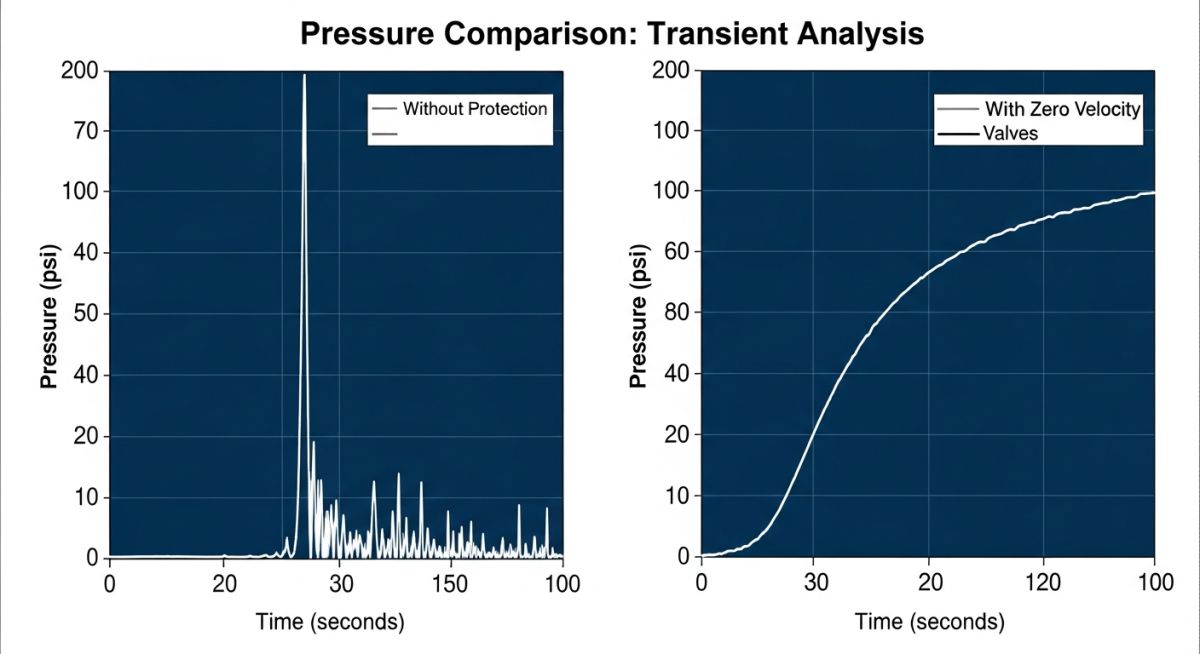
| Parameter | Pre-Retrofit | Post-Retrofit |
|---|---|---|
| Peak Surge Pressure | 28.0 BAR | 17.2 BAR |
| Flow Reversal % | 15% | 0% |
| Valve Slam (Decibels) | 105 dB | Negligible |
Don’t miss this video related to Valves

Summary: Master Piping Engineering with our complete 125+ hour Certification Course: ……
Expert Insights: Lessons from 20 years in the field
-
01.
Spring Fatigue Monitoring: In high-cycle environments, the spring constant of a Zero Velocity Valve can degrade. We recommend a 2026 best practice of borescope inspections every 24 months to ensure the spring hasn’t lost the tension required for millisecond closure.
-
02.
Cavitation Risk: While these valves prevent slam, they do not inherently prevent vacuum formation. Always pair your Zero Velocity Valve with a high-capacity kinetic air release valve to manage column separation.
-
03.
Material Selection for 2026: For saline or corrosive media, insist on Duplex Stainless Steel (ASTM A890) internals. Standard 316SS often lacks the yield strength required to handle the repeated impact loads of high-velocity pumping systems.
-
04.
The Velocity Trap: Never size these valves based purely on pipe diameter. Always size based on the Minimum Velocity to Fully Open to prevent “disc flutter,” which can lead to premature mechanical failure of the seat.
Expert Q&A: Zero Velocity Valves & Surge Control
How do Zero Velocity Valves differ from standard non-slam check valves?
Can Zero Velocity Valves be used in vertical pipelines?
What is the typical maintenance interval for these valves in 2026?
Why did my Zero Velocity Valve still “thump” during the last power failure?
Does the spring force significantly increase my pumping power costs?
Can I retrofit a swing check body with Zero Velocity internals?
📚 Recommended Resources: Zero Velocity Valves

Related posts:
![High-grade industrial Wing Nut Types and Applications for mechanical assemblies.]()
Wing Nut Types and Applications: The 2026 Engineering Guide
![Industrial Monorail Crane Systems installed in a modern manufacturing plant 2026.]()
Monorail Crane Systems: Design, Types & 2026 Standards Guide
![Lead engineer performing a Factory Acceptance Test FAT on an industrial skid system 2026]()
Factory Acceptance Test FAT: The 2026 Engineering Guide to Zero-Defect Delivery
![Professional engineering workspace showing a Basis of Design document layout for a 2026 project.]()
Basis of Design: How to Write a BOD for Engineering Projects in 2026
![Industrial Flare Knockout Drum Sizing and installation in a refinery relief system.]()
Flare Knockout Drum Sizing: Design & API 521 Standards (2026 Guide)
![Advanced Reboiler Control Systems in a modern petrochemical refinery 2026.]()
Reboiler Control Systems: Engineering Guide to Precision Control 2026