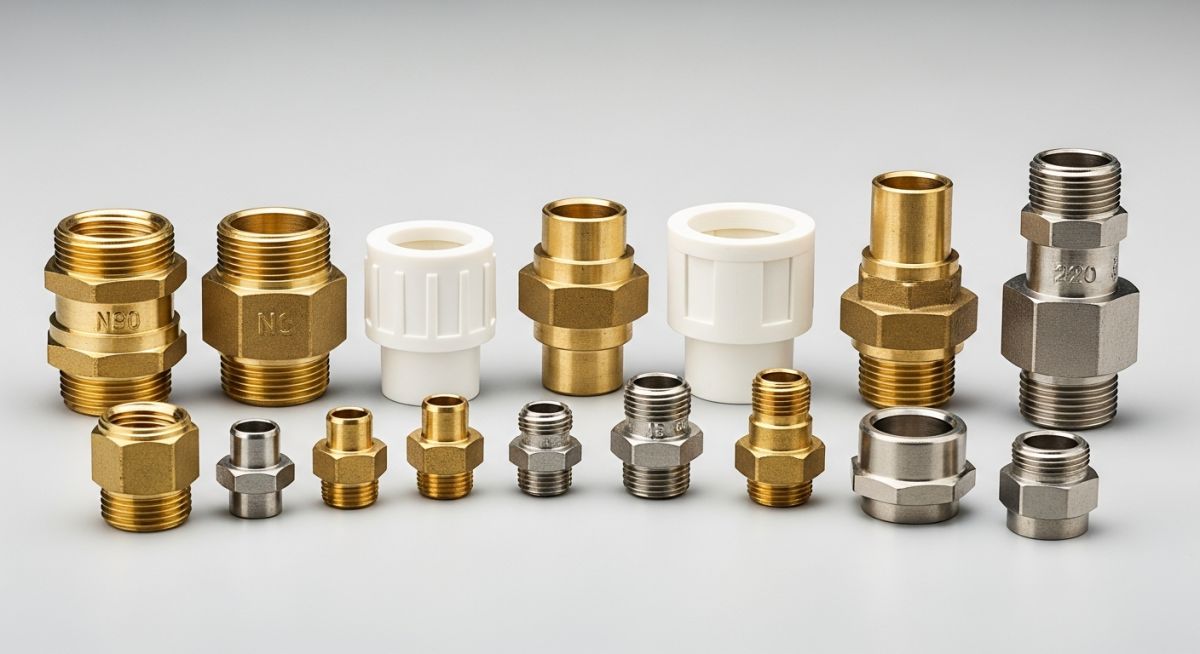
What is a Pipe Adapter and How to Select It
In my 20+ years of managing high-pressure petrochemical piping installations, I have seen minor fitting mismatches shut down entire process lines. A pipe adapter is often the unsung hero of these systems, bridging the gap between incompatible piping runs. Whether you are transitioning from a threaded carbon steel header to a socket-welded stainless steel branch, or connecting a copper utility line to a plastic instrument manifold, selecting the correct adapter is the difference between a reliable system and a catastrophic field failure.
Throughout my career, I have learned that understanding the nuances of thread profiles, material compatibility, and pressure ratings is not just academic—it is a safety requirement. In this guide, I will share my hands-on field experience to help you navigate the complex world of industrial adapters, their types, materials, and selection criteria.
Key Engineering Takeaways
- Understand the structural differences between adapters and standard couplings.
- Learn how to calculate minimum wall thickness under ASME B31.3 rules.
- Identify the risks of galvanic corrosion when joining dissimilar metals.
- Master the field inspection steps to verify adapter integrity before pressure testing.
- Select the correct pressure class (2000#, 3000#, or 6000#) for your specific application.
How Does a Pipe Adapter Function in Piping?
To design a safe piping system, we must first distinguish between a coupling and an adapter. While a standard coupling joins two pipes of the same type and size, an adapter changes the connection style (e.g., male to female, threaded to welded) or joins entirely different materials. This transition introduces localized stress concentrations and potential leak paths that we must carefully analyze.
Pressure Design Calculations under ASME B31.3
To determine the minimum required wall thickness of a forged carbon steel pipe adapter under internal pressure, we apply the design formula from ASME B31.3 Section 304.1.2:
Where:
- t = Minimum design wall thickness (inches)
- P = Internal design gage pressure (psi)
- D = Outside diameter of the adapter (inches)
- S = Allowable stress value for the material from ASME B31.3 Table A-1 (psi)
- E = Quality factor from ASME B31.3 Table A-1A or A-1B
- W = Weld joint strength reduction factor
- Y = Coefficient from ASME B31.3 Table 304.1.1
Let us calculate this for a 1-inch nominal ASTM A105 forged carbon steel adapter operating at 300 degrees Fahrenheit with a design pressure of 1000 psi. The outside diameter D is 1.315 inches. The allowable stress S for ASTM A105 at 300 degrees Fahrenheit is 20,000 psi. Assuming a seamless fitting, the quality factor E is 1.0, and the weld joint factor W is 1.0. For carbon steel at temperatures below 900 degrees Fahrenheit, the coefficient Y is 0.4.
t = 1315 / (2 * (20000 + 400))
t = 1315 / 40800
t = 0.0322 inches
To find the nominal wall thickness, we must add a standard corrosion allowance (typically 0.0625 inches) and account for the manufacturer’s undertolerance (usually 12.5 percent for forged fittings). This yields a robust, safe design that easily fits within standard Class 3000 dimensions.
Never mix NPT (National Pipe Thread) and BSPT (British Standard Pipe Taper) threads. While they may appear similar to an untrained eye, their thread pitches and angles differ. Forcing them together ruins the threads, compromises pressure containment, and leads to sudden joint separation under pressure.
Common Types of Pipe Adapters
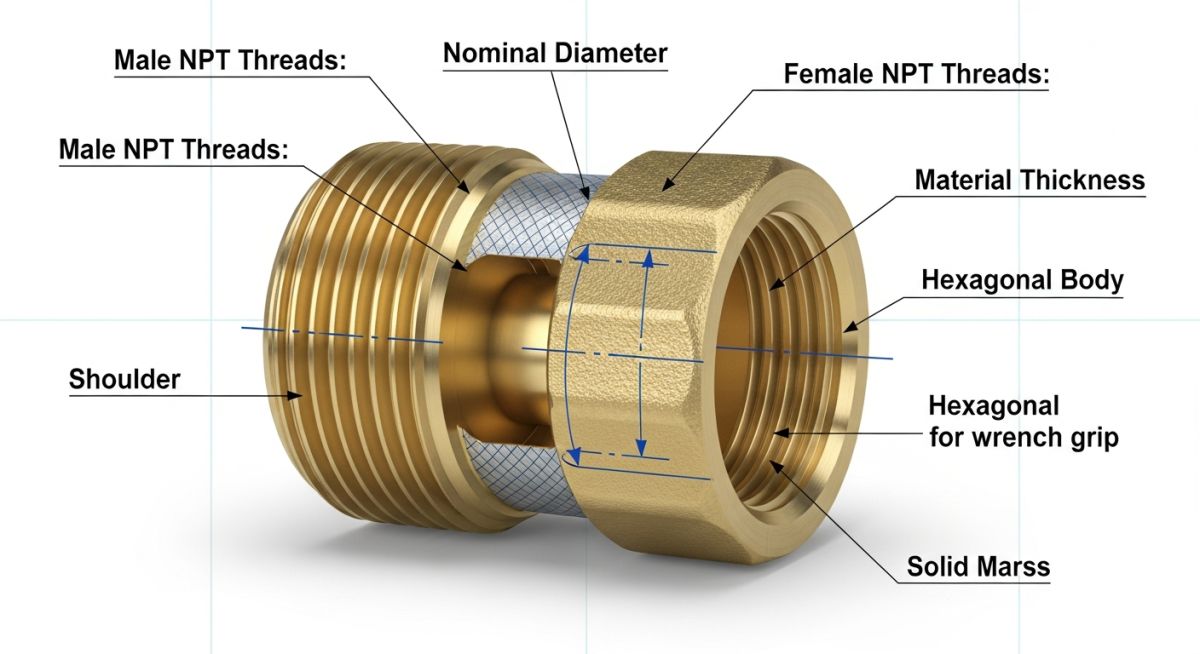
In industrial systems, we categorize adapters based on their end configurations:
- Male vs. Female Adapters: Male adapters feature external threads, whereas female adapters have internal threads. These are used to connect threaded valves or instruments to the main run.
- Threaded-to-Welded Transitions: These allow a threaded instrument line to connect directly to a socket-weld or butt-weld piping system, maintaining structural strength.
- Flanged Adapters: Used to connect threaded or welded pipe runs directly to flanged equipment nozzles, complying with ASME B16.5.
What Are the Standard Pipe Adapter Dimensions?
When specifying adapters for high-pressure systems, you must ensure that the fitting dimensions match the schedule of the mating pipe. Below is the dimensional data for Class 3000 forged carbon steel threaded adapters in accordance with ASME B16.11.
| Nominal Pipe Size (NPS) | Outside Diameter (OD) (in) | Min. Wall Thickness (in) | Thread Engagement (L1) (in) | Approx. Weight (lbs) |
|---|---|---|---|---|
| 1/2″ | 1.12 | 0.125 | 0.32 | 0.45 |
| 3/4″ | 1.38 | 0.138 | 0.34 | 0.70 |
| 1″ | 1.75 | 0.162 | 0.40 | 1.15 |
| 1-1/2″ | 2.44 | 0.178 | 0.42 | 2.30 |
| 2″ | 3.00 | 0.219 | 0.44 | 3.90 |
This matrix maps specific adapter configurations to their corresponding material standards, pressure limits, and typical industrial applications.
| Adapter Type | Material Grade | Standard Reference | Max Pressure Rating | Primary Application |
|---|---|---|---|---|
| Forged Carbon Steel | ASTM A105 | ASME B16.11 | 6000 psi | High-pressure steam, oil, and gas lines |
| Stainless Steel | ASTM A182 F316 | ASME B16.11 | 6000 psi | Corrosive chemical processing, food & beverage |
| Alloy Steel | ASTM A182 F11/F22 | ASME B16.11 | 3000 psi | High-temperature power piping |
| Brass | ASTM B16 | ASME B16.15 | 1000 psi | Instrument air, water, and pneumatic lines |
| PVC / CPVC | Schedule 80 PVC | ASTM D2467 | 150 psi | Water treatment, low-pressure chemical lines |
How to Inspect a Pipe Adapter Onsite?
Before any adapter is welded or threaded into a process line, it must undergo a rigorous quality control check. In my experience, skipping these basic steps is the leading cause of hydrotest failures. Use this checklist on your job site to ensure compliance.
Onsite Inspection Checklist
-
Material Test Report (MTR) Verification: Cross-reference the heat number stamped on the adapter body with the MTR to confirm chemical composition and mechanical properties match ASTM standards.
-
Thread Profile Inspection: Inspect threads visually for nicks, burrs, or flat spots. Use a thread gauge to verify the pitch matches ASME B1.20.1.
-
Pressure Class Verification: Confirm the pressure rating stamp (e.g., 3000# or 6000#) is clearly legible and matches the piping class sheet.
-
Dielectric Isolation Check: If joining copper to steel, verify that the dielectric sleeve or gasket is present and undamaged to prevent galvanic corrosion.
-
Dimensional Tolerances: Measure the socket depth and bore diameter to ensure they comply with ASME B16.11 limits before welding.
Field Case Study: Resolving Pipe Adapter Failures
The Problem: Chronic Steam Leaks and Shutdowns
At a chemical processing plant, a 150 psi saturated steam line experienced repeated leaks at the transition between a carbon steel header and a stainless steel pressure transmitter. The field crew had installed a standard carbon steel threaded coupling with Teflon tape. Within three weeks of operation, the joint began leaking, causing a localized shutdown that cost the facility approximately 15,000 per day in lost production.
The Solution: Engineering Redesign and Adapter Selection
Upon investigation, I discovered two critical errors: first, the carbon steel coupling was experiencing accelerated galvanic corrosion due to direct contact with the stainless steel transmitter stem. Second, the thread sealant used was not rated for the 366 degrees Fahrenheit steam temperature.
We replaced the coupling with an ASTM A182 F316 stainless steel socket-weld to NPT female adapter. We welded the socket end to the branch connection and used a high-temperature nickel-based anti-seize compound on the NPT threads. This eliminated the dissimilar metal contact and provided a robust, leak-tight seal.
Direct Recommendation: Always perform a thermal and chemical compatibility check on both the adapter material and the thread sealant. For steam service above 300 degrees Fahrenheit, avoid standard Teflon tape and opt for high-temperature anaerobic sealants or nickel-filled compounds.
Frequently Asked Engineering Questions
What is the difference between a pipe adapter and a pipe coupling?
How do you prevent galvanic corrosion when using a pipe adapter?
What ASME standards govern the design of a pipe adapter?
Can a pipe adapter be used in high-pressure hydraulic systems?
How do you calculate thread engagement for NPT adapters?
When should you choose a socket-weld adapter over a threaded adapter?
===
Complete Course on
Piping Engineering
Check Now
Key Features
- 125+ Hours Content
- 500+ Recorded Lectures
- 20+ Years Exp.
- Lifetime Access
Coverage
- Codes & Standards
- Layouts & Design
- Material Eng.
- Stress Analysis