What is a Coalescer? Its Types, Working, and Applications
Imagine you are managing a high-pressure natural gas pipeline, and a sudden surge of liquid aerosols threatens to wreck your 5 million dollar compressor. Or perhaps you’re overseeing aviation fuel loading where even a microscopic trace of water could lead to catastrophic engine icing at 30,000 feet. In these high-stakes scenarios, standard filtration isn’t enough. You need to understand exactly what is a coalescer and how it serves as the ultimate line of defense against stubborn emulsions.
This guide breaks down the complex physics of droplet merging, explores the 2026 industry standards for separation, and provides the technical depth required for modern process design.
Key Takeaways
- Mechanism: Coalescers use media to merge small, dispersed droplets into larger masses for gravity-based separation.
- Critical Difference: Unlike filters that trap solids, coalescers are designed to separate immiscible liquids or aerosols from a continuous phase.
- 2026 Efficiency: Modern electrostatic and mechanical designs now achieve separation levels below 5ppm in most industrial applications.
What is a Coalescer?
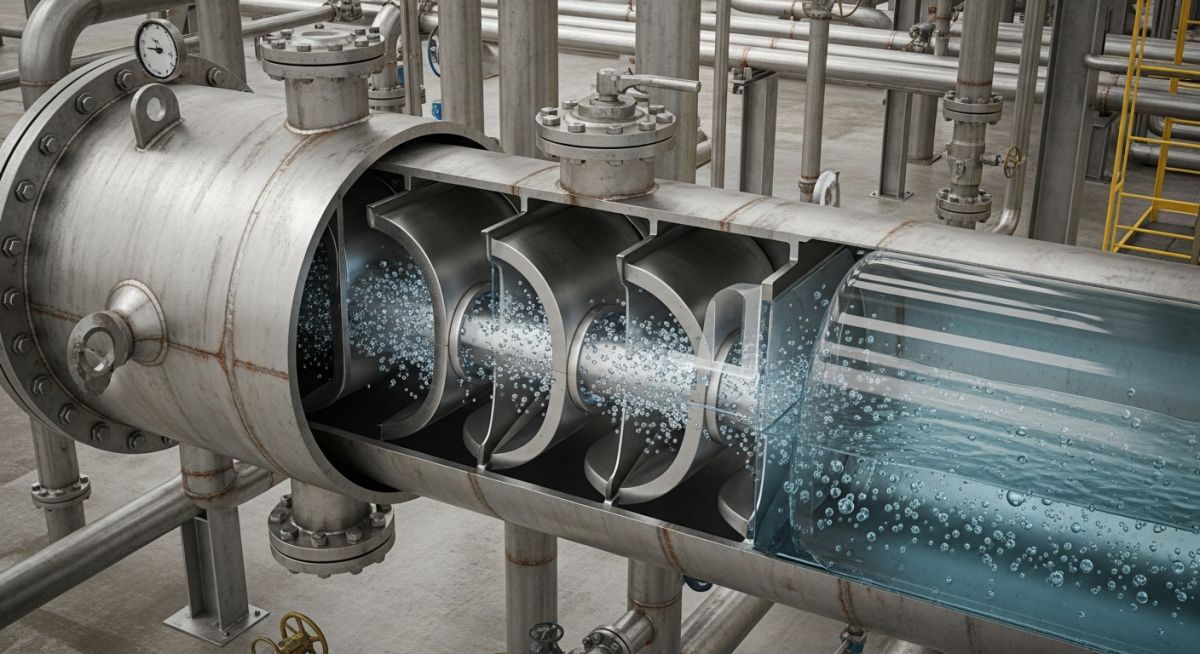
A coalescer is a specialized process vessel or mechanical device used to separate immiscible liquid phases or aerosols from a gas or liquid stream. It works by forcing small droplets to collide and merge (coalesce) into larger globules on a specialized media, allowing for easy separation via gravity.
“While many engineers treat coalescers as ‘just another filter,’ the real magic lies in the surface chemistry and velocity control. In 2026, the shift toward sustainable fuel processing has made high-efficiency coalescing more critical than ever for maintaining equipment integrity.”
— Atul Singla, Founder of EPCLand
Complete Course on
Piping Engineering
Check Now
Key Features
- 125+ Hours Content
- 500+ Recorded Lectures
- 20+ Years Exp.
- Lifetime Access
Coverage
- Codes & Standards
- Layouts & Design
- Material Eng.
- Stress Analysis
Engineering Check: Coalescer Fundamentals
Test your knowledge on 2026 separation standards.
1. What is the primary physical phenomenon utilized in a mechanical coalescer to merge droplets?
Defining the Basics: What is a Coalescer?
To understand what is a coalescer, one must first recognize the inherent difficulty in separating stable emulsions. In many industrial processes, two immiscible fluids (like oil and water) or a liquid and a gas become so finely mixed that gravity alone cannot separate them within a reasonable timeframe. A coalescer is a specialized piece of equipment designed to accelerate this separation by utilizing internal media—such as fiberglass, mesh, or ceramic plates—to merge microscopic droplets into larger masses.
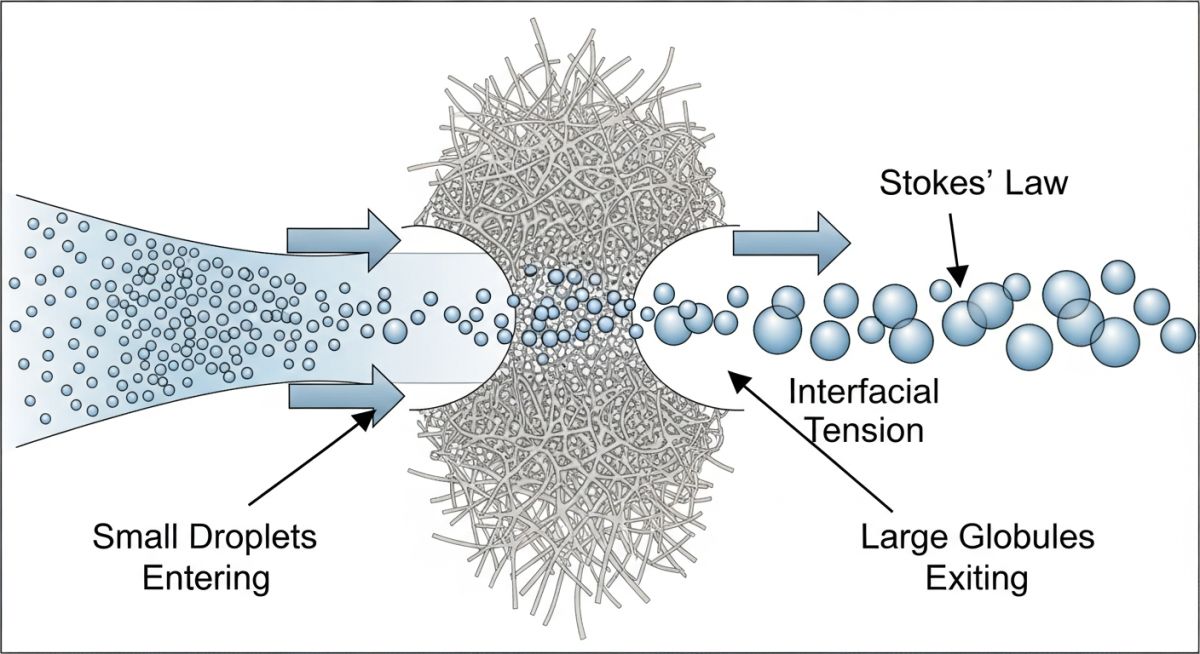
In the context of 2026 process safety, these devices are categorized based on the phases they handle: Liquid-Liquid coalescers (e.g., removing water from hydrocarbons) and Gas-Liquid coalescers (e.g., removing oil mist from compressed air). Unlike simple settling tanks, a coalescer operates on the principle of increasing the effective droplet diameter, which exponentially increases the settling velocity according to the principles outlined by Stokes’ Law (ScienceDirect).
The Science of Separation: What does it mean to Coalescence?
Coalescence is a physical process where two or more droplets, bubbles, or particles merge during contact to form a single daughter droplet. In industrial systems, this is not an instantaneous event. It involves three distinct stages: Impact (droplets hitting the media), Attachment (droplets sticking to the fibers), and Growth (droplets merging until they are heavy enough to detach).
The efficiency of this process is governed by the surface tension of the fluids and the “wettability” of the coalescing media. For instance, a hydrophobic media will repel water droplets, forcing them to cluster together on the surface until their buoyancy or weight overcomes the frictional drag of the flow.
Industrial Utility: What is the Function of a Coalescer?
The primary function of a coalescer is to protect downstream equipment and ensure product purity. In the oil and gas sector, water is a primary contaminant that causes corrosion and catalyst poisoning. By employing high-efficiency coalescing elements, operators can reach “clear and bright” fuel standards that meet international shipping requirements.
Beyond simple separation, the 2026 engineering landscape utilizes coalescers for environmental compliance. For example, treating produced water before offshore discharge requires removing oil droplets smaller than 10 microns—a task impossible for standard separators but routine for a properly sized coalescer unit.
Mechanics of Flow: How does a Coalescer Work?
The working mechanism of a coalescer is a masterclass in fluid dynamics. As the contaminated fluid enters the vessel, it passes through a multi-stage element. The first stage is usually a filter-separator that removes solid particulates which could “blind” or clog the fine coalescing fibers.
Once the solids are removed, the fluid enters the coalescing layer. Here, the tortuous path of the media creates millions of collision opportunities. As small droplets collide, they merge. Because the volume of a sphere increases by the cube of its radius, even a small increase in droplet diameter leads to a massive increase in mass. These large “globules” then travel to a final separator stage, which is typically a secondary pleated or mesh material that allows the continuous phase to pass while blocking the newly formed large droplets, causing them to fall into a collection sump.
Comparing the Main Types of Coalescers
Choosing the right equipment depends entirely on the stability of the emulsion and the specific gravity of the fluids involved. In 2026, engineering standards distinguish between mechanical and electrostatic separation based on the droplet size and fluid conductivity.
Mechanical Coalescers
Mechanical coalescers rely on physical barriers. They are the workhorses of the midstream sector, utilizing pleated media or parallel plates to force droplet contact. Within this category, Plate Coalescers are highly effective for removing bulk water from oil, using a series of inclined plates to shorten the rising or settling distance of droplets.
Electrostatic Coalescers
When emulsions are “tight” (droplets < 10 microns), mechanical forces often fail. Electrostatic coalescers apply a high-voltage electric field to the fluid. This field induces a dipole moment in water droplets, causing them to migrate toward one another and collide with enough force to rupture the interfacial film. This technology is strictly governed by API Standards (American Petroleum Institute) for refinery desalting operations.
| Feature | Mechanical Coalescer | Electrostatic Coalescer |
|---|---|---|
| Primary Mechanism | Physical Impingement/Media | Electrical Dipole Attraction |
| Droplet Size Range | > 10-20 Microns | < 10 Microns |
| Maintenance | High (Media replacement) | Low (Solid electrodes) |
| Typical Use Case | Fuel filtration, Gas drying | Crude oil desalting |
Engineering Standards for Coalescer Design
Designers must adhere to rigid codes to ensure pressure vessel integrity and separation efficiency. The pressure vessel shell itself is typically designed according to ASME Section VIII, Division 1. However, the internal performance is often measured against ISO 12500 (International Organization for Standardization), which defines the testing standards for compressed air filters and coalescers.
Technical Distinction: What is the difference between a Filter and a Coalescer?
While they look identical from the outside, their internal physics are opposites. A filter is designed to trap and hold solid particles within its matrix—it is a storage device for waste. Conversely, a coalescer is a separation device. Its goal is not to “hold” the liquid droplets but to merge them so they can be continuously drained away.
If you use a coalescer for solid removal, it will plug rapidly and fail. If you use a standard filter for water removal, the water will simply saturate the media and eventually “carry over” back into the clean stream.
Coalescer Sizing: Stokes’ Law Settling Calculator
Estimate the terminal settling velocity (Vs) of merged droplets in your vessel (2026 Standard).
Typical coalesced size: 100-500μm
Continuous phase (e.g., Diesel ~2.0, Water ~1.0)
Δρ = |Phase 1 – Phase 2|
Estimated Settling Velocity
Optimizing Aviation Fuel Purity: A 2026 Retrofit Analysis
The Challenge: An international airport refueling hub was experiencing “Cloudy Fuel” alerts in their Jet A-1 supply. Despite having standard particulate filters, water content was measuring at 45 ppm—well above the safe 15 ppm limit for high-altitude flight operations.
The Solution: The engineering team replaced the primary filter housing with a multi-stage liquid-liquid coalescer system. By utilizing hydrophilic glass-fiber media, the system forced microscopic water aerosols to merge into droplets exceeding 200 microns.
Result: Final water content was reduced to < 8 ppm, ensuring 100% compliance with IATA fuel quality standards.
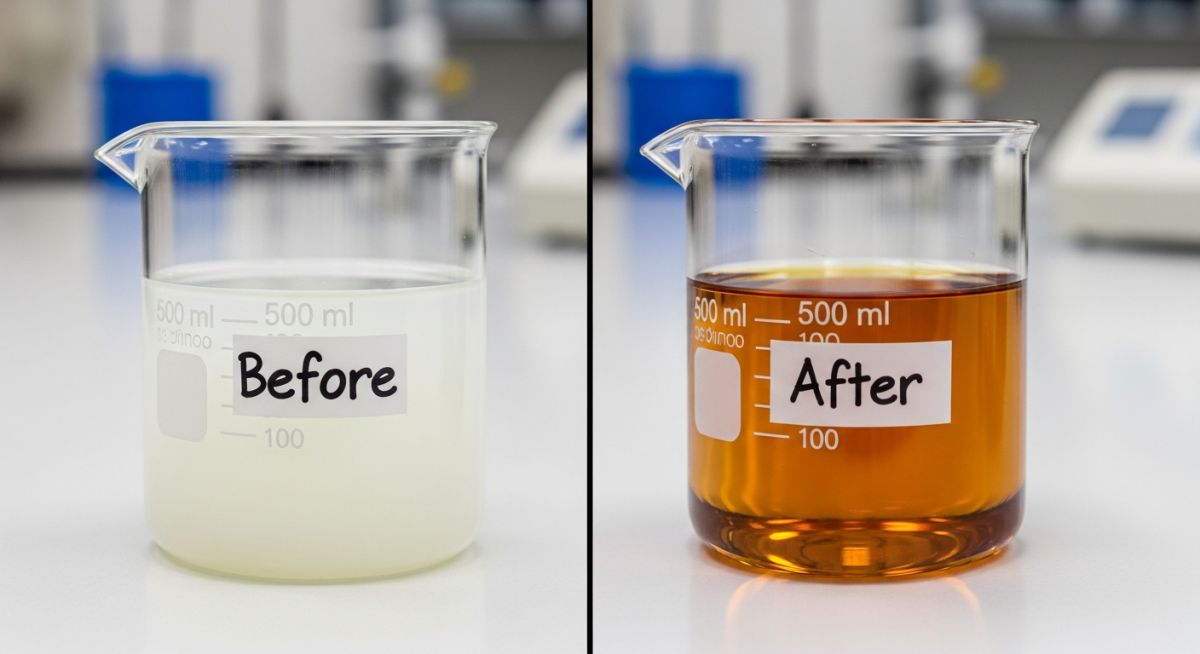
Visual verification of emulsion breaking: Pre-treatment vs. Post-treatment.
EPCLand YouTube Channel
2,500+ Videos • Daily Updates
Expert Insights: Lessons from 20 years in the field
- Temperature Sensitivity: High temperatures reduce fluid viscosity and interfacial tension. While lower viscosity helps settling (Stokes’ Law), it can actually make “breaking” the initial emulsion harder. Always design for the worst-case temperature swing.
- Velocity is the Enemy: Pushing a coalescer beyond its rated flux velocity leads to “shear.” This breaks merged droplets back into micro-droplets, causing massive carryover. Never undersize the vessel diameter.
- The Pre-Filter Rule: 90% of coalescer failures are caused by solid particulates blinding the media. In 2026, we mandate a 2-micron pre-filter upstream of any high-efficiency coalescing element to extend life from months to years.
- Surface Tension Matters: If your process fluid contains surfactants (like soaps or specialized additives), the coalescer media may become “disarmed.” The droplets will simply coat the fibers without merging.
// Pro-Tip for 2026
“When calculating the ROI on a coalescer, don’t look at the media cost. Look at the downstream catalyst life. A properly functioning coalescer often pays for itself in a single quarter by preventing catalyst poisoning.”
— Field Engineering Lead, EPCLand
Frequently Asked Questions
What is a coalescer and how is it different from a separator?
While both devices separate phases, a standard separator relies primarily on gravity and residence time for large droplets. A coalescer uses specialized media to merge microscopic droplets into larger ones, enabling separation that gravity alone cannot achieve for fine emulsions.
When should I use a liquid-liquid coalescer?
A liquid-liquid coalescer is essential when you need to remove trace amounts of an immiscible liquid from a continuous phase, such as water from diesel or oil from produced water, typically aiming for effluent levels below 15 ppm.
How long do coalescing filter elements last?
Under 2026 operational standards, elements typically last 6 to 12 months. However, lifespan depends heavily on the presence of solid contaminants and the efficiency of upstream pre-filtration.
My fuel is still cloudy after coalescing; what is the likely cause?
This is often due to surfactant disarming. Surface-active agents (like additives or soaps) coat the coalescer media, lowering the interfacial tension and preventing droplets from merging. You may need a pre-treatment stage or a different media surface chemistry.
Can I clean and reuse mechanical coalescer elements?
Generally, no. High-efficiency glass-fiber media is delicate. Attempting to backwash or chemically clean them usually ruptures the fiber matrix, destroying the tiny pathways required for coalescence and leading to immediate carryover upon restart.
Why does my differential pressure (DP) rise so quickly?
Rapid DP rise usually indicates the coalescer is being used as a filter for solid debris. Check your upstream particulate filters. In 2026 systems, a coalescer should ideally operate at a low, stable DP, with the main pressure drop occurring across the solids-removal stage.

Related posts:
![High-grade industrial Wing Nut Types and Applications for mechanical assemblies.]()
Wing Nut Types and Applications: The 2026 Engineering Guide
![Industrial Monorail Crane Systems installed in a modern manufacturing plant 2026.]()
Monorail Crane Systems: Design, Types & 2026 Standards Guide
![Lead engineer performing a Factory Acceptance Test FAT on an industrial skid system 2026]()
Factory Acceptance Test FAT: The 2026 Engineering Guide to Zero-Defect Delivery
![Professional engineering workspace showing a Basis of Design document layout for a 2026 project.]()
Basis of Design: How to Write a BOD for Engineering Projects in 2026
![Industrial Flare Knockout Drum Sizing and installation in a refinery relief system.]()
Flare Knockout Drum Sizing: Design & API 521 Standards (2026 Guide)
![Advanced Reboiler Control Systems in a modern petrochemical refinery 2026.]()
Reboiler Control Systems: Engineering Guide to Precision Control 2026