What is a Vibration Sensor? Working, Types, and 2026 Selection Guide
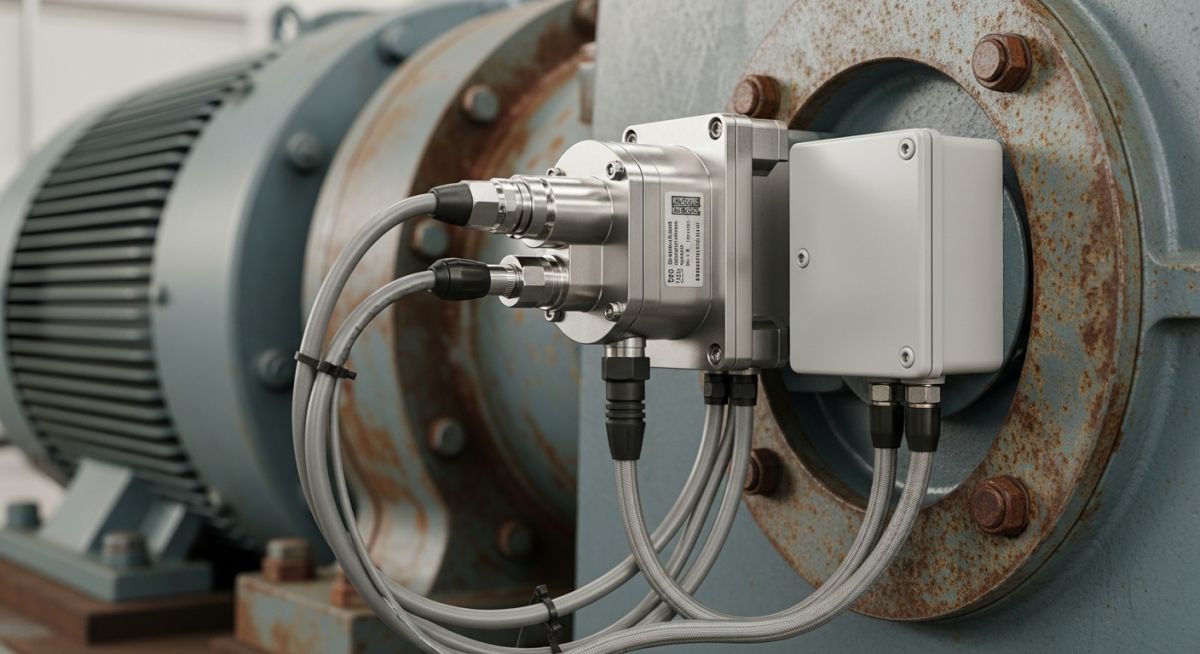
Imagine a critical 500kW turbine at your facility. To the naked eye, it looks stable, but deep within its bearings, a microscopic misalignment is generating heat and fatigue. Without a Vibration Sensor, you are flying blind, waiting for a catastrophic failure that could cost thousands in unplanned downtime. This guide provides the engineering depth to move from reactive repairs to a sophisticated predictive maintenance strategy.
Key Takeaways
- Identify the physical differences between piezoelectric, MEMS, and proximity-based Vibration Sensor types.
- Understand how frequency response and sensitivity dictate sensor placement on rotating equipment.
- Learn the selection criteria based on ISO 10816 standards for machine health monitoring.
What is a Vibration Sensor?
A Vibration Sensor is a precision device that measures the frequency and amplitude of mechanical oscillations in machinery. By converting physical motion into an electrical signal (voltage or current), it enables real-time monitoring of rotating equipment health, helping engineers detect imbalances, bearing wear, and resonance before failure occurs.
Founder’s Insight
“In over two decades of commissioning rotating equipment, I have seen that the most expensive Vibration Sensor is the one that was calibrated for the wrong frequency range. Always match your sensor’s resonance frequency to your machine’s operating harmonics.”
— Atul Singla
Complete Course on
Piping Engineering
Check Now
Key Features
- 125+ Hours Content
- 500+ Recorded Lectures
- 20+ Years Exp.
- Lifetime Access
Coverage
- Codes & Standards
- Layouts & Design
- Material Eng.
- Stress Analysis
Knowledge Check: Vibration Engineering
Question 1 of 5Which parameter is most critical when measuring low-frequency vibrations (below 10 Hz) in heavy machinery?
What are Vibration Sensors and Why are They Critical?
In the industrial ecosystem, a Vibration Sensor serves as the primary diagnostic tool for monitoring the health of mechanical assets. At its core, vibration is the back-and-forth movement or oscillation of machines and components. While some vibration is inherent to operation, excessive or erratic movement is a symptom of underlying mechanical distress. By deploying a Vibration Sensor, engineering teams can capture high-resolution data on velocity, acceleration, and displacement, allowing them to track the evolution of a machine's condition over time.
The criticality of these sensors cannot be overstated. According to industry research, over 40% of rotating equipment failures are caused by misalignment or imbalance—issues that a Vibration Sensor can detect months before a breakdown. These devices are the eyes and ears of Condition-Based Maintenance (CBM), providing the quantitative data necessary to comply with safety standards like ISO 10816, which establishes the basis for evaluating machine vibration by measurements on non-rotating parts.
Industrial Applications of Vibration Sensor Technology
The versatility of the Vibration Sensor allows it to be integrated into various sectors, ranging from heavy manufacturing to aerospace. In a typical petrochemical plant, sensors are permanently mounted on centrifugal pumps, compressors, and gearboxes. These sensors transmit real-time data to a Central Control Room (CCR), where software algorithms perform FFT (Fast Fourier Transform) analysis to identify specific fault signatures.
- Renewable Energy: Monitoring wind turbine main bearings and blade pitch mechanisms to prevent catastrophic failure in remote offshore locations.
- Oil & Gas: Protecting high-speed turbines and reciprocating compressors where even a minor shaft deviation can lead to explosive hazards.
- Civil Infrastructure: Using a Vibration Sensor on bridges and skyscrapers to monitor structural resonance and seismic responses during environmental events.
How Does a Vibration Sensor Work? (The Physics)
The fundamental goal of a Vibration Sensor is to convert mechanical energy into an electrical signal. This process is known as transduction. The most common method involves the Piezoelectric Effect. Inside the sensor, a seismic mass is placed on a piezoelectric crystal. As the machine vibrates, the mass exerts a varying force on the crystal, which in turn generates an electrical charge proportional to the acceleration of the vibration.
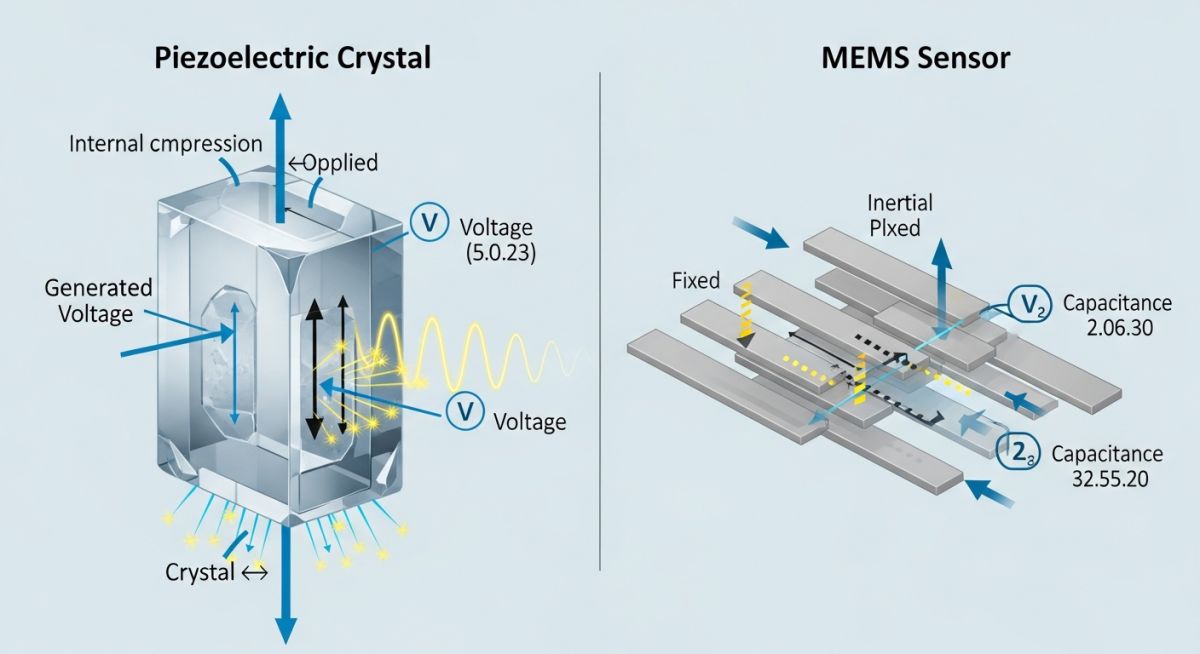
Modern advancements have introduced MEMS (Micro-Electromechanical Systems) technology. A MEMS Vibration Sensor consists of a tiny silicon structure with movable parts that change capacitance when subjected to vibration. This change is measured and converted into a digital signal, allowing for incredibly small, low-power sensors that are ideal for wireless Internet of Things (IoT) applications. Understanding these physics is essential for selecting the right mounting method, as the transfer of vibration from the machine surface to the sensor internal crystal must be as seamless as possible to avoid signal attenuation.
EPCLand YouTube Channel
2,500+ Videos • Daily Updates
Main Types of Vibration Sensor Hardware
Not all vibrations are created equal, and choosing the wrong Vibration Sensor can result in "ghost" readings or missed faults. Industrial hardware is generally categorized by the specific parameter it measures: acceleration, velocity, or displacement. Each serves a unique niche in the maintenance engineer's toolkit, often governed by ASME Standards for mechanical power transmission.
Accelerometers
The piezoelectric accelerometer is the workhorse of industry. Because acceleration is proportional to the square of frequency, these sensors are exceptionally sensitive to high-frequency events, such as early-stage bearing race degradation or gear tooth meshing issues.
Velocity Sensors
Velocity sensors measure the rate of change of displacement. They are preferred for general machine health monitoring because most industrial machinery "severity" charts are based on velocity (RMS). They provide a balanced view across a wide frequency range (typically 10 Hz to 1,000 Hz).
Displacement Sensors (Proximity Probes)
Unlike the other two, a displacement Vibration Sensor is non-contact. It uses eddy current technology to measure the actual distance between the probe tip and a rotating shaft. This is mandatory for sleeve-bearing machines (like large steam turbines) where the housing may not vibrate, but the shaft itself is "whipping" inside the bearing.
Engineering Criteria for Selecting a Vibration Sensor
When specifying a Vibration Sensor for a 2026 project, engineers must look beyond the price tag. The environment and the machine's physics dictate the specifications. For instance, a sensor on a cooling tower must be hermetically sealed against moisture, while a sensor on a high-temperature steam pipe requires a charge-mode output to separate the electronics from the heat.
| Sensor Type | Measurement | Best For | Mounting |
|---|---|---|---|
| Accelerometer | G's (Acceleration) | High-freq / Bearings | Stud / Adhesive |
| Velocity Transducer | mm/s or in/s | General Machine Health | Stud / Magnetic |
| Proximity Probe | mils or μm | Shaft Relative Motion | Bracket (Non-contact) |
Future Trends: MEMS & Wireless Vibration Sensor Data
The industry is shifting toward "Smart Sensors." Modern Vibration Sensor units now include onboard signal processing. Instead of sending raw analog data back to a PLC, these devices perform the FFT analysis internally and only transmit the "health score" via wireless protocols like LoRaWAN or WirelessHART. This significantly reduces cabling costs in large-scale plants.
Vibration Severity Calculator (ISO 10816-1)
Calculate the RMS Velocity to determine the health category of your industrial machinery.
Enter parameters to see Vibration Sensor data interpretation.
Case Study: Detecting Bearing Fatigue in a 1200 RPM Centrifugal Pump
The Challenge
A refinery reported intermittent high-frequency noise from a critical cooling water pump. Traditional manual inspections found no external leaks or heat spikes.
The Solution
Engineers installed a triaxial Vibration Sensor (100mV/g accelerometer) on the outboard bearing housing linked to a 24/7 DAQ system.
The Result
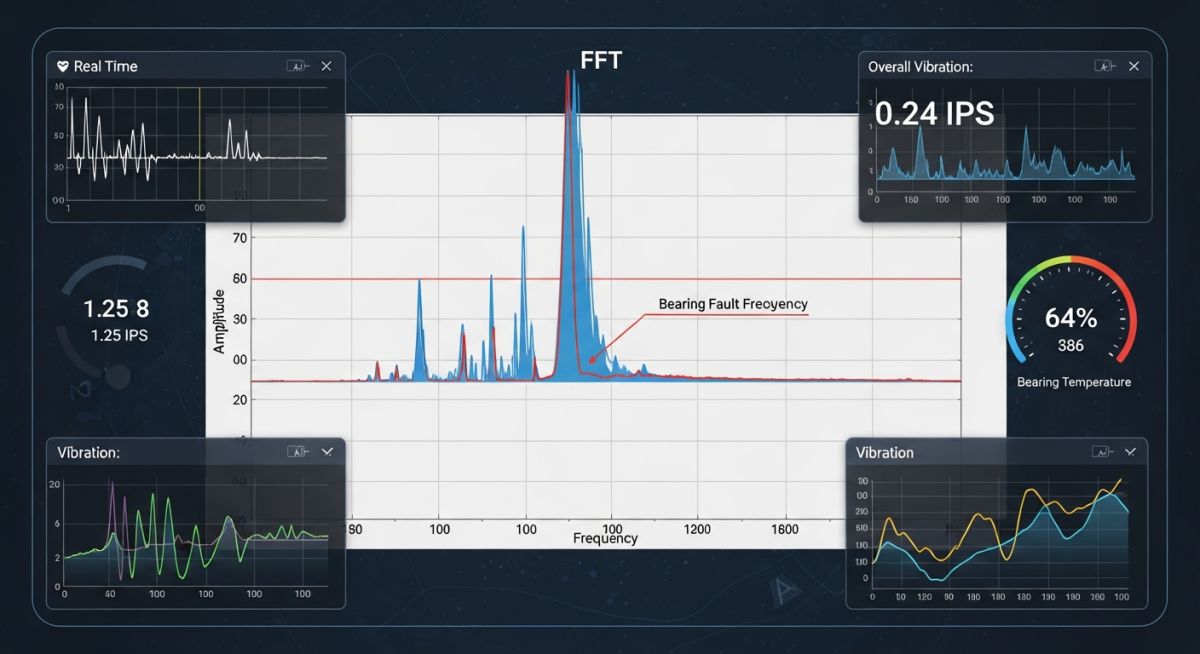
FFT analysis identified a specific peak at 4.2x running speed, confirming an Inner Race defect. Part was replaced during scheduled downtime, saving $45,000.
Technical Analysis of the Vibration Sensor Data:
By utilizing high-frequency "envelope" detection, the Vibration Sensor isolated the impact signals of the bearing balls hitting the inner race pit. While the overall RMS velocity was still within "Satisfactory" limits according to ISO standards, the Peak-to-Peak acceleration showed 5.2g impacts, providing the early warning needed for proactive replacement.
Expert Insights: Lessons from 20 years in the field
-
Avoid Ground Loops: When installing a Vibration Sensor in an electrically noisy environment, always use an isolated-base sensor or a mounting stud with a non-conductive washer to prevent interference from stray voltages.
-
The Cable Stress Factor: 80% of Vibration Sensor failures are actually cable failures. Ensure you use armored conduits and provide a "service loop" near the sensor head to relieve mechanical strain caused by machine movement.
-
Surface Preparation is King: A Vibration Sensor mounted on paint or rust will act as a low-pass filter, killing high-frequency data. Always grind a small flat spot to bare metal and use a thin layer of silicone grease to improve acoustic coupling.
