Vibration Measurement: Instruments, Units, and Applications Explained

Vibration measurement is the cornerstone of modern predictive maintenance, allowing engineers to diagnose mechanical health without dismantling machinery. By capturing the oscillatory motion of machines, technical teams can identify early signs of bearing wear, misalignment, and imbalance, significantly reducing unplanned downtime in heavy industrial environments.
What is Vibration Measurement?
Vibration measurement is the process of capturing the dynamic motion of mechanical systems using sensors like accelerometers or proximity probes. It quantifies the magnitude and frequency of movement in units of displacement, velocity, or acceleration, providing critical data to detect faults and ensure compliance with ISO 20816 standards.
Article Contents
- What is Vibration Measurement in Industrial Engineering?
- Technical Requirements for Vibration Measurement Systems
- How is Vibration Measured? Sensors and Signal Chain
- The Primary Unit of Vibration Measurement: Displacement, Velocity, and Acceleration
- Mathematical Analysis: How to Quantify Vibration Data?
- Comprehensive Guide to Vibration Measurement Instruments
- Critical Applications of Vibration Measurement in Rotating Equipment
- Industry Standards for Oil and Gas Vibration Measurement (API 670 and ISO 20816)
- Precision Analysis Using a Digital Vibration Meter
- Vibration Measurement Case Study: Preventing Pump Bearing Failure
Technical Knowledge Check
Question 1 of 5Quiz Completed!
Complete Course on
Piping Engineering
Check Now
Key Features
- 125+ Hours Content
- 500+ Recorded Lectures
- 20+ Years Exp.
- Lifetime Access
Coverage
- Codes & Standards
- Layouts & Design
- Material Eng.
- Stress Analysis
What is Vibration Measurement in Industrial Engineering?
In the context of mechanical engineering, vibration measurement is the systematic quantification of the oscillatory motion of a machine or component about its equilibrium position. Every rotating machine generates a unique vibration signature. When internal components like bearings, gears, or shafts begin to degrade, these signatures change, often long before a catastrophic failure occurs.
Kinetic Energy and Mechanical Stress in Vibration Measurement
Vibration is essentially the manifestation of alternating forces. High levels of vibration signify that energy is being wasted through friction, impact, or turbulence. Engineering standards like API 670 emphasize that monitoring these forces is not just about maintenance—it is a critical safety requirement for high-speed rotating equipment in the oil, gas, and power generation sectors.
Technical Requirements for Vibration Measurement Systems
To achieve reliable vibration measurement, a system must meet stringent technical criteria to ensure the data is both accurate and repeatable. Engineering teams must evaluate the following parameters before deploying a condition monitoring system:
- Frequency Response: The range of frequencies over which the sensor provides an accurate output. For low-speed fans, this might be 1 Hz to 1,000 Hz, whereas for high-speed turbines, it may extend beyond 20 kHz.
- Dynamic Range: The ratio between the largest and smallest vibration signals the system can detect without distortion or noise interference.
- Signal-to-Noise Ratio (SNR): High SNR is critical for detecting early-stage bearing faults where the vibration energy is very low compared to the background machine noise.
- Environmental Resilience: In industrial settings, sensors must withstand temperatures up to 200 degrees Celsius and exposure to corrosive chemicals or high-pressure washdowns.
How is Vibration Measured? Sensors and Signal Chain
The process of vibration measurement starts at the sensor level, where physical motion is converted into an electrical signal. This signal is then transmitted through shielded cabling to a data acquisition (DAQ) system or a dedicated vibration monitor.
Piezoelectric Sensors in Condition Monitoring
The most common tool for vibration measurement is the piezoelectric accelerometer. Inside the sensor, a mass rests on a piezoelectric crystal. As the machine vibrates, the mass exerts varying pressure on the crystal, generating an electric charge proportional to the acceleration of the machine's housing.
| Sensor Type | Parameter Measured | Best Application |
|---|---|---|
| Accelerometer | Acceleration (g) | High-frequency / Gearboxes |
| Proximity Probe | Displacement (mils) | Sleeve Bearings / Shaft Motion |
| Velocity Transducer | Velocity (mm/s) | General Machinery Health |
The Primary Unit of Vibration Measurement: Displacement, Velocity, and Acceleration
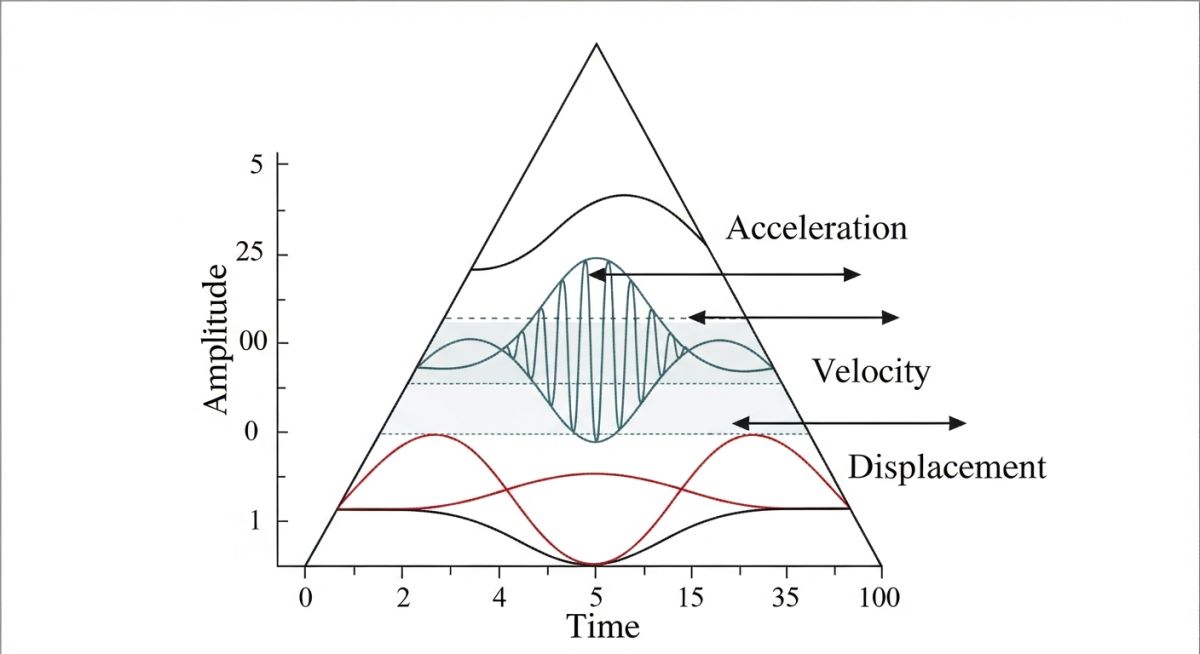
Understanding the units used in vibration measurement is vital for interpreting machine health data. These three parameters—displacement, velocity, and acceleration—are mathematically related via integration and differentiation, but each highlights different mechanical issues.
Displacement (Peak-to-Peak)
Measured in mils (1/1000th of an inch) or micrometers (μm), displacement represents the total distance of the vibrating object's travel. It is the primary vibration measurement unit for low-frequency monitoring (below 10 Hz) and is used to detect rotor unbalance and shaft misalignment.
Velocity (RMS)
Measured in mm/s or in/s, velocity is the rate of change of displacement. It is widely considered the most important parameter for general machinery health. According to ISO 20816, velocity values are used to categorize machine condition from Class I (small machines) to Class IV (heavy turbomachinery).
Acceleration (Peak)
Measured in g-forces (g) or m/s2, acceleration represents the rate of change of velocity. High acceleration levels are indicative of high-frequency impact forces, such as those found in rolling element bearing defects or gear tooth chipping.
Mathematical Analysis: How to Quantify Vibration Measurement Data?
Raw data from vibration measurement sensors is often complex. To make sense of these signals, engineers use specific mathematical quantifications to determine the severity of the motion.
RMS vs. Peak Values
The Root Mean Square (RMS) value is the most common quantification in vibration measurement because it represents the total energy content of the vibration. For a pure sine wave, the relationship between Peak and RMS is:
DPeak-to-Peak = 2 × DPeak
Fast Fourier Transform (FFT) Analysis
Time-domain data shows "when" a vibration happened, but FFT Analysis shows "at what frequency" it happened. By converting a time-waveform into a frequency spectrum, vibration measurement can pinpoint specific mechanical faults. For example, a spike at 1× running speed usually indicates unbalance, while a spike at 2× running speed points toward misalignment.
Comprehensive Guide to Vibration Measurement Instruments
Selecting the right vibration measurement hardware depends on whether you need a quick spot check or continuous monitoring for critical asset protection.
-
1
Portable Data Collectors: Handheld devices used by reliability technicians to walk through a plant and record data from pre-installed mounting pads.
-
2
Online Monitoring Systems: Hardwired racks (like the Bently Nevada 3500) that provide 24/7 vibration measurement and automatic machine shutdown (trip) capabilities.
-
3
Wireless Vibration Sensors: Modern IoT-based sensors that transmit vibration measurement data via LoRaWAN or Bluetooth to cloud platforms for AI-driven trend analysis.
Critical Applications of Vibration Measurement in Rotating Equipment
In heavy industry, vibration measurement is applied across various machine types to ensure operational continuity.
- Centrifugal Pumps: Detecting cavitation, recirculation, and bearing degradation.
- Steam and Gas Turbines: Monitoring shaft orbits and radial vibration to prevent catastrophic rotor-to-stator contact.
- Cooling Tower Fans: Identifying blade pitch issues and gearbox failures in hard-to-reach locations.
- Reciprocating Compressors: Specialized vibration measurement of frame vibration and cylinder pressure.
Industry Standards for Oil and Gas Vibration Measurement (API 670 and ISO 20816)
Engineering standards ensure that vibration measurement is performed consistently across different manufacturers and facilities.
| Standard | Focus Area | Key Metric |
|---|---|---|
| API 670 | Machinery Protection Systems | Real-time trips/alarms |
| ISO 20816-1 | General Vibration Evaluation | Velocity Severity Zones |
| ISO 10816-3 | Industrial Machines > 15 kW | Foundation rigidity limits |
Precision Analysis Using a Digital Vibration Meter
A modern digital vibration measurement meter is more than a simple sensor; it is a computer capable of on-site diagnostic processing. These meters typically provide:
- Spectral Overlays: Comparing current vibration measurement readings against historical baselines.
- Enveloping: A technique to filter out low-frequency noise and focus on high-frequency "bearing clicks."
- Phase Measurement: Used to distinguish between a bent shaft and simple unbalance by comparing the timing of the vibration peak relative to a tachometer signal.
Vibration Measurement Calculator
Convert between Displacement and Velocity to estimate machine health severity based on frequency. (Assumes sinusoidal motion).
Engineering Formulas Used:
- Velocity (in/s) = (Displacement in mils / 1000) × π × Frequency (Hz)
- Acceleration (g) = (Velocity in/s × 2 × π × Frequency Hz) / 386.1
EPCLand YouTube Channel
2,500+ Videos • Daily Updates
Vibration Measurement Case Study: Preventing Pump Bearing Failure

📊 Project Data
- Asset Type: High-Pressure Centrifugal Water Injection Pump
- Operational Speed: 3,000 RPM (50 Hz)
- Standard Applied: ISO 20816-3 (Class II)
- Monitoring Period: 6 Months Continuous
⚠️ Failure Analysis
Routine vibration measurement detected a significant trend increase in the acceleration spectrum. While velocity levels remained within "Satisfactory" limits (2.8 mm/s RMS), high-frequency energy in the 2 kHz to 5 kHz range spiked, indicating inner-race spalling on the drive-end ball bearing.
The Engineering Fix
Upon reviewing the vibration measurement data, the reliability team scheduled a proactive 4-hour maintenance window during a low-demand shift. The drive-end bearing was replaced, and subsequent inspections confirmed severe fatigue on the inner race. During reassembly, a precision laser alignment was performed to reduce the 1x and 2x frequency components.
💡 Lessons Learned
Conclusion: Relying solely on velocity for vibration measurement would have missed this failure. The inclusion of acceleration data was vital for early-stage fault detection.
Frequently Asked Questions about Vibration Measurement
What is the significance of the ISO 20816 standard in predictive maintenance?
ISO 20816 provides the global framework for vibration measurement evaluation on non-rotating parts of machines. It establishes severity zones (A, B, C, and D) based on machine size and foundation rigidity, helping engineers determine if a machine is safe for long-term operation or requires immediate shutdown.
How do piezoelectric accelerometers improve condition monitoring systems?
Piezoelectric accelerometers are essential for vibration measurement because they offer a wide frequency response and high durability. They are capable of capturing high-frequency signals associated with early bearing failure and gear mesh issues, which are often missed by velocity or displacement sensors.
When should displacement be prioritized over velocity for frequency domain analysis?
Displacement should be the primary vibration measurement parameter for low-frequency applications (below 10 Hz or 600 RPM). It is particularly effective for monitoring shaft motion relative to fluid-film bearings and for detecting unbalance or structural looseness in large, slow-moving rotors.
What are the main benefits of real-time machinery protection systems in oil and gas?
Real-time systems following API 670 provide continuous vibration measurement that can trigger automatic emergency shutdowns. This prevents catastrophic equipment failure, protects personnel from potential explosions or high-pressure leaks, and minimizes environmental impact by ensuring assets operate within safe design limits.
Summary of Engineering Best Practices
Effective vibration measurement is a multifaceted discipline that combines high-precision sensors, advanced mathematical analysis, and adherence to international standards. By shifting from reactive maintenance to a data-driven condition monitoring approach, facilities can extend asset life, optimize maintenance costs, and ensure a safer working environment.
Whether you are utilizing a handheld digital meter or a complex online monitoring rack, the fundamental goal remains the same: to listen to the machine and act on the data before a minor vibration evolves into a major failure.
📚 Recommended Resources: Vibration Measurement
Read these Guides



Related posts:
![3D engineering diagram illustrating shear modulus deformation on a solid block with force vectors.]()
Understanding Shear Modulus and Modulus of Rigidity in Piping Design
![3D render of a protective chromium oxide film forming on a stainless steel surface.]()
How Does Stainless Steel Oxide Film Formation Prevent Corrosion?
![Side-by-side comparison of industrial metal casting and metal forging processes.]()
Casting vs Forging: Key Differences for Industrial Piping Systems
![Various types of industrial pumps displayed in a modern engineering facility.]()
Guide to Types of Pumps and Their Working Principles
![3D digital GIS map overlay showing petroleum pipeline routes across a terrain]()
Why GIS in Petroleum and Pipeline Industry is Absolutely Critical
![CAESAR II Version 14 pipe stress analysis software interface displaying a 3D piping model.]()
What Is New in CAESAR II Version 14 Pipe Stress Analysis