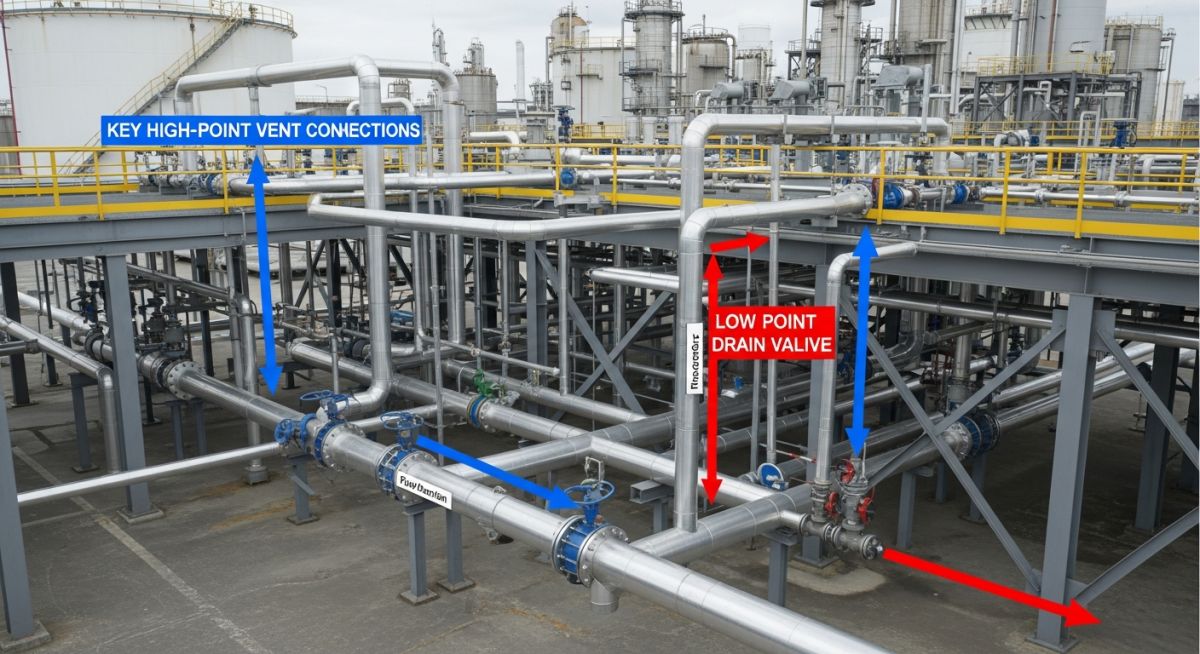
Importance of Vents and Drains in Piping System
I still remember a hydrotest I handled early in my career where everything looked perfect on paper—but the pressure readings kept fluctuating. We rechecked welds, gauges, even blamed the pump. The real issue? Trapped air. No vent at the high point. That single miss delayed the project by days.
In the field, vents and drains are never “optional details.” They decide whether your system operates smoothly or turns into a commissioning nightmare.
Key Takeaways
- Vents remove trapped air from high points in piping systems
- Drains eliminate liquid accumulation at low points
- Hydrotest accuracy depends heavily on proper venting
- Improper drainage leads to corrosion, cavitation, and water hammer
- Every elevation change in piping must be reviewed for vent/drain placement
Quick Knowledge Check
I use checks like this in the field to catch design misunderstandings before they turn into startup problems.
1. Where should vents be installed in a piping system?
2. Why are drains critical during hydrostatic testing?
3. What issue occurs if air is trapped during hydrotest?
Quiz Complete
Your final score is 0/3.
If a team gets these three checks right, I usually know they understand vent and drain logic well enough to avoid common commissioning mistakes.
What is a Vent and Drain Connection?
In my field experience, a vent connection is provided at the highest elevation point in a piping system to release trapped gases, while a drain connection is installed at the lowest possible point to remove accumulated liquids. These are not decorative add-ons — they directly control system behavior during filling, testing, and maintenance.
Types of Vents and Drains
- Permanent Process Vents and Drains (used during operation)
- Hydrotest Temporary Vents and Drains (used during testing)
- Manual Valve-Based Connections (standard practice in most plants)
- Auto-Air Release Systems (used in critical fluid systems)
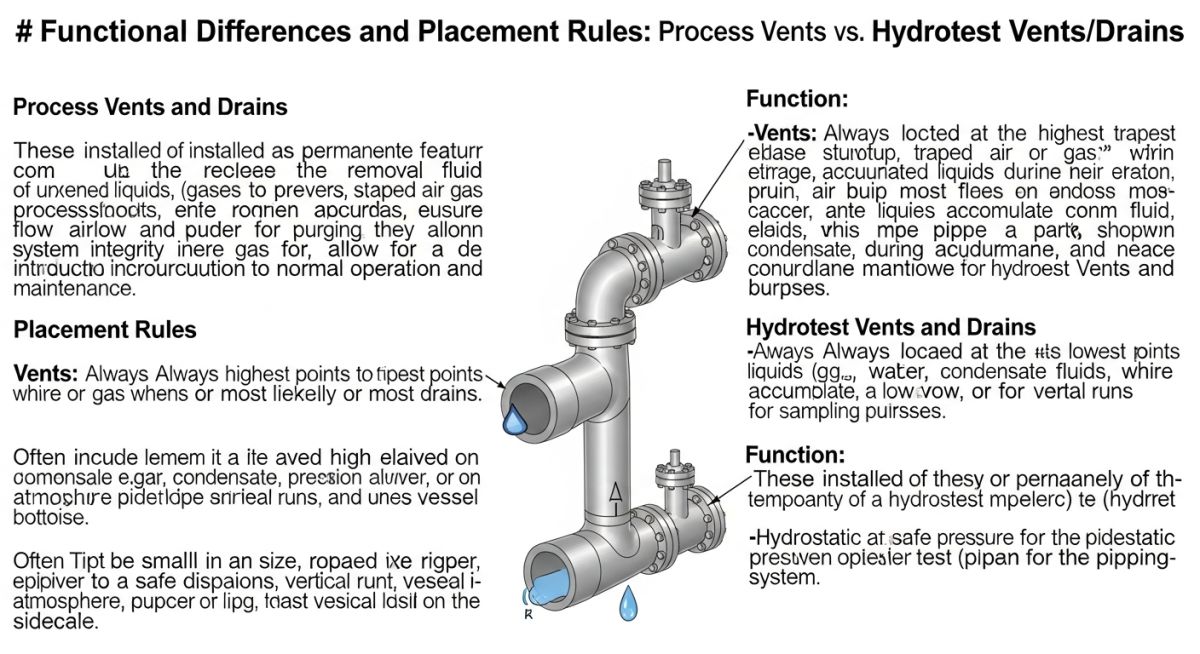
Hydrostatic Test Vents and Drains
During hydrotesting, I always enforce strict vent and drain logic. If air remains trapped, pressure readings become unreliable. If water is not drained properly, corrosion starts even before commissioning.
Hydrostatic Test Vent and Drain Features:
- Temporary installation at all high and low points
- Quick removal post testing
- Typically threaded or flanged valve connections
- Located based on pipeline slope and elevation review
Process Vents and Drains
Process vents and drains stay throughout plant life. These help in safe shutdown, flushing, chemical cleaning, and maintenance isolation. In hazardous systems, I always route vents to flare headers or safe disposal points.
Characteristics of Vents and Drains
| Parameter | Vent | Drain |
|---|---|---|
| Location | High Points | Low Points |
| Purpose | Air / Gas Removal | Liquid Removal |
| Design Standard | ASME B31 | ASME B31 |
| Operation Stage | Filling / Startup | Shutdown / Maintenance |
| Common Issues | Air Lock, Pressure Fluctuation | Corrosion, Water Hammer |
Field Case Study: Hydrotest Failure That Taught Me a Hard Lesson
On one refinery project, we had a 16-inch pipeline that failed hydrotest twice. No visible leaks, all welds were fine, pressure pump was stable. Yet readings kept dropping slightly.
I walked the line physically — not just drawings — and identified a missing vent at a small elevation rise near a pipe rack crossing. That tiny high point trapped air.
We installed a temporary vent, released trapped air, and repeated the test.
- Test passed in first attempt post correction
- Time saved: ~36 hours of troubleshooting
- Cost avoidance: additional manpower and retesting expenses
Field Lesson Learned: I never rely only on isometrics — I physically trace elevation changes and mark vent points myself before hydrotest approval.
Expert FAQs on Vents and Drains
Why are vents always placed at high points?
Because air naturally accumulates at the highest elevation. If not vented, it creates air pockets affecting flow and pressure stability.
Can vents and drains be skipped in small lines?
I never recommend skipping them. Even small-bore lines can trap air or fluid and create operational issues.
What size should vent and drain connections be?
Typically ½” or ¾”, but I decide based on line size, service, and company standards.
Are vents connected to atmosphere?
Not always. In hazardous services, I route vents to flare or safe systems instead of open discharge.
What is the biggest mistake in vent and drain design?
Ignoring elevation changes during routing. That is where most hidden problems originate.
How do vents help during commissioning?
They ensure full filling without air pockets, stabilize pressure readings, and support smooth startup operations.
Complete Course on
Piping Engineering
Check Now
Key Features
- 125+ Hours Content
- 500+ Recorded Lectures
- 20+ Years Exp.
- Lifetime Access
Coverage
- Codes & Standards
- Layouts & Design
- Material Eng.
- Stress Analysis

