What are Polymers? Types of Polymers, Definitions, and Engineering Applications 2026
Key Takeaways
- Classification Mastery: Distinguish between thermoplastic, thermosetting, and elastomeric polymers based on molecular forces.
- Structural Impact: Understand how linear, branched, and cross-linked architectures dictate mechanical strength.
- Standard Compliance: Align material selection with modern 2026 industrial requirements and ASTM testing protocols.
What are the different types of polymers?
The primary Types of Polymers are classified by their source (Natural, Synthetic, Semi-synthetic), structure (Linear, Branched, Cross-linked), and molecular forces (Elastomers, Fibers, Thermoplastics, and Thermosetting). These classifications determine the material’s thermal stability, tensile strength, and recyclability in modern engineering applications.
Founder’s Insight
“In my 20 years of plant commissioning, I’ve seen more failures from incorrect polymer selection than from actual design flaws. Always look beyond the trade name and analyze the cross-linking density. In 2026, the shift toward high-performance semi-synthetics is non-negotiable for sustainable EPC projects.”
— Atul Singla
Complete Course on
Piping Engineering
Check Now
Key Features
- 125+ Hours Content
- 500+ Recorded Lectures
- 20+ Years Exp.
- Lifetime Access
Coverage
- Codes & Standards
- Layouts & Design
- Material Eng.
- Stress Analysis
Knowledge Check: Engineering Types of Polymers
Test your mastery of molecular architecture and material behavior.
1. Which type of polymers can be repeatedly softened by heating and hardened by cooling without significant chemical change?
Primary Types of Polymers Based on Source and Origin
In industrial material science, the origin of a polymer chain dictates its inherent predictability and purity levels. Understanding the Types of Polymers based on their source is the first step in lifecycle assessment and environmental compliance. Engineering materials are generally categorized into three distinct buckets based on where their monomeric units originate.
Natural Polymers
Natural Types of Polymers are found in nature, primarily in plants and animals. These include proteins (like silk and wool), cellulose, starch, and resins. From a structural standpoint, natural polymers often possess complex, high-molecular-weight architectures that are difficult to replicate synthetically. They are essential in the pharmaceutical and food industries due to their biocompatibility.
Synthetic Polymers
These are man-made Types of Polymers synthesized in laboratories or industrial reactors. Common examples include polyethylene, nylon 6,6, and polyester. Synthetic polymers dominate the modern world because their properties—such as tensile strength, chemical resistance, and thermal stability—can be precisely engineered for specific environmental stresses.
Semi-Synthetic Polymers
Semi-synthetic Types of Polymers are derived from naturally occurring polymers through chemical modification. For instance, cellulose acetate (rayon) and cellulose nitrate are produced by treating natural cellulose with chemical reagents. These materials bridge the gap between the sustainability of natural sources and the enhanced mechanical properties of synthetic chemistry.
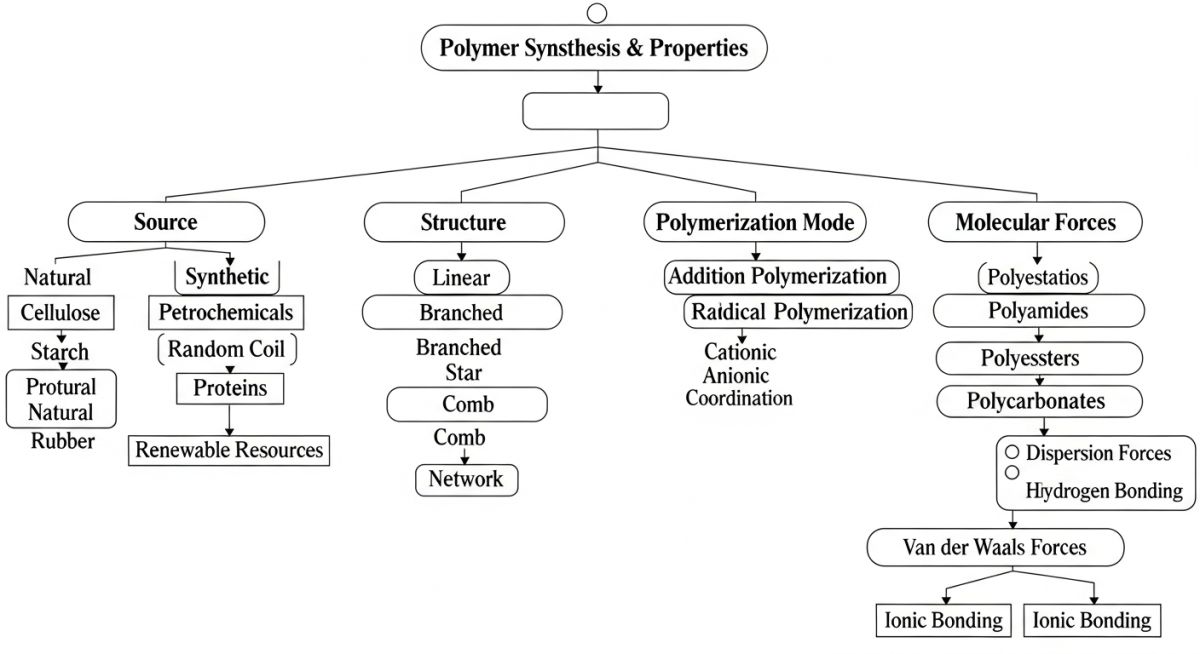
Structural Classification: Types of Polymers in Molecular Architecture
The physical arrangement of monomeric units significantly alters the density, melting point, and tensile strength of the material. When engineers discuss different Types of Polymers, they often refer to the "backbone" of the molecule.
Linear Polymers
Consist of long and straight chains. Because these chains can pack closely, linear Types of Polymers typically exhibit high densities and high melting points, such as High-Density Polyethylene (HDPE).
Branched-Chain Polymers
Contain linear chains with varying lengths of side branches. These branches prevent close packing, leading to lower density and lower tensile strength, as seen in Low-Density Polyethylene (LDPE).
Cross-linked Polymers
Formed from bi-functional and tri-functional monomers with strong covalent bonds between chains. These Types of Polymers (like Bakelite) are hard and brittle.
For a deeper dive into the standardized testing of these molecular structures, engineers should consult the official ASTM International Plastics Standards, which defines the protocols for identifying polymer morphology and mechanical performance.
Polymerization Chemistry: Identifying Types of Polymers by Reaction
The mechanism by which monomers link determines the final purity and molecular weight distribution of the material. In industrial process engineering, we categorize these Types of Polymers primarily into addition and condensation reactions. Understanding this distinction is critical for predicting the presence of by-products like water or methanol in the final resin.
Addition (Chain-Growth) Polymers
These Types of Polymers are formed by the repeated addition of monomer molecules possessing double or triple bonds. No small molecules are eliminated during this process. A prime example is the polymerization of ethene to polyethylene, a staple in ISO 1872 compliant piping systems.
Condensation (Step-Growth) Polymers
Formed by a series of condensation reactions between two different bi-functional or tri-functional monomeric units. This process usually involves the elimination of small molecules such as water or alcohol. High-performance Types of Polymers like Nylon 6,6 and Terylene are synthesized this way, following strict ASTM D4066 specifications for polyamides.
Thermal and Mechanical Types of Polymers (Molecular Forces)
Mechanical properties like tensile strength, elasticity, and toughness are governed by intermolecular forces (e.g., hydrogen bonding, Van der Waals). Engineers must distinguish these Types of Polymers based on their behavior under thermal stress.
| Classification | Molecular Forces | Thermal Behavior | Common Examples |
|---|---|---|---|
| Elastomers | Weakest (Van der Waals) | Highly Elastic | Buna-S, Neoprene |
| Fibers | Strong (H-bonding) | High Tensile Strength | Nylon 6,6, Terylene |
| Thermoplastics | Intermediate | Recyclable / Remeltable | PVC, Polystyrene |
| Thermosetting | Extensive Cross-linking | Infusible / Permanent Set | Bakelite, Urea-formaldehyde |
When evaluating these materials for pressure-vessel gaskets or high-heat components, reference the ASME Codes & Standards to ensure the chosen Types of Polymers meet the safety coefficients required for 2026 industrial operations.
Polymer Engineering: Degree of Polymerization (DP) Calculator
Calculate the average number of repeating units in your polymer chain based on molecular weight—a critical metric for classifying Types of Polymers.
Calculated DP Value
0
EPCLand YouTube Channel
2,500+ Videos • Daily Updates
Engineering Case Study: Material Selection in High-Pressure Systems
The Challenge: Brittle Fracture in HDPE Pipeline Infrastructure
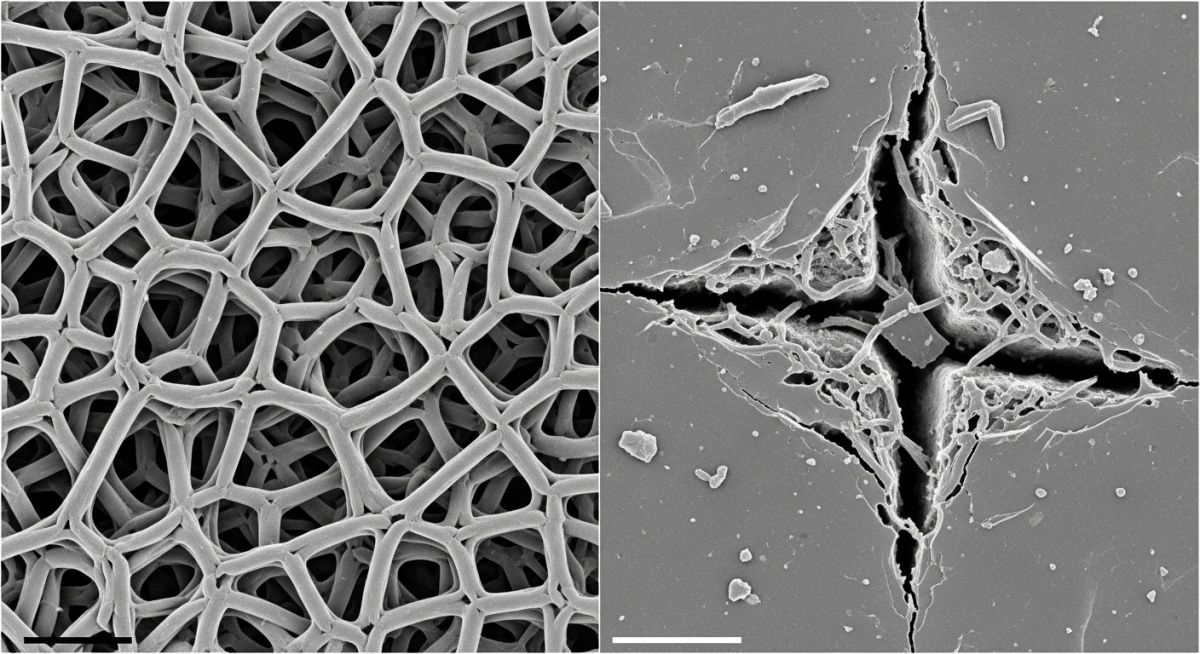
During a 2026 infrastructure audit in a coastal desalination plant, a 24-inch High-Density Polyethylene (HDPE) pipeline exhibited premature cracking. The engineering team had to determine why a material rated for high chemical resistance was failing under nominal operating pressures. The investigation focused on whether the specific Types of Polymers selected possessed the necessary molecular weight distribution for Environmental Stress Cracking Resistance (ESCR).
Investigation Findings
- Structure: The polymer used had excessive short-chain branching, deviating from pure linear Types of Polymers.
- Density: Actual density was 0.941 g/cm3, falling below the ASTM D3350 specification required for the project.
- Root Cause: Low-tier resin substitution during the supply chain phase led to reduced tie-molecule density.
The Resolution
The faulty sections were replaced with PE100+ rated materials. By strictly adhering to ISO 4427 standards, the facility ensured the new Types of Polymers featured a bimodal molecular weight distribution, significantly increasing the pipeline's service life to a projected 50 years.
Key Lesson for EPC Engineers
Never rely solely on the generic name "Polyethylene." Always specify the Types of Polymers by their ASTM cell classification to ensure the molecular architecture matches the environmental stress factors of your site.
Don't miss this video related to Types of Polymers
Summary: Master Piping Engineering with our complete 125+ hour Certification Course: ......
Expert Insights: Lessons from 20 years in the field
The "Creep" Factor in Load-Bearing Design
When specifying different Types of Polymers for structural loads, many junior engineers ignore "creep"—the tendency of solid materials to move slowly or deform permanently under persistent mechanical stresses. Always verify the long-term hydrostatic strength (LTHS) as per ASTM D2837.
Crystallinity vs. Processability
Higher crystallinity in Types of Polymers like Polypropylene increases chemical resistance and strength but makes the material more prone to shrinkage during molding. In 2026, we balance this by using nucleating agents to control crystal growth rates in precision EPC components.
The Sustainability Shift
The industry is moving toward "Circular Engineering." When selecting Types of Polymers, prioritize those with high recyclability ratings (Classes 1 and 2) or those compatible with chemical recycling to meet the latest ISO 14001 environmental benchmarks.

