Types of Condensers: Engineering Guide & Selection Criteria 2026
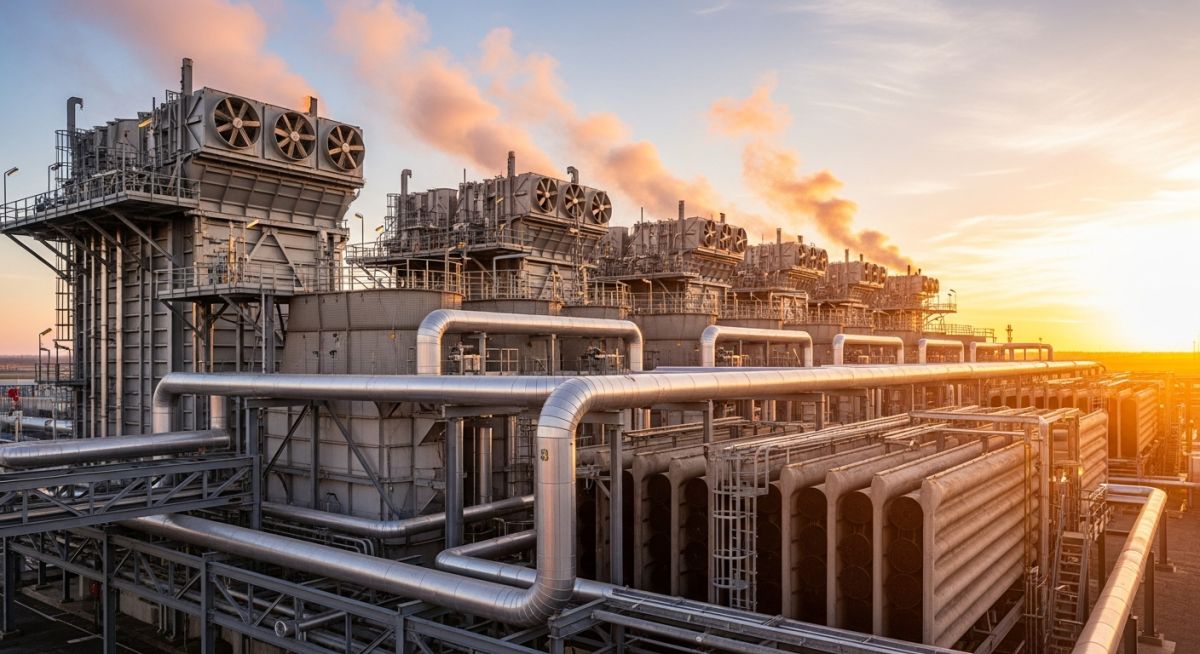
Imagine a mid-summer peak load at a petrochemical refinery where the cooling water temperature rises just 5 degrees above design specs. Suddenly, your high-pressure turbine faces back-pressure alarms, and the entire production line teeters on the edge of an emergency trip. This isn’t just a theoretical problem; it is the daily reality of thermal management. Choosing between different types of condensers is the difference between seamless operational efficiency and a multi-million dollar unplanned shutdown.
In this guide, we dive deep into the thermodynamics and mechanical configurations of modern condensing units to ensure your next project meets 2026 efficiency standards.
Key Takeaways
- Understanding the critical trade-offs between air-cooled, water-cooled, and evaporative heat rejection methods.
- Mastering selection criteria based on fouling factors, water availability, and ambient dry-bulb temperatures.
- Aligning system designs with 2026 global energy efficiency mandates and ASME Section VIII standards.
What are the main types of condensers?
The three primary types of condensers are air-cooled, water-cooled, and evaporative. Air-cooled units use fans for convection; water-cooled units (Shell and Tube or Double Pipe) utilize a liquid coolant for higher heat transfer rates; and evaporative condensers combine both by using water sprays and airflow to leverage latent heat.
Founder’s Insight
“Over 20 years in EPC projects, I’ve seen engineers default to water-cooled systems without considering long-term descaling costs. In 2026, with rising water scarcity, the hybrid evaporative model is often the hidden champion of ROI.”
– Atul Singla
Table of Contents
Complete Course on
Piping Engineering
Check Now
Key Features
- 125+ Hours Content
- 500+ Recorded Lectures
- 20+ Years Exp.
- Lifetime Access
Coverage
- Codes & Standards
- Layouts & Design
- Material Eng.
- Stress Analysis
Technical Proficiency Check: Condenser Systems
Question 1 of 51. Which type of condenser leverages the “Latent Heat of Vaporization” of water to achieve high heat rejection efficiency?
Understanding the Primary Function of Types of Condensers
In the realm of thermodynamics, the condenser acts as a critical heat rejection interface where the working fluid—typically a high-pressure refrigerant vapor or steam—undergoes a phase change into a liquid state. This process is governed by the Second Law of Thermodynamics, necessitating a heat sink (air, water, or a combination) that remains at a lower temperature than the condensing vapor. When evaluating different types of condensers, engineers must analyze the Heat Rejection Ratio (HRR), which is the ratio of the heat rejected at the condenser to the heat absorbed at the evaporator.
The efficiency of this phase change is highly dependent on the Logarithmic Mean Temperature Difference (LMTD). A higher LMTD allows for a more compact condenser design, whereas a smaller temperature gradient requires a significantly larger surface area to achieve the same cooling capacity. In modern industrial applications, maintaining a low Approach Temperature (the difference between the condensing temperature and the cooling medium’s inlet temperature) is paramount for maximizing the system’s overall Coefficient of Performance (COP).
Essential Engineering Specifications for Different Types of Condensers
Designing or selecting types of condensers requires a meticulous review of several mechanical and thermal parameters. According to the ASME Boiler and Pressure Vessel Code (BPVC) Section VIII, pressure ratings and material compatibility are non-negotiable for safety. Beyond structural integrity, the following specifications dictate performance:
- Fouling Factor: This represents the resistance to heat flow caused by the buildup of scales, algae, or corrosion on the heat transfer surfaces. Water-cooled systems require higher fouling allowances than air-cooled counterparts.
- Total Heat of Rejection (THR): This is the sum of the cooling load and the energy added during the compression process. It is the primary metric for sizing the unit.
- Face Velocity: Specifically for air-cooled types of condensers, the speed at which air passes over the finned coils determines both the heat transfer coefficient and the static pressure drop across the fans.
- Sub-cooling Requirement: Many modern refrigeration cycles require the liquid to be cooled below its saturation temperature to prevent “flash gas” before the expansion valve, necessitating additional surface area in the lower portion of the condenser.
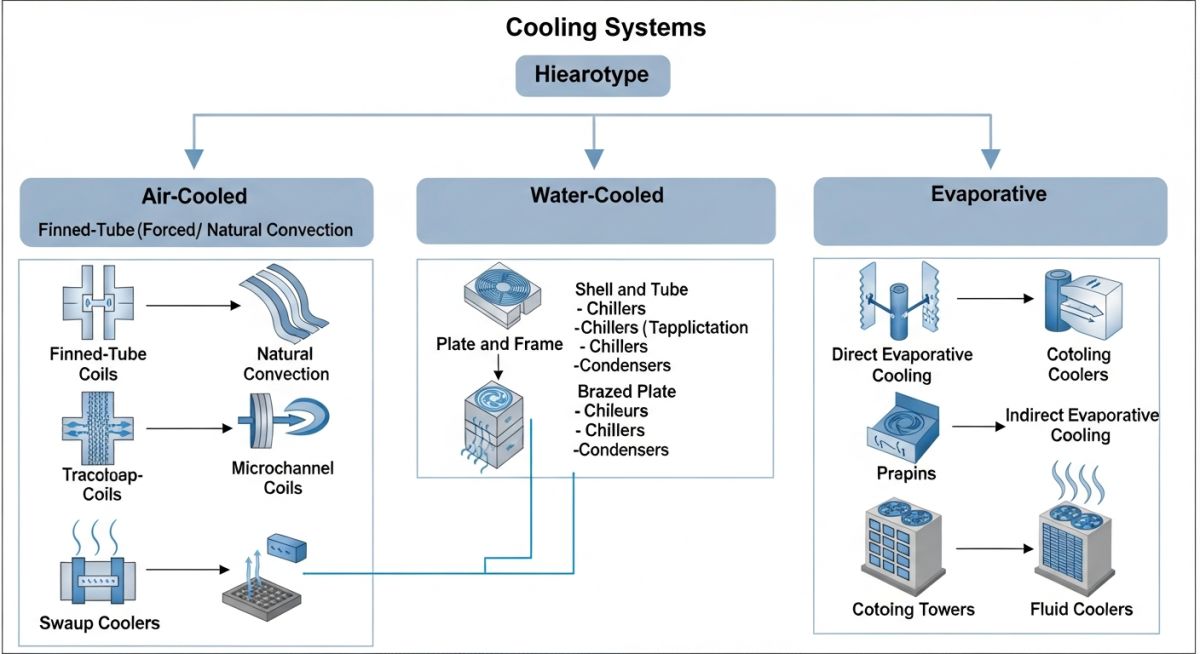
Classification: The 3 Main Types of Condensers
The industry categorizes types of condensers based on the cooling medium employed to carry away the heat. Each category is further subdivided by its mechanical configuration and airflow/water-flow characteristics.
1. Air-Cooled Condensers (ACC)
Air-cooled types of condensers are favored in regions where water is scarce or expensive. They rely on sensible heat transfer to the ambient air. These are generally classified into two sub-types:
- Natural Convection: These utilize the buoyancy of warm air to create flow. Common in domestic refrigerators, they have very low heat transfer rates and require massive surface areas for industrial loads.
- Forced Convection: These utilize high-powered fans to drive air across finned tubes. This is the standard for rooftop HVAC units and large-scale “dry coolers” in power plants.
2. Water-Cooled Condensers
Water-cooled types of condensers are the workhorses of heavy industry due to water’s superior thermal conductivity compared to air. These systems must comply with TEMA (Tubular Exchanger Manufacturers Association) standards for mechanical design. The three dominant configurations include:
- Double Tube (Tube-in-Tube): Small-capacity units where one tube is placed inside another. Water flows in the inner tube while refrigerant flows in the annulus in a counter-flow arrangement.
- Shell and Coil: A welded shell contains a circular copper coil. This is compact but difficult to clean mechanically, often reserved for smaller refrigeration units.
- Shell and Tube Condenser: The industry standard for large chillers. Refrigerant vapor enters the shell and condenses on the outer surface of tubes through which cooling water circulates.
3. Evaporative Condenser Systems
Evaporative types of condensers represent a hybrid approach, combining the benefits of a cooling tower and a water-cooled condenser into a single unit. By spraying water over the condensing coils while simultaneously blowing air, the system utilizes the latent heat of vaporization. This allows the refrigerant to condense at a temperature approaching the ambient wet-bulb temperature, which is consistently lower than the dry-bulb temperature used by air-cooled systems.
Technical Comparison of Types of Condensers
| Feature | Air-Cooled | Water-Cooled | Evaporative |
|---|---|---|---|
| Heat Sink | Ambient Air | Fresh/Sea Water | Air & Water Spray |
| Installation Cost | Low (No Piping) | High (Pumps/Towers) | Moderate to High |
| Maintenance | Low (Cleaning Fins) | High (Descaling) | High (Water Treatment) |
| Energy Efficiency | Lower (High Cond. Temp) | High | Highest (Wet-bulb limit) |
Selection Matrix: How to Choose Between Types of Condensers
When selecting between types of condensers, the engineer must weigh the Life Cycle Cost (LCC) against the initial capital expenditure (CAPEX). For instance, in 2026, many pharmaceutical plants are transitioning to stainless steel shell and tube units to meet ISO 14001 environmental standards regarding water discharge.
Crucial factors include the Availability of Water (if scarce, ACC is mandatory), Local Climate (high humidity reduces evaporative efficiency), and Space Constraints (water-cooled systems with remote towers require significant footprint).
📊 Condenser Heat Rejection & LMTD Estimator
Note: Valid for all types of condensers assuming isothermal condensation.
EPCLand YouTube Channel
2,500+ Videos • Daily Updates
Industrial Case Study: Refinery Cooling Optimization
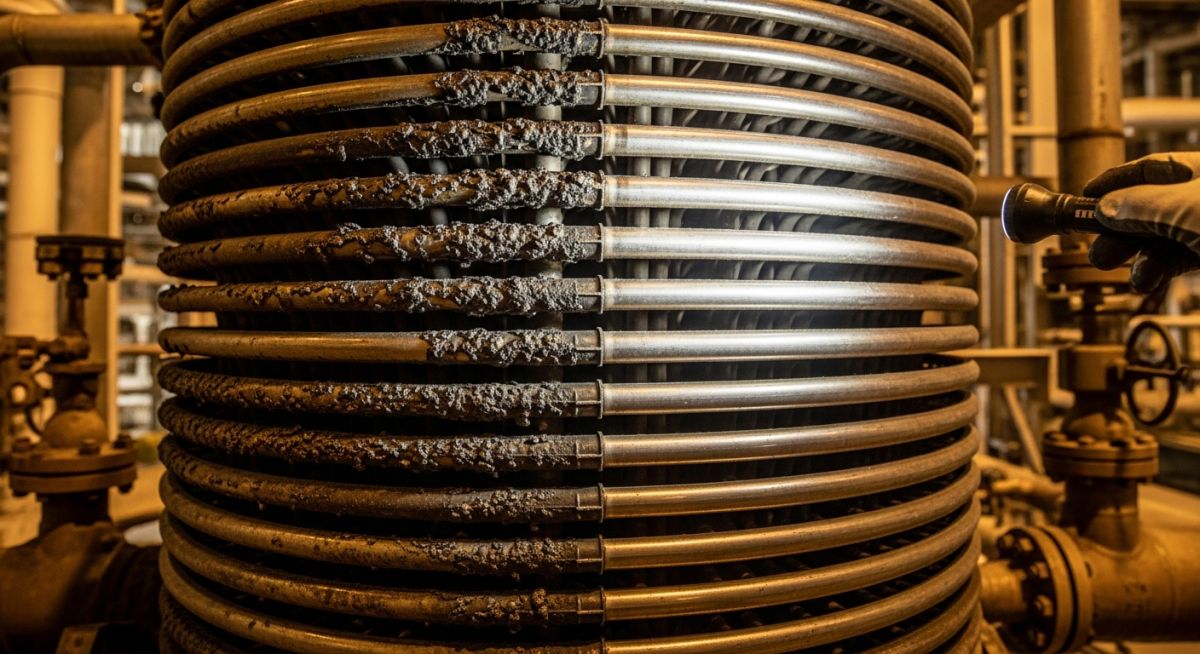
The Challenge: Severe Fouling in Shell and Tube Units
A major oil refinery in a high-salinity coastal region was experiencing weekly performance degradation in their primary fractionation types of condensers. The existing shell and tube units, using untreated seawater, reached critical fouling factors within just 15 days of operation, leading to a 15% increase in turbine back-pressure and significant fuel waste.
The 2026 Engineering Solution
The EPC team performed a Life Cycle Cost (LCC) analysis comparing a complete descaling overhaul versus a transition to a hybrid system. The decision was made to replace the aging horizontal shell and tube units with a modular Evaporative Condenser bank featuring titanium-stabilized stainless steel coils. This setup utilized a closed-loop treated water system for the coils, while using the coastal air and a minimal water spray for heat rejection.
Results & Metrics
-
✓
Maintenance Interval: Increased from 2 weeks to 18 months.
-
✓
Energy Savings: 22% reduction in fan and pump power consumption.
-
✓
ROI: Full capital recovery achieved within 14 months of deployment.
Technical Takeaway: When dealing with aggressive coolants like seawater, the selection of types of condensers must prioritize material compatibility and cleaning accessibility over initial procurement costs. Hybrid systems often provide the best balance of efficiency and reliability in harsh 2026 industrial environments.
Expert Insights: Lessons from 20 years in the field
-
Prioritize Vapor Velocity: In large-scale types of condensers, neglecting vapor distribution leads to stagnant zones and non-condensable gas buildup. Always verify baffle spacing against TEMA standards to prevent vibration and tube erosion.
-
Non-Condensable Management: Even a 1% concentration of air in your steam condenser can drop the heat transfer coefficient by over 50%. Ensure your vacuum extraction system is sized for 2026 airtightness benchmarks.
-
The Water Chemistry Fallacy: Many engineers assume “clean” water doesn’t require high fouling factors. In 2026, shifting water tables mean mineral content fluctuates wildly; always design for the worst-case seasonal Langelier Saturation Index (LSI).
-
Material Choice: For evaporative types of condensers, the move from galvanized steel to 316L stainless steel coils is no longer an “upgrade”—it is a necessity for achieving a 25-year service life in industrial zones.
Frequently Asked Questions: Mastering Types of Condensers
What are the primary types of condensers used in industrial refrigeration? ▼
Which condenser type is most efficient for a 2026 power plant? ▼
How does the “Approach Temperature” affect selection? ▼
Why do many shell and tube condensers fail prematurely in coastal areas? ▼
Can I convert an air-cooled system to an evaporative one? ▼
What is the #1 mistake in sizing condensers for vacuum service? ▼
📚 Recommended Resources: Types of Condensers
Read these Guides
🎓 Advanced Training

Related posts:
![High-grade industrial Wing Nut Types and Applications for mechanical assemblies.]()
Wing Nut Types and Applications: The 2026 Engineering Guide
![Industrial Monorail Crane Systems installed in a modern manufacturing plant 2026.]()
Monorail Crane Systems: Design, Types & 2026 Standards Guide
![Lead engineer performing a Factory Acceptance Test FAT on an industrial skid system 2026]()
Factory Acceptance Test FAT: The 2026 Engineering Guide to Zero-Defect Delivery
![Professional engineering workspace showing a Basis of Design document layout for a 2026 project.]()
Basis of Design: How to Write a BOD for Engineering Projects in 2026
![Industrial Flare Knockout Drum Sizing and installation in a refinery relief system.]()
Flare Knockout Drum Sizing: Design & API 521 Standards (2026 Guide)
![Advanced Reboiler Control Systems in a modern petrochemical refinery 2026.]()
Reboiler Control Systems: Engineering Guide to Precision Control 2026