Tender Documents vs Contract Documents: Key Differences in 2026
Understanding the nuances of Tender Documents vs Contract Documents is fundamental for any project manager or engineer involved in procurement. While these two sets of documentation often share the same technical drawings and specifications, their legal weight and purpose undergo a massive transformation once a bid is accepted. In the complex world of 2026 EPC (Engineering, Procurement, and Construction) projects, a failure to distinguish between the “invitation” phase and the “execution” phase can lead to significant litigation, cost overruns, and scope disputes.
Difference Between Tender Documents and Contract Documents
The main difference between tender documents vs contract documents is their legal status. Tender documents are an “invitation to treat,” issued by the employer to solicit bids. Contract documents are the final, legally binding agreement signed by both parties, incorporating the tender, the acceptance, and any negotiated amendments for project execution in 2026.
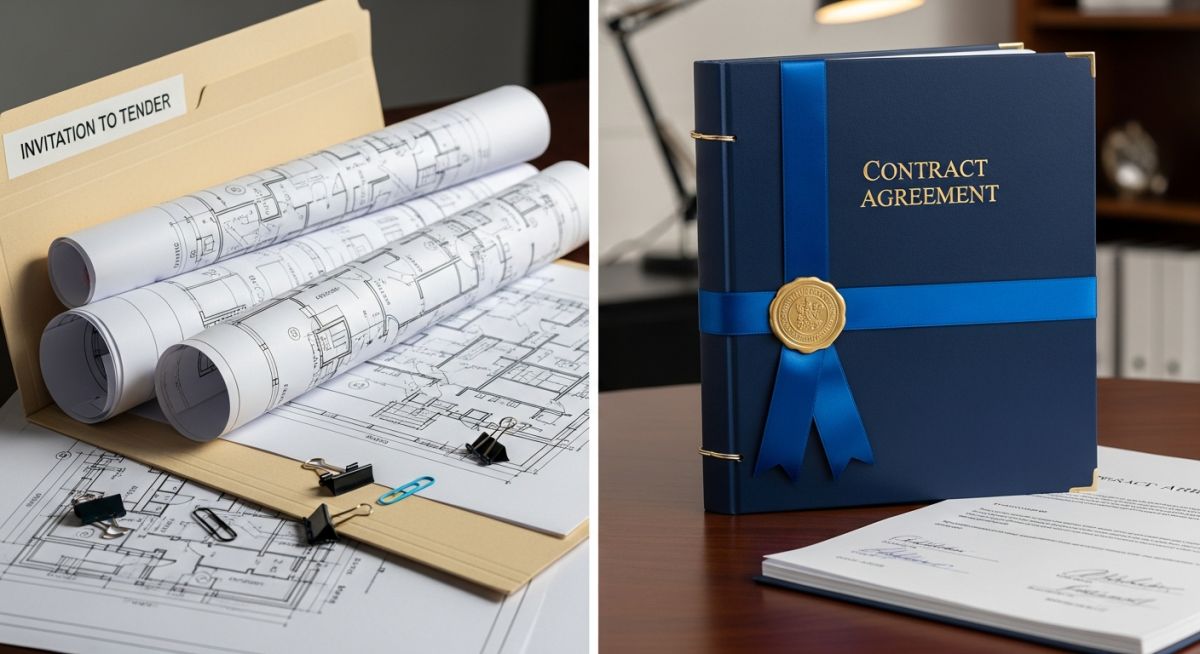
Table of Contents
Contracts & Tenders Knowledge Check
Question 1 of 5What is the legal status of a Tender Document before a bid is accepted?
Complete Course on
Piping Engineering
Check Now
Key Features
- 125+ Hours Content
- 500+ Recorded Lectures
- 20+ Years Exp.
- Lifetime Access
Coverage
- Codes & Standards
- Layouts & Design
- Material Eng.
- Stress Analysis
Comprehensive Guide to Tender Documents vs Contract Documents
In the engineering and construction lifecycle, the movement from a conceptual design to a completed facility is governed by layers of documentation. The relationship between Tender Documents vs Contract Documents is often viewed as a progression. While the tender set provides the baseline for pricing and technical proposals, the contract set serves as the “Rule Book” for the entire execution phase.
For 2026 projects, clarity between these sets is vital. In many jurisdictions, the tender documentation remains an “Invitation to Treat,” meaning it does not create a binding obligation until a formal offer (the Bid) is accepted by the Employer through a Letter of Acceptance. Only then do selected parts of the tender package merge with legal agreements to form the final Contract Documents.

What are Tender Documents? The Invitation to Bid
Tender documents are the package of information prepared by the Employer (or their consultant) to describe the work to be performed. They are designed to allow contractors to prepare a competitive and accurate bid. In modern procurement, these often follow standardized templates like the FIDIC White Book or JCT guidelines.
Key Components of a Tender Package:
- Invitation to Tender (ITT): A formal letter inviting specific firms to bid.
- Instructions to Tenderers (ITT): Rules on how to submit the bid, deadlines, and bond requirements.
- Bill of Quantities (BoQ): A detailed itemization of materials, parts, and labor (for Unit Price contracts).
- Tender Drawings: Preliminary engineering designs (often marked “Not for Construction”).
- Technical Specifications: Quality standards (e.g., ASME, ASTM, ISO) the project must adhere to.
What are Contract Documents? The Legal Execution Set
While tender documents solicit an offer, Contract Documents are the evidence of the agreement. They are the legally enforceable set of papers that define the rights, obligations, and liabilities of both the Employer and the Contractor.
This set is usually broader than the tender set. It includes the original tender components but adds crucial legal instruments such as the Articles of Agreement, the Letter of Acceptance, and any post-tender clarifications or addenda that were negotiated during the bid evaluation period.
5 Critical Differences Between Tender Documents vs Contract Documents
To maintain project discipline in 2026, engineers must understand these five fundamental distinctions between the two stages of documentation:
| Feature | Tender Documents | Contract Documents |
|---|---|---|
| Legal Status | Invitation to Treat | Binding Legal Agreement |
| Purpose | Soliciting a bid/offer from contractors. | Governing project execution and disputes. |
| Inclusion | Baseline drawings and ITT instructions. | Signed agreement, bonds, and insurances. |
| Timing | Issued before the bid is submitted. | Executed after the bid is accepted. |
| Modification | Changed via “Addenda.” | Changed via “Variation Orders.” |
The Transition: When Do Tender Documents Become Contract Documents?
The metamorphosis of Tender Documents vs Contract Documents occurs at a specific legal milestone: the Award of Contract. In many standard forms of contract, such as those published by FIDIC, the process is triggered by the issuance of the “Letter of Acceptance.” This document signals the Employer’s formal acceptance of the Contractor’s offer.
However, simply accepting the bid does not automatically make the entire tender package a contract. During the “Clarification Period,” the parties may have exchanged emails or held meetings to resolve ambiguities in the Bill of Quantities or Technical Specifications. These clarifications must be compiled into a “Schedule of Post-Tender Clarifications” and explicitly listed in the Articles of Agreement to be legally enforceable in 2026.
Understanding the Order of Precedence in Tender Documents vs Contract Documents
One of the most frequent causes of construction disputes is a discrepancy between different documents. For example, a Tender Drawing might show a 150mm pipe, while the Technical Specification calls for a 200mm pipe. In the transition from Tender Documents vs Contract Documents, a hierarchy—known as the Order of Precedence—is established to resolve such conflicts.
Typical Hierarchy of Documents (FIDIC Standard):
- The Contract Agreement: The core signed document.
- The Letter of Acceptance: The formal award notice.
- The Letter of Tender: The contractor’s original bid.
- Particular Conditions: Project-specific legal modifications.
- General Conditions: Standard boilerplate (e.g., Red Book).
- Specifications: Technical quality and standards.
- Drawings: Visual engineering designs.
- Schedules (BoQ): Quantities and pricing.
This hierarchy ensures that if a conflict arises, the document higher in the list takes priority. Engineers must be extremely careful during the assembly of Contract Documents to ensure that any “Addenda” issued during the tender period are integrated at the correct level of precedence.
Essential Components of a Modern Engineering Contract Set
In 2026, a robust contract set for an EPC or major infrastructure project involves more than just drawings and price lists. The comparison between Tender Documents vs Contract Documents highlights that the latter must include administrative and financial security instruments.
| Document Type | Role in the Contract Set | Tender Inclusion? |
|---|---|---|
| Performance Bond | Financial security provided by a bank to protect the Employer. | No (Template only) |
| Insurance Certificates | Proof of CAR (Contractors’ All Risks) and professional indemnity. | No |
| Execution Program | The baseline schedule (CPM) for tracking delays and milestones. | Yes (As draft) |
| Method Statements | Technical descriptions of how critical work will be executed. | Yes |
Formula for Contractual Integrity
For a document to be considered a “Contract Document,” it must satisfy the Identity Principle:
Contract Set = Tender Documents + Addenda + Letter of Acceptance + Signed Agreement
Note: If an item in the Tender Documents vs Contract Documents comparison is not explicitly listed in the “Articles of Agreement,” it may be deemed “Extrinsic Evidence” and ignored during a legal dispute.
Tender Documents vs Contract Documents Risk Scorer
Identify your current documentation status to determine if you are operating under Tender Documents or a fully executed Contract Document set.
Select Present Documents:
Quick Precedence Checker:
Select two document types to see which usually governs in 2026 FIDIC-based contracts.
Don’t miss this video related to Tender Documents

Summary: Master Piping Engineering with our complete 125+ hour Certification Course: ……
Letter of Intent (LOI) vs. Full Contract Execution: Navigating the Risk Limbo
In the fast-paced energy and infrastructure sectors of 2026, project owners often feel pressured to start work before the complex Tender Documents vs Contract Documents transition is fully finalized. This leads to the issuance of a Letter of Intent (LOI)—a document that sits in the legal “limbo” between a bid and a binding contract.

While an LOI allows for the early procurement of “Long Lead Items” (like specialized turbines or heavy-wall piping), it poses significant risks. Unlike the final Contract Documents, which contain detailed dispute resolution and indemnity clauses, an LOI is often a brief 2-page letter. If a dispute arises during this phase, it can be difficult to determine which specific terms from the original Tender Documents actually apply.
The “If-and-When” Trap
Many LOIs contain “if-and-when” clauses, stating that the contractor will only be paid according to the full contract terms if and when that contract is eventually signed. If the Tender Documents vs Contract Documents transition fails and the deal collapses, the contractor may only be entitled to Quantum Meruit (a reasonable sum for work done) rather than the profit margins built into their tender bid.
Best Practices for 2026 Procurement Teams:
- Limit the Scope: The LOI should only authorize specific, low-risk activities (e.g., site mobilization or engineering design) rather than full-scale construction.
- Incorporate by Reference: Explicitly state in the LOI that the “General Conditions” found in the Tender Documents shall govern all work performed under the letter until the final contract is signed.
- Set a Financial Ceiling: Include a “Not-to-Exceed” (NTE) amount to prevent uncontrolled spending before the final Contract Documents are executed.
- Define the Sunset Date: Every LOI should have an expiry date by which the formal contract must be signed to prevent a permanent state of legal ambiguity.
Ultimately, an LOI is a bridge, not a destination. The goal of every procurement manager should be to move from the Tender Documents phase to a fully executed set of Contract Documents as rapidly as possible to ensure both parties are protected by a robust, multi-layered legal framework.
Tender Documents vs Contract Documents Failure Case Study: The Pipe Specification Dispute

Project Data
- Project Type: Municipal Wastewater Treatment Plant Expansion
- Contract Value: $45 Million USD
- Contract Form: FIDIC Red Book (Conditions of Contract for Construction)
- Key Conflict: Material specification for high-pressure aeration piping.
Failure Analysis
During the bidding phase, the Tender Documents contained a Bill of Quantities (BoQ) that listed “Carbon Steel Piping” for the aeration system. However, the Technical Specifications (also part of the tender) required “Grade 316 Stainless Steel” for the same system to prevent corrosion. The contractor bid based on the cheaper Carbon Steel prices found in the BoQ. After the contract was signed, the Employer insisted on Stainless Steel.
The dispute arose because the contractor argued that the BoQ was the primary document used for pricing, while the Employer pointed to the quality standards in the specifications.
Engineering & Legal Fix
The resolution required an analysis of the “Order of Precedence” clause in the executed Contract Documents. Under the FIDIC hierarchy:
- Specifications (Item 6) take precedence over the Bill of Quantities (Item 8).
- Because the Contract Documents were already signed, the Contractor was legally obligated to provide Stainless Steel at their own expense.
- The Employer allowed a “Value Engineering” change to a high-density coating on Carbon Steel as a compromise to avoid a total project stall, documented via a formal Variation Order.
Lessons Learned
This case highlights that Tender Documents vs Contract Documents transitions must involve a “conformation” process. All discrepancies identified during the bid period should be resolved in a “Memorandum of Understanding” (MoU) and included at the top of the contract hierarchy to prevent standard precedence rules from causing financial loss.
Frequently Asked Questions: Tender Documents vs Contract Documents
What is the standard order of precedence in construction contracts for 2026?
When do tender documents become legally binding in a project lifecycle?
How does the bill of quantities in contract documents differ from the tender stage?
Why is the difference between invitation to tender and contract agreement important for engineers?
Conclusion: Mastering the Transition
The transition from Tender Documents vs Contract Documents is a pivotal moment in the life of any engineering project. While the tender documents serve as the foundation for the contractor’s proposal, the contract documents are the ultimate authority that governs performance, quality, and dispute resolution.
In 2026, as projects become more technically complex and legally scrutinized, a deep understanding of the Order of Precedence and the formal “conformation” of documents is the best defense against costly litigation. By ensuring that every post-tender clarification is properly incorporated into the final agreement, project teams can move from the bidding phase to successful execution with absolute legal and technical clarity.
Ensuring compliance with FIDIC, JCT, and NEC4 standards for global procurement and contract administration in 2026.
📚 Recommended Resources: Contract Documents
Read these Guides
- 📄 Comprehensive Guide to Feed Contracts for Oil and Gas Projects: Key Clauses Explained
- 📄 API Standards: The Complete 2026 Engineering Guide (API 610, 650 & 570
- 📄 Interactive Piping Flange Troubleshooting Quiz: Test Your Leak Prevention Skills
- 📄 Test Your ASME B31.3 Compliance Knowledge: An Interactive Quiz
🎥 Watch Tutorials


Related posts:
![High-grade industrial Wing Nut Types and Applications for mechanical assemblies.]()
Wing Nut Types and Applications: The 2026 Engineering Guide
![Industrial Monorail Crane Systems installed in a modern manufacturing plant 2026.]()
Monorail Crane Systems: Design, Types & 2026 Standards Guide
![Lead engineer performing a Factory Acceptance Test FAT on an industrial skid system 2026]()
Factory Acceptance Test FAT: The 2026 Engineering Guide to Zero-Defect Delivery
![Professional engineering workspace showing a Basis of Design document layout for a 2026 project.]()
Basis of Design: How to Write a BOD for Engineering Projects in 2026
![Industrial Flare Knockout Drum Sizing and installation in a refinery relief system.]()
Flare Knockout Drum Sizing: Design & API 521 Standards (2026 Guide)
![Advanced Reboiler Control Systems in a modern petrochemical refinery 2026.]()
Reboiler Control Systems: Engineering Guide to Precision Control 2026