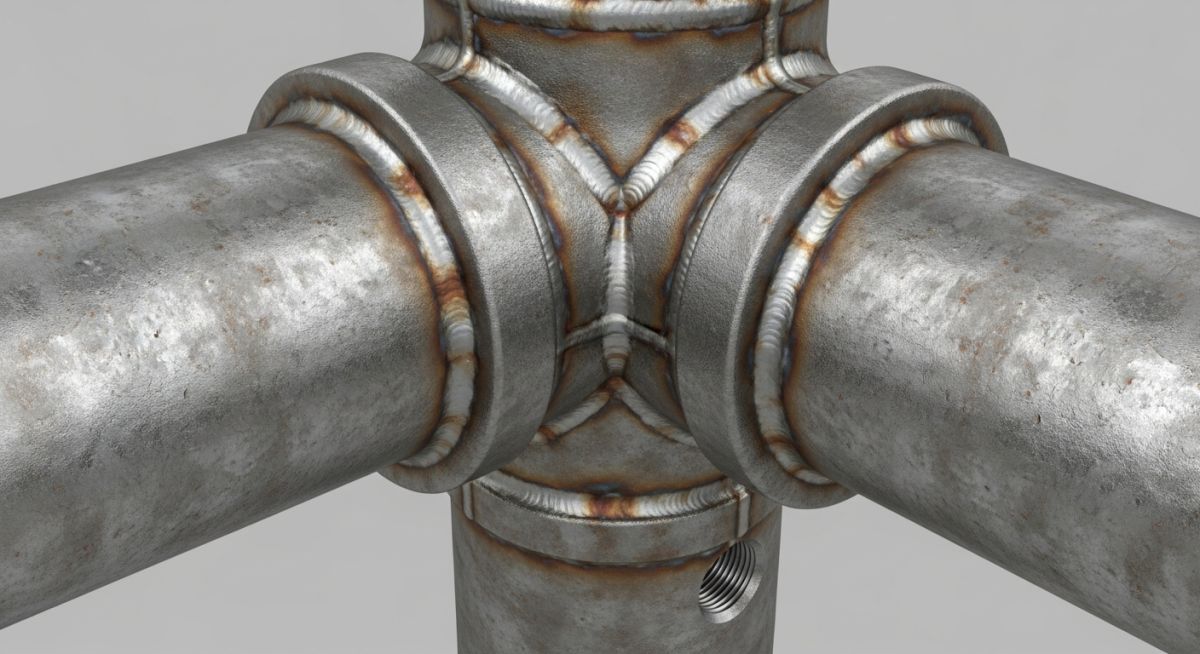
🛠️ EPCLAND WORKSPACE CONTROL PANEL ⚠️ DELETE THIS ENTIRE CONTAINER BOX BEFORE PUBLISHING THE BLOG POST Hero Image: Purpose: To visually introduce the concept of a weep hole on a reinforcing pad of a piping branch connection. Description: A detailed 3D render of a steel piping branch connection featuring a reinforcing pad (repad) with a clearly visible, small threaded weep hole drilled into the pad. SEO Alt Text: 3D render of a piping reinforcing pad showing a weep hole for venting and leak detection. Image Slug: piping-reinforcing-pad-weep-hole-diagram Filename URL: https://epcland.com/wp-content/uploads/2026/06/piping-reinforcing-pad-weep-hole-diagram.jpg Technical Infographic: Purpose: To explain the functional mechanism of a weep hole during welding, testing, and operation. Description: A 2D cross-sectional engineering schematic illustrating the pipe wall, reinforcing pad, weld joints, and the weep hole venting path for pressure release and leak detection. SEO Alt Text: Cross-section diagram of a weep hole in a reinforcing pad showing pressure venting and leak detection path. Image Slug: weep-hole-cross-section-schematic Filename URL: https://epcland.com/wp-content/uploads/2026/06/weep-hole-cross-section-schematic.jpg Meta Data: Focus Keyword: weep hole in piping Title: What is a Weep Hole in Piping and Pressure Vessels? Slug: weep-hole-in-piping-and-pressure-vessels Meta Description: Learn the purpose, design, and safety functions of a weep hole in piping systems and pressure vessels. Tags: weep hole, piping engineering, pressure vessels, reinforcing pad, vent hole, piping safety, non-destructive testing Author: Atul Singla | Piping Engineering Expert | Updated: May 2026 What is a Weep Hole in Piping and Pressure Vessels? [Weep Hole in Piping]: A small venting and detection aperture drilled through reinforcing pads, wear plates, or vessel jackets to prevent pressure build-up behind attachments and to provide immediate visual indication of primary pressure boundary leakage in compliance with ASME Section VIII and ASME B31.3. In my 20+ years of managing piping integrity on high-pressure refinery units, I have seen minor details cause catastrophic failures. One such detail is the humble weep hole—often called a vent hole or tell-tale hole. I remember a commissioning phase where a contractor forgot to clear the temporary wooden plugs from the reinforcing pad weep holes on a 24-inch hydrocarbon line. During hydrotesting, the primary weld leaked, pressure built up behind the repad, and it ruptured violently. That day cemented my respect for this tiny, critical safety feature. A weep hole is not just a random hole drilled into a piece of steel. It is a highly engineered safety and testing port. When we weld a reinforcing pad (repad) around a branch connection or a nozzle on a pressure vessel, we create an enclosed interstitial space. Without a dedicated venting path, this space becomes a hazard during welding, heat treatment, and operation. Key Takeaways from a Piping Expert Prevents dangerous pressure build-up during Post-Weld Heat Treatment (PWHT) by venting expanding trapped air. Serves as a primary diagnostic port for pneumatic leak testing of reinforcing pad welds. Provides an immediate visual warning if the internal run pipe or vessel shell suffers from localized corrosion or cracking. Must never be permanently plugged or painted over during plant maintenance cycles. Interactive Engineering Quiz EPCLAND Portal Question 1 of 3 In accordance with ASME BPVC Section VIII, Division 1, UG-37(g), what is the primary purpose of the telltale (weep) hole required in reinforcing plates (repads) for nozzles, and how should it be treated during pressure testing and operation? To allow continuous monitoring of the nozzle weld via radiography; it must be permanently seal-welded shut after the vessel hydrotest. To vent gases during welding and reveal leakage of the attachment weld during testing and service; it must remain open or be plugged with a non-hardening material. To serve as an injection port for corrosion inhibitors; it must be fitted with a high-pressure check valve during operation. To drain condensation from the vessel interior; it must be plugged with a solid threaded steel plug seal-welded to prevent fugitive emissions. Next Question → Question 2 of 3 Under ASME B31.3 (Process Piping), reinforcing pads on welded branch connections must be provided with a vent (weep) hole. What is the primary mechanical hazard prevented by leaving this vent hole unplugged or packed with a soft, porous material during normal operation? Galvanic corrosion between the run pipe and the reinforcing pad due to stagnant air. Pressure buildup between the pad and the pipe wall due to a pinhole leak in the run pipe weld, which could cause collapse of the run pipe or rupture of the pad. Thermal expansion of the reinforcing pad itself under high-temperature cyclic service. Hydrogen blistering of the reinforcing pad material due to wet H2S service. Next Question → Question 3 of 3 When performing a pneumatic leak test on a reinforcing pad (repad) through its telltale (weep) hole to verify the integrity of the inner attachment welds, what is the standard industry practice and safety limit for the test pressure? 1.5 times the vessel design pressure using water (hydrostatic). 1.1 times the vessel design pressure using nitrogen. Between 5 psi and 15 psi (35 kPa to 100 kPa) using air and a bubble-forming solution. Equal to the vessel's maximum allowable working pressure (MAWP) using helium for mass spectrometer leak detection. 🎉 Quiz Completed! You have passed the engineering review criteria. Technical Design and Code Compliance Why Use a Weep Hole in Piping Systems? [Piping Vent Hole Function]: A safety and testing aperture designed to release trapped gases during welding heat treatment and to prevent pressure accumulation between the run pipe and reinforcing elements under ASME B31.3 guidelines. To understand the physics of a weep hole, we must look at what happens during the fabrication process. When we weld a reinforcing pad to a run pipe, the air trapped in the cavity is sealed. If that piping system undergoes Post-Weld Heat Treatment (PWHT) to relieve residual stresses, the temperature is raised to approximately 620 degrees Celsius (1150 degrees Fahrenheit). Let us calculate the pressure rise of that trapped air using the Ideal Gas Law, assuming a constant volume: Initial State (Ambient): T1 = 20 degrees Celsius = 293.15 Kelvin P1 = 101.325 kPa (absolute atmospheric pressure) Final State (PWHT Temperature): T2 = 620 degrees Celsius = 893.15 Kelvin Using the Pressure-Temperature relationship (P1 / T1 = P2 / T2): P2 = P1 * (T2 / T1) P2 = 101.325 * (893.15 / 293.15) P2 = 308.74 kPa (absolute) Gauge Pressure (P_gauge) = P2 - P1 P_gauge = 308.74 - 101.325 = 207.42 kPa (approximately 30.1 psi or 2.07 bar) A pressure of 30 psi might not sound like much, but when applied over the surface area of a large reinforcing pad, the total force is massive. For example, a reinforcing pad with an outer diameter of 20 inches and an inner diameter of 12 inches has an area of approximately 201 square inches. The resulting force acting to push the pad off the pipe is: Force = Pressure * Area Force = 30.1 psi * 201 sq in = 6,050 lbs (approximately 2.7 metric tons) At 620 degrees Celsius, the yield strength of carbon steel drops significantly. This internal pressure of 2.7 tons will easily distort the hot steel, crack the fillet welds, or cause a catastrophic rupture of the pad during the heat treatment cycle. The weep hole completely eliminates this risk by allowing the expanding air to escape freely. FIELD WARNING: The Danger of Threaded Plugs In my career, I have seen operators screw solid steel threaded plugs tightly into weep holes to "prevent water ingress." This is a dangerous practice. If the primary pipe weld leaks, the pressure will build up behind the pad until it fails. If you must protect the hole from rain, use a breathable silicone sealant, a plastic grease nipple, or a loose-fitting commercial vent plug that allows pressure to escape while keeping water out. Code Compliance: ASME Section VIII and ASME B31.3 The requirement for tell-tale holes is strictly mandated by international design codes. According to ASME Section VIII Division 1 Paragraph UG-37(g), reinforcing plates and saddle plates on nozzles must be provided with at least one tell-tale hole (maximum NPS 1/4 inch tap or equivalent) to reveal leakage through the attachment weld. Similarly, ASME B31.3 Process Piping Paragraph 328.5.4(g) specifies that reinforcing pads must be provided with a vent hole to reveal leakage in the weld between the branch and the run pipe, and to allow venting during welding and heat treatment. Engineering Specifications and Dimensions Standard Dimensions for Weep Hole in Piping [Weep Hole Dimensions]: Standardized sizing and placement criteria for vent holes in reinforcing pads to ensure adequate venting without compromising structural integrity under ASME B31.3. The size of a weep hole must be carefully selected. If it is too small, it can easily become clogged by slag, rust, or paint. If it is too large, it reduces the structural reinforcement area of the pad. The standard industry practice is to use a 1/4-inch or 1/8-inch NPT threaded hole. Run Pipe Size (NPS) Repad Thickness (mm) Weep Hole Size (NPT) Quantity Required Thread Specification 2" to 6" 6.0 to 10.0 1/8" NPT 1 per pad ASME B1.20.1 8" to 18" 10.0 to 16.0 1/4" NPT 1 per pad ASME B1.20.1 20" to 36" 16.0 to 25.0 1/4" NPT 2 per pad (180 deg apart) ASME B1.20.1 38" and above As per design 1/4" NPT 2 to 4 per pad ASME B1.20.1 Technical Mapping & Specifications Matrix To help you map out the different terms and engineering standards associated with weep holes, I have compiled this comprehensive technical matrix. Component / Term Primary Acronym Physical Parameter Standard Reference Engineering Purpose Reinforcing Pad REPAD Thickness & Width ASME B31.3 Para 328.5.4 Restores structural strength lost by cutting the branch opening. Tell-Tale Hole TTH 1/4" NPT Thread ASME Sec VIII Div 1 UG-37 Provides visual indication of primary weld failure or shell corrosion. Pneumatic Test Port PTP 1.5 bar (22 psi) Air ASME B31.3 Para 345.5 Allows soap-bubble testing of the reinforcement attachment welds. Vent Hole VH Unobstructed Path API 650 Para 5.7.2 Vents expanding gases during welding and post-weld heat treatment. Site Verification Checklist Quality Control Checklist for Vent Holes [Weep Hole Quality Control]: A systematic field inspection protocol to verify the drilling, clearing, and testing of tell-tale holes prior to commissioning. During my years as a lead inspector, I developed a strict protocol for verifying weep holes. If you do not check them before the system is insulated or painted, you are inviting trouble. Use this checklist on your job site to ensure complete compliance. Field Inspection Protocol Verify Drilling Before Assembly: Ensure the weep hole is drilled through the reinforcing pad *before* the pad is fitted and welded to the run pipe. Drilling it afterward risks damaging the primary run pipe wall. Check Thread Integrity: Verify that the weep hole is tapped with clean, sharp NPT threads (typically 1/4" NPT) to allow for the connection of pneumatic testing fittings. Perform Pneumatic Leak Test: Inject dry air or nitrogen at 1.0 to 1.5 bar (15 to 22 psi) through the weep hole. Apply a certified soap solution (like Snoop) to the inner and outer fillet welds. Look for bubble formation indicating leaks. Verify Post-Test Venting: After the pneumatic test, ensure the test fitting is removed and the hole is completely clear of soap residue, water, or testing grease. Install Temporary Protection: Ensure the hole is packed with heavy grease or fitted with a breathable plastic plug to prevent water ingress and internal corrosion during storage or construction. Confirm Paint Exclusion: Inspect the completed piping system after final painting. Verify that the painters did not spray paint directly into the weep hole, which would seal it shut. Field Case Study Field Case Study: Real-World Application [Weep Hole Case Study]: A practical analysis of a high-pressure piping system failure caused by a blocked vent hole, demonstrating the necessity of rigorous inspection protocols. The Problem: Ruptured Reinforcing Pad on a Steam Line During a scheduled turnaround at a petrochemical facility, a 16-inch high-pressure steam line (operating at 42 bar and 400 degrees Celsius) suffered a sudden, localized rupture of a reinforcing pad around a 6-inch branch connection. The rupture released superheated steam, forcing an emergency shutdown of the entire unit. Upon my arrival on-site to conduct the failure analysis, I discovered that the weep hole on the reinforcing pad had been completely filled with structural weld metal during a previous modification. Over years of operation, a microscopic pinhole leak developed in the primary branch-to-run weld. Because the weep hole was welded shut, the steam could not escape. The pressure in the cavity slowly equalized with the line pressure (42 bar). The reinforcing pad, which was only designed to provide structural reinforcement and not to contain pressure, ballooned and tore along its outer fillet weld. The Outcome: Corrective Action and Redesign We cut out the damaged branch connection and replaced the section of the run pipe. A new reinforcing pad was fabricated with a 1/4" NPT weep hole. Before welding, we verified the hole was clear. After welding, we performed a pneumatic test at 1.5 bar, which confirmed the integrity of both the primary and attachment welds. To prevent future occurrences, we updated the plant's maintenance standards to mandate that all weep holes must remain open. We installed high-temperature silicone grease nipples in the weep holes. These nipples allow internal pressure to vent safely while preventing rain and moisture from entering the cavity, which could cause localized galvanic corrosion between the pad and the pipe. This case study highlights why we must never treat a weep hole as an optional feature. It is a critical safety valve for the interstitial space. If you block it, you are turning a structural reinforcement into an unrated pressure vessel. Frequently Asked Engineering Questions [Weep Hole FAQ]: A compiled reference of technical answers addressing the design, testing, and maintenance of tell-tale holes in industrial piping systems. 1. Can we plug a weep hole after completing the pneumatic leak test? No, you must never permanently plug a weep hole with a solid metal plug or weld it shut. The weep hole must remain open to the atmosphere during operation. This ensures that any future leak in the primary weld is immediately vented and detected, and it prevents pressure build-up. If environmental protection is required, use a breathable plastic plug or pack the hole with heavy grease. 2. What is the difference between a weep hole, a tell-tale hole, and a vent hole? In industrial piping, these terms are often used interchangeably. However, "vent hole" typically refers to the function of releasing trapped air during welding or heat treatment. "Tell-tale hole" or "weep hole" refers to the diagnostic function of revealing a leak in the primary pressure boundary. All three functions are served by the same physical hole drilled into the reinforcing pad. 3. How do we test a reinforcing pad using the weep hole? We perform a pneumatic test. A temporary air line is connected to the threaded weep hole using a nipple and a pressure gauge. Air or nitrogen is injected into the cavity at a low pressure, typically between 1.0 and 1.5 bar (15 to 22 psi) in accordance with ASME B31.3. A bubble-forming solution is then applied to all fillet welds to check for leaks. 4. Why do some reinforcing pads have two weep holes? For larger pipe sizes (typically NPS 20 and above) or complex geometries, a single weep hole may not provide adequate venting or complete coverage during pneumatic testing. Having two holes, usually positioned 180 degrees apart, ensures that air can flow in one hole and out the other, purging any moisture or contaminants before the test pressure is applied. 5. What happens if water gets into the weep hole? If water enters the cavity, it can cause localized corrosion (crevice corrosion) between the reinforcing pad and the run pipe. In cold climates, trapped water can freeze, expand, and exert extreme localized forces that can crack the attachment welds. This is why we recommend packing the weep hole with heavy grease or using a breathable vent plug. 6. Is a weep hole required on wear plates or pipe shoes? Yes, any welded attachment that completely encloses a portion of the pipe surface (such as a wear plate, structural pipe shoe, or reinforcement saddle) requires a weep hole. This is necessary to vent trapped air during welding and to prevent moisture accumulation that leads to external corrosion under insulation (CUI). ===