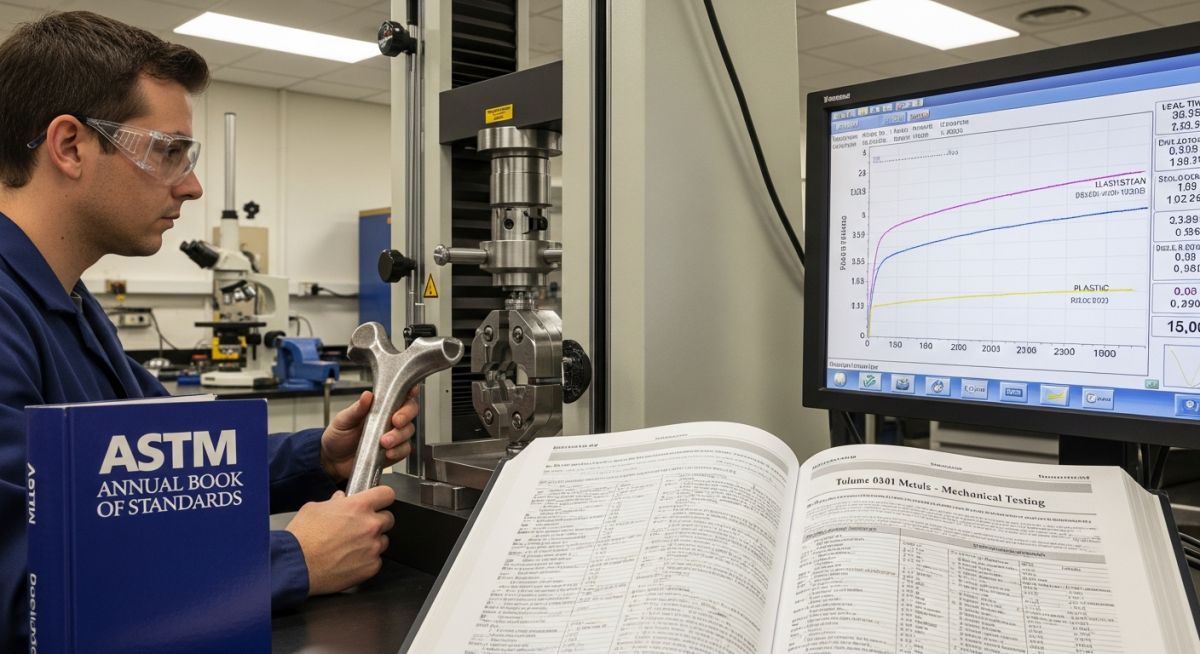
Verified Engineering Content Updated: January 2026 What is ASTM? Comprehensive Guide to ASTM Standards 2026 You are looking at a batch of steel pipes for a high-pressure manifold, and the mill certificate lists ASTM A106. Your client, however, insists on ASME SA106. Are they the same? Or is your procurement about to cost the company millions in rejected materials? In the world of industrial engineering, ASTM Standards are the fundamental DNA of material integrity, yet the nuance between a specification and a code can be the difference between a successful commissioning and a catastrophic failure. Key Takeaways ASTM Standards provide the globally recognized consensus for material properties and testing methods across 12,000+ active specifications. The 2026 engineering landscape requires a deep understanding of the "ASTM vs ASME" relationship for cross-border regulatory compliance. Strategic membership in ASTM International allows engineers to influence the technical committees that define the next decade of material safety. Definition: ASTM Standards ASTM Standards are voluntary consensus documents developed by ASTM International that define technical requirements for materials, products, systems, and services. These standards ensure quality, safety, and market access by providing uniform testing protocols and material specifications used by over 140 countries globally in 2026. "In my 20 years of EPC project management, I have seen that ASTM is the language of the manufacturer, while ASME is the language of the regulator. You cannot build a safe pressure vessel without understanding how ASTM Standards feed into the legal mandates of the ASME Code." — Atul Singla, Founder of Epcland Table of Contents Role of ASTM Standards The Development Process ASTM International Services Global Implementation Annual Book of Steel Membership Benefits Why Standards Matter ASTM Certification ASTM vs ASME Analysis Compliance Summary ASTM Proficiency Assessment Question 1 of 5 1. What is the primary difference between ASTM and ASME in the context of material specifications? A) ASME writes the material specs, ASTM tests them. B) ASTM defines material properties; ASME adopts them for specific code applications. C) ASTM is only for the US, while ASME is international. 2. In the ASTM Annual Book of Standards, which section typically covers "Steel Piping, Tubing, and Fittings"? A) Section 1 B) Section 3 C) Section 4 3. What does it mean when an ASTM standard is developed by "Consensus"? A) The government mandates the technical requirements. B) All stakeholders (producers, users, and consumers) have a balanced vote. C) Only the manufacturers of the material decide the limits. 4. If a material is marked as "ASME SA-106," what does the "S" prefix indicate? A) It is an ASTM material adopted by the ASME Code. B) It is specifically designed for Steam applications. C) It stands for Stainless Steel grade. 5. How often are ASTM standards typically reviewed or updated? A) Every 10 years. B) At least every 5 to 8 years. C) Only when a failure is reported. Next Question → Understanding the Role of ASTM Standards in Modern Engineering In the complex industrial landscape of 2026, ASTM Standards serve as the global benchmark for technical excellence. Formerly known as the American Society for Testing and Materials, ASTM International has evolved into one of the world's largest voluntary standards-developing organizations. These standards are not merely suggestions; they are rigorous technical documents that specify the exact chemical composition, mechanical properties, and testing methodologies required for materials ranging from structural steel to advanced polymers. The primary role of these standards is to provide a "common technical language" for trade. When an engineer in Dubai specifies an ASTM A36 steel plate, a manufacturer in South Korea knows exactly what the yield strength and carbon content must be. This universality reduces cross-border friction, enhances safety, and ensures that materials are fit for their intended purpose, regardless of the site of manufacture. The Rigorous Development of ASTM Standards The development of ASTM Standards is a masterclass in the Consensus-Based Approach. Unlike top-down regulations, ASTM standards are built from the ground up by technical committees. These committees are comprised of more than 30,000 top technical experts from 140 countries. What makes this process unique is its strict adherence to "balance." ASTM regulations mandate that no single interest group—be it producers, users, or general interest parties—can dominate a committee. Every single word in a new standard or revision must pass through a multi-stage balloting process. If a single member casts a "negative vote" based on a technical reason, the committee must address that objection before the standard can proceed. This ensures that the final ASTM Standards reflect a true global consensus, incorporating the latest metallurgical research and field data from 2026 engineering practices. Core Services Provided by ASTM International While the publication of ASTM Standards is the organization's flagship activity, ASTM International provides a suite of critical services that support the engineering lifecycle: Proficiency Testing Programs (PTP): These programs allow laboratories to compare their testing results against a global peer group, ensuring that their equipment and personnel are accurately performing ASTM-specified tests. Training and E-Learning: In 2026, digital fluency is mandatory. ASTM provides specialized training for technical committees and industrial professionals on the application of complex standards. Certification and Declaration: ASTM offers "Certificate of Attendance" and "Personnel Certification" programs that validate an individual's expertise in specific testing protocols, which is vital for Quality Control (QC) managers. Interlaboratory Study (ILS) Program: This service helps committees develop the "precision and bias" statements required for every test method, providing the statistical backbone for material reliability. Global Implementation and Use of ASTM Standards The implementation of ASTM Standards transcends borders. Over 140 countries have adopted or referenced these standards in their national regulations. In many developing economies, ASTM documents are used as the primary building blocks for national safety codes. For a project manager, using ASTM-compliant materials is a strategic move to ensure project bankability; international insurers and lenders often mandate compliance with ASTM Standards to mitigate technical risks associated with structural or mechanical failure. Navigating the ASTM Annual Book of Standards for Steel For the engineering professional in 2026, the ASTM Annual Book of Standards is the ultimate repository of material intelligence. Containing over 80 volumes, the "Section 1" series is particularly critical for the EPC (Engineering, Procurement, and Construction) sector as it focuses exclusively on Steel products. This section is subdivided into specific volumes that categorize steel by its application and form, such as pipes, tubes, plates, and structural shapes. Crucially, these volumes are updated annually to reflect advancements in metallurgical science and manufacturing precision. Engineers must ensure they are referencing the correct version—often denoted by the year suffix (e.g., ASTM A106/A106M-26). Working with outdated volumes can lead to non-compliance with modern safety factors, as newer editions often include tighter tolerances for trace elements and improved testing protocols for hydrogen-induced cracking or high-temperature creep. Strategic Benefits of ASTM Membership for Engineers Joining ASTM International is more than a professional credential; it is a seat at the table where the future of engineering is written. In 2026, membership provides direct access to the Compass platform, a digital portal offering real-time updates on standard revisions. More importantly, members participate in Technical Committees (such as Committee A01 on Steel, Stainless Steel, and Related Alloys), allowing them to vote on changes that directly impact their industry’s cost structure and safety requirements. Why do ASTM Standards Matter in Risk Mitigation? The application of ASTM Standards is a primary defense against litigation and catastrophic failure. By adhering to standardized testing like ASTM E23 (Notch Bar Impact Testing of Metallic Materials), engineers can mathematically predict how a material will behave under extreme stress. In the event of a structural failure, demonstrating adherence to these consensus-based standards provides a "Standard of Care" defense, proving that the design and material selection followed the most rigorous globally recognized protocols available in 2026. Critical Analysis: ASTM vs ASME Comparison Perhaps the most frequent point of confusion in the field is the distinction between ASTM vs ASME. While they are closely linked, they serve distinct regulatory functions. ASTM International focuses on the Material Specification (the "what"), whereas the American Society of Mechanical Engineers (ASME) focuses on the Design Code (the "how"). Feature ASTM Standards ASME Codes Primary Focus Material properties and testing methods. Design, fabrication, and inspection of systems. Adoption Voluntary, unless cited in a contract. Often legally mandatory by state/provincial law. Nomenclature Identified by "A" (Ferrous) or "B" (Non-ferrous). Adds "S" prefix (e.g., SA-106) upon adoption. Example Usage Testing the tensile strength of a bolt. Calculating the wall thickness of a boiler. Requirements for Obtaining ASTM Certification It is vital to note that ASTM International does not "certify" products in the same way a local municipality might. Instead, they provide Certification Programs for personnel and laboratories to verify that they are correctly applying ASTM Standards. Laboratory certification typically requires a rigorous audit of the facility's Quality Management System (QMS), calibration records, and the technical competency of staff as demonstrated through Proficiency Testing Programs (PTP). Referenced Engineering Standards (2026 Compliance) ASME BPVC Section II: Materials (Part A-Ferrous, Part B-Nonferrous). ASTM A106/A106M: Standard Specification for Seamless Carbon Steel Pipe for High-Temperature Service. ISO 9001:2015: Quality management systems requirements (often coupled with ASTM audits). ASTM E8/E8M: Standard Test Methods for Tension Testing of Metallic Materials. ASTM A106/A53 Grade B Carbon Steel Calculator Calculate Minimum Wall Thickness & Tensile Requirements (2026 Reference Data) Nominal Pipe Size (NPS - Inches) Design Pressure (PSI) Allowable Stress (PSI - per ASTM A106 Gr B) *Typical allowable stress at 650°F. Calculate Wall Thickness Calculation Results Calculated Thickness (t): 0.000 in Mill Tolerance (12.5%): 0.000 in Recommended Sch. Min: 0.000 in Engineering Note: This calculation uses the simplified Barlow's formula consistent with ASTM Standards for pressure pipe verification. Always verify against specific 2026 ASME B31.3 or B31.1 code requirements. Don't miss this video related to ASTM Standards Summary: Master Piping Engineering with our complete 125+ hour Certification Course: ...... ✅ 2500+ VIDEOS View Playlists → JOIN EXCLUSIVE EDUCATION SUBSCRIBE ASTM Standards Failure Case Study The Scenario: Brittle Fracture in Low-Temperature Service In early 2026, a midstream gas processing facility experienced a catastrophic rupture of a pressure-retaining flange during a cold-start operation. The ambient temperature had dropped to -20°F. Although the procurement specification called for ASTM A105, the material was sourced from a non-vetted supplier whose Mill Test Report (MTR) lacked secondary ASTM A350 impact testing data. The Root Cause: Missing Supplementary Requirements Forensic metallurgical analysis revealed that while the flange met the basic chemical requirements of the ASTM Standards, it failed to meet the "Supplementary Requirements" (S-codes) for notch toughness. In sub-zero conditions, the carbon steel transitioned from ductile to brittle behavior. Because the engineers did not specify ASTM A370 Charpy V-Notch testing as a mandatory quality gate, the material possessed a high Nil-Ductility Transition (NDT) temperature, leading to an instantaneous crack propagation across the flange face. Lessons Learned for 2026 Projects Always Specify Testing Methods: Simply citing "ASTM A105" is insufficient for critical temperature services; you must explicitly reference the testing standard (e.g., ASTM E23). Verify MTR Authenticity: Digital verification of Mill Test Reports against ASTM Standards database is now a 2026 industry best practice to prevent counterfeit material entry. ASTM vs ASME Coordination: Ensure that the design code (ASME B31.3) requirements for impact testing are mapped directly to the appropriate ASTM Standards for material procurement. Expert Insights: Lessons from 20 years in the field Look for the "M" Suffix: In 2026, global projects often flip-flop between Imperial and Metric. Remember that ASTM Standards like A106 and A106M are technically equivalent but use different units of measure. Always verify which version your stress calculations are based on. Supplementary Requirements are Not Optional: For high-cycle fatigue or sour service (H2S), the base ASTM Standards are rarely enough. You must invoke "S" requirements (like S5 for Ultrasonic Examination) at the time of purchase. The Revision Date Matters: A common audit finding is using a 2020 version of a standard when the 2026 contract mandates the "latest edition." Always check the year suffix on your ASTM Standards. Frequently Asked Questions What does ASTM stand for in 2026? ▼ ASTM originally stood for the "American Society for Testing and Materials." However, as it expanded its global reach, it changed its name to ASTM International to reflect its role as a worldwide leader in voluntary consensus standards. Are ASTM Standards legally mandatory? ▼ By themselves, ASTM Standards are voluntary. However, they become legally mandatory when they are referenced in government regulations, building codes, or private commercial contracts. How can I verify if a material meets ASTM Standards? ▼ You must review the Mill Test Report (MTR) provided by the manufacturer. The MTR should list the specific ASTM designation and confirm that the chemical and mechanical test results fall within the limits defined by that standard. Why did my client reject ASTM A106 pipe for an ASME vessel? ▼ In many jurisdictions, the ASME Boiler and Pressure Vessel Code requires materials to be certified as "SA" (e.g., SA106). While identical in content, the SA designation confirms the material is approved for use under the specific safety rules of the ASME Code. Can I use an older version of an ASTM Standard? ▼ Only if your specific project code (like an older ASME edition) specifically references that version. For most 2026 engineering applications, the latest edition is required to ensure modern safety and material reliability. Who decides the technical limits in ASTM Standards? ▼ The limits are decided by technical committees consisting of a balanced group of producers, users, and general interest members (academics/regulators) through a democratic voting process. References & Standards Official ASTM International Website ASME Boiler and Pressure Vessel Code (BPVC) ISO Standards Organization 📚 Recommended Resources: ASTM Standards Read these Guides 📄 A Comprehensive Guide to Pipe Schedule Charts: Understanding ANSI, ASME, and ASTM Standards 📄 Material of Construction (MOC) of Valves: Clauses from ASTM Standards 📄 What is ASTM A53 Pipe? Standards, Composition, and Applications (2026) 📄 How to Select Piping Materials Based on ASTM and API Standards | EPCLAND 🎓 Advanced Training 🏆 ASTM A53 – Complete Guide to Carbon Steel Pipe Standards 🏆 ASTM A335 – Complete Guide to Alloy Steel Pipe Standards 🎥 Watch Tutorials ASTM A193 vs. ASTM A320: Decoding Alloy Steel Bolting Materials | Which is Best for Your Application ASTM A234 vs. ASTM A105: Understanding the Key Differences | Alloy Fittings vs. Forged Carbon Steel 7 Modules of Pipe Materials II Various alloying Elements II ASTM standards II Steel Types