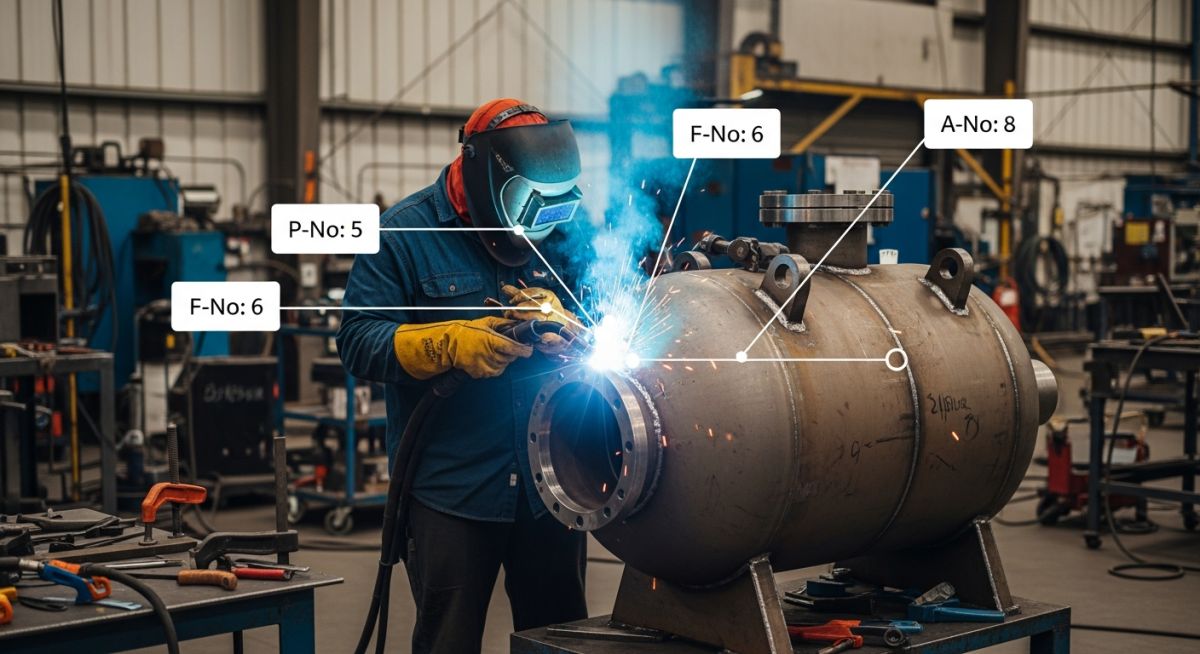
Verified Engineering Content Published: 2026 P-Number, F-Number, and A-Number in Welding: The Definitive ASME IX Guide Imagine you are managing a high-pressure piping project and the supplier suddenly swaps out SA-106 Grade B for SA-333 Grade 6. Do you need to stop production and re-qualify every single Welding Procedure Specification (WPS)? Understanding P-Number, F-Number, and A-Number in Welding is the difference between a minor paperwork update and a 10,000 USD project delay. This guide decodes how the ASME Section IX system allows engineers to group materials logically, ensuring safety without redundant testing. Key Takeaways P-Numbers group base metals by weldability and chemical traits to reduce the number of required PQRs. F-Numbers categorize filler metals based on their usability characteristics and the skill required by the welder. A-Numbers define the chemical composition of the deposited weld metal, critical for corrosion and strength integrity. What are P, F, and A Numbers? In ASME Section IX, P-Number, F-Number, and A-Number in Welding are alphanumeric designations used to group base metals, filler metals, and weld deposits. These groupings are essential variables that allow a single welding qualification (PQR) to support multiple material combinations, significantly reducing the cost and time of procedure qualification. "While most engineers focus only on P-Numbers, the real risk often lies in the A-Number. A slight change in filler metal chemistry can shift your deposit out of its qualified A-Number range, potentially invalidating your entire WPS during a third-party audit." - Atul Singla, Founder of EPCLand Table of Contents Understanding the P-Number, F-Number, and A-Number in Welding Framework What is the P-Number in Welding? (Base Metal Classification) What is the F-Number in Welding? (Filler Metal Usability) What is the A-Number in Welding? (Deposit Chemical Analysis) Essential Variables: Managing P-Number, F-Number, and A-Number in a WPS Advanced Engineering Comparison: P-Number, F-Number, and A-Number in Welding Expert Summary of P-Number, F-Number, and A-Number in Welding Engineering Knowledge Check: P, F, & A Numbers Question 1 of 5 Which ASME Section IX variable groups base metals to reduce the number of welding procedure qualifications? A) P-Number B) F-Number C) A-Number F-Numbers are primarily assigned based on which of the following? A) Base metal tensile strength B) Filler metal usability characteristics C) Chemical analysis of the weld deposit The A-Number in a Welding Procedure Specification (WPS) represents: A) Deposited weld metal chemical composition B) Preheat temperature requirements C) Electrode flux coating thickness If a welder is qualified using an F-4 electrode, are they typically qualified to weld with F-1, F-2, and F-3 electrodes? A) Yes, subject to specific code restrictions B) No, they must re-test for every number Where is the master list of P-Numbers found in the ASME Boiler and Pressure Vessel Code? A) ASME Section II B) ASME Section IX, Table QW-422 C) ASME Section VIII Next Question Understanding the P-Number, F-Number, and A-Number in Welding Framework The logic behind P-Number, F-Number, and A-Number in Welding is rooted in engineering economy and safety. In the absence of these groupings, an organization would be forced to qualify a new Welding Procedure Specification (WPS) for every single combination of base metal and filler metal brands. ASME Section IX solves this by categorizing materials with similar metallurgical characteristics. By understanding these variables, engineers can ensure that the essential properties—such as ductility, weldability, and corrosion resistance—remain consistent across a range of qualified materials. This framework is legally mandated for pressure vessel and piping fabrication under the ASME Boiler and Pressure Vessel Code (BPVC) Section IX. What is the P-Number in Welding? (Base Metal Classification) The P-Number in Welding is an alphanumeric designation assigned to base metals to reduce the number of welding procedure qualifications required. Materials are grouped based on their weldability, chemical composition, and mechanical properties. For example, carbon steels are typically assigned P-Number 1, while high-alloy stainless steels might fall under P-Number 8. When a procedure is qualified for a specific P-Number, it often covers all other materials within that same group, provided other essential variables remain unchanged. It is critical to note that while P-Numbers group materials for procedure qualification, they do not imply that base metals are interchangeable from a design or structural standpoint. Engineers must still consult Table QW-422 in ASME Section IX to identify the specific P-Number and Group Number (used for impact testing requirements) for their specific alloy. What is the F-Number in Welding? (Filler Metal Usability) The F-Number in Welding is used to group filler metals based on their usability characteristics. This grouping primarily reflects the level of skill required by a welder to produce a sound weld with a specific electrode or rod. For instance, F-Number 4 refers to low-hydrogen electrodes like E7018, which require more sophisticated handling than F-Number 1 heavy-coated electrodes. The primary goal of the F-Number system is to reduce the number of welder performance qualifications. In many instances, if a welder demonstrates proficiency with a difficult F-Number electrode, they are automatically qualified to weld with "easier" filler metals within a specific hierarchy defined in Table QW-432. This allows for massive flexibility in workforce management during large-scale industrial projects. What is the A-Number in Welding? (Deposit Chemical Analysis) The A-Number in Welding is a critical variable that focuses exclusively on the chemical composition of the deposited weld metal. Unlike the F-Number, which looks at how the electrode handles, the A-Number ensures that the final "as-welded" deposit matches the intended metallurgical properties of the joint. This is particularly vital in service environments involving high temperatures or corrosive media. For instance, A-Number 1 signifies a plain carbon steel deposit, while A-Number 8 indicates an austenitic stainless steel deposit. Engineers determine the A-Number by reviewing the filler metal manufacturer's certificate or by performing a chemical analysis of the test coupon as per ASME Section IX Table QW-442. If the chromium or molybdenum content shifts outside the specified range, the A-Number changes, necessitating a new procedure qualification to ensure the integrity of the P-Number, F-Number, and A-Number in Welding documentation. Essential Variables: Managing P-Number, F-Number, and A-Number in a WPS In the world of ASME Section IX, these three variables are classified as "Essential Variables." This means that any change in the P-Number, F-Number, and A-Number in Welding beyond the range qualified in the Procedure Qualification Record (PQR) requires a completely new qualification test. For example, you cannot use a WPS qualified for P-Number 1 (Carbon Steel) to weld P-Number 8 (Stainless Steel) without a new PQR, even if the welding process remains the same. Detailed groupings and specific material assignments can be cross-referenced via the ISO 15614 standards for those working on international or hybrid projects. Advanced Engineering Comparison: P-Number, F-Number, and A-Number in Welding Classification Focus Area Governing ASME Table Primary Purpose P-Number Base Metal QW-422 Group materials with similar weldability. F-Number Filler Metal QW-432 Group electrodes by usability and welder skill. A-Number Weld Deposit QW-442 Verify chemical composition of the final weld. Expert Summary of P-Number, F-Number, and A-Number in Welding Mastering the P-Number, F-Number, and A-Number in Welding is the cornerstone of effective welding engineering. These variables provide the structural logic that allows ASME codes to be both safe and commercially viable. By correctly leveraging these groupings, you minimize unnecessary testing while maximizing the technical reach of your existing qualifications. Always ensure your WPS and PQR accurately reflect these values to remain compliant with 2026 industry standards. 🧮 Welding Variable Quick-Check Tool (ASME IX) Select your material and filler attributes to identify the standard P-Number, F-Number, and A-Number in Welding groupings. Base Metal Type SA-106 / SA-516 (Carbon) SA-312 / SA-240 (304/316) SA-335 P11 / P12 SA-335 P22 Electrode Type E7018 / E8018 E6010 / E6011 ER70S-6 / ER308L Inconel Filler Deposit Chemistry Plain Carbon Cr-Ni Stainless Carbon-Moly 1.25Cr-0.5Mo Verify Qualification Grouping Qualification Summary: Base Metal: Filler Usability: Deposit Analysis: Note: Always cross-reference with ASME Section IX Table QW-422, QW-432, and QW-442 for specific project compliance. Engineering Case Study: Optimizing Qualification Costs The Challenge A piping contractor was tasked with welding SA-106 Grade B (Carbon Steel) and SA-333 Grade 6 (Low-Temperature Carbon Steel). Initially, the project manager planned two separate sets of P-Number, F-Number, and A-Number in Welding qualifications, assuming the different material grades required unique Procedure Qualification Records (PQRs). The Solution By auditing ASME Section IX Table QW-422, the engineering team identified that both materials are classified as P-Number 1. Furthermore, by selecting an E7018 electrode (F-Number 4), they ensured the A-Number 1 deposit chemistry met the requirements for both base metals. Key Results & Savings: ✔ Cost Reduction: Saved approximately 4,500 USD by eliminating redundant laboratory testing. ✔ Timeline Optimization: Shaved 10 days off the mobilization phase by using existing P-Number 1 qualifications. ✔ Compliance: Successfully passed a third-party audit confirming the A-Number analysis on the PQR covered the entire range. Don't miss this video related to P-Number F-Number and A-Number in Welding Summary: Master Piping Engineering with our complete 125+ hour Certification Course: ...... ✅ 2500+ VIDEOS View Playlists → JOIN EXCLUSIVE EDUCATION SUBSCRIBE Expert Insights: Lessons from 20 years in the field Watch the Group Numbers: While P-Number, F-Number, and A-Number in Welding are the primary variables, remember that P-Numbers are further divided into Group Numbers. If your project requires impact testing (Charpy V-Notch), a change in Group Number becomes an essential variable even if the P-Number remains the same. The A-Number Trap: Many junior engineers assume the A-Number is based on the filler metal trade name. It is actually based on the deposited weld metal analysis. Always verify the "as-welded" chemical composition against Table QW-442, especially when using shielding gases that might cause alloy burnout. F-Number Hierarchy: Leverage the flexibility of welder qualification. A welder qualified with an F-Number 4 (E7018) is typically qualified to weld with F-Numbers 1, 2, and 3 without additional testing, providing a significant advantage in resource allocation. Unlisted Materials: If a base metal does not have an assigned P-Number in Table QW-422, it is considered an "unassigned metal." You must qualify it specifically; it cannot be covered by a WPS using a standard P-Number qualification. References & Standards 📄 ASME BPVC Section IX (2025/2026 Edition) 📄 AWS B2.1 Welding Procedure Specification 📄 ISO 15614-1: Specification & Qualification 📄 API 1104: Welding of Pipelines Frequently Asked Questions What is the difference between P-Number and Group Number? While the P-Number in Welding groups metals by general weldability for procedure qualification, the Group Number is a sub-classification used specifically when toughness (impact testing) is a requirement. If impact testing is mandatory, a change in Group Number within a P-Number becomes an essential variable. Can one WPS cover multiple F-Numbers? Yes, but only if the PQR supports it. Under ASME Section IX, a change in F-Number is an essential variable. Therefore, if you wish to use both F-6 and F-4 filler metals on a single WPS, your PQR must have been tested using those specific groupings or multiple PQRs must be referenced. How is the A-Number determined for a WPS? The A-Number in Welding is determined by the chemical analysis of the deposited weld metal. This can be taken from the filler metal manufacturer’s data sheet (MTR) or, more reliably, from a chemical analysis performed on the actual PQR test coupon as per Table QW-442. Does a welder need to re-test if the P-Number changes? Not always. For welder performance qualification (WPQ), ASME Section IX Table QW-423 allows a welder qualified on one P-Number to be qualified for a wide range of other P-Numbers. This is different from a WPS qualification, which is much more restrictive. What happens if my material has no P-Number assigned? Materials not listed in Table QW-422 are considered "Unassigned." These materials require individual qualification. You cannot assume an unassigned material belongs to a P-Number based on similarity; you must perform a specific PQR for that exact specification and grade. Why did ASME Section IX create the F-Number system? The F-Number in Welding system was created to minimize the number of welder qualifications. It acknowledges that if a welder can handle a difficult, low-hydrogen electrode (F-4), they possess the technical skill to weld with simpler cellulosic or rutile electrodes (F-1 through F-3). 📚 Recommended Resources: P-Number F-Number and A-Number in Welding Read these Guides 📄 Pipe Couplings, Types & Applications: Piping Quiz 📄 Intergranular Corrosion: IGC: Piping Quiz 📄 12 Major Difference b/w ASME B31.1 & ASME B31.3: Piping Quiz 🎥 Watch Tutorials P Number II F Number II A Number II Welding II Piping II EPCLand.com Dye Penetration Test (DPT)II Principles II Advantages IIDisadvantages #Liquidpenetrant #dyepenetrant