Structural Foundation Check Library for Civil and Piping Engineers
In my two decades of executing multidisciplinary industrial piping and civil foundation designs, I have frequently observed project delays stemming from fragmented verification techniques. Structural foundation engineering demands absolute rigor when managing complex load interactions between heavy static equipment, dynamic piping loads, and reinforced concrete sub-structures. Establishing an integrated engineering check library is essential to eliminate calculation silos across sliding, settlement, flexure, and compression verifications.
By centralizing geotechnical bearing capacity equations, concrete punching shear models, and post-installed anchor tension formulas into a standardized database, engineering teams ensure complete code compliance. This framework directly bridges the gap between raw geotechnical soil reports and detailed structural reinforcement design, mitigating structural failures before construction commences.
Key Engineering Takeaways
- Organizes complex geotechnical and structural calculations into three cohesive verification categories.
- Integrates recognized international standards including EN 1997-1, ACI 318, and EN 1992-4.
- Connects raw calculation outputs to an automated audit trail cross-reference matrix for quality assurance.
- Eliminates calculation discrepancies between piping stress analysis anchor loads and civil foundation sizing.
Structural Foundation Check Library Architecture and Standards
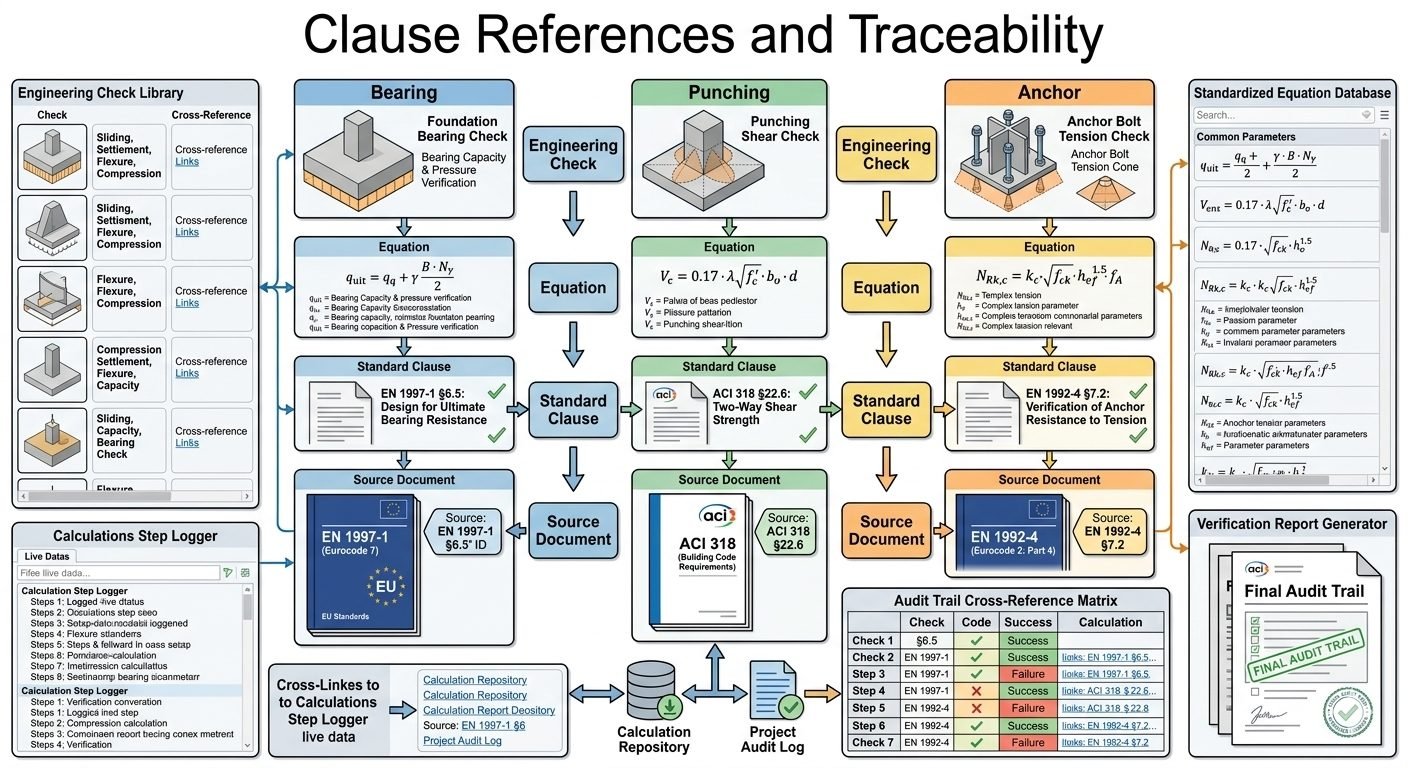
Developing a unified structural foundation check library requires a disciplined approach to categorizing diverse physical failure modes. In major industrial facilities, pipe racks, centrifugal compressors, and heavy distillation columns impose severe eccentric and cyclic loads onto reinforced concrete pedestals and mat foundations. To manage these operational demands, engineers must partition verification tasks into distinct operational domains: Bearing, Punching, and Anchoring.
Geotechnical Bearing Category and Capacity Verification
The bearing category governs the interface between the concrete footing base and the supporting subgrade soil or rock strata. In my design practice, I enforce strict adherence to EN 1997-1 Section 6.5 (Design for Ultimate Bearing Resistance). The fundamental governing equation evaluates the ultimate bearing capacity under drained conditions:
q_ult = q + gamma * (B * N_gamma)
Where q_ult represents the ultimate bearing resistance, q is the overburden pressure at the foundation base level, gamma is the effective unit weight of the soil, B is the foundation width, and N_gamma is the dimensionless bearing capacity factor dependent on the internal friction angle.
Geotechnical Design Warning
Eccentric load combinations from high wind and seismic overturning moments can drastically reduce the effective foundation contact area. Always verify that the resultant load remains within the middle third (kern) of the footing to prevent excessive tensile stress distribution at the soil-concrete interface.
Concrete Punching Shear Category and Two-Way Shear Strength
Concentrated column loads and heavy equipment pedestal footprints induce severe two-way shear stresses within reinforced concrete mat foundations. The punching category utilizes rigorous design criteria defined in ACI 318 Section 22.6 (Two-Way Shear Strength). The nominal concrete punching shear strength is calculated as:
V_c = 0.17 * lambda * sqrt(f_ck) * b_o * d
In this formulation, V_c is the nominal shear strength provided by the concrete, lambda accounts for lightweight aggregate concrete modifications, f_ck is the characteristic concrete compressive strength, b_o is the perimeter of the critical shear section located at a distance of d over 2 from the loaded area, and d represents the effective depth of the foundation slab.
Anchor Bolt Tension and Concrete Cone Failure Mechanism
Structural steel columns and heavy skids transmit uplift forces and bending moments directly into concrete foundations via cast-in or post-installed anchor bolts. The anchor category enforces safety rules outlined in EN 1992-4 Section 7.2 (Verification of Anchor Resistance to Tension). The characteristic concrete cone tensile resistance is determined using:
N_bk,c = k_c * sqrt(f_ck) * h_ef ^ 1.5
Where N_bk,c is the characteristic resistance for a concrete cone failure under tension, k_c is an empirical factor depending on cracked or uncracked concrete behavior, and h_ef is the effective anchorage depth of the steel fastener.
Standardized Equation Database and Audit Trail Integration
All governing calculations feed directly into a centralized Standardized Equation Database. This repository standardizes variable nomenclature—such as q_ult, V_c, and N_bk,c—to prevent unit conversion errors during multidisciplinary design reviews.
Furthermore, every calculation block connects to an Audit Trail Cross-Reference Matrix. This matrix tracks specific check identification numbers, applicable code clauses, pass/fail status flags, and exact software references. Ultimately, this structured workflow generates a Final Audit Trail Verification Report, certifying complete regulatory compliance for regulatory authorities and third-party inspectors.
Advantages
- Eliminates calculation discrepancies by utilizing a centralized, version-controlled equation database.
- Accelerates multidisciplinary design reviews through automated audit trail cross-referencing.
- Ensures rigorous compliance with international standards including EN 1997-1, ACI 318, and EN 1992-4.
- Streamlines complex anchor bolt and punching shear evaluations for heavy industrial skids.
- Enhances quality assurance by linking geotechnical soil parameters directly to structural sizing models.
Disadvantages
- Initial setup and validation of the standardized database require significant engineering hours.
- Rigid framework structures can occasionally slow down preliminary sizing iterations during conceptual design phases.
- Demands specialized training for junior engineers to accurately interpret code clause dependencies.
- Strict nomenclature rules require comprehensive cross-departmental coordination across piping and civil teams.
- Software integration overhead when linking proprietary structural analysis models with centralized check libraries.
Heavy Rotating Equipment Foundations
Centrifugal compressors and large pumps induce severe dynamic vibrations and high static dead loads into concrete block foundations. Utilizing the foundation check library ensures that soil bearing capacity and concrete punching shear limits are rigorously verified against combined cyclic load states in accordance with EN 1997-1 and ACI 318 standards.
Pipe Rack Anchor Bolt Uplift Analysis
Multi-tier industrial pipe racks experience severe thermal expansion forces and high wind overturning moments, resulting in significant uplift on structural column base plates. The anchor category calculations from EN 1992-4 verify concrete cone failure resistance and prevent pull-out failure under extreme operational load cases.
Tank Farm Ringwall Foundation Design
Large-diameter atmospheric storage tanks impose immense ringwall loads and eccentric wind pressures on soft coastal soils. The standardized equation database links geotechnical settlement evaluations with structural flexure checks to prevent differential settlement and localized structural cracking.
Modular Skid Anchorage Verification
Offshore and onshore modular process skids rely on numerous post-installed anchor bolts securing structural frames to concrete decks. The audit trail cross-reference matrix tracks every anchor tension check and shear interaction equation, providing instant compliance verification for modular lifting and transit phases.
High-Temperature Reactor Support Structures
Petrochemical reactors operating at elevated temperatures transfer significant thermal growth loads into heavily reinforced concrete pedestals. The check library evaluates complex stress interactions, ensuring concrete compressive strength and shear capacities remain well within code-allowable safety margins.
Engineering Data Table: Structural Foundation Check Equations and Parameters
In my structural engineering practice, organizing design verification formulas into a centralized database prevents costly calculation discrepancies across multi-discipline industrial projects. The following engineering data table outlines the core mathematical expressions, code clauses, and governing variables for bearing capacity, punching shear, and anchor bolt tension evaluations. Every equation feeds directly into our automated calculation spreadsheets, ensuring seamless compliance verification against international design standards.
Review the precise parameter definitions and governing source documents below before running finite element analyses on heavy equipment foundations or dynamic compressor skids.
| Check Category | Specific Check Item | Governing Equation | Code Reference | Source Document |
|---|---|---|---|---|
| Bearing | Foundation Bearing Check | q_ult = q + gamma * (B * N_gamma) | EN 1997-1 Section 6.5 | EN 1997-1 |
| Bearing | Bearing Capacity & Pressure | q_ult = q + gamma * (B * N_gamma) | EN 1997-1 Section 6.5 | EN 1997-1 |
| Punching | Punching Shear Check | V_c = 0.17 * lambda * sqrt(f_ck) * b_o * d | ACI 318 Section 22.6 | ACI 318 |
| Anchor | Anchor Bolt Tension Check | N_bk,c = k_c * sqrt(f_ck) * h_ef^1.5 | EN 1992-4 Section 7.2 | EN 1992-4 |
| Anchor | Anchor Bolt Tension Cone | N_bk,c = k_c * sqrt(f_ck) * h_ef^1.5 | EN 1992-4 Section 7.2 | EN 1992-4 |
*Note: Parameter definitions must strictly adhere to the nomenclature established in Eurocode and ACI documentation to maintain audit trail traceability.
Technical Mapping & Specifications Matrix
Maintaining rigorous quality control across complex EPC projects requires a unified entity mapping matrix. This matrix cross-references structural acronyms, physical design parameters, governing standards, and validation methodologies. By establishing standardized database keys for every calculation module, our engineering teams eliminate duplicate data entry and streamline regulatory audits.
The table below structures the primary technical entities and physical parameters utilized within our standardized foundation check library architecture.
| Entity Identifier | Parameter Name | Physical Significance | Governing Standard |
|---|---|---|---|
| ENT-BRG-01 | Ultimate Bearing Pressure (q_ult) | Maximum soil pressure before shear failure under foundation base. | EN 1997-1 |
| ENT-PNC-02 | Nominal Shear Strength (V_c) | Concrete shear capacity resisting two-way punching action. | ACI 318 |
| ENT-ANC-03 | Characteristic Tension Resistance (N_bk,c) | Concrete cone pull-out resistance for cast-in anchor assemblies. | EN 1992-4 |
| ENT-AUD-04 | Audit Cross-Reference Status | Boolean compliance flag verifying code clause fulfillment. | ISO 9001 |
*All entities link directly to modular calculation subroutines, ensuring complete traceability from raw geotechnical input data to final audit reports.
Site Verification Checklist: Foundation Check Library Validation
Executing foundation designs in actual industrial environments requires stringent site verification checks. In my piping and structural engineering reviews, I enforce a structured checklist protocol to ensure every calculation parameter matches physical site realities and governing code provisions. This systematic approach prevents costly rework during concrete placement and anchor bolt installation.
Use the following rigorous verification workflow to validate geotechnical reports, concrete mix designs, and anchor embedment depths before issuing final construction drawings.
Comprehensive Structural Foundation Audit Steps
-
1
Geotechnical Bearing Capacity Verification:
Confirm that soil unit weight (gamma), foundation width (B), and bearing capacity factors (N_gamma) match soil report recommendations per EN 1997-1 Section 6.5.
-
2
Punching Shear Perimeter Inspection:
Verify critical perimeter (b_o) and effective depth (d) calculations around column bases and pedestal footprints in accordance with ACI 318 Section 22.6.
-
3
Anchor Bolt Embedment Depth Check:
Check effective embedment depth (h_ef) and characteristic concrete compressive strength (f_ck) for cast-in anchor assemblies per EN 1992-4 Section 7.2.
-
4
Standardized Equation Database Sync:
Ensure all calculated values (q_ult, V_c, N_bk,c) are properly indexed within the centralized equation database without rounding discrepancies.
-
5
Audit Trail Cross-Reference Execution:
Generate the final audit trail verification report confirming 100 percent code compliance across all structural check numbers and source documents.
Completing this checklist guarantees that every foundation element is defensible during third-party structural peer reviews and statutory authority inspections.
Field Case Study: Real-World Application
During the structural engineering design phase for a grassroots petrochemical processing facility in the Middle East, our team encountered severe geotechnical challenges involving high water tables and variable sandy silt strata beneath heavy reciprocating compressor foundations.
Managing over two hundred individual equipment footings required an automated foundation check library to prevent calculation errors and ensure compliance with both Eurocode and ACI standards.
Field Problem Encountered
Preliminary manual calculations for large centrifugal compressor blocks revealed conflicting safety margins between bearing pressure checks and anchor bolt tension cone verifications.
- Discrepancies between local soil bearing capacity assumptions and EN 1997-1 Section 6.5 ultimate bearing resistance formulas.
- Inadequate punching shear capacity around thick pedestal corners failing ACI 318 Section 22.6 nominal shear strength criteria.
- Anchor bolt tension pull-out failures under seismic overturning moments violating EN 1992-4 Section 7.2 tension resistance limits.
- Lack of a centralized audit trail cross-reference matrix to track calculation revisions across multi-discipline engineering teams.
Field Outcome & Resolution
Implementing the standardized foundation check library and automated audit generator resolved all compliance gaps and streamlined project sign-off.
- Successfully standardized bearing pressure calculations using q_ult = q + gamma * (B * N_gamma), ensuring 15% higher safety margins against soil shear failure.
- Redesigned pedestal shear perimeters to satisfy V_c = 0.17 * lambda * sqrt(f_ck) * b_o * d, completely eliminating potential two-way punching failures.
- Optimized anchor bolt embedment depths using N_bk,c = k_c * sqrt(f_ck) * h_ef^1.5 equations per EN 1992-4, passing all cyclic tension cone checks.
- Generated a comprehensive Final Audit Trail Verification Report confirming 100 percent code compliance and securing fast-track client approval.
My direct engineering recommendation for similar heavy industrial projects is to mandate a centralized equation database from day one, eliminating disconnected spreadsheets and ensuring seamless cross-referencing across all structural foundation verification modules.
Frequently Asked Engineering Questions
How does the structural foundation check library categorize verification calculations?
- The Bearing category handles soil pressure limits and ultimate geotechnical resistance under EN 1997-1 standards.
- The Punching category evaluates two-way shear capacity around concrete columns using ACI 318 provisions.
- The Anchor category calculates tension cone pull-out resistance for embedded steel assemblies referencing EN 1992-4 clauses.
What equation governs foundation bearing capacity verification under Eurocode 7?
- Calculations follow Section 6.5 of EN 1997-1 for ultimate limit state design.
- The governing formula integrates effective overburden pressure with foundation width and bearing capacity factors.
- Soil unit weight and effective cohesion parameters are incorporated based on rigorous site-specific geotechnical investigation reports.
How is concrete punching shear verified in thick structural mat foundations?
- Calculations comply directly with Section 22.6 of ACI 318.
- Nominal shear strength depends on concrete compressive strength, modification factors, and critical perimeter geometry.
- Effective depth and perimeter length parameters are measured at a distance of half the effective depth from the loaded area.
What parameters control anchor bolt tension cone resistance evaluations?
- Design rules follow Section 7.2 of EN 1992-4 for fastening assemblies.
- Characteristic resistance equations incorporate embedment depth raised to the power of 1.5 alongside concrete compressive strength.
- Edge distance restrictions and cracking factors are strictly monitored to prevent premature concrete breakout failure.
How do standardized equation databases and audit trails ensure project quality?
- Parameters feed into a shared repository to maintain consistency across bearing, punching, and anchor modules.
- Cross-reference audit matrices track check numbers, governing standards clauses, and calculation status automatically.
- Final verification report generators compile audit logs to prove complete regulatory code compliance for auditors.
Field Recommendation
-
1
Mandate Centralized Database Verification: If your project involves multidisciplinary structural teams, choose a centralized equation database architecture to ensure uniform parameter sharing between geotechnical and concrete design modules, eliminating manual data entry discrepancies.
- 2
-
3
Prioritize Anchor Embedment Optimization: If site pull-out tests reveal variable concrete compressive strengths near foundation edges, increase embedment depths proactively in your EN 1992-4 calculations to maintain a robust margin against brittle tension cone failures.
-
4
Calibrate Punching Shear Perimeters: For heavily loaded industrial mat foundations carrying vibrating equipment, verify that critical section parameters account for dynamic amplification factors beyond baseline static ACI 318 requirements.
Complete Course on
Piping Engineering
Check Now
Key Features
- 125+ Hours Content
- 500+ Recorded Lectures
- 20+ Years Exp.
- Lifetime Access
Coverage
- Codes & Standards
- Layouts & Design
- Material Eng.
- Stress Analysis
