What is a Spiral Wound Gasket? Applications, Types, and Specifications 2026
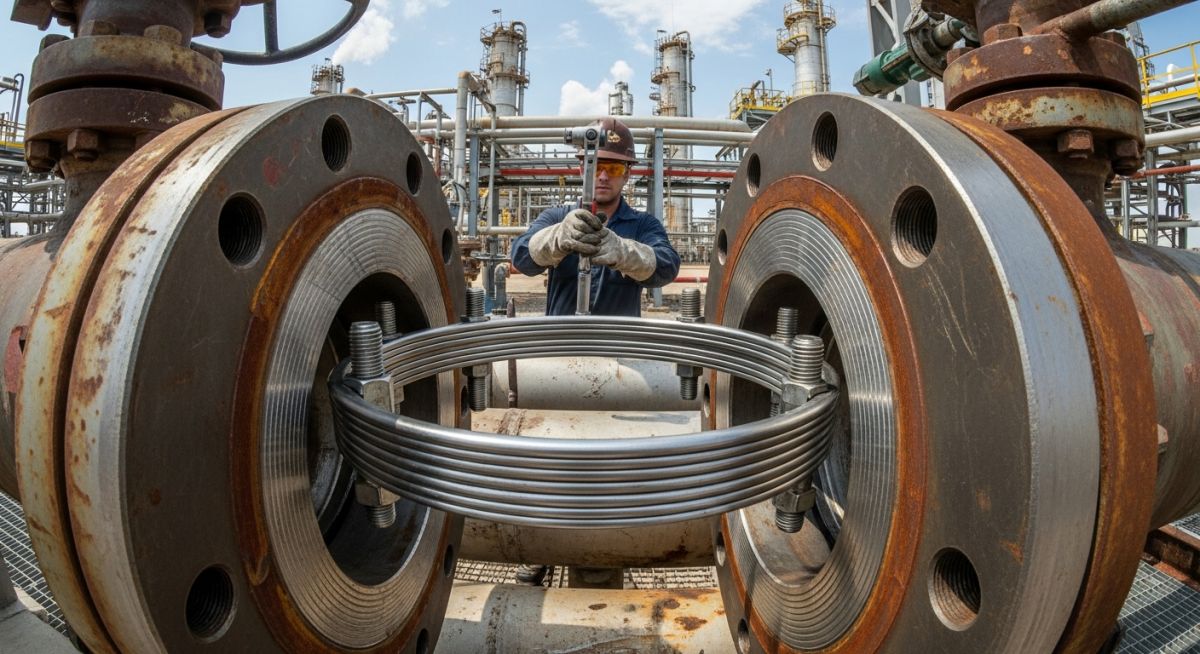
Imagine a high-pressure steam line in a refinery hitting 450°C. Suddenly, a standard flat gasket yields under the thermal cycle, leading to a catastrophic blowout that shuts down the entire unit. This is the exact pain point where the Spiral Wound Gasket becomes non-negotiable. Engineered for resilience, these semi-metallic seals “breathe” with the flange movement, ensuring your plant stays leak-free under the most punishing hydrostatic loads.
Key Engineering Takeaways
- Dynamic Sealing: Unlike solid gaskets, the spiral winding acts like a spring, compensating for flange face variations.
- Standard Compliance: Dimensions and markings are governed strictly by ASME B16.20.
- Material Versatility: Can be customized with various metals (SS316, Monel) and fillers (Graphite, PTFE) for specific chemical compatibility.
What is a Spiral Wound Gasket?
A Spiral Wound Gasket is a semi-metallic seal formed by winding an alternating V-shaped metal strip and soft non-metallic filler. This construction provides exceptional recovery properties, allowing the gasket to maintain a tight seal under fluctuating temperatures and pressures up to Class 2500 in industrial piping systems.
“In my 20 years of site inspections, the most common failure isn’t the gasket itself, but the omission of an inner ring in high-pressure vacuum services. Always specify Style CGI for anything above Class 600 to prevent winding buckling.”
— Atul Singla, Founder of EPCLand
Table of Contents
Complete Course on
Piping Engineering
Check Now
Key Features
- 125+ Hours Content
- 500+ Recorded Lectures
- 20+ Years Exp.
- Lifetime Access
Coverage
- Codes & Standards
- Layouts & Design
- Material Eng.
- Stress Analysis
Spiral Wound Gasket Engineering Check
Question 1 of 5Which ASME standard governs the dimensions and markings of a Spiral Wound Gasket?
Engineering Construction of Spiral Wound Gasket Components
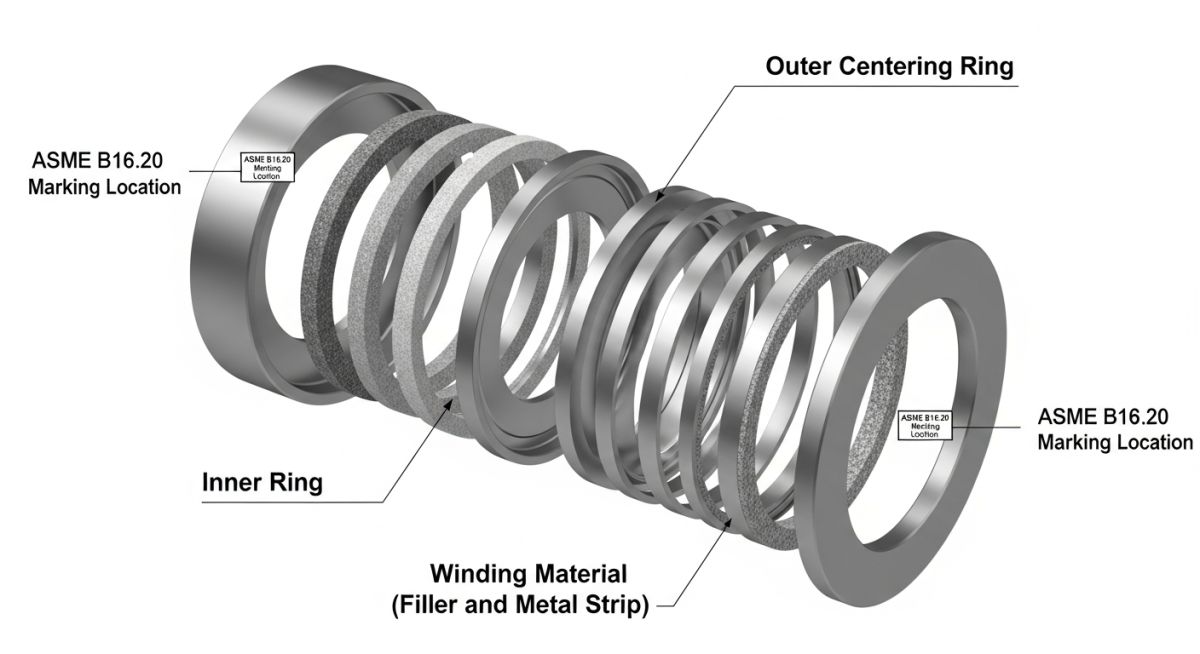
The Spiral Wound Gasket is not a single piece of material but a precision-engineered assembly designed to handle the mechanical stresses of high-pressure piping. Under the ASME B16.20 standard, the construction is divided into three distinct functional parts. Each component plays a critical role in maintaining seal integrity during thermal expansion and pressure surges.
Outer ring (Centering Ring)
The outer ring, typically made of carbon steel with a corrosion-resistant epoxy coating, serves as a centering device. It fits snugly within the bolt circle of the flange, ensuring the sealing element is perfectly aligned with the pipe bore. Beyond alignment, it acts as a compression stop, preventing the internal winding from being crushed by excessive bolt torque. In modern engineering, the outer ring is color-coded to identify the winding and filler materials at a glance.
Inner ring
Often overlooked but technically vital, the inner ring provides an additional compression stop and acts as a heat shield. Its primary engineering purpose is to prevent "buckling"—a phenomenon where the internal windings are pushed into the pipe bore due to high bolt loads or internal pressure. According to ASME B16.20, inner rings are mandatory for all PTFE-filled gaskets and for all gaskets in Class 900 and above to maintain structural stability.
Sealing element (Winding)
This is the "heart" of the Spiral Wound Gasket. It consists of a pre-formed V-shaped metallic strip (the winding) and a soft filler material (Graphite, PTFE, or Mica). The V-shape creates a spring-like effect, allowing the gasket to compress under load and "recover" or expand when the flange faces move due to thermal cycling. This dynamic sealing capability is what makes the spiral wound design superior to flat-sheet gaskets in critical service applications.
Mandatory Markings on a Spiral Wound Gasket (ASME B16.20)
For traceability and safety, every Spiral Wound Gasket must be etched with specific data on the outer ring. These markings are the "identity card" of the gasket, allowing inspectors to verify compatibility before installation. A standard marking includes:
- Manufacturer's Name or Trademark: Identification of the producer.
- Flange Size & Pressure Class: e.g., 4" 600# (Class 600).
- Winding Material: Often abbreviated (e.g., 316L for Stainless Steel).
- Filler Material: (e.g., FG for Flexible Graphite).
- Designation: ASME B16.20.
Material Selection for Spiral Wound Gasket Fillers and Metals
Selecting the right metallurgy and filler is a balance between temperature, pressure, and chemical compatibility. While 304 and 316L Stainless Steel are the industry workhorses, extreme environments require exotic alloys like Monel, Inconel, or Titanium. The filler material is equally critical; Flexible Graphite is the standard for high-temp steam, while PTFE is reserved for highly corrosive chemical environments where graphite may be attacked.
Standard Spiral Wound Gasket Color Coding Chart
To prevent catastrophic installation errors, the industry follows a strict visual identification system. The outer edge of the centering ring is painted with a specific color to identify the metal winding material, while the rim may feature stripes to identify the filler. For instance, a Spiral Wound Gasket with a Green rim and Gray stripe immediately tells a technician they are holding a 316L Stainless Steel gasket with Flexible Graphite filler, as per ASME B16.20 guidelines.
| Metal Winding Material | Color Code (Rim) | Filler Material | Strip Color |
|---|---|---|---|
| 304 Stainless Steel | Yellow | Flexible Graphite | Gray |
| 316L Stainless Steel | Green | PTFE | White |
| Monel 400 | Orange | Ceramic | Light Blue |
| Inconel 600 | Gold | Mica-Graphite | Pink |
Classification of Spiral Wound Gasket Types (Style R, CG, CGI)
Choosing the correct "Style" is as important as the material. The four primary configurations define how the Spiral Wound Gasket interacts with the flange face and the internal fluid:
- Style R (Sealing Element Only): Used in tongue-and-groove or male-and-female flanges. It lacks rings and relies entirely on the flange recess for centering.
- Style CG (With Outer Ring): The most common type for raised-face flanges. The outer ring centers the gasket and acts as a compression limiter.
- Style CGI (With Inner & Outer Ring): The "Gold Standard" for high-pressure/temperature service. The inner ring protects the windings from heat and prevents inward buckling.
Dimensional Spiral Wound Gasket Specification and Tolerances
Dimensional accuracy is governed by ASME B16.20 for pipe sizes 1/2" to 60" and pressure classes 150 to 2500. A critical specification is the uncompressed thickness. While most people assume the gasket is flat, the sealing element is actually thicker than the rings to allow for proper compression.
Determining Correct Spiral Wound Gasket Thickness
Standard Spiral Wound Gasket thickness for the sealing element is 4.5 mm (0.175"), which compresses down to approximately 3.2 mm to 3.4 mm when fully seated. The metal rings (Inner/Outer) are typically manufactured to a thickness of 3.2 mm (0.125"). Maintaining this differential is what ensures the "spring-back" or recovery necessary to seal fluctuating loads.
Spiral Wound Gasket Pressure Rating and Temperature Limits
Pressure ratings are intrinsically linked to the flange class. A gasket marked for Class 1500 can withstand significantly higher hydrostatic loads than a Class 300 equivalent due to increased winding density. Temperature limits are defined by the filler: Flexible Graphite can handle up to 450°C in oxidizing atmospheres, whereas PTFE is limited to 260°C. For cryogenic service, these gaskets remain functional down to -196°C.
EPCLand YouTube Channel
2,500+ Videos • Daily Updates
🧮 Spiral Wound Gasket Torque & Selection Helper
Technical Specification Output
Recommended Style: ---
Est. Bolt Torque (Lubricated): ---
Inner Ring Requirement: ---
Don't miss this video related to Spiral Wound Gasket
Summary: Master Piping Engineering with our complete 125+ hour Certification Course: ......
Engineering Case Study: Preventing Inner Buckling in High-Pressure Steam Lines
The Scenario
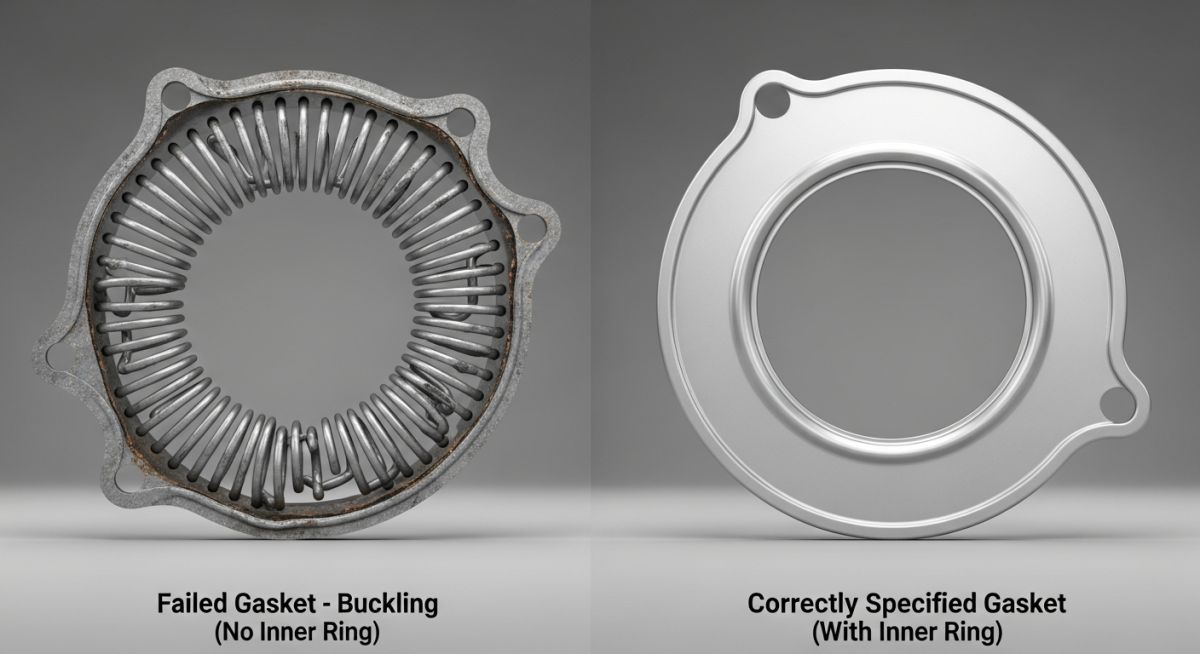
A petrochemical plant in Gujarat experienced recurring flange leaks on a 12-inch, Class 900 steam header. The maintenance team was using standard Spiral Wound Gasket Style CG (without inner rings). During every thermal cycle, the internal windings were being sucked into the pipe bore, creating a path for high-velocity steam to erode the flange face.
The failure analysis revealed that the lack of internal support allowed the "V-shape" metal strips to collapse under the combined load of bolt torque and 150 bar operating pressure.
The Solution
Following ASME B16.20 mandates for high-pressure service, the gaskets were upgraded to Style CGI (incorporating a 316L Stainless Steel inner ring).
- Inward Buckling: Eliminated via the rigid inner ring barrier.
- Flow Turbulence: Reduced by shielding the winding from direct steam impingement.
- Recovery: Increased sealing life by 300% through four turnaround cycles.
Technical Verdict:
"Never treat the inner ring as an optional accessory for Class 600 and above. It is a structural requirement. The cost difference between a Style CG and CGI Spiral Wound Gasket is negligible compared to the cost of a single emergency shutdown."
Frequently Asked Questions: Spiral Wound Gasket Authority Guide
What are the main components of a Spiral Wound Gasket?
How do I identify the material of a Spiral Wound Gasket?
Can a Spiral Wound Gasket be reused?
Why is my Spiral Wound Gasket "buckling" inward after installation?
Is Flexible Graphite better than PTFE for steam service?
How does flange surface finish affect the gasket seal?
📚 Recommended Resources: Spiral Wound Gasket
Read these Guides



Related posts:
![High-grade industrial Wing Nut Types and Applications for mechanical assemblies.]()
Wing Nut Types and Applications: The 2026 Engineering Guide
![Industrial Monorail Crane Systems installed in a modern manufacturing plant 2026.]()
Monorail Crane Systems: Design, Types & 2026 Standards Guide
![Lead engineer performing a Factory Acceptance Test FAT on an industrial skid system 2026]()
Factory Acceptance Test FAT: The 2026 Engineering Guide to Zero-Defect Delivery
![Professional engineering workspace showing a Basis of Design document layout for a 2026 project.]()
Basis of Design: How to Write a BOD for Engineering Projects in 2026
![Industrial Flare Knockout Drum Sizing and installation in a refinery relief system.]()
Flare Knockout Drum Sizing: Design & API 521 Standards (2026 Guide)
![Advanced Reboiler Control Systems in a modern petrochemical refinery 2026.]()
Reboiler Control Systems: Engineering Guide to Precision Control 2026