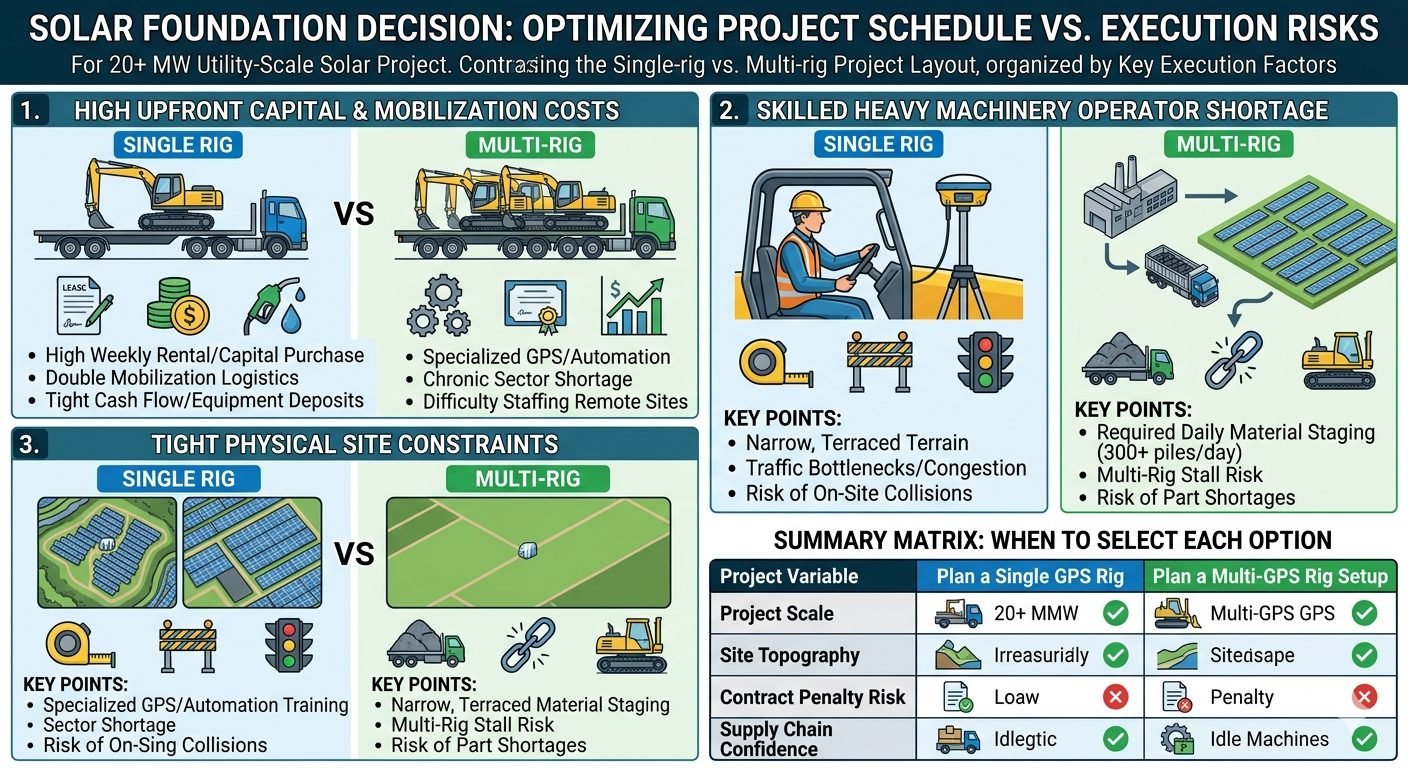
Single vs Multi-Rig Layouts for Utility-Scale Solar Projects
In my two decades of managing industrial construction sites, I have seen many utility-scale solar projects falter simply because the pile-driving strategy did not match the site reality. When you are staring down a 20+ MW project, the decision to deploy a single-rig or a multi-rig fleet is not just about speed; it is about managing the flow of capital and the physical constraints of the terrain.
A single-rig setup often feels safer for smaller or more complex, terraced sites where maneuverability is limited. However, as project scales grow, the pressure to meet aggressive commercial operation dates often forces a shift toward multi-rig fleets. This transition introduces complex logistical challenges, from material staging to the chronic shortage of qualified GPS-automation operators.
Key Takeaways for Project Managers:
- Single-rig layouts minimize mobilization costs and preserve cash flow on irregular, narrow sites.
- Multi-rig fleets are necessary for 20+ MW projects but require robust supply chain support.
- Operator availability remains the primary bottleneck for high-speed, multi-rig automation deployments.
- Site topography dictates the maximum efficient density of your pile-driving equipment.
Optimizing Utility-Scale Solar Project Pile Driving
When evaluating the deployment of a single-rig versus a multi-rig layout, I focus heavily on the “piles-per-day” metric. A single rig typically manages 80 to 120 piles per day, depending on soil conditions and operator proficiency. In contrast, a multi-rig fleet aims for 300+ piles per day. This jump in productivity is not linear; it is exponential in terms of logistical complexity.
The primary technical constraint is the staging area. For a multi-rig operation, you must maintain a constant supply of steel piles. If your staging area is constrained by narrow access roads or steep terrain, the rigs will sit idle waiting for material. This “idle-rig” scenario is a silent killer of project margins.
From a structural perspective, the ASTM D1143 standard for deep foundations provides the framework for load testing. When using multiple rigs, you must ensure that the calibration of the GPS-guided hammer systems is identical across all units. Even a 5mm deviation in pile verticality can lead to significant structural issues during the racking installation phase.
I calculate the “Fleet Efficiency Factor” (FEF) as follows: FEF equals the actual daily output divided by the theoretical maximum output of the fleet. In my experience, a single-rig setup often achieves an FEF of 0.85, while a multi-rig setup rarely exceeds 0.65 due to the increased probability of mechanical failure and supply chain bottlenecks. You must account for this efficiency drop when bidding your project timelines.
Furthermore, the integration of GPS-automation requires a dedicated site surveyor. With a single rig, the surveyor can manage the layout and the rig’s digital twin in real-time. With four or five rigs, the surveyor becomes a bottleneck. You must invest in automated machine control (AMC) systems that allow each rig to pull data directly from the BIM model without constant manual intervention.
Finally, consider the power requirements. Multi-rig fleets often require dedicated on-site fuel depots and mobile maintenance units. If your site is remote, the cost of maintaining this infrastructure can quickly negate the labor savings gained from higher pile-driving speeds. Always perform a cost-benefit analysis that includes the “hidden” costs of fleet support.
Advantages
- Single-Rig: Lower mobilization and demobilization costs.
- Single-Rig: Superior maneuverability on narrow, terraced terrain.
- Multi-Rig: Significantly higher daily pile-driving throughput.
- Multi-Rig: Faster project completion for 20+ MW scales.
- Multi-Rig: Economies of scale for large-site logistics.
Disadvantages
- Single-Rig: Vulnerable to schedule delays if the rig stalls.
- Single-Rig: Limited capacity for large-scale, time-sensitive projects.
- Multi-Rig: High risk of site congestion and collision.
- Multi-Rig: Chronic shortage of skilled GPS-automation operators.
- Multi-Rig: Complex supply chain requirements for material staging.
Terraced Hillside Solar Installations
On sites with significant elevation changes and narrow access paths, a single-rig approach is often the only viable option. The ability to navigate tight corners without risking equipment collision or damaging the site’s natural drainage patterns is paramount for environmental compliance.Utility-Scale Flatland Projects (20+ MW)
For large, open-field projects, a multi-rig fleet is the industry standard for meeting aggressive deadlines. By deploying four or more rigs, you can maintain a consistent pace of 300+ piles per day, provided your staging area is large enough to handle the incoming steel volume.Remote Site Logistics Management
In remote locations where fuel and maintenance parts are difficult to source, a single-rig setup reduces the logistical footprint. This minimizes the risk of total project stoppage due to a single missing part or a lack of specialized maintenance personnel.Selecting the optimal pile driving configuration for a 20+ MW utility-scale solar project requires a granular analysis of production rates versus operational overhead. The following table outlines the performance expectations and logistical requirements for single-rig versus multi-rig deployments, grounded in standard ASCE construction management guidelines for heavy civil works.
When evaluating these metrics, consider that the “Piles per Day” capacity assumes a standard 8-hour shift with optimal soil conditions. Deviations in geotechnical profiles, such as high rock content or excessive moisture, will disproportionately impact multi-rig fleets due to the compounding effect of downtime across multiple units.
| Metric | Single-Rig Strategy | Multi-Rig Strategy |
|---|---|---|
| Daily Pile Output | 80 – 120 units | 300 – 500+ units |
| Mobilization Cost | Low (Single Load) | High (Fleet Logistics) |
| Operator Requirement | 1 Lead + 1 Helper | 3+ Leads + Support Crew |
| Site Footprint | Minimal Staging | Extensive Staging Required |
The primary takeaway is that while multi-rig setups offer superior speed, they introduce a non-linear increase in logistical complexity. Project managers must weigh the cost of potential schedule penalties against the increased risk of equipment failure and operator shortages inherent in larger fleets.
This matrix maps the critical technical entities and structural parameters that dictate the viability of your pile driving strategy. By aligning these variables with API and AISC standards, you can ensure that your equipment selection matches the structural requirements of the solar racking system.
The entities listed below represent the intersection of geotechnical site data and mechanical equipment capabilities. Understanding these relationships is vital for mitigating risks associated with pile refusal, verticality tolerances, and structural integrity during the installation phase of utility-scale solar projects.
| Entity | Parameter | Standard Reference |
|---|---|---|
| GPS Automation | Tolerance (± 10mm) | ISO 19011 |
| Pile Verticality | Angular Deviation | ASTM D1143 |
| Soil Resistance | Blow Count (N-Value) | ASTM D1586 |
Effective management of these parameters requires a robust quality assurance program. Ensure that your field team is trained to interpret these standards in real-time, as site conditions often fluctuate across a 20+ MW project footprint, necessitating dynamic adjustments to the driving force and GPS alignment settings.
Site Verification: Before committing to a single-rig or multi-rig layout, you must conduct a comprehensive site audit. This process ensures that your chosen strategy aligns with the physical realities of the terrain and the logistical constraints of the project site. Failure to verify these points often leads to costly mid-project pivots.
- 01. Geotechnical Baseline: Confirm soil N-values across all zones to ensure equipment torque capacity meets ASTM D1586 requirements.
- 02. Staging Area Capacity: Verify that the site can accommodate the daily delivery of 300+ piles for multi-rig operations without creating traffic bottlenecks.
- 03. Operator Availability: Validate the availability of certified GPS-automation operators for the entire duration of the project schedule.
- 04. Topographical Constraints: Map all terraced areas and narrow access paths to determine if multi-rig maneuverability is physically possible.
- 05. Supply Chain Confidence: Confirm that spare parts and fuel logistics can support the higher consumption rates of a multi-rig fleet.
Each checkpoint above serves as a gatekeeper for your project’s success. If you cannot satisfy the requirements for a multi-rig setup, it is safer to default to a single-rig strategy to maintain schedule predictability. Always document these findings in your project management software to provide a clear audit trail for stakeholders and insurance providers.
Problem: Multi-Rig Stalling on Terraced Terrain
A 25 MW project attempted a multi-rig deployment on a highly terraced site, leading to significant operational friction.
- Narrow access roads caused constant collision risks between rigs.
- GPS signal interference occurred due to the proximity of multiple units.
- Staging areas were insufficient for the volume of steel delivered daily.
- Qualified operator turnover led to a 40% reduction in daily output.
Outcome: Strategic Pivot to Single-Rig Efficiency
The project team transitioned to a single-rig strategy, which stabilized the installation process and improved overall project health.
- Daily pile installation consistency increased by 25% despite lower peak speed.
- Collision risks were eliminated through simplified traffic patterns.
- Logistical overhead dropped, allowing for better site management.
- Project completion was achieved within the revised, more predictable schedule.
My recommendation based on this case is to prioritize site-specific constraints over raw speed. If the topography is complex, a single, well-managed rig will almost always outperform a struggling multi-rig fleet. Always maintain a buffer in your schedule to allow for these types of operational adjustments.
Frequently Asked Engineering Questions
When should a project manager prioritize a single-rig layout over a multi-rig fleet?
- Reduces initial mobilization costs and simplifies logistics for smaller or irregular project footprints.
- Mitigates risks associated with narrow, terraced terrain where multiple machines create traffic bottlenecks.
- Preserves cash flow by avoiding the high upfront investment required for multiple GPS-enabled units.
- Minimizes collision risks in confined work zones where maneuverability is severely restricted.
How does the shortage of skilled operators influence the choice of pile driving equipment?
- Multi-rig operations require a larger pool of specialized talent, increasing the risk of project delays due to staffing gaps.
- Single-rig setups allow for more focused training and supervision of a smaller, more manageable crew.
- Remote site locations exacerbate the difficulty of recruiting multiple skilled operators simultaneously.
- Operational efficiency drops significantly if the fleet size exceeds the available pool of certified GPS-automation experts.
What are the primary logistical risks associated with a multi-rig solar construction fleet?
- Requires high-volume material staging, often exceeding 300 piles per day, to keep all rigs productive.
- Increases the probability of fleet-wide stalling if supply chain disruptions affect critical spare parts.
- Demands more robust site infrastructure to support simultaneous movement of multiple heavy machines.
- Heightens the impact of mechanical failures, as one down rig can disrupt the entire production sequence.
When is a multi-rig fleet the superior choice for utility-scale solar projects?
- Projects exceeding 20 MW benefit from the economies of scale provided by parallel pile driving operations.
- Broad, open sites allow for efficient staging and movement of multiple rigs without significant interference.
- High contract penalty risks justify the increased operational cost of maintaining a fully active, multi-unit fleet.
- Stable supply chains ensure that the high material demand of a multi-rig setup is consistently met.
How do site topography and physical constraints dictate equipment selection?
- Narrow or terraced sites inherently favor single-rig operation to prevent congestion and safety incidents.
- Flat, expansive sites are better suited for multi-rig fleets that require significant room for staging and maneuvering.
- Constrained sites increase the risk of equipment stalls, making a single-rig approach more reliable for maintaining steady progress.
- Site-specific geotechnical conditions may limit the number of rigs that can operate safely in close proximity.
Complete Course on
Piping Engineering
Check Now
Key Features
- 125+ Hours Content
- 500+ Recorded Lectures
- 20+ Years Exp.
- Lifetime Access
Coverage
- Codes & Standards
- Layouts & Design
- Material Eng.
- Stress Analysis
