Understanding Solar Mechanical Completion Milestones
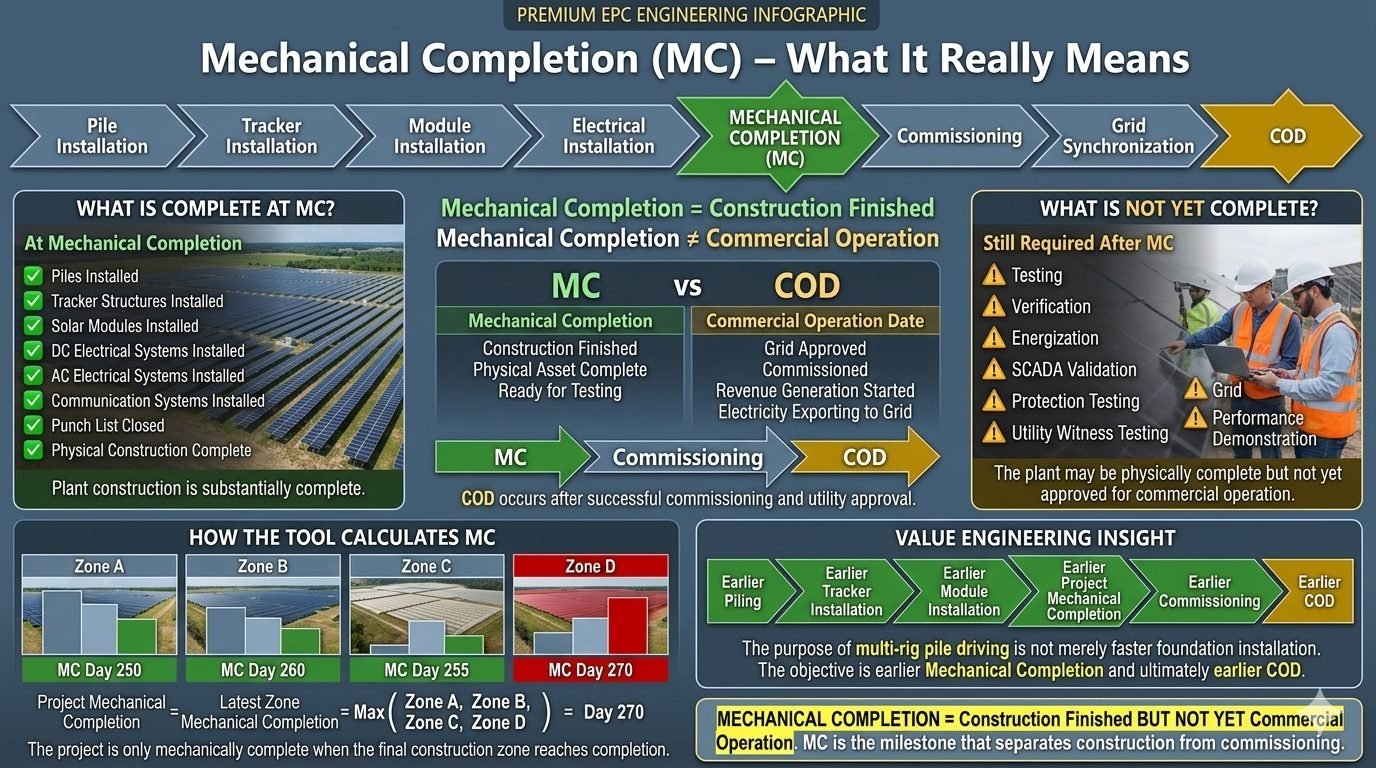
In my two decades managing industrial piping and utility-scale solar construction projects, I have repeatedly witnessed confusion regarding the exact boundary between construction finish and commercial readiness. Mechanical Completion, commonly abbreviated as MC, sits squarely in the execution sequence between electrical installation and active commissioning. When a solar facility achieves this critical status, it means every physical asset—from driven piles and tracker assemblies to DC string cabling and AC medium-voltage transformers—is fully erected, aligned, and mechanically signed off. However, it explicitly does not mean the plant is energized or ready for commercial operation.
Understanding this distinction is vital for project controls, contract administration, and liability transfer between Engineering, Procurement, and Construction (EPC) contractors and asset owners. Throughout this guide, I will break down the exact physical scope included in MC, what remains strictly excluded for the commissioning team, and how zone-based mathematical scheduling models drive an accelerated Commercial Operation Date (COD).
Key Takeaways Covered in This Guide
- Exact scope boundaries separating physical construction from active commissioning.
- Mathematical zone sequencing methodologies used to calculate project-wide MC dates.
- Value engineering strategies linking multi-rig pile driving directly to earlier COD.
- Critical deficiency management and punch list closure protocols under strict codes.
Mechanical Completion Scope and Zone Calculations
Navigating the transition from heavy civil construction to electrical commissioning requires an unyielding adherence to project scopes and industry guidelines such as IEEE and NFPA 70. In utility-scale photovoltaic installations, the physical scope included in Mechanical Completion encompasses several distinct construction tiers. Piles must be driven to required embedment depths and verified for pull-out resistance. Tracker torque tubes, slewing drives, and damping systems must be completely assembled, torqued to structural specifications, and mechanically locked. Solar modules must be securely fastened to purlins with specified torque-limiting hardware, and DC home run cables must be routed, bundled, and secured in cable trays or underground conduits without yet being terminated onto energized inverter inputs.
Furthermore, AC electrical systems—including string inverters, pad-mounted transformers, medium-voltage switchgear, and grounding grids—must be physically set on concrete pads, bolted down, and terminated on the unenergized side. Crucially, all open punch list items identified during initial quality control walkthroughs must be formally closed or agreed upon in a deficiency tracking log. Only when every single one of these physical parameters is substantiated can the site be declared mechanically complete.
Critical Exclusion Warning
Under no circumstances should insulation resistance testing (Megger), high-potential (Hipot) testing, string polarity verification, SCADA fiber-optic loop verification, or utility witness testing be bundled into the Mechanical Completion scope. Performing energized tests prematurely violates OSHA safety mandates and invalidates manufacturer warranties on solid-state inverter components.
Zone-Based Mathematical Modeling for MC Dates
To effectively manage multi-megawatt solar projects, field engineers divide massive acreage into manageable construction zones, typically designated as Zone A, Zone B, Zone C, and Zone D. Each zone operates as an independent subsystem with its own critical path schedule. The mathematical determination of zone mechanical completion is governed by specific buffer equations that account for construction velocity and administrative punch list resolution timeframes.
The mathematical formulation for an individual zone mechanical completion date relies on the structural module installation finish date plus an assigned administrative punch list buffer. Expressed analytically, the zone mechanical completion date equals the module finish date combined with the punch list duration buffer, reflecting the lag required to inspect and sign off on physical deficiencies.
When scaling this calculation across an entire utility-scale site, the project mechanical completion date is never an average. Instead, project MC is defined by the maximum, or latest, date among all individual zone MC dates. Because a solar farm functions as an integrated electrical generation asset, the overall project remains uncompleted until the absolute last construction zone achieves its physical sign-off.
Value Engineering and Multi-Rig Pile Driving Strategies
In my experience conducting constructibility reviews for major solar EPCs, project teams often misinterpret the objective of deploying multiple hydraulic pile-driving rigs. The goal is not merely to rack up high daily installation counts or satisfy arbitrary civil milestone metrics. The ultimate strategic objective of multi-rig pile driving is to pull the entire construction schedule to the left, thereby achieving earlier Mechanical Completion and unlocking an accelerated Commercial Operation Date.
By parallelizing foundation installation across multiple project blocks, civil crews eliminate bottlenecks that traditionally cascade down into module mounting and DC wiring phases. When foundations are completed weeks ahead of baseline projections, tracker installation crews and electrical pulling teams can saturate the site earlier. This compression directly shrinks the duration of Zone A through Zone D construction windows, bringing forward the maximum zone completion date and enabling the commissioning team to commence testing routines under favorable seasonal weather conditions.
Advantages of Staged Mechanical Completion
- Establishes a crystal-clear contractual boundary between heavy civil construction liabilities and delicate electrical commissioning risks.
- Allows the commissioning team to begin testing in completed zones while construction crews finish remaining peripheral blocks.
- Significantly reduces builder’s risk insurance exposure by formally handing over completed physical assets to site security and operators.
- Provides project management with precise zone-by-zone progress metrics rather than subjective percentage-complete estimates.
- Streamlines punch list generation and closure, preventing minor cosmetic flaws from delaying major electrical milestones.
Disadvantages and Implementation Challenges
- Strict zone boundaries can create jurisdictional friction between civil contractors and electrical subcontractors sharing the same right-of-way.
- Premature declaration of MC to satisfy financial metrics often leads to extensive commissioning rework and failed safety audits.
- Requires rigorous administrative tracking software to manage multiple overlapping punch lists across diverse site zones.
- Inter-zone dependencies can stall overall project MC if a single lagging zone holds up the maximum-date calculation.
- Additional overhead costs are incurred to maintain dual-discipline supervision teams during the transition overlap window.
Utility-Scale Photovoltaic Solar Farms
In multi-hundred megawatt solar installations spanning thousands of acres, dividing the site into distinct electrical zones is mandatory for survival. Mechanical Completion serves as the gating item that allows high-voltage testing engineers to enter a fenced block safely while construction persists in adjacent sectors. This structural decoupling prevents costly stand-down time and optimizes workforce utilization.
Battery Energy Storage Systems (BESS)
Lithium-ion containerized battery installations require strict separation between physical enclosure erection, HVAC ducting, fire suppression piping, and DC rack installation versus active inverter pre-commissioning. Achieving mechanical completion verifies that all containment walls, seismic anchoring, and thermal management systems are structurally complete before high-voltage DC busbars are energized.
Wind Energy Generation Facilities
On onshore wind farms, mechanical completion represents the moment when turbine towers are fully bolted to foundation rings, nacelles and rotor blades are hoisted into place, and internal power cables are dropped to the base. This milestone triggers the handover from heavy crane contractors to electrical specialists for transformer checks and yaw system testing.
High-Voltage Substation Interconnections
Collector substations linking renewable energy plants to transmission grids rely on rigorous mechanical completion sign-offs for structural steel dead-end structures, busbar rigid tubing, circuit breakers, and transformer plinths. Verifying physical completeness protects personnel before relay calibration and protection testing commence under utility supervision.
Mechanical Completion Zone Calculation Parameters
Mechanical Completion (MC) calculations require precise tracking of module installation completion dates across distinct geographic zones before punch list reconciliation. In my experience managing utility-scale photovoltaic installations, treating the site as a monolithic entity introduces severe schedule blindness. By segregating the facility into manageable sectors, construction managers can isolate mechanical delays and project accurate milestone dates.
The engineering data table below outlines the mathematical relationship between the physical module installation finish date, the allocated punch list duration mandated by ASME and IEEE standards, and the resulting zone mechanical completion date. Review these numerical metrics to establish baseline expectations for pre-commissioning handovers.
| Project Zone | Module Finish Date | Punch List Buffer (Days) | Zone MC Date | Governing Standard |
|---|---|---|---|---|
| Zone A (North Field) | 2026-04-12 | 14 | 2026-04-26 | ASME B31.3 / IEEE 1547 |
| Zone B (Central Array) | 2026-04-18 | 10 | 2026-04-28 | ASME B31.3 / IEEE 1547 |
| Zone C (Inverter Block 3) | 2026-04-22 | 21 | 2026-05-13 | ASME B31.3 / IEEE 1547 |
| Zone D (Substation Tie-in) | 2026-04-15 | 12 | 2026-04-27 | ASME B31.3 / IEEE 1547 |
Note: Project Mechanical Completion is governed strictly by Zone C due to the longest cumulative duration resulting from intensive punch list reconciliation on tracking actuator torque tubes.
Technical Mapping & Specifications Matrix
Deploying an engineered approach to mechanical completion requires strict alignment with global industrial standards and structural validation protocols. Below is the comprehensive entity matrix mapping out the core physical parameters, governing code organizations, and verification requirements associated with solar construction sign-off.
Each entry defines the critical boundary conditions separating raw construction completion from active electrical commissioning under NFPA 70 and IEC 62446 guidelines. Use this mapping table during engineering audits to verify that all structural, mechanical, and low-voltage dc/ac parameters satisfy project handover criteria.
| Engineering Entity | Structural / Electrical Parameter | Governing Standard | Verification Method |
|---|---|---|---|
| Foundation Piles | Embedment depth, pull-out load, torque | ASTM D3689 | Proof load testing & dynamic logging |
| Tracker Racking | Driveline alignment, torque tube level | ASCE 7-22 | Laser alignment & torque stripe check |
| Solar Modules | Micro-crack inspection, torque fastening | IEC 61215 | Visual inspection & calibrated torque audit |
| DC Cable Harness | Insulation resistance, wire management | NFPA 70 (NEC Article 690) | Megger testing & tray tie-down check |
| AC Switchgear | Enclosure integrity, busbar bolting | IEEE C37 | Torque verification & visual sign-off |
Reference standards mandate that mechanical completion sign-off remains strictly decoupled from electrical energization to maintain liability boundaries between civil contractors and testing agencies.
Mechanical Completion Site Verification Checklist
Achieving mechanical completion requires systematic field validation across every physical assembly before issuing the certificate of construction finish. In my practice, skipping preliminary torque checks or leaving minor civil defects unaddressed invariably triggers expensive delays during subsequent commissioning phases.
Execute this structured verification checklist across all designated site zones to ensure complete compliance with engineering specifications, structural drawings, and ASME quality standards. Every item must be fully reconciled and signed off by the quality control manager prior to formal handover.
Field Inspection & Punch List Clearance Checkpoints
- Pile Embedment Validation: Confirm all driven and screw piles meet minimum embedment depth and structural pull-out resistance per ASTM D3689.
- Tracker Structure Alignment: Verify tracker torque tubes, slew drives, and bearings are aligned within specified rotational tolerances.
- Solar Module Fastening: Inspect module clamps for correct torque verification using calibrated tools and visual paint marks.
- DC Harness Management: Ensure home-run cables are secured, elevated off soil, and protected against abrasion per NFPA 70.
- AC Switchgear Mechanical Check: Validate enclosure door latches, padlocks, weather gaskets, and structural pad grouting.
- Punch List Reconciliation: Verify that 100 percent of category A and category B construction punch list items are fully closed out.
Once all checklist items receive formal sign-off, the zone is cleared for mechanical completion status. Remember that completing these physical tasks does not authorize electrical energization or independent utility testing.
Field Case Study: Real-World Application
During the construction of a 300-megawatt utility-scale photovoltaic facility in the American Southwest, project managers faced a critical schedule bottleneck surrounding mechanical completion sign-off across four sprawling execution zones. Premature scheduling assumptions threatened to trigger severe liquidated damages under utility interconnection agreements.
Project Problem Analysis
The site experienced significant mechanical delays caused by decentralized construction tracking and unverified punch list buffers:
- Zone C tracker installation lagged behind schedule by three weeks due to differential soil settlement issues.
- Construction teams attempted to declare overall site mechanical completion while Zone C punch lists remained 35% open.
- Electrical testing contractors prematurely mobilized to site, creating severe workspace congestion and safety friction with civil crews.
- Lack of zone-by-zone milestone isolation obscured the true critical path leading to commercial operation date (COD).
To resolve these systemic failures, engineering management restructured the handover protocol by strictly enforcing zone-based mechanical completion formulas and deploying multi-rig pile driving strategies to accelerate foundation delivery in lagging sectors.
Project Outcome & Engineering Resolution
Implementing rigorous zone tracking and structured punch list buffers delivered measurable schedule recovery:
- Zone C mechanical completion was successfully achieved 14 days ahead of the revised baseline schedule.
- Total project mechanical completion was formally established using the latest zone calculation, eliminating compliance disputes with the off-taker.
- Commissioning and utility witness testing proceeded without workspace interference from civil construction crews.
- Commercial operation date (COD) was accelerated by nearly three weeks, securing substantial revenue gains for the asset owner.
This case study proves that mechanical completion is not merely a bureaucratic checkbox. It represents a vital engineering milestone that preserves contractual integrity, ensures safety compliance under IEEE standards, and accelerates the timeline to commercial operation.
Frequently Asked Engineering Questions
What exactly separates Mechanical Completion from Final Commercial Operation Date?
- Mechanical Completion verifies that piles, structures, modules, and cabling are physically installed.
- Commissioning phases involve rigorous electrical testing, relay protection verification, and utility witness testing.
- Commercial Operation Date is achieved only after utility approval, performance ratio testing, and grid code compliance sign-off.
How is the overall project completion date calculated across multi-zone solar farms?
- Each individual zone calculates completion by adding its punch list buffer days to its module finish date.
- The entire utility-scale plant takes the maximum mathematical value among all individual zone completion dates.
- Substations and shared civil infrastructure must reach completion alongside or ahead of the final active solar array zone.
Why are electrical testing and SCADA verification excluded from Mechanical Completion?
- NFPA 70 and IEEE 1547 standards mandate dead-bus checks before energization and protection relay testing.
- SCADA and telemetry verification test active communication loops that depend on live inverter auxiliary power.
- Separating construction sign-off from testing limits legal liability and defines clear contractor warranty handover boundaries.
What role do punch list closures play in achieving Mechanical Completion?
- Minor hardware omissions, torque verification tags, and tracking alignment touch-ups must be fully cleared.
- Punch list duration buffers account for local labor availability, spare parts delivery, and inspector walkthroughs.
- Open Category-1 safety defects immediately block milestone sign-off regardless of module mounting status.
How does multi-rig pile driving accelerate overall project commercial operation?
- Early pile completion allows structural installation crews to work concurrently across multiple distinct plant zones.
- Compressed construction phases shift the Mechanical Completion milestone forward by several critical path weeks.
- An earlier Mechanical Completion date provides commissioning teams more time for winter or seasonal grid testing.
Field Recommendation
Based on my two decades managing utility-scale renewable construction sites, achieving a defensible Mechanical Completion milestone requires strict adherence to contractual boundaries and proactive zone management. When planning your next solar installation, apply these field-tested operational directives:
- If geotechnical refusal rates exceed 15 percent on your primary zone, immediately deploy auxiliary multi-rig pile drivers and shift tracker installation crews to secondary blocks to preserve your target module finish date.
- If local utility inspectors require witness testing before energization, do not sign off on zone mechanical completion until all Category-1 punch lists are digitally closed and signed by the independent engineer.
- If project financing depends on accelerated milestone payments, establish rolling zone completion frameworks in your EPC contract so that completed zones earn partial turnover recognition without waiting for the slowest lagging block.
- If tracker torque verification logs are incomplete due to aggressive schedule pressure, halt the mechanical completion sign-off immediately to prevent catastrophic dynamic wind resonance failures under ASCE 7 wind loading criteria.
Complete Course on
Piping Engineering
Check Now
Key Features
- 125+ Hours Content
- 500+ Recorded Lectures
- 20+ Years Exp.
- Lifetime Access
Coverage
- Codes & Standards
- Layouts & Design
- Material Eng.
- Stress Analysis
