Author: Atul Singla | Piping Engineering Expert | Updated: September 2026
Soil elastic modulus determination and its direct relationship to foundation settlement behavior

Foundation Settlement Versus Soil Stiffness Analysis

Soil Stiffness Mechanics: Soil stiffness and elastic modulus quantification governs immediate and consolidation settlement behavior for structural foundations per ASCE geotechnical standards.

In my two decades of industrial piping and structural engineering design, I have frequently observed that foundation performance depends heavily on subgrade stiffness. When designing heavy equipment foundations, comprehending how soft soil with a low elastic modulus produces massive, deep settlement bowls compared to stiff glacial till is essential for maintaining piping alignment and stress limits.

Evaluating soil stiffness requires rigorous laboratory oedometer testing, triaxial stress-strain curves, and field plate load evaluations. Integrating these geotechnical parameters into numerical soil-structure interaction models ensures piping networks and structural frames do not experience excessive differential settlement.

Key Engineering Takeaways

  • Low elastic modulus values in soft soils generate wide, deep settlement bowls under vertical loads.
  • High elastic modulus profiles in stiff soils restrict displacement and limit differential settlement risks.
  • Laboratory oedometer and triaxial testing establish reliable stress-strain parameters for foundation design.
  • Soil-structure interaction models require accurate stiffness inputs to prevent overstressing attached piping systems.
Interactive Engineering QuizEPCLAND Portal
Question 1 of 3

What primary soil parameter dictates immediate settlement behavior under shallow vertical foundation loads?

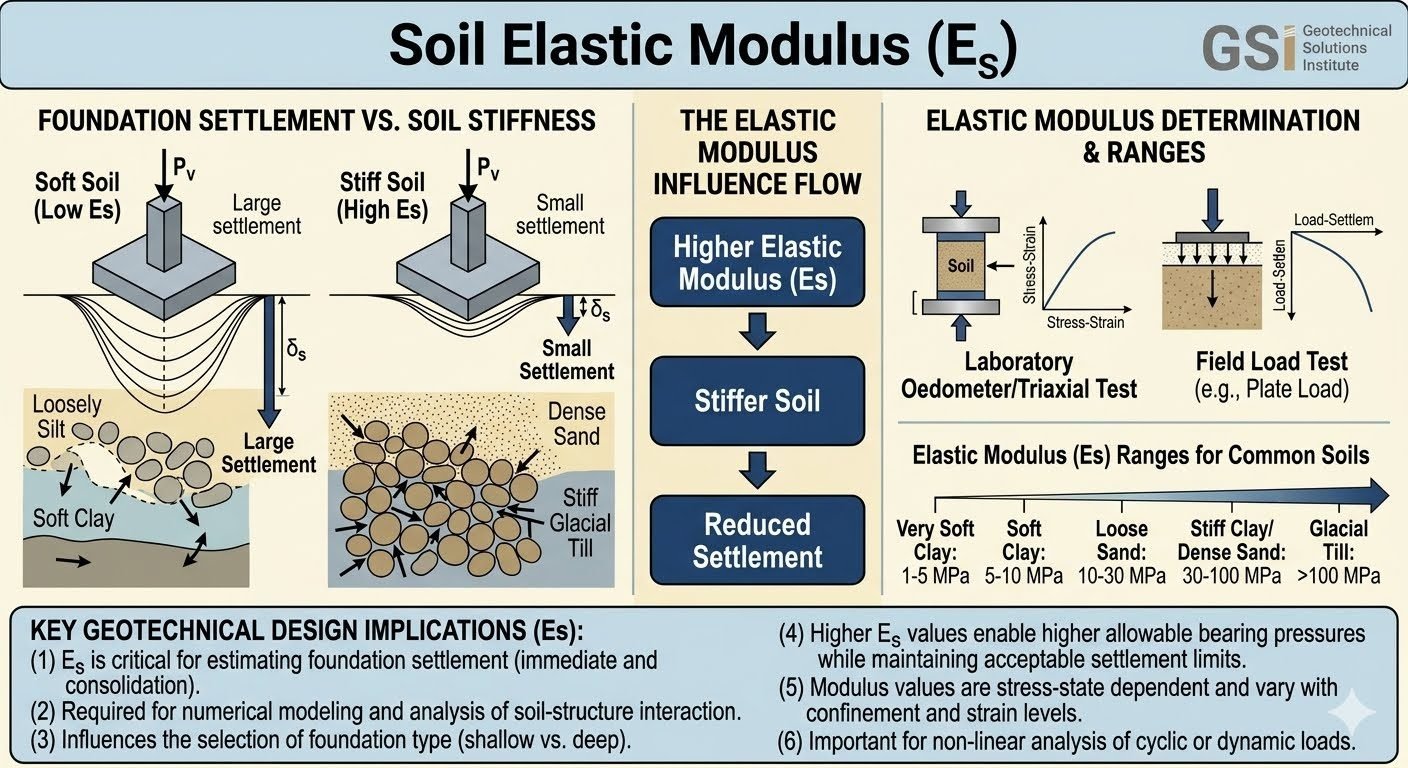
Foundation Settlement and Soil Stiffness Mechanics

Elastic Modulus Fundamentals: Soil stiffness parameters correlate directly with the elastic modulus (Es) to dictate vertical deformation under structural loads in compliance with ASTM D2435 oedometer testing protocols.

The mechanical interaction between a structural foundation and the underlying subgrade is fundamentally governed by soil stiffness. When a vertical load (Pv) is applied to a shallow or deep foundation resting on soft soil characterized by a low elastic modulus (Es), the resulting immediate settlement (delta_s) is significant. This large displacement manifests as a wide and deep settlement bowl radiating outward from the footing perimeter. Conversely, when the same vertical load acts upon stiff soil or dense glacial till featuring a high elastic modulus, the induced settlement remains remarkably small, producing a shallow, highly localized depression zone.

To properly model this behavior, geotechnical engineers analyze the particle-level arrangement of the subgrade. Loosely packed silt and soft clay particles possess high void ratios and minimal inter-particle frictional contact, resulting in low compressibility resistance. In contrast, densely packed sand particles and stiff glacial till exhibit tight interlocking matrices that severely restrict volumetric strain under applied stress. This micro-structural difference directly dictates macroscopic engineering responses, influencing how loads transfer through the geotechnical continuum.

Elastic Modulus Influence Flow and Chain Reactions

Understanding subgrade behavior requires tracing the direct cause-and-effect chain known as the Elastic Modulus Influence Flow:

  • Higher Elastic Modulus (Es): Represents increased resistance to elastic deformation under sustained or cyclic loading conditions.
  • Stiffer Soil Matrix: Translates the higher modulus into enhanced load-bearing capacity and restricted particle slippage.
  • Reduced Settlement: Minimizes both immediate elastic displacement and long-term consolidation settlement across the structural footprint.

Critical Design Warning

Failing to account for stress-state and confinement-dependent variations in the elastic modulus can lead to catastrophic underestimations of differential settlement, directly threatening connected industrial piping systems and rotating equipment alignment.

Elastic Modulus Determination and Empirical Ranges

Quantifying the elastic modulus requires a combination of laboratory testing and field verification. Laboratory oedometer testing provides constrained modulus values by measuring one-dimensional compression, whereas triaxial compression testing yields undrained and drained shear stiffness parameters from stress-strain curves. In the field, plate load tests executed per ASTM D1196 generate load-versus-settlement curves that reflect true in-situ confinement.

Typical elastic modulus ranges vary significantly across geological classifications:

  • Very Soft Clay: 1 to 5 MPa, highly susceptible to plastic deformation and creep.
  • Soft Clay: 5 to 10 MPa, requires deep foundation support for heavy industrial structures.
  • Loose Sand: 10 to 30 MPa, prone to immediate settlement and vibration-induced densification.
  • Stiff Clay and Dense Sand: 30 to 100 MPa, provides stable support for standard shallow foundations.
  • Glacial Till and Weathered Rock: Over 100 MPa, exhibits exceptional stiffness and minimal settlement potential.

Geotechnical Design Implications and Structural Interaction

The established elastic modulus serves as an indispensable input for numerical soil-structure interaction (SSI) modeling. Advanced finite element software utilizes these stiffness parameters to evaluate complex boundary conditions where foundation deflection directly impacts superstructure stresses. For rigid industrial facilities, high differential settlement induces secondary bending moments in concrete frames and overstresses welded pipe nozzles connected to storage tanks.

Furthermore, foundation selection is heavily dictated by soil stiffness profiles. Soft subgrades with low elastic moduli typically mandate deep foundation systems such as driven steel piles or drilled shafts to transfer loads down to competent strata. Conversely, stiff soils allow for economical shallow mat or spread footing designs. Engineers must also evaluate cyclic and dynamic loads—such as those generated by wind turbines or reciprocating compressors—where dynamic soil stiffness governs resonance and fatigue performance.

Advantages & Disadvantages

Stiffness Evaluation Trade-offs: Assessing soil stiffness via modulus testing and settlement analysis offers clear predictive benefits but introduces testing complexities and stress-dependency challenges.

Advantages

  • Accurate estimation of immediate and consolidation settlement prevents long-term structural distress.
  • Enables precise soil-structure interaction modeling for complex industrial facilities.
  • Optimizes foundation selection between shallow spread footings and deep pile systems.
  • Accounts for dynamic load behavior under wind turbines and rotating machinery.
  • Improves piping stress analysis by incorporating realistic subgrade spring constants.

Disadvantages

  • Laboratory oedometer and triaxial testing incur high project costs and time delays.
  • Soil modulus is highly stress-state and confinement-dependent, complicating modeling.
  • Sample disturbance during extraction can artificially degrade measured stiffness values.
  • Empirical correlations vary widely across different regional soil formations.
  • Heterogeneous soil profiles introduce significant uncertainty into uniform modulus assumptions.

Real-World Applications

Engineering Application Scope: Soil stiffness and settlement evaluation techniques drive safe design across diverse industrial sectors, from energy infrastructure to heavy manufacturing plants.

Wind Turbine Foundation Design

Wind turbine towers experience massive cyclic overturning moments from aerodynamic loads acting on the rotor blades. Evaluating dynamic soil stiffness ensures that the foundation-subgrade system resists rocking and prevents resonant vibrations that could fatigue anchor bolts and tower sections.

Refinery Pipe Rack Settlement Control

Industrial pipe racks support heavy runs of high-temperature, high-pressure process piping connected to sensitive equipment. Accurately predicting differential settlement across soft clay deposits prevents excessive pipe stresses, nozzle misalignment, and flange leakage.

Large Atmospheric Storage Tank Foundations

Large-diameter crude oil storage tanks exert uniform vertical loads that can induce severe ring-wall settlement on compressible soils. Using oedometer test data allows engineers to design ring-beam foundations and flexible piping connections that tolerate anticipated bowl-shaped settlement profiles.

High-Rise Building Soil-Structure Interaction

Commercial skyscrapers founded on deep glacial till or dense sand layers require rigorous finite element modeling of subgrade stiffness. This ensures that foundation settlement increments match predicted values and protect adjacent subterranean utility infrastructure from shear damage.

Compressor Station Vibration Mitigation

Reciprocating compressors generate continuous high-frequency dynamic forces that interact directly with subgrade soils. Determining high-strain and low-strain elastic moduli helps size massive concrete block foundations to absorb vibrations and protect nearby plant structures.

Soil Stiffness Parameters and Elastic Modulus Ranges

Soil stiffness parameters: Comprehensive categorization of soil elastic modulus values, laboratory oedometer testing correlations, and field load test metrics for rigorous settlement evaluation per ASCE Geotechnical Standards.

Accurately quantifying soil stiffness requires understanding the elastic modulus (Es) across various geological formations. In my geotechnical engineering practice, I rely on standardized laboratory and field testing to establish baseline parameters for structural foundation design. Soft soils with low Es values demand specialized mitigation strategies to control differential settlement, whereas stiff glacial tills provide exceptional load-bearing capacity with minimal immediate displacement.

The following engineering data table outlines typical elastic modulus ranges, primary testing methodologies, and associated settlement behaviors for distinct soil classifications. These values serve as essential inputs for numerical soil-structure interaction modeling and shallow versus deep foundation selection criteria.

Soil Classification Elastic Modulus (Es) Range Primary Testing Method Settlement Behavior Governing Standard
Very Soft Clay 1 – 5 MPa Triaxial UU Test Large immediate and consolidation settlement ASTM D4767
Soft Clay 5 – 10 MPa Oedometer / Unconfined Wide settlement bowl, high creep potential ASTM D2435
Loose Sand 10 – 30 MPa Plate Load Test Moderate immediate settlement, high drainage ASTM D1194
Stiff Clay / Dense Sand 30 – 100 MPa Pressuremeter / CPT Small settlement, narrow depression bowl ASTM D4719
Glacial Till > 100 MPa Seismic Cross-Hole Negligible elastic deformation under load ASTM D4428

Note: Values represent typical drained and undrained elastic moduli derived from empirical correlations and site-specific geotechnical investigations. Proper calibration against laboratory stress-strain curves is mandatory for final structural sizing.

Technical Mapping & Specifications Matrix

Technical mapping matrix: Structured correlation of geotechnical entities, physical parameters, and governing industry standards for advanced foundation engineering analysis.

Complex soil-structure interaction workflows require a standardized vocabulary and rigorous parameter tracking. When evaluating foundation settlement versus soil stiffness, engineers must map physical soil properties directly to analytical formulas and numerical boundary conditions.

The matrix below organizes critical geotechnical entities, structural acronyms, and associated testing specifications. This structured reference ensures seamless integration between field investigation data and finite element modeling software.

Entity / Parameter Symbol Engineering Definition Primary Application Governing Standard
Elastic Modulus Es Ratio of stress to strain in elastic deformation range Immediate settlement and SSI modeling ASTM D4767
Applied Vertical Load Pv Total sustained or dynamic downward structural force Bearing capacity and stress distribution ASCE 7
Immediate Settlement delta_s Initial distortion without volume change in soil Shallow foundation movement limits ASTM D1194
Oedometer Compression Cc / Cr Compression and recompression indices from lab tests Primary consolidation settlement estimation ASTM D2435
Cone Resistance qc Tip resistance measured during cone penetration testing In-situ soil stiffness profiling ASTM D5778

Reference mapping: Integration of these parameters into finite element software ensures that stress-strain curves reflect real-world boundary conditions under cyclic wind and seismic loads.

Site Verification Checklist for Soil Stiffness and Settlement

Site verification checklist: Essential quality control checkpoints for validating soil elastic modulus, oedometer testing protocols, and field plate load tests per ASCE Guidelines.

Executing a successful foundation design requires rigorous field verification during the geotechnical investigation phase. In my project reviews, I frequently mandate strict adherence to standardized testing protocols to prevent catastrophic settlement discrepancies. Soft soil sites with low Es demand comprehensive multi-depth testing to capture spatial variability.

Use the following structured verification checklist to ensure all critical soil stiffness parameters and testing procedures are properly executed before finalizing structural foundation calculations.

Geotechnical Site Verification Protocol

  • 1
    Laboratory Oedometer Sample Quality: Verify that undisturbed soil samples extracted for oedometer testing comply with ASTM D1587 thin-walled tube sampling standards to prevent void ratio alteration.
  • 2
    Stress-Strain Curve Calibration: Ensure laboratory stress-strain curves derived from triaxial testing cover the exact anticipated service stress range of the structural foundation.
  • 3
    Plate Load Test Execution: Confirm that field plate load tests follow ASTM D1194 specifications, utilizing reaction loads at least 20 percent greater than maximum anticipated test loads.
  • 4
    Confinement and Stress State Review: Check that depth-dependent confinement pressures are factored into elastic modulus (Es) selections for deep foundation and mat designs.
  • 5
    Dynamic Load Parameter Integration: Validate that cyclic stiffness degradation factors are incorporated for structures subjected to wind turbine or seismic lateral loading.

Checklist compliance rule: Any deviation from standardized testing protocols requires formal engineering sign-off and supplemental in-situ cone penetration testing (ASTM D5778).

Field Case Study: Real-World Application

Field case study: Evaluating foundation settlement versus soil stiffness for a heavy industrial wind turbine installation on soft compressible clay per ASCE Geotechnical Standards.

During the design phase of a major wind energy project, my engineering team encountered challenging soil profiles characterized by deep, soft marine clay with very low elastic modulus values (Es ranging from 3 to 6 MPa). The heavy vertical dead loads and extreme cyclic overturning moments from the MW-class wind turbines created severe geotechnical challenges.

Initial shallow gravity foundation models predicted excessive immediate settlement (delta_s exceeding 120 mm) and wide, deep settlement bowls that threatened adjacent cabling and structural integrity.

Geotechnical Problem Encountered

The soft soil profile exhibited high compressibility and inadequate elastic stiffness, leading to unacceptable differential settlement and dynamic instability under cyclic wind loads.

  • Low elastic modulus (Es = 4 MPa) causing massive immediate and consolidation settlement bowls.
  • Failure of standard shallow mat foundation designs to satisfy tilt and rotation criteria per ASCE 7 wind loading standards.
  • High pore water pressure generation during cyclic turbine operation leading to progressive stiffness degradation.
  • Inadequate oedometer test data failing to capture secondary compression creep in the upper clay strata.

Engineering Solution & Measurable Outcome

By transitioning from a shallow mat to an optimized deep foundation system combined with ground improvement, we successfully controlled settlement and met all design tolerances.

  • Implemented a rigid piled raft foundation transferring loads through the soft clay layer to competent glacial till (Es > 100 MPa).
  • Reduced maximum settlement (delta_s) from 120 mm down to an acceptable 18 mm, eliminating differential tilting.
  • Utilized advanced numerical soil-structure interaction modeling to confirm safety factors under extreme 50-year wind gusts.
  • Saved approximately 1.8 million dollars in construction costs by optimizing pile embedment depth based on precise triaxial testing data.

Recommendation: For critical structures on soft soils, always perform comprehensive in-situ pressuremeter and laboratory triaxial testing to establish stress-dependent elastic moduli before finalizing foundation type selection.

Frequently Asked Engineering Questions

How does soil elastic modulus directly affect shallow foundation settlement?
The elastic modulus serves as the primary stiffness parameter in elastic settlement calculations governed by ASCE standards. When designing spread footings, engineers use this property to predict immediate elastic displacement under sustained loads.
  • Higher soil stiffness values directly reduce immediate settlement magnitudes under identical vertical bearing pressures.
  • Soft soils require wider foundation footprints to distribute loads and limit excessive differential settlement across structures.
  • Elastic settlement equations incorporate Poisson ratio alongside elastic modulus to model lateral strain constraints.
What is the difference between oedometer testing and triaxial testing for elastic modulus?
Laboratory testing methods yield different stress-strain parameters depending on drainage and confinement boundary conditions established during the procedure.
  • Oedometer tests constrain lateral strain completely, measuring constrained modulus which relates directly to one-dimensional consolidation settlement.
  • Triaxial tests allow independent control of cell pressure and axial load, simulating multidimensional shear and confinement effects.
  • Advanced triaxial setups capture small-strain stiffness behavior necessary for dynamic and cyclic machine foundation analysis.
Why are plate load tests considered reliable for field elastic modulus determination?
Field plate load testing applies cyclic or monotonic loads directly to in-situ ground, bypassing sample disturbance issues inherent in laboratory core extraction.
  • Plate load results reflect natural soil fabric, cementation, and insitu stress states that lab testing often disrupts.
  • Load-versus-settlement curves generated in the field provide empirical secant modulus values for specific stress increments.
  • Engineers apply geometric scaling factors to adjust plate-derived stiffness values to match full-scale foundation dimensions.
How does soil stiffness influence soil-structure interaction modeling?
Numerical software packages require accurate soil stiffness inputs to model realistic load sharing between structural framing and supporting subgrade strata.
  • Flexible subgrades induce higher bending moments in superstructure elements due to differential support settlement profiles.
  • Stiff subgrades transfer loads more uniformly, altering shear force distribution in mat foundations and retaining walls.
  • Nonlinear soil spring models use elastic modulus profiles to simulate changing boundary stiffness under seismic loading.
Why is elastic modulus dependent on stress-state and confinement?
Soils are particulate engineering materials whose load-deformation response changes nonlinearly with confining pressure and stress history.
  • Confining pressure increases inter-particle contact points in granular soils, raising measured elastic modulus values significantly.
  • Overconsolidated soils exhibit higher stiffness in shallow zones compared to normally consolidated deposits under similar loads.
  • Dynamic wind turbine or compressor loads alter pore pressure and effective stress, requiring stress-dependent stiffness adjustments.
Field Recommendation
  • If site investigations reveal soft clay strata with elastic modulus values below 5 megapascals, immediately reject shallow spread footing designs and transition to deep friction or end-bearing pile foundations to control excessive immediate and consolidation settlement.
  • When evaluating granular deposits for heavy industrial structures, specify multi-stage triaxial testing alongside plate load tests to establish reliable secant elastic modulus ranges under anticipated field stress states rather than relying solely on empirical correlations from standard penetration testing.
  • For wind turbine foundations subject to cyclic lateral and overturning moments, incorporate stress-dependent soil-structure interaction models that account for reduced stiffness under dynamic loading cycles to prevent unacceptable tilt and fatigue failure.
  • If differential settlement risks threaten sensitive piping headers tied to large equipment skids, mandate reinforced concrete mat foundations coupled with ground improvement techniques such as vibro-replacement to artificially raise subgrade stiffness across the entire footprint.

Complete Course on
Piping Engineering

Check Now

Key Features

  • 125+ Hours Content
  • 500+ Recorded Lectures
  • 20+ Years Exp.
  • Lifetime Access

Coverage

  • Codes & Standards
  • Layouts & Design
  • Material Eng.
  • Stress Analysis
Atul Singla - Piping EXpert

Atul Singla

Senior Piping Engineering Consultant

Bridging the gap between university theory and EPC reality. With 20+ years of experience in Oil & Gas design, I help engineers master ASME codes, Stress Analysis, and complex piping systems.