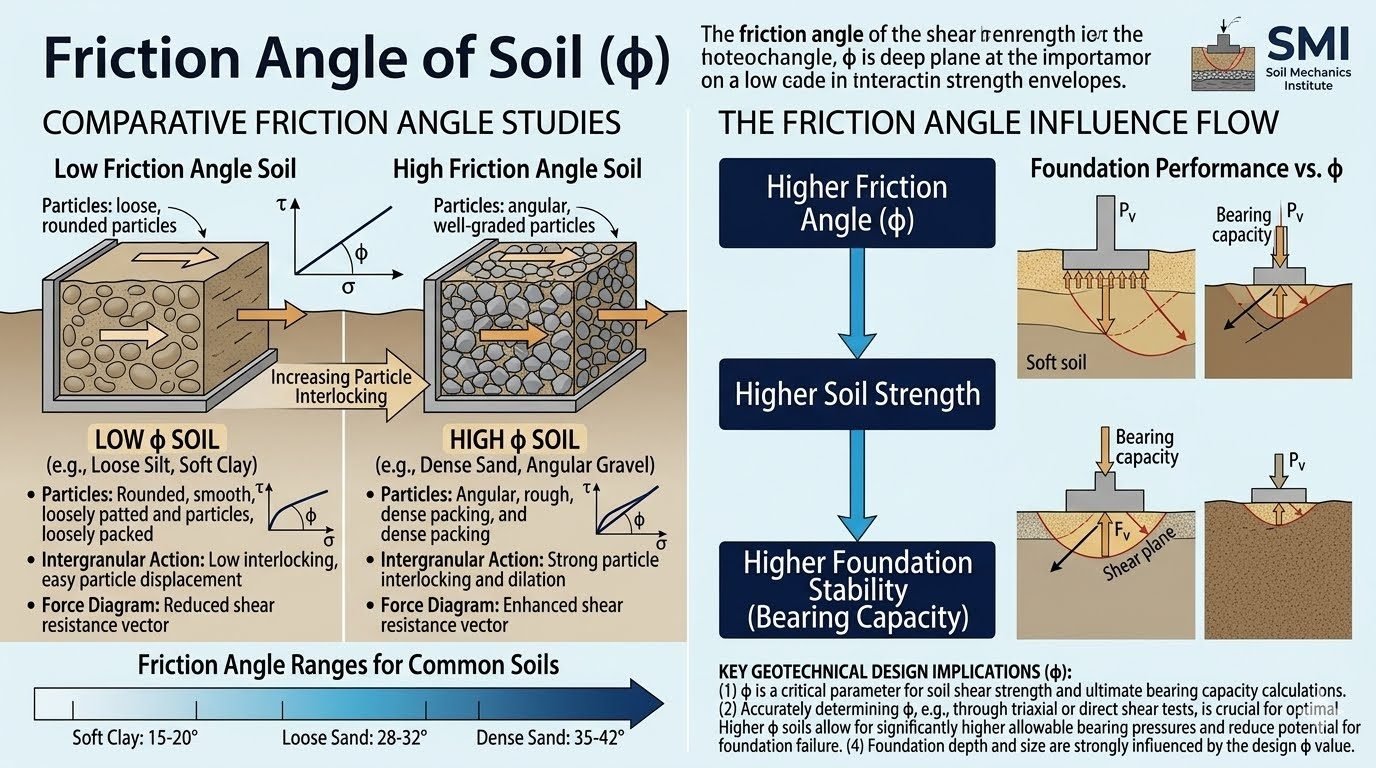
Soil Friction Angle Mechanics and Foundation Shear Strength Analysis
In my two decades of industrial piping and heavy civil infrastructure design, I have frequently witnessed unexpected structural settlements that trace directly back to unverified geotechnical parameters. When evaluating deep foundation loading or underground buried piping networks, understanding the soil friction angle is paramount to preventing catastrophic shear failure along structural interfaces.
Evaluating geotechnical parameters requires strict adherence to ASTM D3080 direct shear testing protocols and ASTM D4767 triaxial compression standards. These standardized testing methods establish the baseline shear strength parameters utilized across all major industrial foundation engineering software and design codes.
Key Engineering Takeaways
Soil Friction Angle and Mohr-Coulomb Mechanics
The fundamental mechanics of soil shear strength rely heavily on the Mohr-Coulomb failure criterion. In my geotechnical reviews for heavy industrial pipe racks, establishing accurate friction angles prevents differential settlement across interconnected process units. The shear strength equation is expressed as tau equals sigma-n times the tangent of phi, where tau represents shear strength, sigma-n is the normal stress, and phi is the internal friction angle.
Particle morphology dictates the magnitude of this friction angle. Low friction angle soil typically consists of loose, rounded particles such as loose silt or soft clay. These materials exhibit minimal interlocking and easy particle displacement under load, producing a reduced shear resistance vector.
Conversely, high friction angle soil features angular, well-graded particles like dense sand or angular gravel. These formations benefit from strong particle interlocking and dilation during shear displacement, generating an enhanced shear resistance vector that significantly increases load-bearing capacity.
Typical Soil Friction Angle Ranges
- Soft Clay: 15 to 20 degrees (high compressibility, low shear resistance).
- Loose Sand: 28 to 32 degrees (moderate void ratio, susceptible to liquefaction).
- Dense Sand: 35 to 42 degrees (tight particle interlocking, high load capacity).
- Angular Gravel: 40 to 48 degrees (maximum frictional resistance and interlocking).
The Friction Influence Flow establishes a direct performance chain: a higher friction angle leads directly to higher soil strength, which ultimately results in higher foundation stability and bearing capacity. When comparing bearing capacity performance in soft soil against firm soil under identical vertical loads, soft soils exhibit a small bearing capacity zone prone to deep shear failure, whereas firm soils develop a vastly expanded shear zone capable of supporting massive structural loads.
Critical Design Warning
Never assume default friction angle values for critical industrial foundations without site-specific ASTM D3080 direct shear testing. Overestimating phi by as little as three degrees in loose sandy soils can lead to a 25% overstatement of allowable bearing pressure and severe differential settlement.
Laboratory testing procedures must replicate field stress conditions. Undrained triaxial tests (ASTM D4767) evaluate cohesive soils, while drained direct shear tests quantify frictional parameters for cohesionless granular backfills. Engineers must account for groundwater table fluctuations, as saturation reduces effective stress and alters apparent shear resistance.
Advantages of High Friction Angle Soils
- Provides high allowable bearing capacity for shallow spread footings and mat foundations.
- Reduces active lateral earth pressures against retaining walls and underground vaults.
- Accelerates construction timelines by minimizing the need for deep soil improvement.
- Exhibits minimal long-term consolidation settlement under sustained static loads.
- Enhances slope stability for excavated trenches and embankment construction.
Disadvantages and Limitations
- Cohesionless granular soils are highly susceptible to seismic liquefaction hazards.
- Requires rigorous laboratory testing (ASTM D3080) to capture peak versus residual friction angles.
- Prone to severe erosion and piping when subjected to high-velocity groundwater seepage.
- Dense particle interlocking can complicate excavation and trench shoring installation.
- Variations in moisture content can unpredictably alter apparent shear strength characteristics.
Industrial Pipe Rack Foundation Design
Heavy pipe racks carrying high-temperature process piping exert substantial vertical and horizontal loads on shallow spread footings. Utilizing accurate soil friction angle data ensures that sliding resistance and bearing capacity satisfy ASCE 7 stability requirements under combined wind and seismic load combinations.
Lateral earth pressure coefficients (Ka and Kp) calculated using Rankine and Coulomb theories depend directly on the backfill soil friction angle. Proper characterization of granular backfill prevents structural wall rotation and guarantees long-term geotechnical stability for plant perimeter security.
Subterranean Pipeline Trench Stability
Deep trench excavations for cross-country hydrocarbon pipelines require precise friction angle assessments to determine safe benching and shoring angles. Exceeding the critical friction threshold without adequate trench box protection risks catastrophic wall collapse and worker safety violations.
Deep Foundation Driven Piles
Skin friction resistance for driven steel piles and cast-in-place concrete piers is calculated directly as a function of the surrounding soil friction angle and effective overburden pressure. High-friction granular strata dramatically increase skin friction, reducing required pile embedment depths.
Tank Farm Ringwall Foundation Engineering
Large-diameter crude oil storage tanks exert massive symmetrical loads on ringwall foundations. Evaluating the subgrade friction angle ensures that the underlying soil can resist edge shear failures induced by ringwall loading and hoop stresses without excessive localized settlement.
Soil Friction Angle Parameters and Shear Strength Reference
Evaluating geotechnical design criteria requires precise quantification of internal friction angles across varying soil classifications and packing densities. In my professional practice, I rely heavily on empirical ranges codified within ASTM D3080 direct shear testing guidelines and ASTM D4767 triaxial compression standards. The following engineering data table outlines standard friction angle ranges, corresponding volumetric behaviors, and typical shear strength envelopes for common geotechnical materials encountered during deep foundation and retaining wall design.
Reviewing these parameters allows structural engineers to establish reliable shear resistance inputs before running finite element stability models or performing manual bearing capacity calculations under combined vertical and lateral loads.
| Soil Classification & State | Friction Angle Range (phi) | Volumetric Behavior | Primary Testing Standard | Dominant Shear Mechanism |
|---|---|---|---|---|
| Soft Clay (Normally Consolidated) | 15 degrees to 20 degrees | Contractive under load | ASTM D2850 | Undrained cohesive shear |
| Loose Silt or Silty Sand | 25 degrees to 30 degrees | Mildly contractive | ASTM D3080 | Sliding and minimal interlocking |
| Medium Dense Sand | 30 degrees to 35 degrees | Neutral to slight dilation | ASTM D3080 | Moderate particle rearrangement |
| Dense Sand (Well-Graded) | 35 degrees to 42 degrees | Significant volume dilation | ASTM D4767 | Strong interlocking and friction |
| Angular Crushed Rock / Gravel | 40 degrees to 48 degrees | Extreme dilation | ASTM D3080 | Mechanical particle interlock |
Technical Mapping & Specifications Matrix
Establishing a standardized technical vocabulary is essential when integrating geotechnical soil mechanics with structural foundation engineering. The mapping matrix below bridges core physical entities, mathematical variables, and standardized testing procedures governed by recognized international authorities like ASTM International.
Each entry cross-references primary design variables with their governing calculation parameters, ensuring complete traceability from field borehole samples to final structural design drawings.
| Entity / Parameter | Symbol / Notation | Engineering Definition | Governing Standard | Primary Application |
|---|---|---|---|---|
| Internal Friction Angle | phi (degrees) | Shear resistance derived from particle interlocking and friction. | ASTM D3080 | Mohr-Coulomb failure envelope |
| Effective Cohesion | c’ (kPa or psf) | Interparticle bonding strength independent of normal stress. | ASTM D4767 | Clay shear strength analysis |
| Normal Stress | sigma (kPa) | Perpendicular compressive force per unit area on shear plane. | ASTM D2166 | Effective stress calculations |
| Ultimate Bearing Capacity | q_ult (kPa) | Maximum foundation pressure before general shear failure. | ASTM D1194 | Shallow footing sizing |
| Void Ratio | e (dimensionless) | Ratio of void volume to solid particle volume in soil matrix. | ASTM D854 | Relative density determination |
Site Verification Checklist for Soil Friction Angle Testing
Inspecting geotechnical investigation reports and verifying shear strength parameters requires a rigorous, step-by-step quality control protocol. In my engineering practice, skipping field verification steps often leads to catastrophic settlement or bearing failure. Use this structured site verification checklist to ensure that all soil friction angle measurements comply with ASTM testing mandates and structural design requirements.
Geotechnical Quality Control Verification Items
- Borehole Sampling Integrity: Confirm undisturbed soil samples are retrieved in strict accordance with ASTM D1587 thin-walled tube sampling standards.
- Direct Shear Testing: Verify that direct shear box tests (ASTM D3080) apply at least three distinct normal stress increments to establish an accurate Mohr-Coulomb envelope.
- Triaxial Compression Review: Ensure consolidated-undrained (ASTM D4767) pore pressure measurements are documented for cohesive-frictional soils.
- Groundwater Table Effect: Account for buoyant unit weight and effective stress reductions if the phreatic surface fluctuates near the footing foundation depth.
- Particle Gradation Verification: Cross-check sieve analysis results (ASTM D6913) to confirm angularity and grading match the assumed friction angle parameters.
- In-Situ Density Correlation: Validate Standard Penetration Test (SPT) N-values against empirical correlations to guard against disturbed laboratory sample errors.
Completion of this checklist ensures that structural foundation designs are built upon defensible, code-compliant shear strength parameters.
Field Case Study: Real-World Application
Examining actual industrial failures provides crucial context for how improper soil friction angle assumptions impact structural safety. In a recent heavy industrial plant expansion project I investigated, settlement distress occurred on a large compressor foundation due to inaccurate geotechnical assumptions.
The Engineering Problem
Differential settlement and excessive tilting occurred beneath a reciprocating compressor concrete block resting on loose silty sand with a low friction angle.
- Design engineers assumed an unconservative friction angle of 34 degrees based on preliminary SPT blow counts without laboratory shear testing.
- Actual direct shear testing per ASTM D3080 revealed an effective friction angle of only 27 degrees.
- Dynamic machine vibrations induced progressive particle rearrangement, reducing shear resistance and triggering local bearing capacity failure.
- Foundation footing dimensions were undersized by 35 percent relative to the true Mohr-Coulomb shear strength envelope.
The Engineering Outcome
Implementing rigorous soil densification and structural underpinning fully restored foundation stability and eliminated harmful vibrations.
- Compaction grouting was injected beneath the mat footing to increase relative density and raise the effective friction angle to 34 degrees.
- Footing load capacity was verified using ASTM D1194 plate load test procedures.
- Maximum measured settlement dropped from 45 millimeters down to an allowable 6 millimeters under full operating load.
- Engineering protocols were updated to mandate triaxial and direct shear testing on all future dynamic foundation projects.
Recommendation: Always verify soil friction angle parameters through laboratory shear testing rather than relying solely on empirical correlations, particularly for vibratory or high-load industrial structures.
Frequently Asked Engineering Questions
How is the soil friction angle determined in laboratory testing?
- Execute consolidated drained direct shear tests according to ASTM D3080 to measure shear stress against normal stress.
- Perform triaxial compression testing per ASTM D4767 to capture principal stress states and pore pressure response.
- Plot Mohr-Coulomb failure envelopes across multiple confining pressures to isolate the internal friction angle from cohesion.
Why do angular particles exhibit a higher friction angle than rounded particles?
- Angular grains experience mechanical interlocking that requires higher energy to override during sliding.
- Rounded particles easily roll over one another, reducing frictional resistance and shear strength.
- Dense, well-graded angular gravels dilate under shear, mobilizing extra resistance vectors along the failure plane.
How does the friction angle impact shallow foundation bearing capacity?
- Terzaghi and Meyerhof bearing capacity formulas scale exponentially with the friction angle via the factor Nq and Ngamma.
- Higher friction angles expand the Prandtl shear failure zone beneath shallow footings, increasing allowable vertical loads.
- Soft soils with low friction angles produce restricted failure zones, requiring larger footing widths to prevent geotechnical failure.
What is the typical range of friction angles for common soil types?
- Soft clay and loose silt typically exhibit low friction angles ranging between 15 and 20 degrees.
- Loose sand and silty sand demonstrate moderate frictional resistance spanning 28 to 32 degrees.
- Dense sand and well-graded gravel achieve high friction angles between 35 and 42 degrees.
Can the soil friction angle be assumed purely from empirical correlations?
- Standard Penetration Test N-values offer quick empirical approximations of friction angles for sandy soils.
- Critical infrastructure projects require site-specific laboratory shear testing to account for fabric anisotropy and stress history.
- Relying solely on published tables without verification can lead to unconservative foundation designs in variable strata.
Field Recommendation
Based on my two decades of reviewing geotechnical design packages and foundation failure investigations, I advise practicing engineers to adhere to strict verification protocols when handling shear strength parameters:
- If site exploration reveals loose silty sand with a friction angle below 30 degrees, reject shallow spread footings and specify deep foundation piling to bypass compressible strata.
- If project budget constraints limit laboratory testing to Standard Penetration Tests, apply a conservative reduction factor of 15 percent to empirical friction angle correlations before calculating bearing capacity.
- If designing high-load industrial structures on granular soils, mandate multi-stage consolidated drained triaxial tests per ASTM D4767 to capture peak dilation behavior accurately.
- If compaction quality control reports show failing density targets on granular backfill, halt slab construction immediately because even a two-degree drop in friction angle degrades bearing capacity significantly.
Complete Course on
Piping Engineering
Check Now
Key Features
- 125+ Hours Content
- 500+ Recorded Lectures
- 20+ Years Exp.
- Lifetime Access
Coverage
- Codes & Standards
- Layouts & Design
- Material Eng.
- Stress Analysis
