What is Smart Plant Review (SPR)? Functions and Engineering Advantages
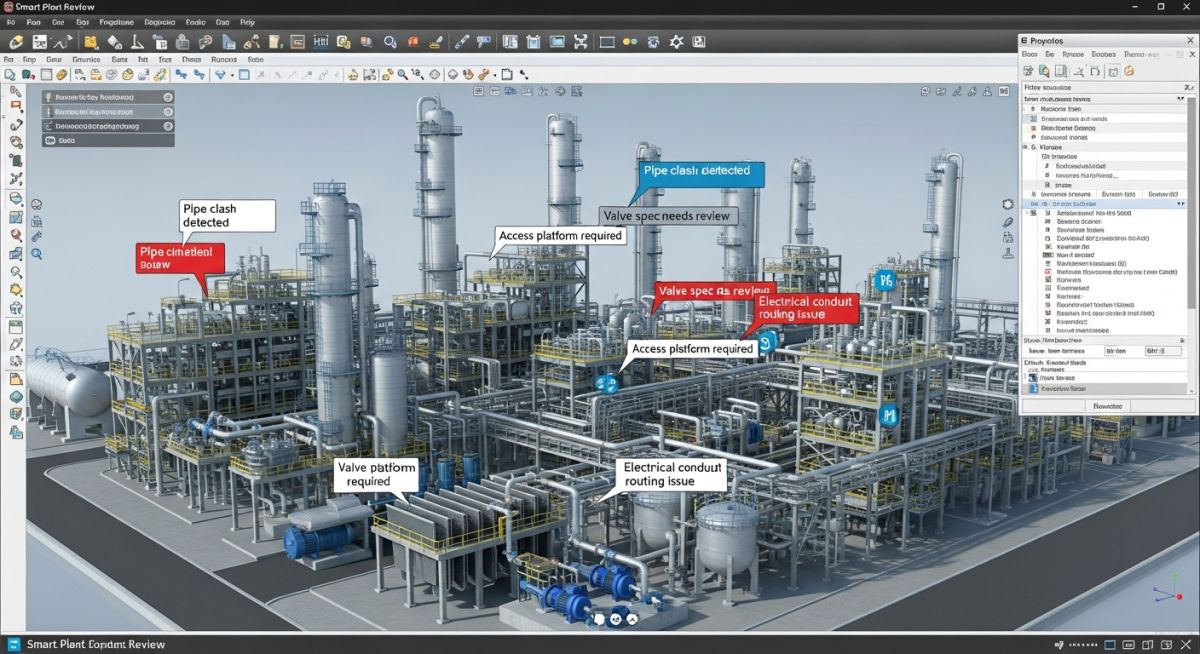
Smart Plant Review (SPR) is the industry-standard visualization solution for displaying complex 3D plant models and associated data throughout the project lifecycle. In 2026, it remains the primary tool for EPC firms to perform multi-discipline design reviews, safety audits, and construction planning within a high-performance 3D environment.
Defining Smart Plant Review
Smart Plant Review is a 3D visualization and collaboration tool by Hexagon PPM used to review large-scale engineering models. It enables users to navigate complex designs, perform interference detection, and access intelligent data attributes from S3D or PDS databases, facilitating faster decision-making and reducing costly onsite rework.
Table of Contents
- Core Capabilities of Smart Plant Review in 2026
- Key Advantages of Smart Plant Review for EPC Projects
- Technical Functions of Smart Plant Review for 3D Coordination
- Intergraph Freeview vs. Smart Plant Review Lite
- Modern Integration with Hexagon PPM Software Suites
- Troubleshooting Common SPR Performance Issues
- References and Global Engineering Standards
Engineering Knowledge Check: SPR Essentials
Question 1 of 5Quiz Complete!
Complete Course on
Piping Engineering
Check Now
Key Features
- 125+ Hours Content
- 500+ Recorded Lectures
- 20+ Years Exp.
- Lifetime Access
Coverage
- Codes & Standards
- Layouts & Design
- Material Eng.
- Stress Analysis
Core Capabilities of Smart Plant Review in 2026
As of 2026, the landscape of industrial visualization has evolved, yet Smart Plant Review remains the bedrock for high-performance 3D model interrogation. Its core strength lies in its ability to process massive datasets from Smart 3D (S3D) and PDS without compromising frame rates. This capability is essential for large-scale modular projects where thousands of components must be audited simultaneously.
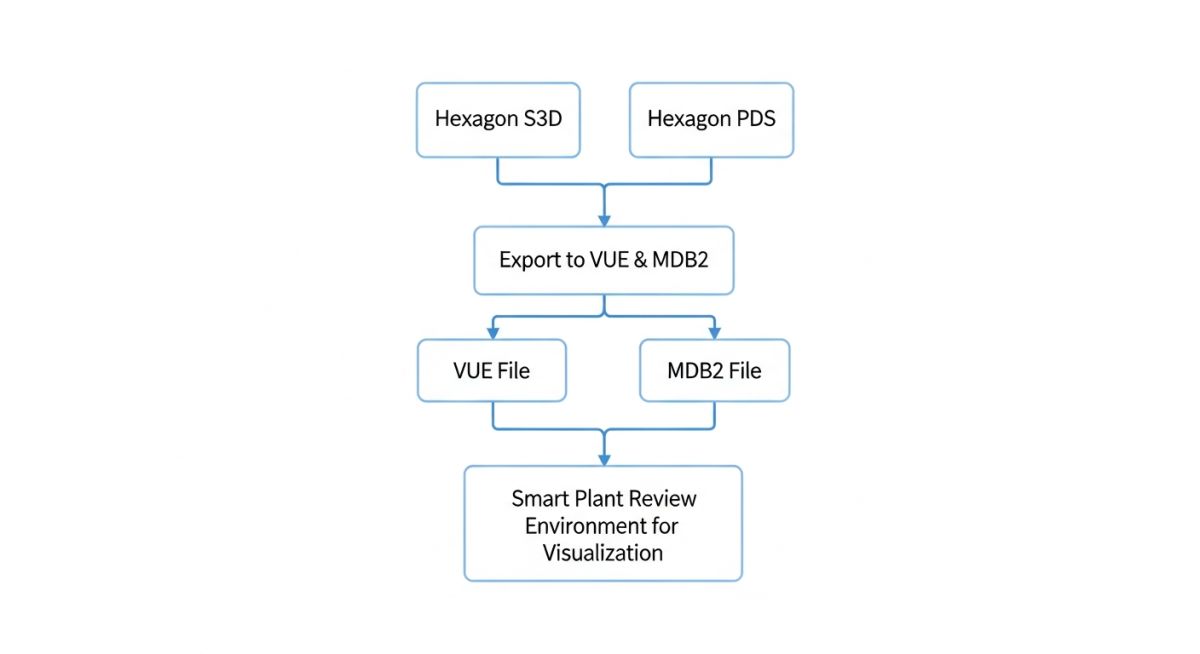
The software operates on a file-based streaming architecture. By utilizing VUE files for geometry and MDB2 files for attribute data, users can navigate through a "virtual plant" with real-time access to engineering properties such as line numbers, material specifications, and design temperatures.
Key Advantages of Smart Plant Review for EPC Projects
The Smart Plant Review environment provides several strategic advantages that directly impact the bottom line of Engineering, Procurement, and Construction (EPC) projects:
- Reduced Rework: By identifying multi-discipline design inconsistencies early, firms can avoid field changes that often cost 10 times more than design-phase fixes.
- Enhanced Safety Audits: Engineers use SPR to conduct Virtual HAZOP and PSSR (Pre-Commissioning Safety Reviews) sessions, identifying potential access and egress hazards before a single steel beam is erected.
- Data Centralization: Acting as a "Single Source of Truth," it links 3D visuals with external project databases via the API or ODBC connections.
- Scalability: Whether reviewing a single skid or a 5,000 USD million offshore platform, the software maintains performance by managing Level of Detail (LOD) settings dynamically.
Technical Functions of Smart Plant Review for 3D Coordination
Beyond simple viewing, the Smart Plant Review suite offers advanced technical modules that integrate with ASME B31.3 piping design workflows and API standards for equipment spacing.
Advanced SPR Interference Detection
This function automates the discovery of "hard" and "soft" clashes. A "hard" clash might be a pipe hitting a structural column, while a "soft" clash identifies a breach of maintenance clearance required for valve operation or instrument access.
Collaborative Design Review and Markup Tools
Markups in SPR allow engineers to place "Redlines" directly on the 3D model. These markups are saved as external files that can be shared across the design team to ensure all comments are addressed in the native 3D authoring tool.
Intergraph Freeview vs. Smart Plant Review Lite
Choosing the right version of Smart Plant Review depends on the level of interactivity required by the stakeholder. While Intergraph Freeview is an excellent entry-point for subcontractors to visualize models, it lacks the heavy-duty engineering audit tools found in the professional versions.
| Feature Description | Intergraph Freeview | Smart Plant Review (Full) |
|---|---|---|
| VUE File Visualization | Yes | Yes |
| MDB2 Attribute Data Access | Limited | Full Support |
| Interference Detection (Clash) | No | Yes (Module Required) |
| Advanced API Customization | No | Yes |
Modern Integration with Hexagon PPM Software Suites
In 2026, Smart Plant Review serves as the visual aggregator for the Hexagon Digital Twin ecosystem. It seamlessly integrates data from Smart 3D, Smart P&ID, and SmartPlant Foundation. This integration allows for "Cross-Probing," where selecting a valve in the 3D environment highlights the corresponding symbol in the 2D P&ID.
Technical Data Capacity and Performance
The software utilizes a proprietary culling algorithm to maintain high frame rates (FPS). The relationship between the number of visible triangles (T) and the memory consumption (M) can be generalized by the following engineering logic:
Note: Effective memory management ensures that even models exceeding 50,000 components can be navigated with less than 8 GB of VRAM.
Troubleshooting Common SPR Performance Issues
Even the most robust Smart Plant Review setup can encounter bottlenecks. Engineers should monitor the following technical parameters:
VUE File Bloat
Ensure the "Level of Detail" (LOD) settings are optimized during export from S3D to prevent oversized visualization files.
MDB2 Link Breaks
Verify that the .vue and .mdb2 files reside in the same directory and share an identical filename prefix for auto-linking.
Z-Buffer Fighting
Occurs when two surfaces are perfectly coplanar. Use the "Near Plane" clipping settings to resolve flickering geometry.
EPCLand YouTube Channel
2,500+ Videos • Daily Updates
Smart Plant Review Data & Performance Calculator
Estimate the expected Smart Plant Review VUE file size and the minimum recommended RAM for smooth 3D navigation based on your project component count.
Note: Calculations assume 2026 standard hardware optimization for 3D rendering.
Case Study: Smart Plant Review in Brownfield Refinery Expansion
Project Data & Challenge
In 2026, a major Southeast Asian refinery underwent a 250 USD million brownfield expansion. The primary challenge involved integrating new modular high-pressure piping into a 30-year-old existing facility where legacy drawings were inaccurate.
Failure Analysis
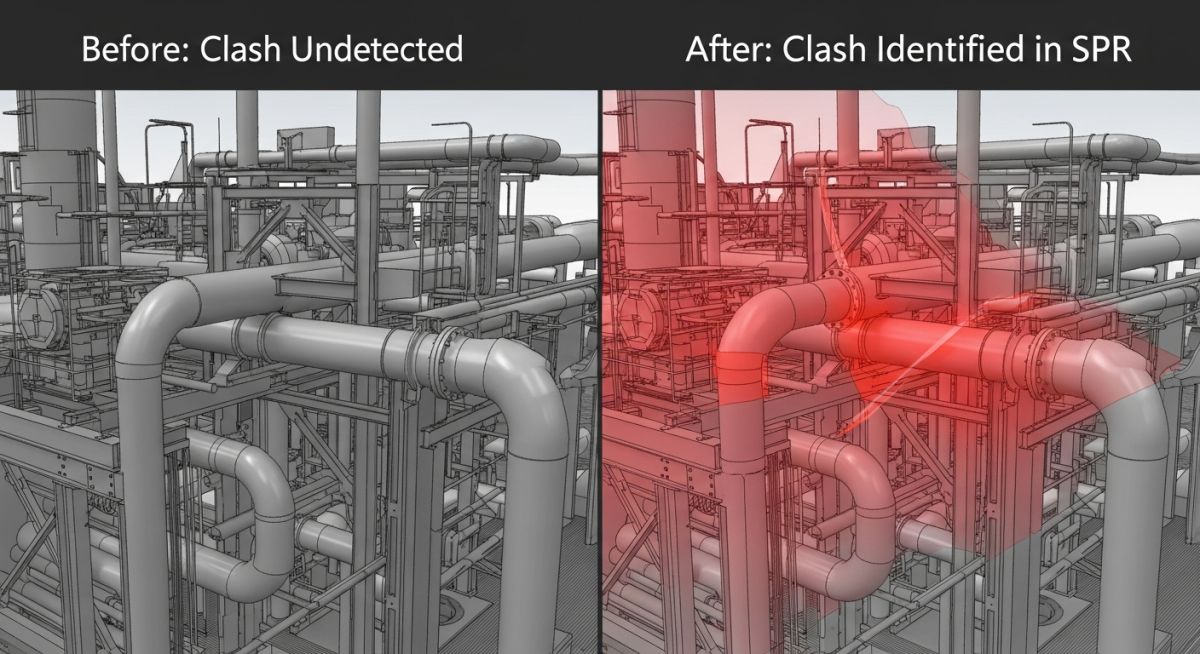
Initial manual surveys failed to account for thermal expansion loops. Without a 3D audit, the new pipe rack would have caused over 112 "hard" clashes with existing structural steel and firewater lines, potentially delaying the project by 4 months.
Engineering Fix with Smart Plant Review
The team utilized Smart Plant Review to merge laser-scan point clouds with the new S3D model. By running the SPR Interference Detection module, the team identified all 112 clashes in a virtual environment.
- ✔ Resolution: 85% of clashes were resolved by rerouting small-bore piping in the 3D model.
- ✔ Efficiency: Reduced onsite hot-work permits by 40% through precise pre-fabrication.
Lessons Learned
"The integration of Smart Plant Review with real-world laser scans transformed our coordination process. We moved from reactive firefighting to proactive engineering, saving approximately 1.2 USD million in potential rework costs." — Lead Piping Engineer.
Frequently Asked Questions about Smart Plant Review
How does Smart Plant Review handle different engineering standards like ASME and API? ▼
Smart Plant Review itself is a visualization tool, not an authoring tool that enforces standards directly. However, it displays the data exported from authoring tools like Smart 3D which *do* enforce these standards (e.g., ensuring piping stress compliance with ASME B31.3 or equipment placement per API 650). SPR allows auditors to visually verify that design rules have been followed.
Can I perform clash detection with third-party software models (e.g., from Revit or Inventor)? ▼
Yes, Smart Plant Review supports the import of neutral file formats like IFC or DGN. These can be converted into the VUE format using the SPR Translator tools. Once converted, these models can be loaded alongside native Hexagon models to run comprehensive, multi-vendor clash detection reports.
What are the typical hardware requirements for running Smart Plant Review in 2026? ▼
In 2026, the primary bottlenecks are RAM and VRAM (Video Card Memory). For standard projects (50,000 components), a minimum of 16 GB system RAM and 8 GB VRAM is recommended. Mega-projects often require 32 GB RAM and professional-grade GPUs for smooth performance of Smart Plant Review functions.
Is Intergraph Freeview still supported by Hexagon PPM in 2026? ▼
Yes, Intergraph Freeview is still actively supported and maintained by Hexagon as a lightweight, viewer-only solution. It is ideal for field personnel and non-technical stakeholders who only need to visualize the 3D model without needing advanced functions like data linking or interference checking.
Conclusion: Mastering Your Digital Twin with Smart Plant Review
The ability to effectively visualize and interrogate a complex digital twin is non-negotiable for competitive EPC execution in 2026. Smart Plant Review provides the robust, high-performance platform required to ensure design integrity, enhance safety reviews, and streamline construction planning. By mastering its functions—from basic 3D navigation to advanced SPR interference detection—engineering professionals ensure projects are delivered on time, within budget, and with zero surprises in the field.
References and Global Engineering Standards
- Hexagon PPM Official Documentation for Smart Plant Review, Version 2026.
- ASME B31.3 Process Piping Code, 2023 Edition.
- API RP 14E Recommended Practice for the Design and Installation of Offshore Production Platform Piping Systems.
- ISO 15926 Industrial automation systems and integration—Integration of life-cycle data for process plants.
