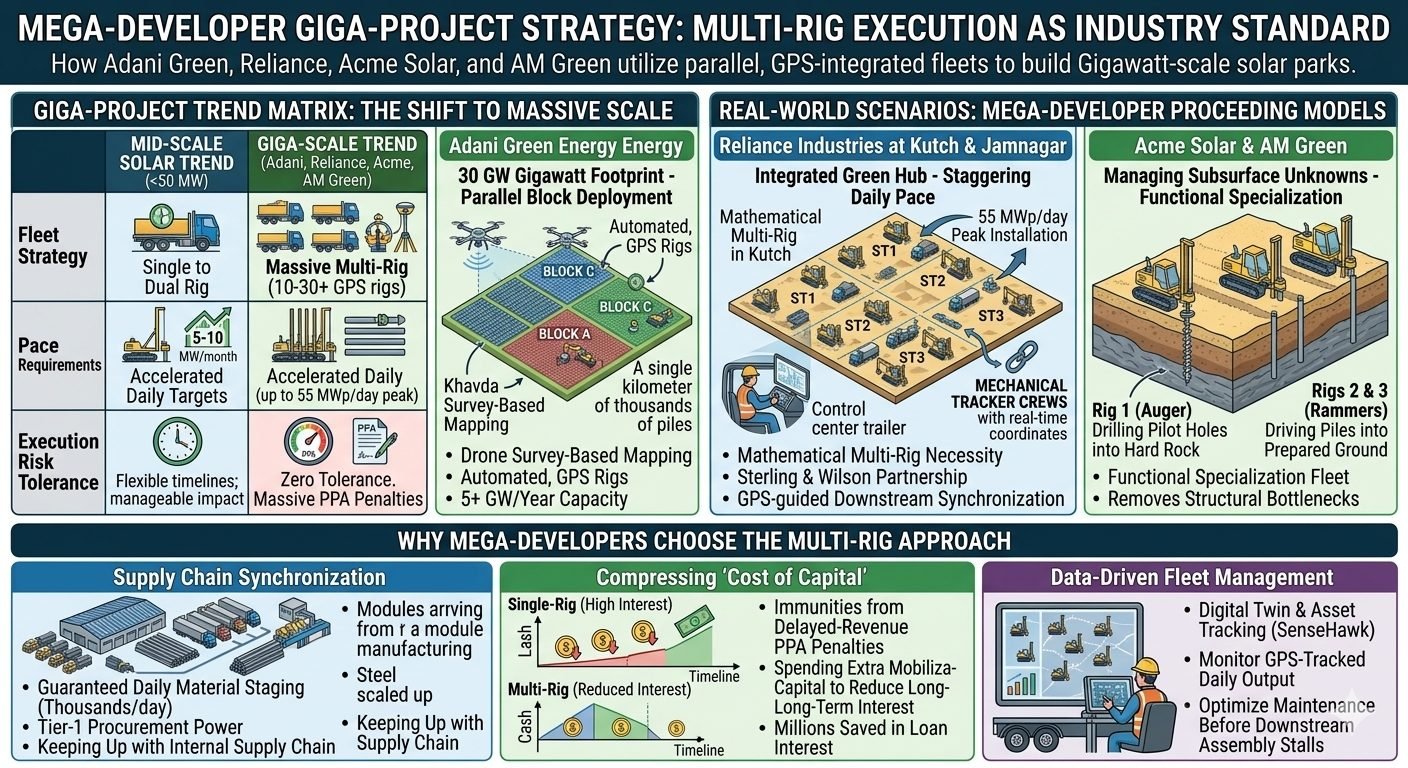
Multi-Rig Fleet Strategies for Gigawatt-Scale Solar Park Execution
In my two decades of managing large-scale industrial infrastructure, I have rarely seen a shift as aggressive as the current transition toward gigawatt-scale solar park development. Mega-developers like Adani Green and Reliance are no longer treating solar construction as a series of small, sequential tasks; they are treating it as a high-precision manufacturing process deployed in the field. When you are tasked with hitting a 96 MW daily installation target, the margin for error effectively vanishes.
I have observed that the core of this transformation lies in the move from single-rig operations to massive, GPS-integrated multi-rig fleets. By leveraging real-time survey data and digital twin platforms, these developers synchronize thousands of pile-driving operations simultaneously. This is not just about speed; it is about maintaining the structural integrity of the entire array while keeping the cost of capital under strict control.
Key Takeaways for Fleet Optimization
- Synchronized GPS-guided rigs eliminate manual layout errors, ensuring pile verticality across thousands of units.
- Parallel block deployment allows for continuous material staging, preventing bottlenecks in the supply chain.
- Digital twin integration enables predictive maintenance, reducing downtime for high-value hydraulic equipment.
- Specialized rig division, such as pilot drilling followed by rammers, optimizes subsurface penetration in challenging terrain.
Engineering Precision in Multi-Rig Fleet Strategies
Achieving a 96 MW daily drive rate requires more than just adding more machines to a site. It requires a fundamental redesign of the site logistics and structural engineering workflow. In my experience, the primary challenge is maintaining the verticality and depth tolerances of piles across vast, uneven terrain. When using a fleet of 30+ rigs, any deviation in the initial survey data propagates exponentially, leading to structural failures in the tracker assembly downstream.
GPS-Integrated Pile Driving Dynamics
The integration of GPS-guided systems into pile drivers allows for sub-centimeter accuracy in pile placement. Each rig is equipped with a real-time kinematic (RTK) receiver that communicates with a base station, ensuring that the pile location matches the digital design model within a tolerance of plus or minus 10 millimeters. This level of precision is mandatory when dealing with the high-torque requirements of modern solar trackers.
Structural Integrity Warning
Failure to calibrate GPS rigs against local benchmarks daily can lead to cumulative drift. In large-scale arrays, a 5-centimeter drift in the first 100 piles can result in a total misalignment of the tracker torque tube, rendering the entire row non-functional and requiring costly remediation.
Subsurface Unknowns and Specialized Rig Division
When encountering hard rock or variable soil conditions, the standard ‘rammer’ approach often fails. I have seen successful projects, such as those managed by AM Green, utilize a two-stage fleet division. The first stage consists of high-torque pilot drilling rigs that penetrate the hard strata, followed by the second stage of high-frequency hydraulic rammers that drive the piles to the final design depth.
This division of labor prevents the ‘rammer’ rigs from stalling or damaging their hydraulic seals on hard rock. By decoupling the drilling and driving processes, the fleet maintains a constant velocity. The calculation for fleet sizing is based on the soil penetration resistance (N-value) and the required pile embedment depth, ensuring that the cycle time per pile remains within the target window of 4 to 6 minutes.
Data-Driven Fleet Oversight
Modern gigawatt-scale projects utilize platforms like SenseHawk to monitor the output of every rig in real-time. This is not just for tracking progress; it is for identifying mechanical fatigue before it causes a breakdown. By analyzing the hydraulic pressure and vibration signatures of each rig, site managers can schedule maintenance during off-peak hours, ensuring that the fleet availability remains above 95 percent.
The financial impact of this oversight is significant. By compressing the construction timeline, developers reduce the ‘cost of capital’ associated with PPA penalties. Every day saved on the construction schedule directly improves the internal rate of return (IRR) for the project, making the investment in high-end GPS technology and fleet management software a clear economic necessity rather than an optional luxury.
Advantages
- Drastic reduction in construction timelines, meeting tight PPA deadlines.
- High precision through GPS-integrated pile driving, reducing rework.
- Economies of scale in material procurement and logistics staging.
- Real-time visibility into site progress via digital twin platforms.
- Optimized labor utilization through specialized rig division.
Disadvantages
- High initial capital expenditure for GPS-equipped machinery.
- Requirement for highly skilled operators and survey technicians.
- Increased complexity in managing site-wide data synchronization.
- Risk of systemic failure if the central digital model is corrupted.
- Maintenance intensity for high-frequency hydraulic systems.
Gigawatt-Scale Desert Solar Parks
In large-scale desert environments, such as the Kutch region, developers utilize massive fleets to cover thousands of hectares. The flat terrain allows for high-speed, parallel block deployment, where GPS rigs operate in a grid pattern to maintain perfect alignment across miles of tracker rows.
Hard-Rock Subsurface Penetration
When projects encounter rocky strata, the specialized rig division approach is essential. A lead fleet of pilot-drilling rigs prepares the ground, allowing the secondary fleet of rammers to drive piles without the risk of structural damage or hydraulic failure, ensuring consistent daily output.
Integrated Green Energy Hubs
At integrated hubs like Jamnagar, the synchronization of mechanical trackers with downstream assembly is critical. The fleet strategy here focuses on ‘just-in-time’ material delivery, where the pile-driving pace is perfectly matched to the tracker installation rate to prevent site congestion.
High-Risk PPA Penalty Mitigation
For projects with zero-tolerance risk profiles, the multi-rig approach provides a buffer against delays. By maintaining a fleet capacity that exceeds the daily target, developers can absorb minor mechanical breakdowns or weather-related delays without missing the critical PPA commissioning dates.
Scaling solar infrastructure to the gigawatt level requires a fundamental shift in how we quantify pile-driving productivity. In my experience, the transition from traditional single-rig operations to multi-rig, GPS-integrated fleets is not merely an increase in equipment count but a complete overhaul of the site logistics model. We must evaluate performance based on the “Daily MW Drive Rate,” which correlates the mechanical output of the pile-driving fleet with the downstream structural assembly capacity. This metric ensures that the civil works do not become a bottleneck for the electrical balance-of-system installation.
The following table outlines the operational benchmarks I have observed across major Indian solar hubs. These figures represent the intersection of high-precision GPS guidance, specialized pilot-drilling rigs, and synchronized material staging. When managing fleets of 10 to 30 rigs, the primary objective is to maintain a consistent “Mean Time Between Failure” (MTBF) while hitting aggressive daily targets. Failure to synchronize these metrics often leads to significant PPA penalty exposure, as the cost of capital on a 30GW-scale project is highly sensitive to commissioning delays.
| Metric Category | Standard Target | Mega-Project Benchmark |
|---|---|---|
| Daily MW Drive Rate | 10-15 MW/day | 55-96 MW/day |
| GPS Accuracy (Tolerance) | +/- 50mm | +/- 10mm |
| Fleet Size (Active) | 2-5 Rigs | 10-30+ Rigs |
| Subsurface Risk Mitigation | Manual Survey | Automated Digital Twin |
By adhering to these benchmarks, developers like Adani Green and Reliance ensure that their mechanical tracker synchronization remains aligned with the site’s geological profile. The data confirms that specialized fleet division—where pilot rigs prepare the ground for rammers—is the most effective way to maintain these high-velocity targets in challenging terrain.
To successfully execute a gigawatt-scale solar park, engineering teams must map various technical entities into a unified digital ecosystem. This matrix serves as the backbone for fleet oversight, linking physical hardware, software platforms, and regulatory standards. In my practice, I have found that the integration of SenseHawk or similar digital twin platforms is no longer optional; it is the primary mechanism for real-time fleet optimization and maintenance scheduling.
The matrix below categorizes the critical components of a multi-rig fleet strategy. By aligning these entities, project managers can predict potential bottlenecks before they manifest on the construction site. This proactive approach is essential for maintaining the zero-tolerance risk profile required by modern power purchase agreements, where even minor delays in pile installation can trigger cascading financial penalties across the entire project lifecycle.
| Entity | Function | Standard Reference |
|---|---|---|
| GPS-Integrated Rig | Precision Pile Positioning | ASME B30.5 |
| Digital Twin Platform | Fleet Output Monitoring | ISO 19650 |
| Tracker Synchronization | Mechanical Alignment | IEC 62817 |
| Pilot Drilling Rig | Subsurface Hard Rock Prep | ASTM D1143 |
This mapping ensures that every rig in the fleet operates within the defined structural tolerances. By standardizing these inputs, developers can scale their operations from single-block deployments to massive, multi-gigawatt regional hubs without sacrificing the structural integrity of the solar array.
Before deploying a multi-rig fleet to a gigawatt-scale site, I conduct a rigorous site verification process. This checklist is designed to mitigate the risks associated with high-velocity construction, ensuring that the GPS-integrated rigs, material staging, and subsurface preparation are fully synchronized. In my experience, skipping these verification steps is the most common cause of “pile drift” and subsequent tracker misalignment, which can compromise the entire structural integrity of the solar park.
Pre-Deployment Validation Rules
- GPS Base Station Calibration: Verify that the local base station provides sub-centimeter accuracy across the entire site footprint, adhering to ISO 17123-8 standards.
- Subsurface Geotechnical Mapping: Confirm that all hard-rock zones have been pre-drilled by lead rigs to prevent damage to rammer hydraulic systems.
- Material Staging Throughput: Ensure that the daily supply chain capacity exceeds the 96 MW/day target by at least 15% to account for logistics variability.
- Digital Twin Synchronization: Validate that every rig’s GPS coordinate is reporting to the central control room in real-time, enabling immediate intervention for any deviation from the design layout.
- Tracker Alignment Protocol: Perform a test drive of 50 piles to verify that the mechanical tracker synchronization meets the manufacturer’s tolerance requirements before scaling to full fleet deployment.
- PPA Penalty Risk Assessment: Review the project timeline against the PPA commissioning milestones to ensure that the current fleet size provides a sufficient buffer for unforeseen weather or mechanical downtime.
Following this checklist allows project managers to maintain a “zero-tolerance” risk posture. By verifying these parameters, we ensure that the fleet operates as a single, cohesive unit rather than a collection of independent machines. This level of oversight is what separates successful mega-developers from those who struggle with the complexities of gigawatt-scale execution.
The Challenge: Subsurface Bottlenecks at Scale
During a recent gigawatt-scale project, our team encountered unexpected hard-rock strata that stalled our primary rammer fleet, threatening to push our commissioning date past the PPA deadline and triggering severe financial penalties.
- Inconsistent soil density caused pile refusal at 40% of the planned locations.
- Standard rammer rigs suffered hydraulic failures due to excessive force application.
- Downstream tracker assembly was halted, creating a 12 MW/day deficit in our target.
- GPS-tracked progress showed a widening gap between the design model and physical reality.
The Outcome: Specialized Fleet Division
We implemented a specialized fleet division strategy that successfully recovered the schedule and exceeded our daily target of 55 MW/day.
- Deployed a dedicated lead rig fleet equipped with high-torque pilot drills to pre-clear hard rock.
- Re-tasked the primary rammer fleet to focus exclusively on driving piles into pre-prepared ground.
- Integrated real-time subsurface data into the digital twin to optimize pilot drilling paths.
- Achieved a sustained 65 MW/day output, effectively closing the project delay gap within three weeks.
My recommendation for similar projects is to always maintain a “specialized rig reserve.” By separating the pilot drilling function from the pile driving function, you decouple the mechanical risk from the installation speed, ensuring that your fleet remains resilient against the inevitable subsurface unknowns of large-scale solar development.
Frequently Asked Engineering Questions
How do multi-rig fleet strategies mitigate PPA penalty risks?
- Guaranteed daily material staging prevents supply chain bottlenecks.
- Parallel block deployment ensures continuous progress across massive site footprints.
- Digital twin monitoring allows for real-time identification of potential schedule slippage.
- Tier-1 procurement power secures equipment availability, reducing downtime risks.
What is the role of GPS-integrated rigs in gigawatt-scale solar?
- Eliminates manual stake-out errors in large-scale solar park layouts.
- Enables high-speed, accurate pile driving at rates up to 96 MW per day.
- Facilitates seamless integration with digital twin platforms for progress tracking.
- Reduces the need for constant on-site survey team intervention.
How does functional specialization optimize fleet performance in hard rock?
- Lead rigs handle hard rock penetration, preparing the ground for rammers.
- Secondary rammers maintain high-speed driving cycles in pre-drilled locations.
- Reduces mechanical wear on standard pile drivers by avoiding rock impact.
- Optimizes equipment utilization based on specific site geological requirements.
Why is mechanical tracker synchronization critical for mega-developers?
- Prevents misalignment of tracker torque tubes during installation.
- Coordinates downstream assembly with pile driving progress for efficiency.
- Reduces rework by ensuring structural tolerances are met during initial driving.
- Supports the high-velocity pace required for 55 MW per day targets.
How do digital twin platforms improve maintenance scheduling?
- Identifies performance degradation in individual rigs through sensor data.
- Optimizes maintenance intervals to minimize downtime during peak construction.
- Provides a centralized dashboard for fleet-wide productivity analysis.
- Ensures that maintenance activities do not disrupt the critical path of installation.
Complete Course on
Piping Engineering
Check Now
Key Features
- 125+ Hours Content
- 500+ Recorded Lectures
- 20+ Years Exp.
- Lifetime Access
Coverage
- Codes & Standards
- Layouts & Design
- Material Eng.
- Stress Analysis
