Mastering Preventive Maintenance: The Ultimate Industrial Reliability Guide
In my 20 years of managing piping systems and heavy rotating equipment in petrochemical plants, I have seen the devastating consequences of run-to-failure mindsets. Waiting for a high-pressure flange to leak or a centrifugal pump casing to crack is not a strategy; it is a liability. Implementing a rigorous, mathematically backed maintenance program is the only way to guarantee plant safety and operational continuity.
Throughout my career, I have transitioned multiple facilities from chaotic reactive firefighting to structured, proactive asset management. This guide shares the exact engineering principles, mathematical formulas, and field-tested strategies required to build a world-class reliability program.
Key Takeaways You Will Master:
- The mathematical foundations of reliability engineering, including Mean Time Between Failures (MTBF) and failure rate calculations.
- How to structure time-based versus usage-based maintenance schedules for static and rotating equipment.
- Real-world field application methods to balance maintenance costs against risk profiles.
- A comprehensive site verification checklist to ensure field technicians execute tasks with precision.
What is Preventive Maintenance in Modern Plants?
To truly understand this philosophy, we must look at the physics of wear. Every mechanical component undergoes degradation. By intervening at calculated intervals, we reset the wear cycle, preventing the asset from entering the rapid wear-out phase of the classic “bathtub curve.”
The Mathematical Foundations of Reliability
In reliability engineering, we quantify the effectiveness of our maintenance intervals using the failure rate (lambda) and the Reliability function R(t). The failure rate is defined as the number of failures per unit of operating time:
For assets operating in their useful life phase (where the failure rate is relatively constant), the Reliability R(t) over a specific operating time interval (t) is calculated using the exponential distribution:
Let us look at a practical example. Suppose a group of high-pressure control valves in a refinery has a calculated Mean Time Between Failures (MTBF) of 25,000 operating hours. The failure rate (lambda) is:
If we want to determine the probability that a valve will operate without failure for a 2,000-hour production cycle without any intervention, we calculate:
By performing a scheduled inspection and calibration (a preventive intervention) at 1,500 hours, we effectively reset the reliability curve, keeping the probability of failure within acceptable safety margins.
Types of Preventive Maintenance Strategies
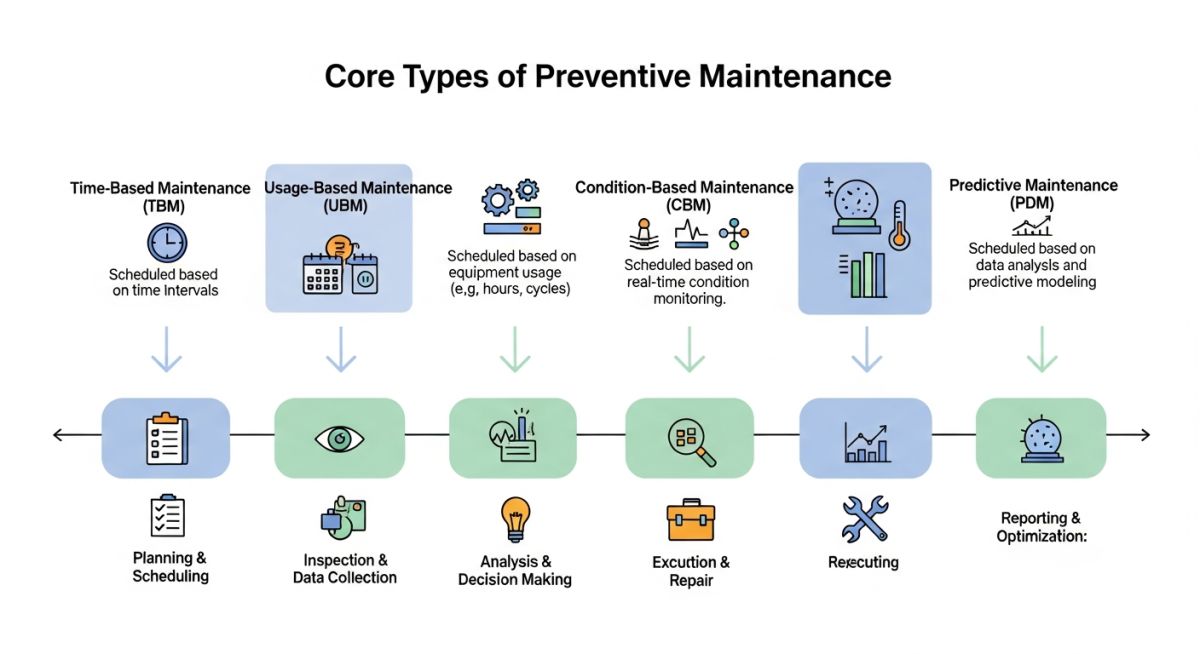
We categorize these activities into two primary execution paths:
- Time-Based (Calendar-Driven): Tasks performed at fixed calendar intervals (e.g., monthly, quarterly, or annually) regardless of equipment usage. This is ideal for static equipment like piping systems, pressure vessels, and structural supports subject to atmospheric corrosion.
- Usage-Based (Runtime-Driven): Tasks triggered by operational metrics (e.g., operating hours, stroke cycles, or production volume). This is highly effective for rotating machinery such as compressors, turbines, and pumps.
Preventive Maintenance Intervals and Technical Parameters
The table below outlines standard maintenance intervals and key inspection parameters for critical plant assets. These values are derived from industry standards, including API 570 for piping inspection and ASME Section VIII for pressure vessels.
| Asset Class | PM Type | Standard Frequency | Critical Parameters to Measure | Governing Code |
|---|---|---|---|---|
| Process Piping (Class 1) | Thickness Measurement (UT) | Every 5 Years (or half-life) | Minimum wall thickness, corrosion rate | API 570 |
| Centrifugal Pumps | Vibration & Lube Oil Analysis | Monthly / 1,000 Hours | Velocity (mm/s), particle count, viscosity | ISO 10816 |
| Pressure Vessels | External Visual Inspection | Every 5 Years | Insulation integrity, weld cracking, settlement | API 510 |
| Emergency Shutdown Valves | Full Stroke Testing | Annually | Stroke time, seat leakage rate | ISA 84 / IEC 61511 |
Technical Mapping & Specifications Matrix
To integrate these practices into a Computerized Maintenance Management System (CMMS), engineers must map physical parameters to specific technical entities.
| Entity Acronym | Technical Definition | Physical Parameter | Reference Standard |
|---|---|---|---|
| MTBF | Mean Time Between Failures | Operating Hours / Failures | ISO 14224 |
| MTTR | Mean Time To Repair | Active Repair Time / Failures | IEEE 3004.5 |
| OEE | Overall Equipment Effectiveness | Availability x Performance x Quality | ISO 22400 |
| RBI | Risk-Based Inspection | Probability x Consequence of Failure | API 580 / 581 |
How to Execute Site Verification Inspections?
Before signing off on any preventive maintenance work order, field supervisors must physically verify the quality of the work. Use this checklist to ensure no critical steps are missed during field execution.
Field Inspection Verification Checklist
Field Case Study: Real-World Application
The Problem: Catastrophic Steam Line Failure
At a major chemical processing facility, a 12-inch high-pressure superheated steam line (operating at 450 degrees Celsius and 40 bar) suffered a sudden catastrophic weld failure. The plant operated on a purely reactive maintenance model, only inspecting piping when visible steam leaks occurred. The failure caused an immediate emergency shutdown, costing the facility approximately 180,000 per day in lost production, along with significant safety risks to nearby personnel.
The Solution & Outcome: Implementing API 570 PM Protocols
I was brought in to lead the root cause analysis and redesign the maintenance strategy. We discovered the failure was caused by localized thermal fatigue and stress corrosion cracking. We immediately implemented a structured preventive maintenance program:
- Established a Risk-Based Inspection (RBI) program in compliance with API 580.
- Scheduled semi-annual ultrasonic thickness measurements (UT) at high-stress elbows and weld joints.
- Introduced quarterly thermal imaging surveys to detect insulation degradation and localized hot spots.
Over the next 36 months, this proactive approach identified three separate instances of localized wall thinning before they reached critical limits. The plant avoided an estimated 1.2 million in unplanned outage costs, and overall piping reliability increased by 94%.
My recommendation for any plant manager is clear: do not wait for a catastrophic failure to force your hand. The cost of implementing a structured inspection program is a fraction of the cost of a single day of unplanned downtime.
Frequently Asked Engineering Questions
What is the difference between preventive and predictive maintenance?
How do you determine the optimal PM frequency for a new asset?
Can preventive maintenance cause equipment failures?
What are the main disadvantages of a PM strategy?
How does ISO 55001 relate to preventive maintenance?
What is the target ratio of proactive to reactive maintenance?
======
Complete Course on
Piping Engineering
Check Now
Key Features
- 125+ Hours Content
- 500+ Recorded Lectures
- 20+ Years Exp.
- Lifetime Access
Coverage
- Codes & Standards
- Layouts & Design
- Material Eng.
- Stress Analysis