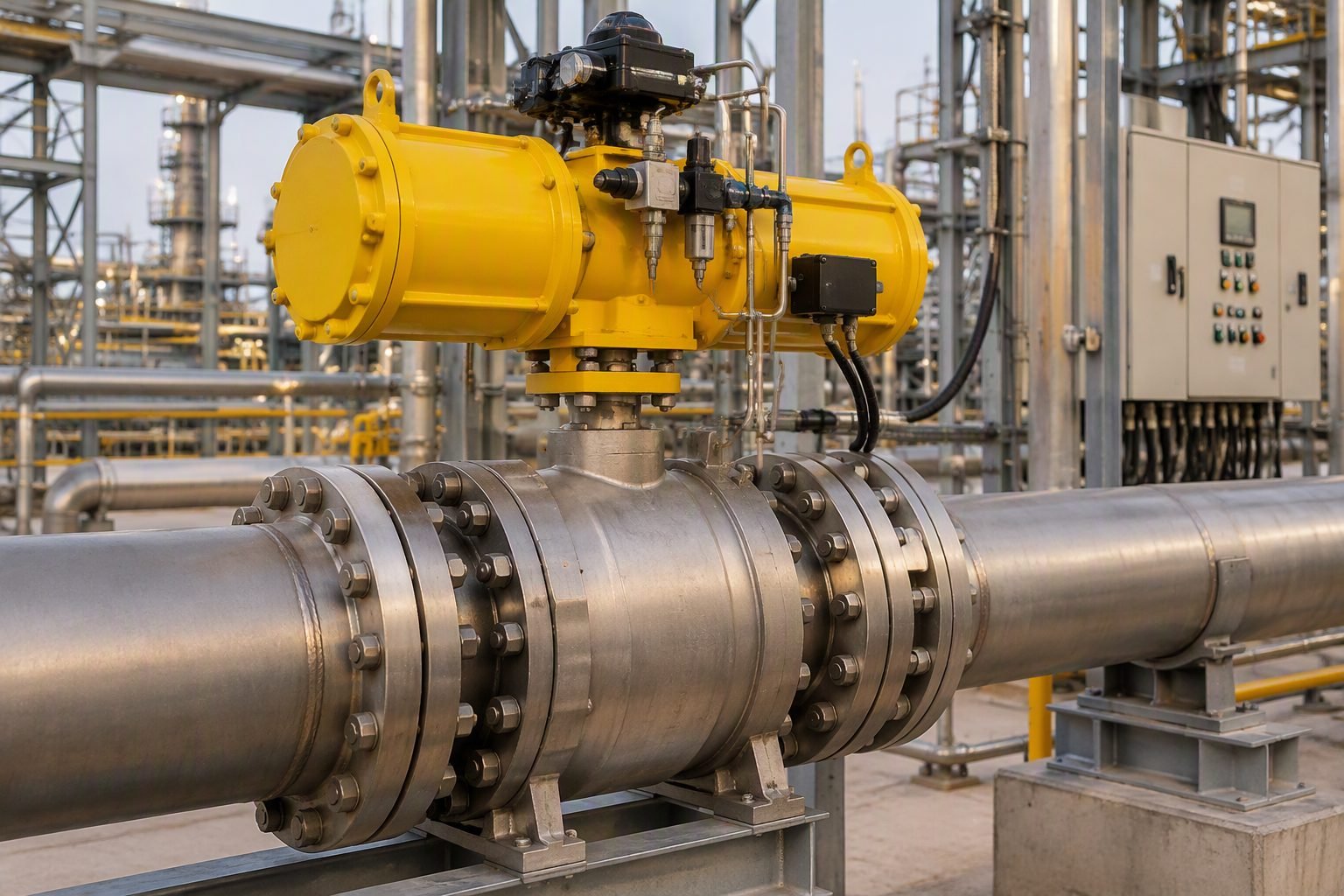
Pneumatic Actuated Ball Valves for Emergency Shutdown
In my twenty years of designing high-consequence process plants, selecting the right final control element for HAZOP-flagged safety instrumented functions remains one of the most critical responsibilities for a piping engineer. When a hydrocarbon leak or runaway reaction threatens an entire unit, milliseconds matter. That is why I rely on heavy-duty pneumatic actuated ball valves equipped with fail-safe spring-return mechanisms to achieve positive isolation.
Throughout this guide, I will walk you through the rigorous mechanical sizing, torque calculations, actuator selection criteria, and maintenance frameworks required to keep your emergency shutdown (ESD) loops compliant and reliable. We will examine how spring torque margins, seat friction coefficients, and instrument air supply integrity dictate whether your valve will successfully close against maximum differential pressure when DCS signals trip.
- Actuator sizing must incorporate a minimum 25% safety margin over clean breakaway torque.
- Spring-return pneumatic cylinders ensure fail-safe closure upon loss of instrument air or electrical signal.
- Valve bodies must conform to ASME B16.34 pressure-temperature ratings and fire-safe testing per API 607.
- Routine partial stroke testing (PST) verifies valve responsiveness without interrupting live process flow.
Pneumatic Actuated Ball Valve Engineering Principles
Designing an emergency shutdown valve requires a deep understanding of hydrodynamic forces, friction coefficients, and dynamic torque profiles. Unlike standard modulating control valves, ESD valves spend the majority of their operational life in the fully open position. This stagnant operating state can lead to seat stiction and mineral scaling, which dramatically increases the breakaway torque required when an emergency trip occurs.
When calculating the required pneumatic actuator output torque, I always evaluate four distinct torque components mandated by good engineering practice. These include breakaway torque under maximum differential pressure, running torque across the 90-degree stroke, end closure seating torque, and minimum unseating torque. Neglecting any of these variables can result in a valve stalling mid-stroke during a plant emergency.
Sizing Calculations and Torque Margins
To calculate the baseline breakaway torque (T_b) for a trunnion-mounted ball valve, engineers utilize the seating friction formula combined with hydrostatic end loads. The fundamental equation accounts for ball diameter, seat face width, coefficient of friction between the seat and ball, and the differential pressure across the bore:
In this expression, d represents the ball diameter, F_s is the total seating force generated by fluid pressure and pre-loaded seat springs, and mu is the dynamic friction coefficient of the soft or metal seat material. For severe service applications handling abrasive catalyst fines or high-velocity gas, metal-seated ball valves require significantly higher friction multipliers, often ranging from 0.35 to 0.50.
Never size a spring-return pneumatic actuator using only the minimum spring end-torque rating at zero air pressure. If the supply air pressure drops below the design threshold during a plant brownout, the stored spring force must still overcome maximum upset differential pressure to achieve bubble-tight shutoff per API 598 test criteria.
Actuator Mechanics and Cylinder Configurations
Rack-and-pinion and scotch-yoke pneumatic actuators represent the two primary mechanical designs deployed in hydrocarbon processing facilities. Rack-and-pinion actuators deliver a nearly constant torque output across the entire 90-degree rotation, making them ideal for smaller ball valves up to 6 inches where torque demands remain relatively flat.
For larger pipeline isolation valves operating at ASME Class 600 or higher, scotch-yoke actuators are the industry standard. The scotch-yoke mechanism produces a high torque output at both ends of the stroke—precisely where the ball requires maximum breakout force to unseat against stagnant process fluids. This torque curve perfectly matches the natural resistance profile of a quarter-turn ball valve.
Compliance with International Piping Codes
Every pneumatic actuated ball valve assembly installed on HAZOP-flagged emergency lines must be fully traceable and certified to recognized international standards. Valve bodies are designed in strict accordance with ASME B16.34 for wall thickness and pressure ratings, while flange dimensions conform to ASME B16.5 or ASME B16.47.
Furthermore, fire-safe qualifications per API 607 or ISO 10497 are mandatory for any installation handling flammable hydrocarbons. These standards verify that secondary metal-to-metal sealing surfaces maintain containment even if elastomeric soft seats are completely destroyed during a plant fire event.
- Extremely fast stroke times, frequently achieving full closure in under two seconds for critical ESD service.
- Inherently fail-safe mechanical spring return guarantees valve closure upon loss of plant instrument air or electrical power.
- High torque-to-weight ratio compared to heavy electric motor actuators, reducing piping support loads.
- Robust resistance to vibration and high-temperature ambient conditions common in refinery and petrochemical units.
- Simpler mechanical construction lowers initial capital expenditure and reduces mean time to repair.
- Requires a clean, dry, and continuous instrument air header system with dedicated accumulator tanks for remote locations.
- Prone to moisture condensation and internal cylinder corrosion if air filtration and drying systems fail.
- Challenging to achieve precise intermediate throttling positions without expensive electro-pneumatic positioners and digital feedback loops.
- Spring-return cylinders are physically bulky and heavy on large diameter high-pressure valves.
- Continuous air consumption from pneumatic accessories can increase overall plant utility operating costs.
High-pressure hydroprocessing units handle hydrogen and heavy gas oils at extreme pressures exceeding 150 bar. Pneumatic actuated trunnion ball valves are installed on reactor feed and effluent lines to provide rapid emergency isolation when high-temperature excursions or reactor leaks trigger the plant safety instrumented system.
On offshore top-side facilities, space and weight constraints are paramount. Compact rack-and-pinion pneumatic actuated ball valves manage wellhead master and wing isolation, ensuring that subsea or surface production lines can be instantly shut in during severe weather or topside hydrocarbon releases.
Cryogenic boil-off gas handling systems operate at temperatures down to minus 162 degrees Celsius. Specialized extended-bonnet pneumatic ball valves prevent cryogenic freezing of actuator stem seals while delivering rapid fail-safe shutdown across flammable refrigerant loops.
Manufacturing facilities producing toxic intermediates like phosgene or chlorine rely on fail-safe pneumatic ball valves with dual-acting spring cylinders and tight shutoff ratings to prevent fugitive emissions during catastrophic seal failures or scrubbing system upsets.
Pneumatic Actuator Sizing and Valve Torque Parameters
Precision sizing of pneumatic actuators for emergency shutdown ball valves requires balancing breakaway torque, running torque, and maximum allowable stem stress against available supply pressures. In my professional piping design practice, failing to account for unseating friction over prolonged idle periods frequently results in stalled actuators during safety instrumented system trips.
The following reference table outlines standard sizing margins, operating pressure ranges, and torque multipliers mandated across critical process applications under ASME B16.34 and API 6D manufacturing frameworks. These figures ensure compliance with stringent safety integrity level requirements on HAZOP-flagged isolation headers.
| Valve Size (NPS) | Breakaway Torque (Nm) | Min Air Supply (bar) | Actuator Safety Factor | Design Standard |
|---|---|---|---|---|
| NPS 2 (DN 50) | 145 Nm | 5.5 bar | 1.35x | API 6D / ASME B16.34 |
| NPS 4 (DN 100) | 480 Nm | 6.0 bar | 1.40x | API 6D / ASME B16.34 |
| NPS 8 (DN 200) | 1,850 Nm | 6.5 bar | 1.50x | API 6D / ASME B16.34 |
| NPS 12 (DN 300) | 4,200 Nm | 7.0 bar | 1.50x | API 6D / ASME B16.34 |
Note: All actuator selections must incorporate spring-return fail-safe configurations capable of overcoming maximum differential pressure across the ball element during emergency isolation events.
Technical Mapping & Specifications Matrix
To establish complete traceability across engineering deliverables, procurement packages, and safety validation dossiers, a rigorous entity mapping matrix is essential. This matrix correlates major pneumatic actuated ball valve subsystems with their respective governing industrial codes, material grades, and diagnostic parameters.
In my system designs, referencing this structured matrix during HAZOP resolution walkthroughs eliminates ambiguity between mechanical piping teams, instrumentation specialists, and process safety engineers.
| System Entity | Structural Acronym | Physical Parameter | Governing Standard |
|---|---|---|---|
| Emergency Shutdown Valve | ESDV | Stroke Speed (< 2 seconds) | IEC 61508 / ANSI/ISA-84 |
| Pneumatic Spring Return Actuator | PSRA | Spring Torque Output | ISO 5211 / ASME B31.3 |
| Solenoid Operated Valve | SOV | Cv Flow Capacity / Response Time | IEC 60534 |
| Position Feedback Transmitter | PFT | 4-20mA HART / Profibus PA | IEC 60529 |
Entity relationships must be verified during pre-commissioning loop checks to confirm that electrical interlocks and pneumatic venting pathways operate in unison during safety instrumented system activations.
Pneumatic Actuated Ball Valve Site Verification Checklist
Validating the installation and functional readiness of emergency shutdown pneumatic ball valves requires a meticulous site verification process. Drawing from my field commissioning experience, overlooking minor instrument tubing routing errors or inadequate mechanical support brackets can compromise valve stroking times when it matters most.
Use the structured verification framework below during pre-startup safety reviews to ensure total compliance with ASME B31.3 process piping requirements and API 570 inspection standards.
Pre-Commissioning & Operational Readiness Audit
- ☑ Actuator Alignment Check: Verify mounting bracket assembly is rigidly secured with zero angular deflection between valve stem and actuator drive shaft.
- ☑ Air Supply Quality Audit: Confirm instrument air supply meets ISO 8573-1 purity standards for particulate, oil, and moisture content before purging lines.
- ☑ Solenoid Function Testing: Test de-energization of the pilot solenoid valve to verify rapid exhaust and smooth spring-return closure within required timing limits.
- ☑ Control Tubing Integrity: Inspect all stainless steel control tubing runs for proper slope, vibration damping clamps, and leak-free compression fittings.
- ☑ Limit Switch Calibration: Ensure open and closed limit switch feedback contacts accurately register position on the central distributed control system.
- ☑ HAZOP Interlock Verification: Perform a complete loop dry run confirming emergency trip signals successfully actuate the isolation valve without manual intervention.
All completed verification checkpoints must be signed off by both the lead mechanical piping engineer and the instrument quality control inspector prior to introducing hydrocarbon process fluids.
Field Case Study: Real-World Application
During a recent offshore platform HAZOP re-validation study, an existing emergency shutdown line equipped with a pneumatic actuated trunnion mounted ball valve exhibited critical response time delays during routine partial stroke testing.
Problem Statement
The emergency isolation valve failed to achieve complete closure within the mandatory two-second safety window, threatening compliance with safety instrumented system integrity targets.
- Undersized quick-exhaust valves restricted rapid venting of pneumatic actuator cylinder chambers during trip simulation.
- Accumulation of hydrocarbon condensate in the instrument air supply header caused internal corrosion and sluggish piston movement.
- Frictional drag from high differential pressure across the metal-seated ball exceeded the available spring-return torque margin.
- Improper bracket alignment introduced bending stress on the valve stem, binding the internal guide bearings.
Outcome & Resolution
Implementing a comprehensive retrofit engineering package successfully restored full compliance and reduced emergency closure times to 1.4 seconds.
- Upgraded dual high-capacity quick-exhaust valves directly at the actuator ports to eliminate pneumatic backpressure.
- Installed an upstream dual-tower regenerative air dryer and coalescing filter package to guarantee ISO 8573-1 dry instrument air.
- Re-engineered the actuator-to-valve coupling with an increased 1.5x torque safety factor to overcome breakout friction under full line pressure.
- Completed laser alignment checks on the mounting hardware to eliminate stem binding and ensure smooth axial travel.
Engineering Recommendation: Always conduct dynamic torque calculations under maximum differential pressure conditions rather than relying solely on breakaway torque ratings when specifying emergency shutdown valves for HAZOP-flagged hazardous services.
Frequently Asked Engineering Questions
What defines a HAZOP-flagged emergency shutdown valve under ASME standards?
- Compliance with ASME B16.34 for pressure-temperature ratings and shell thickness
- Verification under API 6D or API 6FA for fire-safe testing and leakage rates
- Design verification for rapid closure against maximum allowable working pressure
How do spring-return pneumatic actuators ensure fail-safe operation during power loss?
- Pneumatic pressure is counteracted by pre-compressed mechanical springs during normal operation
- Loss of supply air exhausts cylinder pressure instantly via a solenoid trip valve
- Stored spring force drives the ball rotation mechanism to closed or open positions within mandated stroking times
What are the key sizing parameters for actuator torque calculation on ball valves?
- Break-to-open and unseating torque derived from maximum pipeline differential pressure
- Running and dynamic torque during 90-degree rotation under flowing conditions
- Application of a minimum safety factor of twenty-five percent as recommended in engineering practices
Why are trunnion-mounted ball valves preferred over floating designs for ESD service?
- Line pressure pushes spring-loaded seats against the fixed ball to achieve positive sealing
- Lower operating torque allows the use of smaller, faster pneumatic actuators
- Enhanced resistance to jamming and high-frequency cycling in severe industrial environments
What routine inspection criteria apply to pneumatic control tubing and quick exhaust valves?
- Leak testing of instrument air connections using bubble solutions or ultrasonic detectors
- Inspection of stainless steel tubing for corrosion, vibration fatigue, and secure routing
- Functional testing of quick exhaust valves and solenoid vents to verify stroke speed compliance
Field Recommendation
- If your HAZOP review designates the emergency shutdown valve with a Safety Integrity Level rating of SIL-2 or higher, specify dual-acting spring-return pneumatic actuators paired with 316L stainless steel control tubing to eliminate single points of failure.
- When sizing actuators for severe hydrocarbon services with high differential pressures, always apply a minimum thirty percent torque safety margin over the calculated unseating torque to prevent sticking during emergency stroking.
- Specify trunnion-mounted ball valve configurations for all elevated process lines exceeding ASME Class 300 ratings, as floating ball designs introduce excessive seat wear and operational torque under high line pressure.
- Mandate quick exhaust blocks and volume booster relays directly on the pneumatic cylinder ports if stroking times must meet strict safety shutdown windows under two seconds.
Complete Course on
Piping Engineering
Check Now
Key Features
- 125+ Hours Content
- 500+ Recorded Lectures
- 20+ Years Exp.
- Lifetime Access
Coverage
- Codes & Standards
- Layouts & Design
- Material Eng.
- Stress Analysis
