
Why PMP Certification is Key for Engineering Careers
In my 20+ years of managing large-scale piping and EPC projects, I have seen brilliant technical minds struggle when transitioned into leadership roles. They can calculate the exact wall thickness of a high-pressure steam line or design a flawless manifold system, but they falter when managing stakeholder expectations, tracking project budgets, or handling contract disputes. This is where the gap between pure engineering and project management becomes a major bottleneck.
Early in my career, I realized that technical expertise alone would not secure me a seat at the executive table. To truly drive multi-million dollar industrial projects to successful completion, I needed a structured framework. Obtaining my project management credentials changed everything. It provided me with a systematic language to communicate with clients, finance teams, and construction crews alike.
Key Takeaways of This Guide
- Understand how project management frameworks integrate with technical engineering workflows.
- Learn the exact Earned Value Management (EVM) formulas required to control project costs.
- Discover a structured roadmap to prepare for and pass the certification exam on your first attempt.
- Explore real-world case studies demonstrating the impact of formal project controls on industrial sites.
How PMP Certification Empowers Industrial Engineers
Engineering projects are inherently complex, involving multiple disciplines, strict regulatory codes, and tight margins. When we apply the principles of the Project Management Institute (PMI), we transition from reactive troubleshooting to proactive project control. This transition is critical when dealing with high-risk environments like petrochemical plants, power generation facilities, and infrastructure developments.
The Math of Project Control: Earned Value Management
One of the most powerful tools an engineer gains from project management training is Earned Value Management (EVM). EVM integrates scope, schedule, and resources to measure project performance. Let us look at a real-world piping modification project to see how these calculations work in practice.
Project Parameters:
Budget at Completion (BAC) = 1,200,000 USD
Planned Value (PV) at Mid-Point = 600,000 USD
Earned Value (EV) Achieved = 500,000 USD
Actual Cost (AC) Incurred = 550,000 USD
Calculations:
1. Cost Variance (CV) = EV – AC
CV = 500,000 – 550,000 = -50,000 USD (Over Budget)
2. Schedule Variance (SV) = EV – PV
SV = 500,000 – 600,000 = -100,000 USD (Behind Schedule)
3. Cost Performance Index (CPI) = EV / AC
CPI = 500,000 / 550,000 = 0.91 (Only 91 cents of value delivered per dollar spent)
4. Schedule Performance Index (SPI) = EV / PV
SPI = 500,000 / 600,000 = 0.83 (Progressing at 83% of the planned rate)
5. Estimate at Completion (EAC) = BAC / CPI
EAC = 1,200,000 / 0.91 = 1,318,681 USD (Projected final cost)
As an engineering lead, these metrics give you the objective data needed to make course corrections. If your CPI is 0.91, you cannot simply hope things get better. You must investigate the root cause—whether it is design rework, piping fabrication delays, or inefficient field labor—and implement corrective actions immediately.
Relying solely on technical intuition without formal project controls is a recipe for project failure. I have seen projects where the engineering design was award-winning, but the project failed because the team ignored scope creep and failed to document change orders under ASME B31.3 design modifications.
| Metric | Formula | Engineering Interpretation | Project Impact |
|---|---|---|---|
| Cost Variance (CV) | EV – AC | Measures budget surplus or deficit relative to work completed. | Negative values indicate cost overruns in design or procurement. |
| Schedule Variance (SV) | EV – PV | Measures schedule alignment against the baseline plan. | Negative values signal delays in engineering deliverables. |
| Cost Performance Index (CPI) | EV / AC | Efficiency ratio of capital spent on the project. | Values below 1.0 require immediate cost-containment strategies. |
| Schedule Performance Index (SPI) | EV / PV | Efficiency ratio of schedule progression. | Values below 1.0 indicate a need to optimize resource allocation. |
| PMBOK Process Group | Engineering Phase Deliverable | Key Focus Area | Applicable Standards |
|---|---|---|---|
| Initiating | Feasibility Study & FEED | Project Charter, Stakeholder Identification | PMI Standards |
| Planning | Detailed Engineering Design | WBS, Resource Loading, Risk Register | ASME Codes |
| Executing | Procurement & Construction | Quality Assurance, Team Management | API Standards |
| Monitoring & Controlling | Field Inspection & Testing | EVM, Change Control, Quality Control | ISO 9001 |
| Closing | Commissioning & Handover | As-Built Drawings, Lessons Learned | OSHA Regulations |
Your Step-by-Step PMP Certification Roadmap
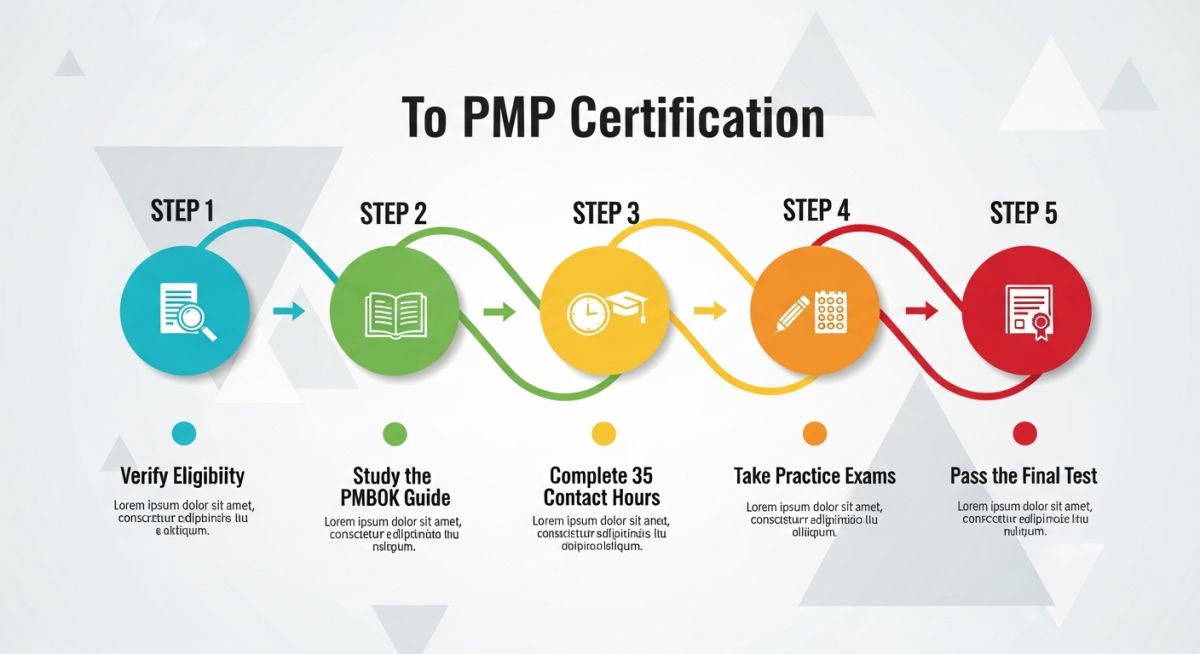
Preparing for the exam requires a disciplined approach, much like executing a complex engineering design. You cannot rely on last-minute cramming. Based on my experience mentoring dozens of engineers through this process, I have compiled a comprehensive checklist to guide your preparation.
Engineering PMP Preparation Checklist
Ensure you have a four-year degree with 36 months of leading projects, or a high school diploma with 60 months of leading projects.
Enroll in a PMI-approved Registered Education Provider (R.E.P.) course to satisfy the formal education requirement.
Focus on the integration of predictive (waterfall) and adaptive (agile/hybrid) methodologies, which now make up 50% of the exam.
Practice calculating CPI, SPI, CV, SV, EAC, and ETC without relying on external reference sheets.
Complete at least 3 to 4 full 180-question practice exams under timed conditions to build stamina.
Document your project experience using professional project management terminology (initiating, planning, executing, monitoring, closing).
Field Case Study: Real-World Application
During a major refinery expansion project, the engineering team faced severe schedule slippage and cost overruns. The primary issue was uncontrolled scope creep. The client kept requesting minor design modifications to the piping layouts without formal change orders. Because the lead engineers lacked formal project management training, they accepted these changes to maintain good relations, unaware of the compounding impact on the project baseline.
A PMP-certified Lead Engineer was brought in to stabilize the project. He immediately established a formal Change Control Board (CCB) and implemented Earned Value Management tracking. By calculating the Cost Performance Index (CPI) and Schedule Performance Index (SPI) weekly, the team identified that piping fabrication was the primary bottleneck.
With objective data in hand, they renegotiated the schedule baseline, documented all outstanding design changes, and recovered 14% of the schedule variance, completing the project within the revised budget.
My direct recommendation to any engineering firm is to mandate project management training for all lead and principal engineers. When your technical leads understand the financial and contractual implications of their design decisions, your project success rate will increase dramatically.
Answering Your PMP Certification Questions
Does my engineering experience count toward the PMP requirements?
How long does it take to prepare for the PMP exam?
Is the PMP exam difficult for technical professionals?
What is the passing score for the PMP exam?
How does PMP compare to a Professional Engineering (PE) license?
How often do I need to renew my PMP certification?
===FAQ_BLOCK===
Complete Course on
Piping Engineering
Check Now
Key Features
- 125+ Hours Content
- 500+ Recorded Lectures
- 20+ Years Exp.
- Lifetime Access
Coverage
- Codes & Standards
- Layouts & Design
- Material Eng.
- Stress Analysis

📚 Recommended Resources: PMP certification for engineers
Read these Guides
- 📄 PMP Certification Training: The Complete Guide to 35 Contact Hours & Passing the 2025/2026 Exam
- 📄 Master Piping Engineering: Your Complete Course Blueprint
- 📄 Complete Course on Valve Material Specification (VMS): Piping Engineering
- 📄 Comprehensive Guide to Feed Contracts for Oil and Gas Projects: Key Clauses Explained


