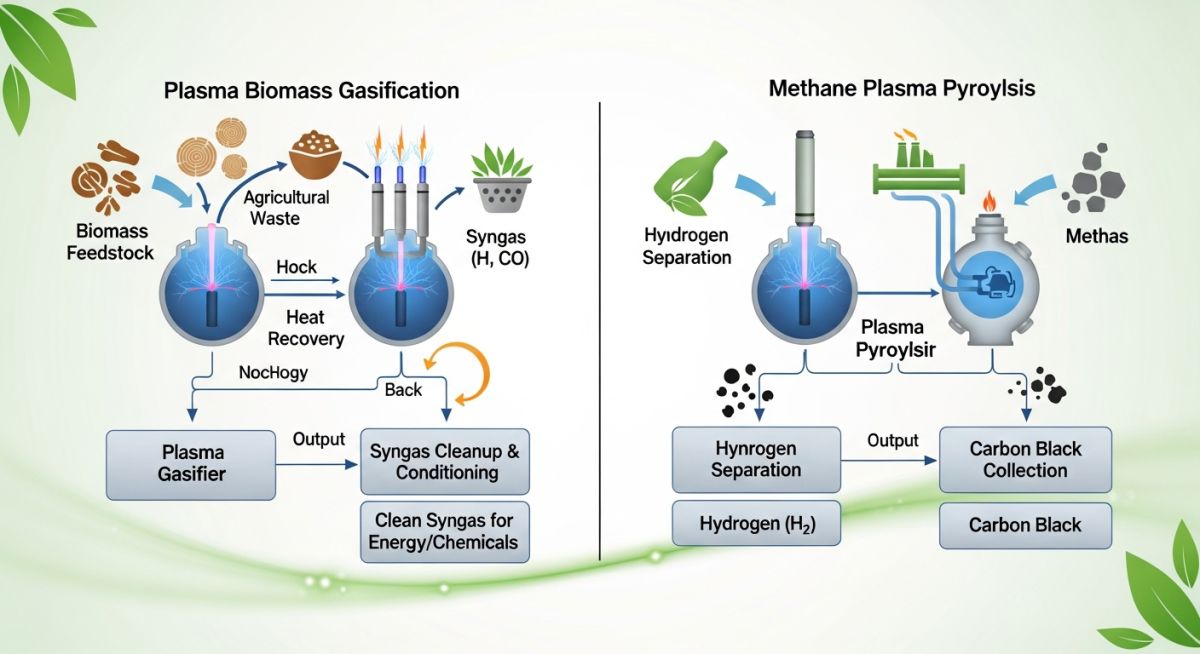
Plasma Biomass Gasification and Methane Plasma Pyrolysis: TRLs, Licensors, and Process Optimization
Plasma Biomass Gasification represents the pinnacle of waste-to-energy technology, offering a near-tar-free syngas pathway for complex feedstocks, while methane plasma pyrolysis emerges as the premier route for Turquoise Hydrogen Production. As we navigate the 2026 energy landscape, understanding the Technology Readiness Level (TRL) of these ionized thermal processes is critical for global decarbonization and high-purity carbon black valorization.
Summary of Plasma Conversion
Plasma Biomass Gasification utilizes high-energy thermal plasma (1300–1400 °C) to convert organic matter into high-quality syngas (H₂, CO) with tar levels below 0.1 g/Nm³. Simultaneously, methane plasma pyrolysis cracks CH₄ into Turquoise Hydrogen and solid carbon black without direct CO₂ emissions, achieving TRL 8 in commercial facilities.
Table of Contents
Plasma Engineering Knowledge Check
Question 1 of 5What is the typical operating temperature range for a thermal Plasma Biomass Gasification reactor?
Quiz Complete!
Complete Course on
Piping Engineering
Check Now
Key Features
- 125+ Hours Content
- 500+ Recorded Lectures
- 20+ Years Exp.
- Lifetime Access
Coverage
- Codes & Standards
- Layouts & Design
- Material Eng.
- Stress Analysis
Understanding Plasma Biomass Gasification Theory and Fundamentals
The core of Plasma Biomass Gasification lies in the utilization of ionized gas to create an extremely high-energy environment. Unlike conventional gasification, which relies on partial oxidation of the feedstock to provide heat, plasma systems decouple the energy source from the chemical reactions. This allows for temperatures exceeding 1300°C, ensuring the total breakdown of complex organic molecules.
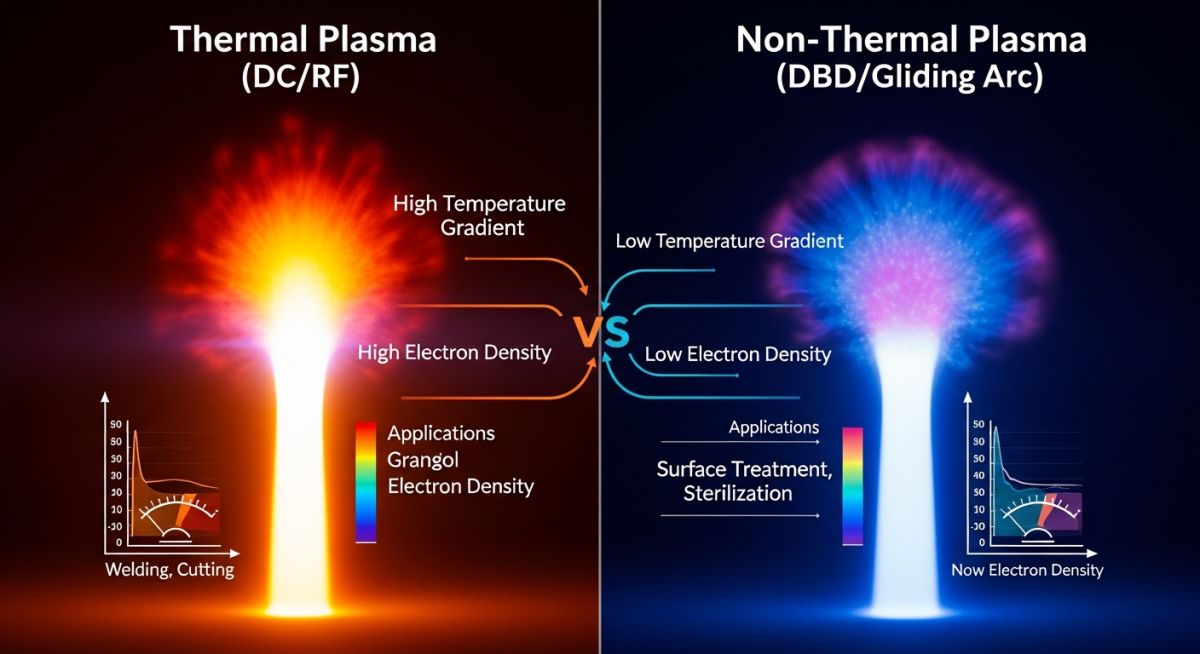
Thermal vs Non-Thermal Plasma (NTP) Systems
Engineering designs typically fall into two categories: Thermal and Non-Thermal. Thermal plasmas (DC or RF torches) achieve local thermodynamic equilibrium, where gas temperatures match electron temperatures (5000–10,000 K). In contrast, Non-Thermal Plasma (NTP), such as Dielectric Barrier Discharge (DBD) or Gliding Arc, maintains high electron energy while the bulk gas remains relatively cool (300–1000 K), offering unique pathways for selective chemical excitation.
Syngas Tar Reforming and Plasma Reactions
A primary advantage of this technology is Syngas Tar Reforming. Conventional biomass gasification is plagued by tar production (5–50 g/Nm³), which fouls downstream equipment. High-temperature plasma ensures that heavy hydrocarbons are cracked into primary syngas components (H₂ and CO). Standard ASME and API guidelines for syngas purity are easily met, with tar levels often plummeting to below 0.1 g/Nm³.
Technology Readiness Level (TRL) and Global Licensor Audit
The commercial viability of these technologies varies significantly. Plasma Biomass Gasification currently sits at TRL 5–6 for pure biomass applications, while waste-to-energy variants have reached TRL 7–8. Licensors like Alter NRG (Westinghouse) and Advanced Biofuel Solutions (RadGas) have demonstrated scales up to 200 tpd.
Plasma Biomass Gasification Commercial Players
Key players in the 2026 market include:
- Plasco: Historical focus on MSW with plasma-refined syngas.
- PyroGenesis: Specialist in high-powered torch systems for hazardous waste and biomass.
- Advanced Plasma Power: Pioneers of the Gasplasma® process combining fluid bed gasification with plasma polishing.
Methane Plasma Pyrolysis TRL 8 Leaders
While biomass gasification matures, Methane Plasma Pyrolysis has surged to TRL 8. Companies like Monolith Materials (Olive Creek facility) have proven the commercial-scale production of hydrogen and carbon black. This process is increasingly recognized as the gold standard for Turquoise Hydrogen Production due to its carbon-negative potential when paired with renewable grid power.
Energy Balances in Methane Plasma Pyrolysis and Gasification
The thermodynamic efficiency of plasma systems is heavily dictated by the feedstock’s enthalpy and moisture content. In Plasma Biomass Gasification, the net energy balance must account for the high specific heat capacity of water. For a typical system, the energy balance is defined as:
For Methane Plasma Pyrolysis, the energy input is focused on breaking the C-H bond (approx. 435 kJ/mol). Since no oxygen is present, no CO2 is formed, directing the majority of the energy into the H2 product and solid carbon.
Calculating Turquoise Hydrogen Production Efficiency
The efficiency (η) of Turquoise Hydrogen Production is the ratio of the energy content in the produced H2 and carbon black to the total electrical and feedstock energy input.
Efficiency Impacts of Feedstock Moisture
In Plasma Biomass Gasification, moisture levels exceeding 20% lead to an exponential increase in Edrying. Engineering teams must prioritize pre-treatment or torrefaction to maintain a Cold Gas Efficiency (CGE) above 60%.
| Parameter | Plasma Gasification | Methane Pyrolysis |
|---|---|---|
| Primary Product | Syngas (H2, CO) | Turquoise Hydrogen |
| By-Product | Vitrified Slag | Carbon Black Valorization |
| Energy Intensity | 1–2 kWh/kg feedstock | 15–25 kWh/kg H2 |
| TRL (2026) | 5–7 | 8 |
Turquoise Hydrogen Production and Carbon Black Valorization
The commercial bridge between these technologies is the Carbon Black Valorization pathway. In Methane Plasma Pyrolysis, the carbon is sequestered as a high-value solid rather than emitted as a gas. This carbon black meets specifications for rubber reinforcement, UV stabilization, and specialty conductive coatings.
Environmental Impact (LCA) of Plasma Technologies
Lifecycle Assessments (LCA) indicate that if the electricity source is renewable (Wind/Solar), Turquoise Hydrogen Production achieves a negative carbon footprint. For Plasma Biomass Gasification, the vitrification of ash into non-leachable slag provides a superior waste management solution compared to traditional incineration or landfilling, meeting stringent 2026 environmental protocols.
Plasma Biomass Gasification & Pyrolysis Calculator
Estimated 2026 Yields
Engineering Challenges in Scaling Plasma Biomass Gasification
The primary hurdle in scaling Plasma Biomass Gasification remains the electrode lifespan and torch stability. In high-temperature oxidizing environments, even tungsten or copper electrodes suffer from rapid erosion. Advanced cooling jackets and magnetic arc rotation are mandatory engineering requirements to ensure continuous operation beyond 1,000 hours.
CAPEX/OPEX Analysis for 2026
For a 100 tpd facility, CAPEX is estimated between $5M and $10M, depending on the feedstock pre-treatment complexity. OPEX remains sensitive to electricity pricing, making these plants most viable in regions with high tipping fees or abundant renewable energy for Turquoise Hydrogen Production.
EPCLand YouTube Channel
2,500+ Videos • Daily Updates
Don’t miss this video related to Biomass Gasification

Summary: Let’s dive into the technical rulebook of India’s Green Hydrogen Certification Scheme (GHCI). In Module 2, we cover the essential ……
Plasma Biomass Gasification Failure Case Study: The Plasco Trail Road Analysis
Project Data
- Location: Ottawa, Canada
- Design Capacity: 135 tpd (Tons Per Day)
- Technology: Plasma Arc Gasification (Plasco Conversion System)
- Primary Goal: MSW to Electricity via Gas Engines
Failure Analysis
Despite successful TRL 5 pilot testing, the commercial-scale facility faced critical operational hurdles that led to decommissioning.
- Syngas Quality Fluctuations: Variability in moisture and feedstock composition caused massive spikes in plasma power demand.
- Refractory Degradation: Extreme thermal gradients led to premature failure of reactor linings.
- Scale-Up Reliability: The system failed to achieve a consistent 90% uptime required for power purchase agreements.
Engineering Fix & Lessons
Contemporary designs in 2026, such as those used in Methane Plasma Pyrolysis and Turquoise Hydrogen Production, have implemented:
- ✔ Hybridization: Combining conventional gasification with plasma “polishing” to reduce torch load.
- ✔ Predictive Control: AI-driven plasma arc adjustment to handle feedstock variability.
- ✔ Electrode Advancement: Transitioning to RF (Radio Frequency) torches to eliminate electrode erosion entirely.
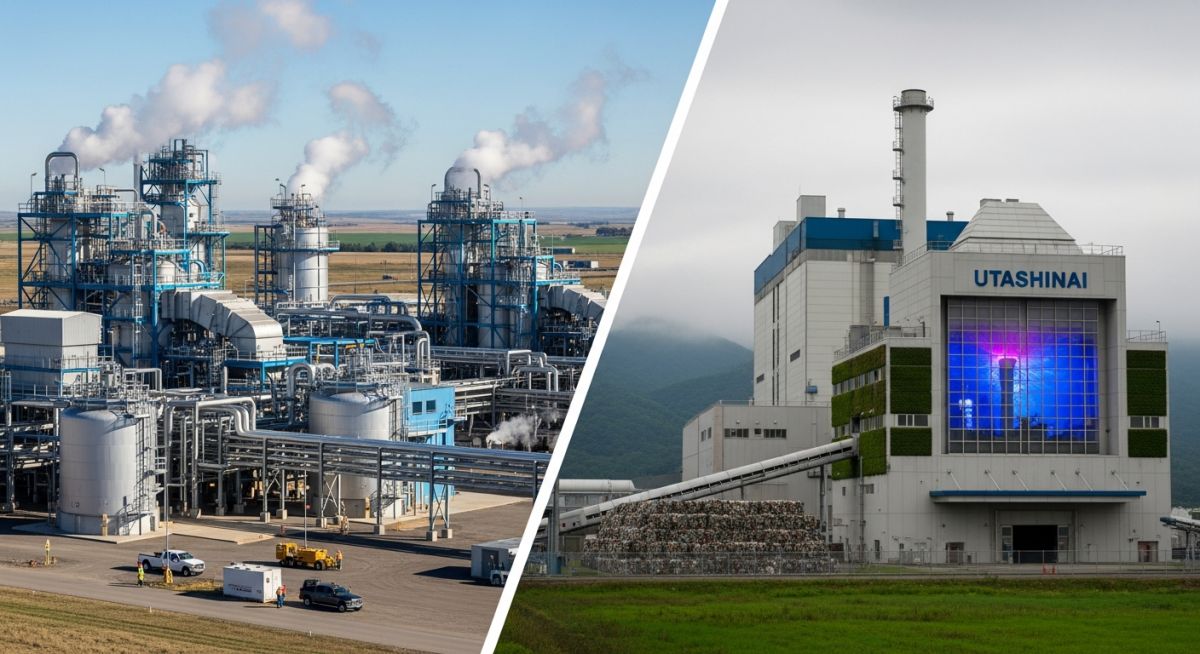
Figure 3: Comparative layout of large-scale thermal plasma reactors and their downstream syngas/hydrogen purification trains.
The 2026 Deployment Roadmap for Turquoise Hydrogen Production
The path to global deployment relies on modularity. Unlike massive central gasifiers, modern Plasma Biomass Gasification units are being designed as skid-mounted systems. This “distributed energy” model allows for the Turquoise Hydrogen Production to occur at the point of use—such as industrial hubs or refueling stations—minimizing H2 transport costs and maximizing Carbon Black Valorization profits.
Frequently Asked Questions about Plasma Technology
Is plasma biomass gasification a net-zero solution?
It can be. The CO and CO2 produced are from recently sequestered biomass carbon, making it theoretically neutral. However, the net carbon footprint depends entirely on the electricity source used for the plasma torch. Renewable power ensures a near-zero or negative lifecycle assessment (LCA).
What is the Technology Readiness Level (TRL) of commercial turquoise hydrogen production?
Turquoise Hydrogen Production via methane plasma pyrolysis is highly mature, achieving TRL 8 (commercial scale operation) at facilities like Monolith Materials in Nebraska. The primary challenge now is market absorption of the co-product, carbon black.
How does syngas tar reforming in plasma compare to traditional catalysts?
Plasma achieves superior syngas tar reforming compared to catalysts because the extreme temperatures (1300°C+) rapidly crack all complex hydrocarbons into simple H₂ and CO molecules, virtually eliminating catalyst poisoning issues common in conventional methods.
What are the main engineering standards (ASME/API) relevant to methane plasma pyrolysis reactors?
Reactors fall under rigorous pressure vessel codes (ASME Boiler and Pressure Vessel Code Section VIII) and require compliance with API 510/570 for inspection and piping standards (ASME B31.3). Material selection is critical due to high thermal stresses.
Conclusion: The Future of Plasma in Decarbonization
The 2026 engineering landscape clearly demarcates the utility of high-energy plasma systems. While Plasma Biomass Gasification offers a robust solution for circular economies and waste valorization, Methane Plasma Pyrolysis provides an immediate, scalable pathway for Turquoise Hydrogen Production. The key to future success lies in leveraging high Technology Readiness Level (TRL) designs, optimizing energy balances with renewable power, and finding profitable avenues for Carbon Black Valorization and vitrified slag. Epcland anticipates rapid growth in modular plasma solutions over the next decade.
📚 Recommended Resources: Biomass Gasification
Read these Guides



Related posts:
![High-grade industrial Wing Nut Types and Applications for mechanical assemblies.]()
Wing Nut Types and Applications: The 2026 Engineering Guide
![Industrial Monorail Crane Systems installed in a modern manufacturing plant 2026.]()
Monorail Crane Systems: Design, Types & 2026 Standards Guide
![Lead engineer performing a Factory Acceptance Test FAT on an industrial skid system 2026]()
Factory Acceptance Test FAT: The 2026 Engineering Guide to Zero-Defect Delivery
![Professional engineering workspace showing a Basis of Design document layout for a 2026 project.]()
Basis of Design: How to Write a BOD for Engineering Projects in 2026
![Industrial Flare Knockout Drum Sizing and installation in a refinery relief system.]()
Flare Knockout Drum Sizing: Design & API 521 Standards (2026 Guide)
![Advanced Reboiler Control Systems in a modern petrochemical refinery 2026.]()
Reboiler Control Systems: Engineering Guide to Precision Control 2026