Piping Engineering Certification Course: The 2026 Career Roadmap

A comprehensive Piping Engineering Certification Course is the definitive bridge between academic mechanical theory and the rigorous demands of the EPC (Engineering, Procurement, and Construction) industry. While university degrees teach you fluid dynamics, they rarely cover the practical application of ASME B31.3 process piping code or how to route a line through a congested refinery without causing a clash. In the competitive job market of 2026, possessing a certification that proves competence in design, materials, and stress analysis is often the deciding factor between landing a role at a top-tier firm or being passed over.
What Does a Piping Engineer Actually Do?
Piping Engineering is a multi-disciplinary specialization responsible for the layout, design, and integrity of piping systems that transport fluids. It stands on three technical pillars:
- ➤ Layout & Design: Routing pipes using 3D modeling software SP3D/E3D to connect equipment while optimizing space and operations.
- ➤ Stress Analysis: Using CAESAR II stress analysis training to ensure pipes don’t fail under thermal expansion or vibration.
- ➤ Materials: Selecting the correct piping material classes and specs (ASTM/API) for corrosive or high-pressure service.
⚡ Pre-Course Diagnostic: What Do You Know?
Loading Quiz…
Complete Course on
Piping Engineering
Check Now
Key Features
- 125+ Hours Content
- 500+ Recorded Lectures
- 20+ Years Exp.
- Lifetime Access
Coverage
- Codes & Standards
- Layouts & Design
- Material Eng.
- Stress Analysis
The Core Curriculum: More Than Just CAD
A high-quality Piping Engineering Certification Course is structured to simulate the workflow of a real EPC project. It begins not with drawing lines, but with understanding the rules of the game—the Codes and Standards. The absolute foundation is the ASME B31.3 process piping code, which governs the design of piping in petroleum refineries, chemical plants, and terminals.
Without mastering B31.3, an engineer cannot determine if a pipe is safe for service. Certification programs dissect this code, teaching students how to calculate wall thickness based on pressure, temperature, and material strength, rather than simply guessing a schedule. This theoretical rigor is what separates a certified engineer from a CAD drafter.

Mastering Piping Layout and Design Fundamentals
Once the code requirements are understood, the course moves to the spatial challenge: Piping layout and design fundamentals. This module is the “Art” of engineering. It involves routing pipes through a congested plant while ensuring operability, maintainability, and safety.
Key concepts covered in top-tier Piping Engineering Certification Course modules include:
- Equipment Layout: Positioning pumps, columns, and exchangers to minimize piping runs and ensuring Net Positive Suction Head (NPSH).
- Pipe Rack Design: Organizing the arterial veins of the plant, managing tiers for utility, process, and electrical lines.
- Nozzle Orientation: Determining the optimal angle for vessel connections to facilitate easy routing and maintenance access.
The Digital Toolkit: SP3D & E3D
In 2026, 2D drafting is largely obsolete for complex plants. The industry demands proficiency in intelligent 3D modeling software SP3D/E3D (SmartPlant 3D or AVEVA E3D). These aren’t just drawing tools; they are database-driven environments where every “line” contains data about pressure ratings, fluid content, and insulation.
A reputable Piping Engineering Certification Course will provide hands-on training in these platforms. You will learn to perform “Clash Detection”—identifying where a pipe physically hits a beam or cable tray—before the first piece of steel is cut on site. This digital rehearsal saves projects millions in rework costs.
Decoding Piping Material Classes and Specs
A pipe is only as good as its metallurgy. The “Materials” module teaches you how to read and create a Piping Material Specification (PMS). You will dive deep into piping material classes and specs, learning why Carbon Steel (ASTM A106) is used for steam but Stainless Steel (ASTM A312) is required for corrosive acids.
The Golden Formula: Wall Thickness (B31.3)
t = (P × D) / [ 2 ( S × E × W + P × Y ) ]
- t = Pressure Design Thickness
- P = Internal Design Pressure
- D = Outside Diameter
- S = Stress Value (Material)
- E = Quality Factor
- Y = Temperature Coefficient
*Note: A certified engineer must calculate this to select the correct Schedule (e.g., Sch 40 vs Sch 80).
What to Expect: Module Breakdown
When evaluating a Piping Engineering Certification Course, ensure the syllabus covers these critical competencies. A course lacking Stress Analysis or Code calculations is merely a drafting tutorial.
| Module Name | Key Topics | Industry Deliverable |
|---|---|---|
| Fundamentals & Codes | ASME B31.1/B31.3, ASTM Specs, API 5L | Line List, Wall Thickness Calc |
| Layout & Design | Plot Plan, Rack Piping, Pump/Column Piping | General Arrangement (GA) Dwg |
| 3D Modeling | SP3D, E3D, Navisworks Review | 3D Model, Isometric Extraction |
| Stress Analysis | Static Analysis, Thermal Expansion, Support Selection | Stress Report, Support Standards |
*Table 1: Essential modules for a comprehensive EPC-ready certification.
Career Impact Report
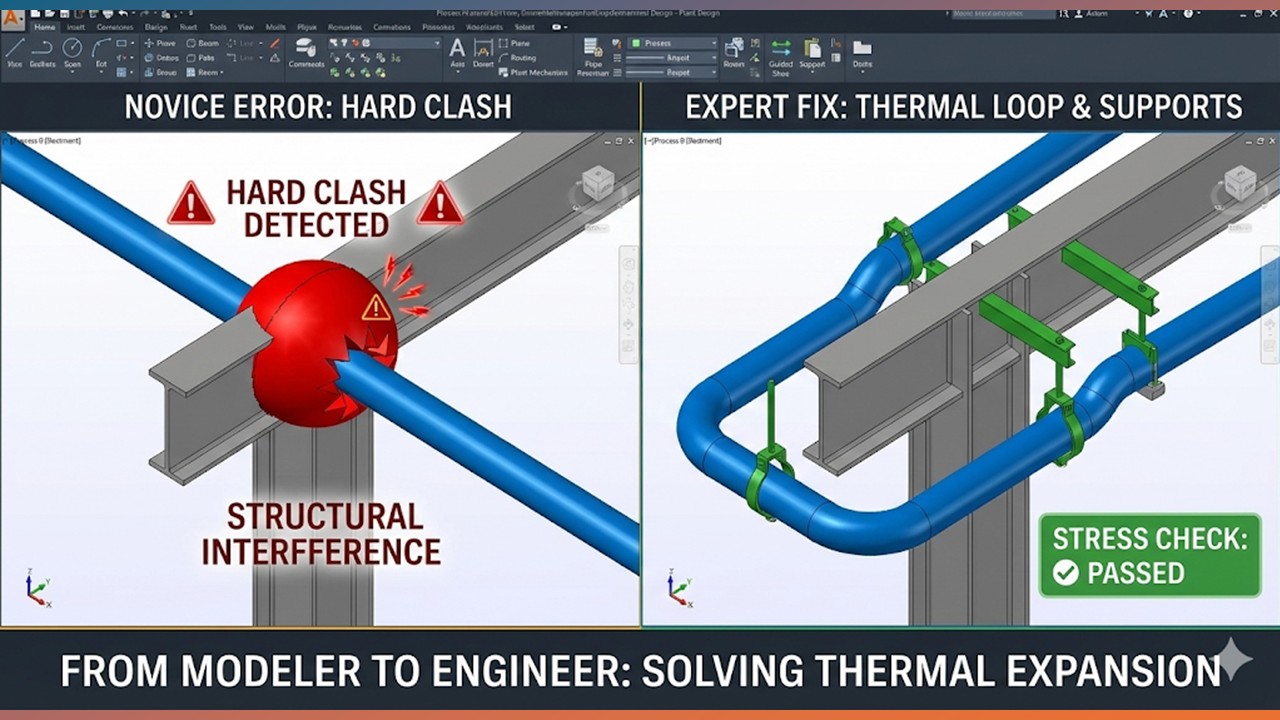
Case Study: The “Modeler vs. Engineer” Gap
Candidate Profile
- Role: Junior Piping Designer
- Skillset: Advanced SP3D Modeling
- Gap: No ASME B31.3 / Stress Knowledge
- Goal: Transition to Piping Engineer
Technical Challenge
- System: Hot Oil Supply (350°C)
- Issue: Pump Nozzle Load Failure
- Cause: Lack of Thermal Expansion Loop
The Trap: “It Looks Good in 3D”
A junior designer at an EPC firm was tasked with routing a 6-inch Hot Oil line from a centrifugal pump to a heat exchanger. Being proficient in CAD, the designer routed the pipe in a straight line to save material and maximize aesthetic alignment in the 3D model.
Visually, the design was perfect. Engineering-wise, it was a disaster. At an operating temperature of 350°C, carbon steel expands significantly (approx. 4mm per meter). Because the pipe was routed straight between two fixed anchors (the pump and the exchanger), there was nowhere for this growth to go. The resulting axial force transferred directly to the pump nozzle, exceeding the API 610 allowable loads by 400%.
The Solution: Applying Course Knowledge
Realizing the gap in his knowledge, the designer enrolled in a comprehensive Piping Engineering Certification Course that included a module on CAESAR II stress analysis training. He didn’t just learn the software interface; he learned the physics of flexibility.
- Step 1 (Diagnosis): He identified that the system was “stiff” and needed flexibility.
- Step 2 (Redesign): Using the rules learned in the course, he introduced a “U-Loop” (Expansion Loop) in the pipe run. This geometry allowed the pipe to flex like a spring, absorbing the thermal growth.
- Step 3 (Verification): He ran a static analysis in CAESAR II, confirming that the nozzle loads dropped to within acceptable limits.
The Career ROI
The revised design was approved immediately by the Lead Engineer. More importantly, this demonstrated that the candidate had evolved from a “Drafter” (who draws lines) to an “Engineer” (who designs systems).
This competency is critical for the EPC industry career path. Within six months of completing the certification and demonstrating this applied knowledge, the candidate was promoted to Senior Engineer, securing a significant salary increase. The certification bridged the gap that years of on-the-job CAD work could not filling.
EPCLand YouTube Channel
2,500+ Videos • Daily Updates
Frequently Asked Questions: Starting Your Piping Career
Who is eligible for a Piping Engineering Certification Course?
Primarily, these courses are designed for graduates with a Bachelor’s degree in Mechanical or Chemical Engineering. However, Diploma holders with significant industry experience in drafting or site supervision can also benefit. The certification bridges the gap between university theory and the practical EPC industry career path requirements.
Is learning ASME B31.3 mandatory for designers?
Absolutely. The ASME B31.3 process piping code is the governing law for refinery and chemical plant piping. Even if you are a modeler working in SP3D, you must understand code requirements for pressure testing, support spacing, and material limitations to create a compliant design that won’t be rejected by the Stress team.
Which software should I prioritize: SP3D, E3D, or CAESAR II?
It depends on your desired role. For Layout/Design Engineers, 3D modeling software SP3D/E3D is essential as these are the industry standards for creating the plant model. If you wish to specialize as a Pipe Stress Engineer, mastering CAESAR II is non-negotiable. A lead engineer typically understands the basics of all three.
Does a certification guarantee a job in Oil & Gas?
No certification guarantees a job, but it significantly improves your odds. EPC companies often filter candidates based on their familiarity with codes and software. A recognized certification proves you are “project-ready” and reduces the training burden on the employer, making you a preferred candidate over a fresh graduate.

Related posts:
![High-grade industrial Wing Nut Types and Applications for mechanical assemblies.]()
Wing Nut Types and Applications: The 2026 Engineering Guide
![Industrial Monorail Crane Systems installed in a modern manufacturing plant 2026.]()
Monorail Crane Systems: Design, Types & 2026 Standards Guide
![Lead engineer performing a Factory Acceptance Test FAT on an industrial skid system 2026]()
Factory Acceptance Test FAT: The 2026 Engineering Guide to Zero-Defect Delivery
![Professional engineering workspace showing a Basis of Design document layout for a 2026 project.]()
Basis of Design: How to Write a BOD for Engineering Projects in 2026
![Industrial Flare Knockout Drum Sizing and installation in a refinery relief system.]()
Flare Knockout Drum Sizing: Design & API 521 Standards (2026 Guide)
![Advanced Reboiler Control Systems in a modern petrochemical refinery 2026.]()
Reboiler Control Systems: Engineering Guide to Precision Control 2026