Pipe Support Engineering: The Ultimate 2026 Technical Guide
Pipe Support Engineering is the specialized discipline of ensuring that a piping system is properly carried, guided, and anchored to handle static and dynamic loads throughout its operational lifecycle. In 2026, as industrial facilities push the boundaries of temperature and pressure, understanding the synergy between structural integrity and thermal expansion management in piping has become the cornerstone of safe plant operations.
Engineering Knowledge Check
1. Which ASME code primarily governs the design and requirements for process piping supports?
Complete Course on
Piping Engineering
Check Now
Key Features
- 125+ Hours Content
- 500+ Recorded Lectures
- 20+ Years Exp.
- Lifetime Access
Coverage
- Codes & Standards
- Layouts & Design
- Material Eng.
- Stress Analysis
What are Pipe Supports and Restraints?
In a modern piping system, supports and restraints are essential for maintaining structural integrity. They act as the “skeletal system” of the facility, absorbing loads, limiting movement, and ensuring the stability of the piping under both operating and occasional loads such as wind or seismic activity.
Pipe Supports
These elements primarily bear the weight of the pipe, its fluid contents, insulation, and attached components like valves. Their primary engineering role is to prevent the pipe from sagging due to gravitational forces.
Pipe Restraints
Restraints control the movement of the system caused by thermal expansion, pressure variations, or dynamic forces. They limit or guide displacement to prevent damage to sensitive equipment connections.
The ASME B31.3 Distinction
While the ASME B31.3 pipe support requirements do not provide a standalone glossary for these terms, the code implies a clear functional split in section 319.2.1:
- ● Pipe Support: A structural assembly required to absorb the weight load and contain sustained longitudinal stress within allowable limits.
- ● Pipe Restraint: A structural element specifically designed to constrain or limit thermal expansion management in piping.
Core Functions in 2026 Engineering
| Primary Function | Engineering Objective |
|---|---|
| Supporting Weight | Carrying pipes, fittings, and internal fluids to prevent excessive sag. |
| Controlling Thermal Movement | Ensuring dimensional changes stay within allowable material stress limits. |
| Limiting Load Transfer | Minimizing thermal expansion forces transferred to pumps and turbines. |
| Absorbing Dynamic Loads | Managing sudden impacts from wind, earthquake, or water hammer events. |
Rigid Pipe Supports
Rigid supports are the primary structural members in most industrial piping systems, specifically designed to bear the weight of the pipe and its contents. By preventing vertical downward movement, they ensure the system maintains its intended slope and alignment.
1. Pipe Shoe Supports
Pipe shoes are structural attachments welded or clamped to the pipe. They rest on the supporting steel, providing a larger contact surface than the bare pipe wall to prevent local crushing and wear.
2. Pipe Trunnion or Dummy Supports
Trunnions consist of a tubular member welded directly to the pipe. They are commonly used for vertical pipes or welded to elbows on horizontal runs to provide a robust support point that can be anchored to the ground or a structural frame.
Flexible or Resilient Pipe Supports
In systems with high temperature fluctuations, thermal expansion management in piping requires flexible supports. These allow vertical movement without compromising the load-bearing capacity.
Variable Spring Supports
Utilized for moderate movement. The supporting force varies with the spring’s compression. Standard engineering practice in 2026 limits variability to 25% to avoid overloading connected equipment.
Constant Spring Supports
Essential for critical applications where large vertical displacement occurs. Using a lever and cam mechanism, they maintain a uniform supporting force throughout the entire range of travel.
Types of Pipe Restraints
Function: Allows axial movement but restrains lateral and rotational shifts.
Commonly installed on long pipe racks to maintain alignment during expansion.
Function: Restrains movement within a defined threshold in one or more directions.
Often used to prevent over-expansion of joints or to protect pump suction nozzles.
Function: Prevents all translational and rotational movement relative to the structure.
Acting as a “fixed point,” anchors are the most restrictive type of pipe support engineering element.
At-a-Glance: Common Pipe Support & Restraint Types
Selecting the correct hardware is a vital phase of Pipe Support Engineering. The following table provides a high-level summary of the most frequently utilized support and restraint types in 2026 industrial projects, categorized by their primary function and application.
| Type | Primary Function | Typical Application (2026) |
|---|---|---|
| Pipe Shoe Support | Supports pipe weight | Piping on racks or structural members |
| Trunnion Support | Supports vertical or horizontal runs | Control valve stations, pump piping |
| Variable Spring Support | Allows moderate thermal movement | Systems with low to medium movement |
| Constant Spring Support | Allows significant thermal movement | Sensitive equipment like pumps, turbines |
| Pipe Guide | Restrains lateral movement | Piping on racks, pump nozzles |
| Limit Stop | Limits axial movement | Expansion control in long runs |
| Anchor | Restrains all movement | Nozzle connections, sensitive systems |

EPCLand YouTube Channel
2,500+ Videos • Daily Updates
Core Theory & ASME Standards in Pipe Support Engineering
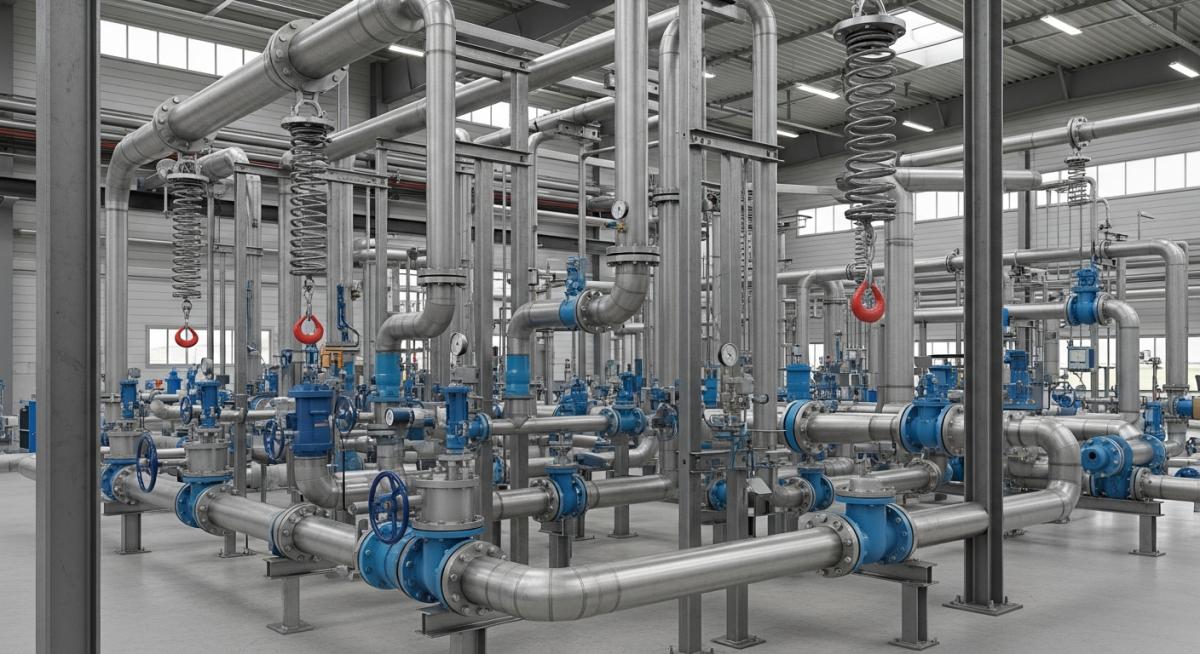
The fundamental goal of Pipe Support Engineering is to manage various load combinations: sustained loads (weight of the pipe, fluid, insulation, components), occasional loads (wind, seismic events), and expansion loads (thermal movement). The engineering codes, primarily **ASME B31.3 pipe support requirements**, dictate the minimum structural integrity and flexibility needed.
Failure to adhere to these standards can lead to excessive stress, deflection beyond limits, or even catastrophic failure. This is why engineers spend significant time on analytical checks.
The Physics of Stress and Span
A critical aspect is determining the optimal pipe support span calculation. Spans that are too long induce excessive bending stress and sag (deflection). While advanced software handles this, the core formula for bending stress (simplified for education) relates stress (σ) to bending moment (M) and section modulus (Z):
Bending Stress Equation:
σ = M / Z
Where M is Bending Moment and Z is Section Modulus (related to pipe geometry).
The moment M increases significantly as the span length increases (often with the cube of the length for uniformly distributed loads). This calculation directly impacts material selection and support spacing protocols outlined in MSS SP-58 and ASME B31.3.
Rigid vs Flexible: Mastering the Support Selection Logic
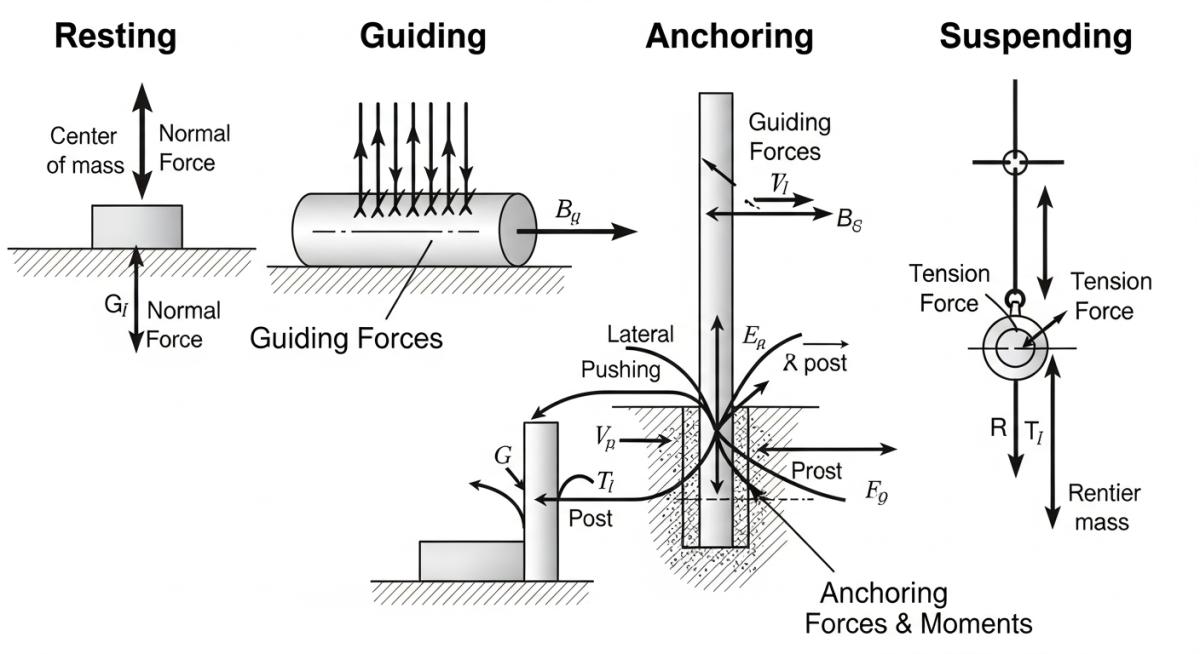
The choice between **rigid vs flexible pipe supports** is rarely arbitrary. Rigid supports (like solid struts, anchors, or shoes on resting surfaces) restrict movement in one or more directions. Flexible supports (like spring hangers, sway braces) accommodate movement while still bearing the load.
For high-temperature applications, managing thermal growth is paramount. This is where specialized selection criteria come in, specifically the variable spring hanger selection process. Engineers must calculate the “variability” (change in supporting force as the pipe moves from cold to hot position), ensuring it remains within acceptable limits (typically < 25%).
Engineering Data Table: Support Types & Applications
Below is a guide for initial selection criteria, critical for any new project or when performing a pipe shoe installation guide 2026 review.
| Support Type | Function | Movement Allowed | Typical Application (2026) |
|---|---|---|---|
| Pipe Shoe (Rigid) | Vertical load bearing, some longitudinal slide | Longitudinal (sliding) | Hot/Cold lines on structural steel |
| Anchor (Rigid) | Restricts all 3 axes of movement & rotation | None | Pump nozzles, directional changes |
| Variable Spring Hanger (Flexible) | Supports weight while allowing vertical travel | Vertical movement (controlled) | High-temp steam lines, boiler piping |
| Sway Brace / Snubber (Dynamic) | Allows slow thermal movement, dampens rapid motion | Slow, controlled | Seismic zones, water hammer prevention |
The successful implementation of these components defines the quality of the overall Pipe Support Engineering plan, balancing rigidity to counteract forces with flexibility to manage thermal dynamics efficiently and safely.
Applications of Pipe Supports and Restraints in Various Industries
The practical execution of Pipe Support Engineering varies across sectors, though the core physics remains constant. In 2026, specialized hardware is deployed to meet the unique safety and environmental challenges of different industrial landscapes.
Oil and Gas
In upstream and midstream operations, supports are critical for maintaining safety in high-pressure systems. They prevent catastrophic equipment damage by managing the vibration and surge loads common in hydrocarbon transport.
Chemical Plants
Chemical facilities require rigorous thermal expansion management in piping. Supports here must manage both extreme weight and rapid thermal cycling, especially in high-temperature reactor piping where corrosive environments demand specialized alloy shoes.
Power Plants
Modern 2026 power cycles utilize high-pressure steam systems where variable spring hanger selection is non-negotiable. These supports control massive thermal growth, ensuring that turbine nozzles are never subjected to forces exceeding ASME B31.3 pipe support requirements.
Engineering Conclusion
The correct selection and installation of pipe supports and restraints are the bedrock of structural integrity and operational safety. In 2026, the distinction between rigid vs flexible pipe supports is more than a design choice—it is a safety mandate.
By understanding the nuanced functions of various restraints and adhering to modern pipe support engineering standards, designers can build resilient systems capable of operating safely under the most demanding load conditions of the next decade.
Case Study: Pipe Support Engineering Failure Analysis
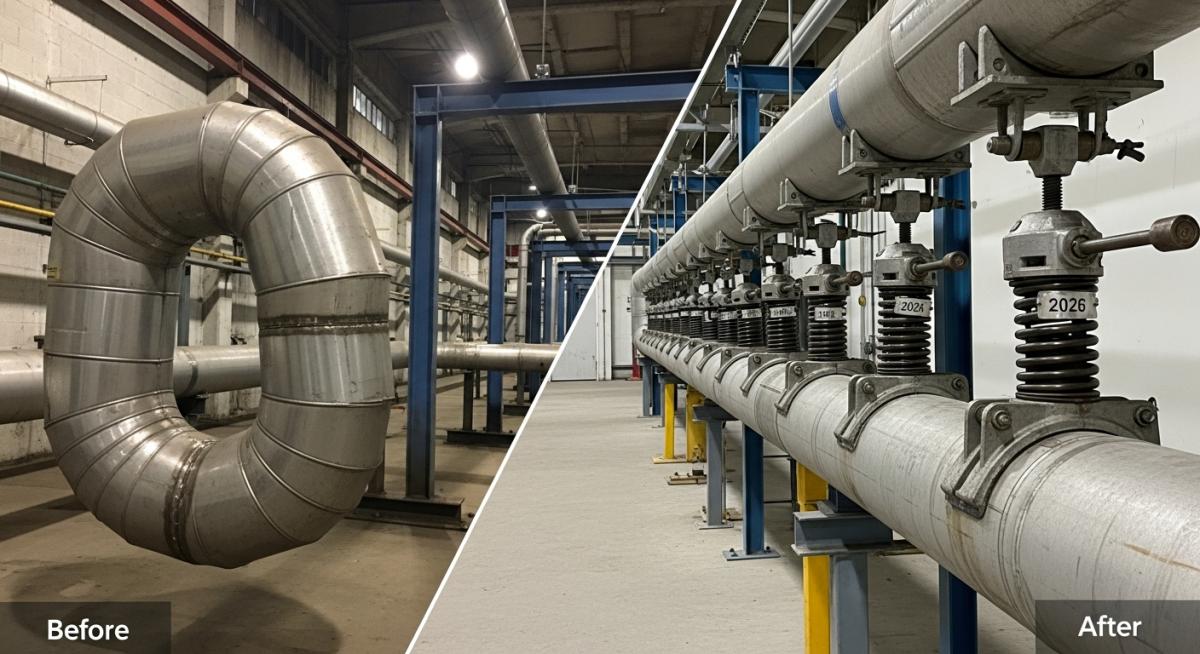
In early 2026, a major chemical processing facility in Texas reported recurring flange leaks and visible distortion on a 12-inch high-pressure steam line. Initial inspections suggested that the existing rigid supports were insufficient for the operational cycles. A comprehensive Pipe Support Engineering audit revealed that the system was undergoing extreme thermal cycles that hadn’t been fully accounted for in the original 1990s design.
Project Location
Gulf Coast Petrochemical Hub (2026 Retrofit)
Equipment Type
High-Pressure Steam Header (12″ Sch 80)
Operational Temp
750 Degrees Fahrenheit (399 Degrees Celsius)
Failure Mode
Thermal Bowing & Hanger Overload
Problem & Analysis
The analysis showed that the original rigid supports were causing “thermal locking.” As the pipe expanded, it could not move vertically, forcing the stress into the turbine nozzles and flange connections. Stress levels exceeded the allowable limits defined by ASME B31.3 pipe support requirements by nearly 45%. The lack of a proper variable spring hanger selection meant the weight of the pipe was not being adequately supported during the “hot” state, leading to a downward sag that stressed the mid-span joints.
The 2026 Solution & Result
The engineering team implemented a two-fold fix. First, they replaced three rigid resting supports with variable spring hangers designed for 2.5 inches of vertical travel. Second, they utilized a modern pipe shoe installation guide 2026 to install low-friction PTFE-lined sliding shoes at secondary support points to allow for longitudinal expansion without friction-induced binding.
Outcome Metrics:
- Zero reported leaks over the first 6 months of 2026 operation.
- Pipe stress reduced to 72% of code allowable limits.
- Estimated ROI: Saved 140,000 USD in potential downtime and nozzle repair costs.
- Maintenance frequency reduced from monthly checks to bi-annual visual inspections.
This case highlights why modern Pipe Support Engineering must move beyond “set-and-forget” rigid designs and embrace dynamic, flexibility-driven solutions to meet 2026 safety standards.
Frequently Asked Questions: Pipe Support Engineering
How is a variable spring hanger selection performed in 2026?
What factors influence the pipe support span calculation?
Where can I find the latest pipe shoe installation guide 2026?
Why is thermal expansion management in piping so critical?
Summary & Final Outlook
As we navigate the complexities of modern industrial design, Pipe Support Engineering remains a pillar of plant safety and reliability. By adhering to ASME B31.3 pipe support requirements and choosing between rigid vs flexible pipe supports with analytical precision, engineers can ensure their systems operate safely well into 2026 and beyond.
