Optimizing Pile Driving Rig Deployment for Industrial Site Efficiency
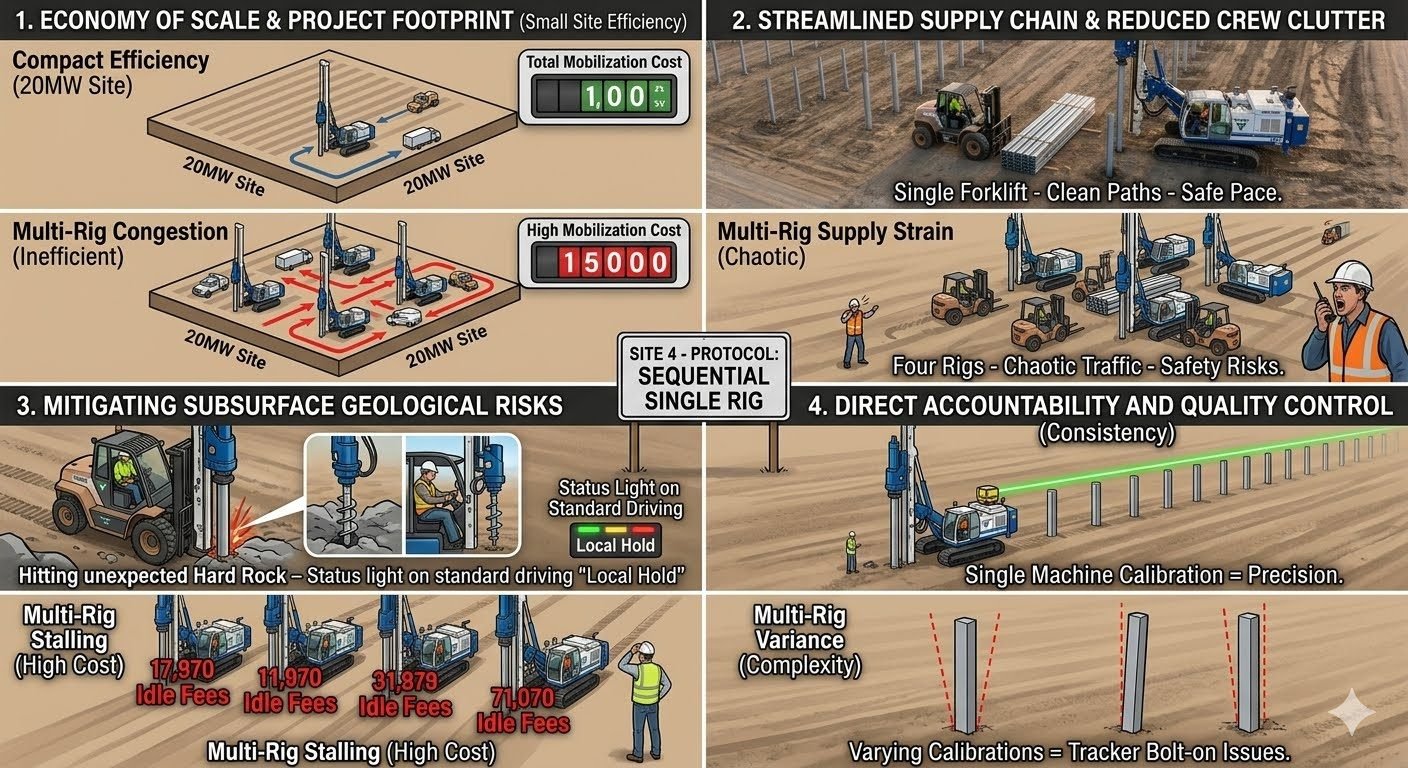
In my two decades of managing large-scale industrial foundation projects, I have seen countless schedules derailed by poor equipment deployment strategies. Choosing between a single pile driving rig and multiple units is not merely a matter of speed; it is a complex calculation of site logistics, safety, and risk management. When we deploy multiple rigs, we often trade off precision and safety for a perceived gain in production velocity that rarely materializes in the field.
My experience dictates that on smaller sites, the overhead of managing multiple crews and their associated support equipment often creates a bottleneck rather than a solution. We must evaluate the specific geotechnical profile and site footprint before committing to a multi-rig spread. This article breaks down the technical trade-offs required to make an informed decision for your next foundation phase.
Key Takeaways for Rig Deployment:
- Single-rig setups minimize mobilization costs and site traffic congestion.
- Multiple rigs increase the risk of calibration variance and bolt-hole misalignment.
- Geotechnical variability can cause exponential cost spikes when multiple rigs stall simultaneously.
- Safety is significantly improved by reducing the number of support vehicles on-site.
Technical Analysis of Pile Driving Rig Performance
Rig performance optimization: The technical evaluation of pile driving rig performance requires rigorous adherence to ASTM D1143 standards for load testing and ASCE guidelines for foundation design.
When analyzing the deployment of a pile driving rig, we must first consider the energy transfer efficiency. A single rig allows for a controlled, consistent energy delivery per blow, which is critical when working with sensitive soil profiles. In my experience, the primary challenge with multiple rigs is the introduction of “calibration drift.” Even when using identical models, subtle differences in hydraulic pressure settings or hammer strike frequency can lead to inconsistent pile penetration depths. This variance is often invisible until the tracker installation phase, where bolt-hole misalignment becomes a costly reality.
From a structural perspective, the stress parameters during driving are governed by the wave equation analysis of piles (WEAP). When we operate multiple rigs, the vibration profile of the site changes. The superposition of seismic waves from multiple hammers can lead to localized soil liquefaction or excessive vibration in nearby sensitive structures. A single rig provides a predictable, singular vibration source that is easier to monitor and mitigate using standard geotechnical instrumentation.
Consider the calculation of the “Stalling Cost Factor.” If a single rig encounters a hard rock layer, the project manager faces a linear delay. With multiple rigs, the probability of at least one machine encountering an obstruction increases significantly. If three rigs are operating, the likelihood of a “status-light hold” is tripled. If these rigs are interdependent—meaning they share a single supply chain for pile delivery—the entire site operation grinds to a halt, creating a cascading failure in the project schedule.
Furthermore, the logistical footprint of a single rig is significantly smaller. A single rig requires one primary forklift and one dedicated crew. This keeps the site paths clear and reduces the “crew clutter” that often leads to near-miss incidents. When we introduce multiple rigs, we must also introduce multiple support vehicles. This creates a chaotic traffic pattern that requires more rigorous safety oversight and increases the probability of equipment-to-equipment collisions.
In terms of quality control, the single-rig approach allows for a tighter feedback loop. The site engineer can monitor the performance of one machine in real-time, adjusting the hammer energy or pile alignment immediately. With multiple rigs, the engineer is often stretched thin, leading to delayed detection of installation errors. This is particularly critical in projects requiring high-precision tolerances for solar tracker foundations or heavy industrial equipment supports.
Deployment trade-offs: Evaluating the operational benefits and inherent risks of single versus multiple pile driving rig configurations for industrial foundation projects.
Advantages of Single Rig Deployment
- Lower mobilization and demobilization costs for small-to-medium sites.
- Consistent calibration and uniform pile penetration across the entire site.
- Reduced site traffic and lower risk of equipment-related safety incidents.
- Simplified logistics with a single support crew and forklift path.
- Easier real-time monitoring and quality control for the site engineer.
Disadvantages of Multiple Rig Deployment
- Increased risk of calibration variance between different machines.
- Higher probability of cascading delays due to variable subsurface conditions.
- Significant increase in site congestion and logistical complexity.
- Elevated safety risks due to increased heavy equipment traffic.
- Higher overhead costs for additional crews and support machinery.
Strategic deployment scenarios: Identifying the optimal pile driving rig configuration for diverse industrial and renewable energy construction environments.
Utility-Scale Solar Foundation Projects
On 20MW solar sites, a single rig is often the most efficient choice to maintain tight tolerances for tracker bolt-hole alignment. The limited site footprint makes multiple rigs counterproductive, as the congestion prevents efficient pile delivery and increases the risk of installation errors.
Brownfield Industrial Retrofits
When working in constrained industrial environments, space is at a premium. A single rig allows for precise maneuvering around existing underground utilities and structures, whereas multiple rigs would create an unmanageable safety hazard and logistical bottleneck.
Geotechnically Variable Sites
In areas with high subsurface uncertainty, a single rig allows for immediate assessment and adjustment of driving parameters. This prevents the “aggregated stalling” effect where multiple machines are forced into downtime simultaneously, protecting the project schedule from exponential cost growth.
Fleet allocation requires evaluating equipment mobilization, layout congestion, material handling logistics, and subsurface refusal escalation risks. The table below delineates the empirical performance parameters comparing a single pile driving rig configuration against multi-rig deployments across standard utility-scale project boundaries.
| Evaluation Parameter | Single Rig Setup (10–25 MW) | Dual Rig Setup (30–75 MW) | Triple+ Fleet (>75 MW) | Governing Code / Standard |
|---|---|---|---|---|
| Mobilization Overhead ($/MW) | 1,200 – 1,800 | 2,400 – 3,600 | 3,800 – 5,500+ | ASCE 7-22 |
| Support Telehandlers Required | 1 Dedicated Unit | 2 Dedicated Units | 3–4 Units (Staged) | OSHA 1926.602 |
| Row Clearance Margin | >6.0 m (Open Access) | 4.5 – 6.0 m (Managed) | <4.5 m (Choke Points) | OSHA 1926.1400 |
| Refusal Standby Risk Multiplier | 1.0x (Baseline Exposure) | 2.3x (Staggered Holds) | 4.1x (Compound Delays) | ASTM D4945 |
| Plumbness Variance (Mast Sensor) | <0.25° Consistent | 0.35° – 0.60° Delta | >0.75° Fleet Spread | ASTM D1143 |
| Tracker Alignment Rework Rate | <0.8% of Total Posts | 2.1% – 3.4% of Posts | 5.2% – 8.0% of Posts | IBC 2024 Ch. 18 |
Deploying a single pile driving rig establishes a single point of quality control that eliminates machine-to-machine sensor offsets. For projects below 30 MW, the single-rig approach provides predictable daily cycles while keeping transport logistics clean.
This mapping outlines critical parameters, physical tolerances, control systems, and code frameworks governing machine selection and driving performance in utility foundations.
| Entity / Subsystem | Technical Metric | Target Operational Range | Impact on Multi-Rig Ops | Code Reference |
|---|---|---|---|---|
| Hydraulic Impact Hammer | Rated Energy Output | 950 – 1,500 Joules/blow | Different hammer energies alter refusal counts across rows | ASTM D4945-17 |
| GPS Mast Positioning | RTK Base Corrections | ±10 mm Easting / Northing | Dual base calibrations risk coordinate offsets across blocks | FGDC-STD-007 |
| Verticality Inclinometer | Dual-Axis Plumbness | < 0.5° (1.0% deviation) | Sensor drift creates opposing tilt in adjacent tracker bays | IBC Section 1810 |
| Refusal Threshold | Penetration Resistance | < 25 mm per 10 blows | Multiple rigs multiply hold status calls and idle billing | API RP 2GEO |
| Embedment Depth | Structural Reveal Height | ±12 mm tolerance | Discrepancies force post cut-off or drilling extensions | ASCE 7-22 Ch. 15 |
Aligning machine parameters to strict structural standards ensures piles meet minimum embedment targets while keeping tracker drive linkages within design rotation limits.
Fleet Configuration Assessment: Technical verification protocol to validate rig count against site boundaries, soil profiles, and traffic management rules per OSHA 1926.602 and ASTM D4945.
Before moving heavy equipment to site, run through this verification checklist. It confirms that the chosen rig count fits site access roads, material laydown yards, and geotechnical profiles.
-
1
Subsurface Rock & Refusal Assessment:
Review test pile drive records and borings. If variable caliche, basalt, or limestone lenses appear across tracker blocks, evaluate whether multiple units will trigger simultaneous hold status fees.
-
2
Internal Roadway Clear Width Verification:
Verify inter-row driving corridors provide at least 5.5 meters clear width if running multiple telehandlers. A single pile driving rig needs only 4.0 meters of lateral clearance for safe staging.
-
3
Cross-Machine GPS & Sensor Benchmarking:
When running two or more machines, calibrate all mast inclinometers and RTK receivers against the same primary benchmark to prevent step offsets in tracker post lines.
-
4
Material Distribution & Staging Balance:
Ensure structural beam shakes out at least 24 hours ahead of the driving path. Confirm staging keeps forklift shuttles from crossing paths with active driving rigs.
-
5
Pre-Drill and Remediation Fleet Sizing:
Pair pre-drilling rigs directly with driving capacity. Operating two driving rigs against a single pre-drilling unit creates bottlenecks that stall driving crews.
Field Case Study: Real-World Application
On a 22 MWdc solar installation in west Texas, the EPC contractor deployed three tracked hydraulic driving machines to accelerate foundation installation and meet a tight 45-day commercial deadline.
The Problem Encountered:
The multi-machine approach caused logistics bottlenecks and quality issues across the 120-acre site.- Three rigs required three telehandlers, causing heavy traffic in narrow 4.2-meter rows that led to two near-miss vehicle incidents.
- Variable caliche lenses triggered 14 simultaneous refusal holds, running up 12,800 per day in idle standby costs.
- Sensor calibration drift among the three rigs created a 22 mm post height variance, causing 118 tracker torque-tube connection failures during mechanical assembly.
The Engineering Solution & Outcome:
The site team demobilized two units, transitioning to a single, high-output pile driving rig paired with a dedicated continuous-flight pre-drilling unit.- Traffic conflicts dropped to zero with one dedicated telehandler route along the central spine road.
- Pre-drilling ahead of the single rig eliminated refusal stoppages, raising production to a consistent 160 piles per 10-hour shift.
- Single-machine sensor consistency cut post plumbness and elevation defects to below 0.3%, eliminating tracker alignment rework.
- Total installation costs came in 18% below the multi-rig projection, despite the smaller equipment fleet.
For projects under 30 MW, choosing a single pile driving rig with dedicated pre-drill support reduces site congestion, stabilizes daily production, and maintains tight structural tolerances for downstream tracker assembly.
Frequently Asked Engineering Questions
How does site size influence the decision to use a single pile driving rig?
- Minimal mobilization costs are achieved by limiting equipment transport.
- Congestion on small sites leads to significant productivity bottlenecks.
- Single-rig operations maintain a predictable, linear workflow.
- Multiple rigs on restricted sites increase idle time due to limited maneuverability.
What are the primary safety risks associated with operating multiple rigs simultaneously?
- Each rig requires dedicated support equipment, such as forklifts, increasing site traffic.
- Crowded work zones complicate emergency egress and material delivery routes.
- Increased crew density elevates the potential for human-machine interface accidents.
- Coordinating multiple operators requires more rigorous site supervision and safety protocols.
How do variable subsurface conditions affect the cost of multi-rig deployments?
- Aggregated stalling costs multiply rapidly when multiple rigs hit variable strata.
- Geotechnical uncertainty makes scheduling multiple crews highly volatile.
- Single-rig operations allow for controlled, sequential investigation of subsurface issues.
- Hidden costs of downtime are easier to manage and mitigate with one unit.
Why is quality control more consistent with a single pile driving rig?
- Single-machine calibration ensures uniform bolt-hole alignment across the array.
- Multiple rigs introduce mechanical variance between different units.
- Reduced operator turnover on a single rig improves installation repeatability.
- Quality assurance audits are simplified when tracking data from one source.
What are the key logistical trade-offs when scaling up to multiple rigs?
- Increased demand for fuel, maintenance, and support staff logistics.
- Higher risk of supply chain disruption for specialized pile components.
- Need for advanced site planning to prevent equipment interference.
- Potential for diminishing returns if site layout cannot support parallel work.
Complete Course on
Piping Engineering
Check Now
Key Features
- 125+ Hours Content
- 500+ Recorded Lectures
- 20+ Years Exp.
- Lifetime Access
Coverage
- Codes & Standards
- Layouts & Design
- Material Eng.
- Stress Analysis
