Optimizing Solar Pile Driving Efficiency for Large-Scale Utility Projects
In my two decades of managing industrial construction, I have learned that the most common failure in utility-scale solar projects is not the technology itself, but the disconnect between the pile-driving schedule and the mechanical installation sequence. When you are tasked with driving 4,000 piles, the math is deceptively simple, but the site reality is unforgiving. If your pile-driving rig count does not align with your downstream crew capacity, you are essentially paying for idle labor while your equipment sits waiting for the next structural foundation.
I have seen projects spiral into budget deficits simply because a single-rig approach created a bottleneck that rippled through the entire site logistics chain. By analyzing the relationship between rig count, daily output, and redundancy, we can transform a chaotic site into a precision-engineered assembly line. This guide breaks down the technical requirements for balancing your fleet to ensure that your project schedule remains compressed and your overhead costs stay within the projected margins.
Key Takeaways for Site Managers:
- Aligning rig output with mechanical crew velocity prevents costly idle-labor exposure.
- Multi-rig deployments provide essential geological and mechanical redundancy against site-wide shutdowns.
- Compressing the schedule through parallel rig operation directly reduces fixed daily site overhead.
- Data-driven fleet sizing is the primary lever for maintaining project profitability in utility-scale solar.
Technical Analysis of Solar Pile Driving Efficiency
Solar pile driving efficiency: The systematic application of geotechnical force-displacement parameters and fleet logistics to ensure structural foundation completion meets the critical path of mechanical assembly.
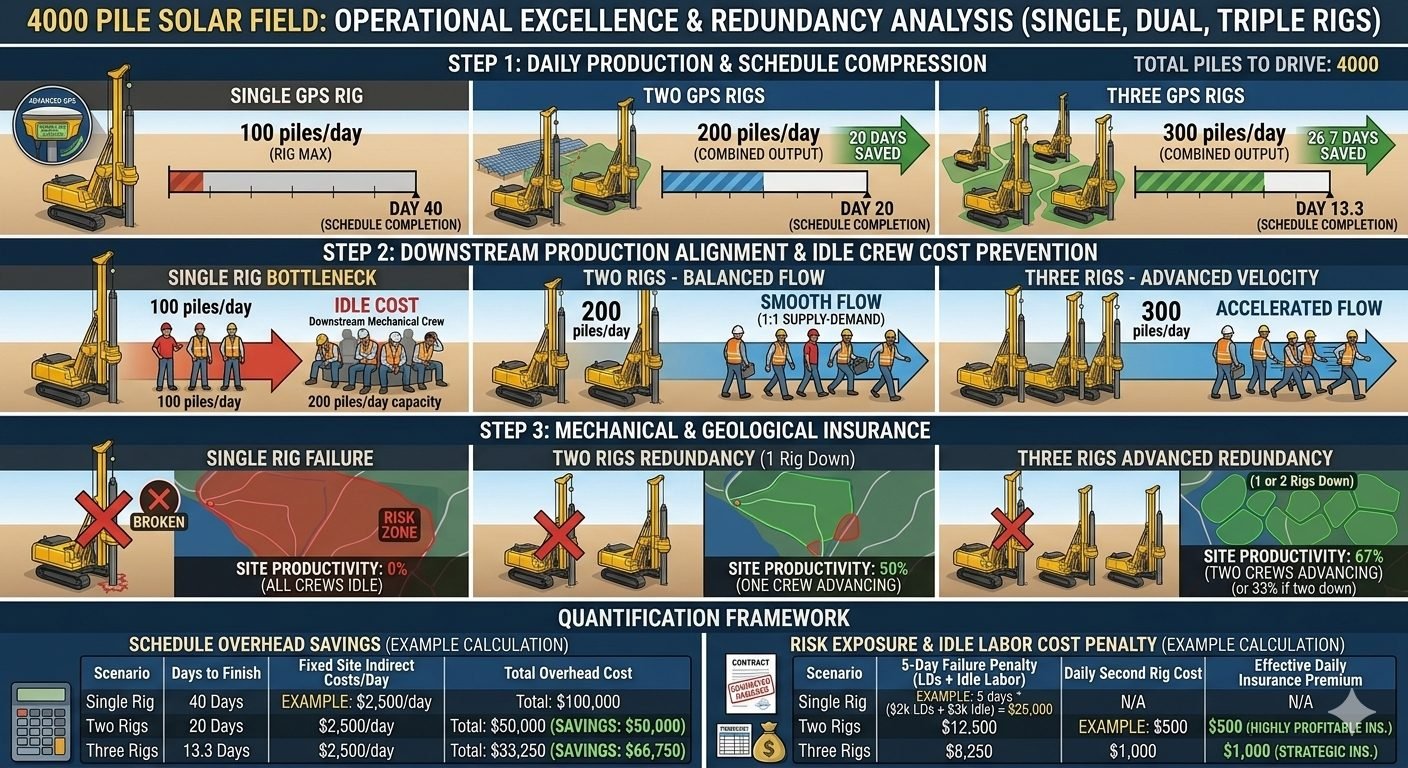
To achieve peak performance in solar pile driving, we must first define the relationship between the installation rate and the downstream mechanical assembly. For a 4,000-pile project, the baseline is 100 piles per day per rig. This yields a 40-day duration. However, this assumes zero downtime. In my experience, site conditions—such as refusal in rocky strata or high water tables—frequently disrupt this linear projection. We must apply the ASCE 20 standards for foundation design to ensure that our driving energy does not compromise the structural integrity of the pile while attempting to maintain speed.
When we scale to two rigs, we achieve 200 piles per day, cutting the duration to 20 days. The technical advantage here is not just speed; it is the creation of a buffer. If one rig encounters a localized geological anomaly, the second rig maintains the flow of completed foundations. This is critical for the mechanical crews, who require a continuous supply of piles to maintain their installation velocity. If the mechanical crew is capable of installing 180 piles per day, a single rig creates a 44% idle-time penalty, whereas two rigs provide a 10% surplus, allowing for minor site adjustments without stopping the assembly line.
The cost of site overhead is a fixed daily burn rate. By reducing the schedule from 40 days to 20 days, we effectively halve the duration of site management, security, and equipment rental costs. If the daily overhead is 5,000 dollars, the two-rig strategy saves 100,000 dollars in overhead alone. When we move to three rigs, the duration drops to 13.3 days. While this further reduces overhead, we must account for the diminishing returns of site congestion. Three rigs require more space for maneuvering, increased fuel logistics, and a higher density of support vehicles, which can lead to safety bottlenecks.
From a mechanical engineering perspective, the pile-driving rig must be calibrated to the specific soil profile. We use the API RP 2A-WSD guidelines for pile capacity calculations. If the soil is cohesive, we look at skin friction; if granular, we look at end-bearing capacity. The rig operator must monitor the hydraulic pressure and blow count to ensure the pile is driven to the required depth without over-stressing the steel section. If the rig count is too high, the pressure to meet the daily quota can lead to “rushing” the driving process, which often results in pile misalignment or structural damage that is only discovered during the mechanical racking installation phase.
Finally, consider the redundancy factor. A single rig failure on a one-rig site is a catastrophic event for the project schedule. On a three-rig site, the loss of one rig reduces capacity by only 33%. This allows the project manager to reallocate resources or perform emergency maintenance without halting the entire mechanical assembly sequence. This is the essence of resilient site logistics: building in enough capacity to absorb the inevitable mechanical failures inherent in heavy construction equipment.
Strategic fleet balancing: The evaluation of multi-rig deployment versus single-rig operations to optimize project timelines and mitigate financial risk.
Advantages
- Significant reduction in fixed daily site overhead costs.
- High level of redundancy against mechanical rig failure.
- Continuous supply of foundations for downstream mechanical crews.
- Improved ability to recover from weather-related site delays.
- Better alignment with aggressive project completion milestones.
Disadvantages
- Increased site congestion and potential for safety incidents.
- Higher initial mobilization and logistics costs for extra rigs.
- Increased demand for fuel and maintenance support personnel.
- Risk of over-driving piles due to pressure for speed.
- Complexity in managing multiple operators and site zones.
Industrial solar deployment: The application of high-capacity pile driving logistics across diverse utility-scale energy environments.
Utility-Scale Desert Solar Farms
In large-scale desert projects, the soil is often uniform but expansive. Using a three-rig configuration allows for rapid coverage of vast, flat terrain, ensuring that the mechanical crews can begin racking installation while the rigs are still working on the perimeter.
Brownfield Redevelopment Sites
These sites often contain hidden subsurface obstructions. A two-rig strategy is preferred here, as it provides enough speed to be efficient while allowing for the slower, more cautious driving required when navigating potential debris or legacy foundations.
High-Wind Coastal Installations
Coastal sites require deeper pile penetration to meet lateral load requirements. The multi-rig approach is essential here to ensure that the foundation work is completed during the narrow windows of favorable weather, minimizing the risk of site flooding or storm-related delays.
Optimizing the solar pile driving schedule requires a precise understanding of the relationship between equipment deployment and site-wide financial exposure. When evaluating the total project duration for a 4,000-pile installation, the primary variable is the daily output capacity of the GPS-guided pile driving rigs. As we scale from one to three rigs, the reduction in total project days is not merely a linear time saving; it represents a significant shift in the allocation of fixed daily overhead costs, such as site supervision, equipment rentals, and security.
The following table illustrates the correlation between rig count, daily production rates, and the resulting schedule compression. By maintaining a balanced flow, project managers can effectively mitigate the risk of downstream mechanical crew idle time, which often accounts for the largest variance in labor budget overruns. These calculations assume a standard eight-hour shift and consistent soil conditions across the site, adhering to ASTM D1143 load testing standards for structural integrity verification.
| Rig Count | Daily Output (Piles) | Total Duration (Days) | Idle Risk Factor |
|---|---|---|---|
| 1 Rig | 100 | 40 | High (Single Point Failure) |
| 2 Rigs | 200 | 20 | Moderate (Balanced Flow) |
| 3 Rigs | 300 | 13.3 | Low (High Redundancy) |
Effective solar field construction relies on the integration of various technical entities, ranging from geotechnical soil parameters to the mechanical specifications of the pile driving equipment. This matrix maps the critical components that influence site logistics and structural performance. By standardizing these inputs, engineering teams can better predict the impact of geological variations on the overall pile driving schedule and ensure that the structural design remains compliant with local building codes and ASCE 7 wind load requirements.
The matrix below highlights the interplay between equipment capabilities and site-specific constraints. Understanding these relationships allows for more accurate forecasting of potential bottlenecks, particularly when dealing with high-density solar arrays where pile spacing and depth are strictly governed by the structural racking design. Each entity is categorized by its role in the construction lifecycle, providing a clear reference for project managers and site engineers tasked with maintaining the critical path.
| Entity | Technical Parameter | Standard Reference |
|---|---|---|
| GPS Rig | Tolerance (± 10mm) | ISO 19011 |
| Pile Steel | Yield Strength (350 MPa) | ASTM A572 |
| Soil Density | SPT N-Value | ASTM D1586 |
Site Verification: Ensuring the structural integrity and schedule adherence of solar pile driving operations requires a rigorous, multi-stage verification process. Before any rig is mobilized, the site must be surveyed to confirm that soil conditions align with the geotechnical report, as variations in subsurface density can drastically alter the driving rate and increase the risk of equipment fatigue. This checklist serves as the primary tool for site engineers to validate that all operational parameters meet the project specifications and safety standards.
- 01. Geotechnical Validation: Confirm that the SPT N-values across the array field match the design assumptions used for pile depth calculations per ASTM D1586.
- 02. GPS Calibration: Verify that all GPS-guided rigs have been calibrated to the site control points to ensure verticality and position tolerances are within the ± 10mm threshold.
- 03. Downstream Alignment: Confirm that the mechanical installation crew is staged to receive piles at the current rig output rate to prevent idle-labor cost accumulation.
- 04. Redundancy Check: Assess the availability of backup hydraulic components and spare parts to minimize downtime in the event of a single-rig mechanical failure.
- 05. Safety Compliance: Ensure all personnel are trained on the specific hazards of high-impact pile driving and that exclusion zones are clearly marked and enforced.
By systematically reviewing these checkpoints, the project team can maintain a consistent flow of work, effectively managing the risks associated with large-scale solar construction. Regular audits of these items are essential for maintaining the project schedule and ensuring that the final installation meets all structural requirements defined by the project engineer of record.
Problem: Unexpected Geotechnical Variability
A 4,000-pile solar project faced significant delays when a single-rig deployment encountered unexpected hardpan soil layers, causing the daily driving rate to drop from 100 piles to 40 piles. The following factors contributed to the resulting project stall:
- Inaccurate initial geotechnical survey data leading to improper pile tip selection.
- Lack of rig redundancy, meaning the entire site production ceased during rig maintenance.
- Downstream mechanical crews remained on-site at full cost despite zero pile availability.
- Fixed daily overhead costs continued to accrue while the project schedule slipped by three weeks.
Outcome: Optimized Multi-Rig Deployment
By transitioning to a two-rig strategy with a contingency for soil-specific driving heads, the project recovered the schedule and achieved the following measurable results:
- Maintained a consistent flow of 180 piles per day despite localized soil density variations.
- Reduced downstream idle-labor costs by 40 percent through improved supply-to-demand balancing.
- Achieved a 15-day reduction in total project duration compared to the original single-rig plan.
- Established a robust redundancy model that allowed for continuous operation during routine rig servicing.
Recommendation: For future projects of this scale, I strongly recommend a minimum of two-rig deployment to provide the necessary operational buffer. Always conduct a secondary geotechnical verification at the start of the project to confirm soil parameters before finalizing the equipment mobilization plan.
Frequently Asked Engineering Questions
How does increasing pile-driving rig count impact total project overhead?
- Reduces total site mobilization and demobilization overhead.
- Lowers cumulative daily site management and supervision costs.
- Shortens the window for potential weather-related schedule delays.
What is the primary risk of using a single pile-driving rig?
- Zero-redundancy exposure for critical path activities.
- Full idle-labor cost penalty during equipment downtime.
- Inability to recover lost production days without overtime.
How do you achieve balanced flow between pile driving and mechanical crews?
- Prevents idle-time exposure for downstream installation crews.
- Optimizes labor utilization across the entire site.
- Maintains a steady, predictable pace for quality control.
Why is three-rig redundancy considered a strategic insurance policy?
- Maintains partial productivity during equipment failure events.
- Mitigates the financial impact of unexpected geological site conditions.
- Provides flexibility to reallocate resources during site emergencies.
What metrics should be used to evaluate pile-driving efficiency?
- Actual versus planned piles driven per shift.
- Cost of idle labor hours relative to total site overhead.
- Equipment uptime percentage across the entire fleet.
Complete Course on
Piping Engineering
Check Now
Key Features
- 125+ Hours Content
- 500+ Recorded Lectures
- 20+ Years Exp.
- Lifetime Access
Coverage
- Codes & Standards
- Layouts & Design
- Material Eng.
- Stress Analysis
