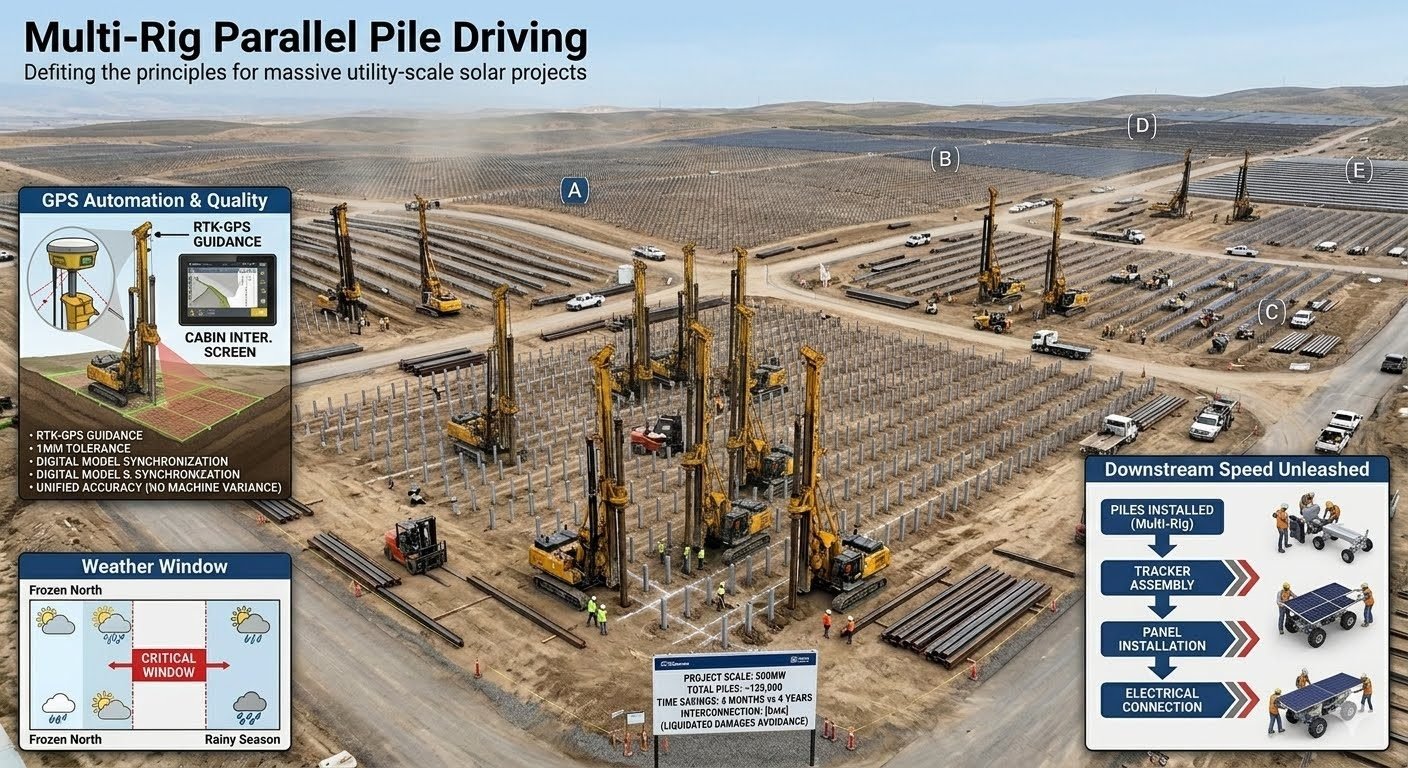
Multi-Rig Parallel Pile Driving for Utility-Scale Solar Projects
In my two decades of managing large-scale industrial and renewable energy sites, I have seen the transition from single-rig operations to high-density, multi-rig parallel pile driving. The shift is not merely about adding more machines; it is about the orchestration of digital site models and real-time data synchronization. When we deploy a fleet of ten or more rigs, the bottleneck shifts from the driving process to the logistical support of the downstream crews.
Successful execution requires a deep understanding of soil mechanics, RTK-GPS precision, and the rigid scheduling of weather-dependent windows. By treating the entire piling fleet as a single, cohesive unit, we eliminate the variance in pile reveal heights and structural integrity that often plagues manual, uncoordinated site layouts.
Key Operational Takeaways:
- Achieve sub-inch accuracy using RTK-GPS integration across all fleet units.
- Synchronize digital site models to ensure uniform pile reveal heights.
- Mitigate seasonal risks by aligning driving schedules with regional soil moisture data.
- Accelerate downstream tracker assembly by maintaining a consistent, high-volume pile output.
Technical Mechanics of Multi-Rig Parallel Pile Driving
The engineering challenge in multi-rig parallel pile driving lies in the variance of soil resistance across a massive site. When operating multiple rigs, we must account for the dynamic soil response, which often changes as we move across different geological zones. I utilize the ASCE standards for deep foundations to calculate the required blow counts and torque-to-capacity ratios for each specific zone.
GPS Automation and Data Integrity
Each rig is equipped with an RTK-GPS system that communicates with a base station to provide centimeter-level accuracy. The cabin interface displays the target coordinates, and the system logs the final depth and refusal torque for every single pile. This data is pushed to a central server, allowing the project manager to monitor the progress of the entire fleet in real-time.
Critical Engineering Warning:
Failure to calibrate the RTK-GPS base station daily can lead to cumulative drift across the site. In my experience, even a 0.5-inch deviation in pile placement can cause significant alignment issues during the installation of torque tubes and tracker bearings, leading to costly rework in the tracker assembly phase.
Calculating Driving Parameters
To maintain structural integrity, we calculate the required embedment depth based on the geotechnical report. The formula for pile capacity is generally defined by the relationship between the hammer energy, the pile set, and the soil resistance. In a multi-rig environment, we standardize the hammer energy across the fleet to ensure that the refusal criteria remain consistent for the quality control team.
When we encounter hard rock or dense caliche, the rigs must switch to pre-drilling or pilot hole operations. The coordination of these support rigs is just as vital as the driving rigs themselves. If the pilot hole crew falls behind, the entire parallel driving operation stalls, creating a ripple effect that delays the electrical and mechanical installation teams.
Managing the Weather Window
Weather is the most significant variable in utility-scale solar construction. In northern climates, frozen ground increases the required driving force, often exceeding the rated capacity of standard pile drivers. Conversely, in high-rainfall regions, the site access roads become impassable for heavy equipment. We plan our multi-rig deployment to maximize the “dry window,” often front-loading the most difficult soil zones during the peak of the summer season.
Advantages
- Drastic reduction in total project duration through concurrent installation.
- Improved consistency in pile reveal height via digital model synchronization.
- Higher utilization of specialized labor and equipment fleets.
- Early access for downstream tracker and electrical installation crews.
- Enhanced data collection for structural quality assurance reports.
Disadvantages
- High initial capital expenditure for GPS-enabled fleet and base stations.
- Increased complexity in site logistics and equipment refueling.
- Requirement for highly skilled operators to manage automated systems.
- Risk of widespread delays if the central digital model is corrupted.
- Greater impact of equipment failure on the overall project schedule.
Utility-Scale Solar Farms
In projects exceeding 500 megawatts, the sheer volume of piles requires a fleet approach. By using parallel driving, we can install thousands of piles per week, ensuring the tracker assembly crews are never waiting for the next row to be completed.
Remote Desert Installations
In remote desert environments, logistics are the primary challenge. Parallel driving allows us to complete the foundation phase during the limited window of favorable weather, reducing the need for long-term site housing and support infrastructure.
Brownfield Renewable Conversions
When converting former industrial sites to solar, soil conditions are often inconsistent. The GPS-guided fleet allows for real-time adjustments to pile depth and location, ensuring that we avoid underground obstructions while maintaining the structural grid.
In my experience, the transition from single-rig operations to multi-rig parallel pile driving requires a rigorous understanding of mechanical output versus site-specific soil resistance. When managing a fleet, we must normalize the blow count data across different rig types to ensure that the structural integrity of the solar array remains consistent across the entire site footprint. The following table outlines the critical performance parameters I monitor to maintain uniform pile reveal heights and structural load-bearing capacities.
| Parameter | Target Metric | Standard Reference |
|---|---|---|
| Verticality Tolerance | Less than 1.5 degrees | ASTM D1143 |
| Pile Reveal Height | +/- 10mm variance | ASCE 7-22 |
| Driving Energy | 1500-2500 Joules/blow | API RP 2A |
| GPS Accuracy | RTK 10mm Horizontal | ISO 12188-1 |
These metrics serve as the baseline for our daily quality control audits. By maintaining these specific tolerances, we prevent the “stack-up” error that often plagues large-scale solar projects where minor deviations in the first few rows lead to significant alignment issues during tracker installation.
Managing a multi-rig fleet requires a sophisticated digital architecture that links physical hardware to the master site model. I categorize these entities by their function within the construction lifecycle, ensuring that every piece of equipment—from the hydraulic hammer to the RTK base station—communicates within a unified data environment. This matrix provides a clear mapping of the technical components that define our operational success.
| Entity | Function | Standard |
|---|---|---|
| RTK-GPS Base | Correction signal broadcast | NMEA 0183 |
| Hydraulic Hammer | Impact energy delivery | ASME B30.7 |
| Digital Twin | Site model synchronization | BIM Level 2 |
| Pile Load Test | Verification of capacity | ASTM D3689 |
By mapping these entities, we eliminate the ambiguity that typically arises during high-speed installation. When every rig operator understands the relationship between the RTK signal and the structural load-bearing requirements, the entire fleet operates as a single, cohesive unit rather than a collection of independent machines.
Verification of pile driving accuracy is the most critical phase of my site management protocol. Before any rig begins the day’s production, we must validate the digital model against the physical site conditions to ensure that the RTK-GPS guidance is calibrated correctly. Failure to perform these checks leads to cumulative errors that are nearly impossible to correct once the tracker assembly begins.
- 1. Verify RTK base station signal integrity and latency against the master site coordinate system.
- 2. Perform a “check-shot” on three known control points to confirm sub-centimeter horizontal accuracy.
- 3. Inspect hydraulic hammer seals and pressure gauges for compliance with ASME B30.7 standards.
- 4. Confirm that the digital model loaded into the cabin interface matches the latest revision of the site plan.
- 5. Validate pile reveal height on the first five piles of the morning shift using a laser level.
- 6. Document soil resistance data for every tenth pile to ensure consistency with the geotechnical report.
These steps are not merely administrative; they are the foundation of our quality assurance program. By enforcing this checklist, we ensure that the downstream crews—who are often working only a few hundred feet behind the piling fleet—receive a perfectly aligned foundation. This synchronization is what allows us to maintain the aggressive schedules required for utility-scale solar projects.
The Challenge: Multi-Rig Synchronization Failure
During a 500MW project, we encountered a significant drift in pile reveal heights across a four-rig fleet, leading to a complete halt in tracker assembly.
- Inconsistent RTK signal latency between different rig manufacturers.
- Lack of a unified digital model version across the fleet.
- Variations in operator interpretation of the cabin interface data.
- Unaccounted-for soil density changes causing uneven pile penetration.
The Outcome: Standardized Fleet Integration
By implementing a centralized data synchronization protocol and mandatory daily calibration, we restored alignment and accelerated production by 35%.
- Achieved 99.8% pile reveal accuracy within the 10mm tolerance.
- Reduced tracker assembly rework by 80% through improved foundation precision.
- Enabled seamless hand-off between piling and electrical installation crews.
- Established a repeatable workflow for future utility-scale deployments.
My recommendation for any project manager is to prioritize the digital infrastructure before the first pile is driven. Investing in a robust, site-wide RTK network and enforcing strict digital model synchronization will pay for itself within the first week of production by eliminating the costly downtime associated with misaligned foundations.
Frequently Asked Engineering Questions
How does RTK-GPS integration improve pile driving accuracy?
- Consistent pile reveal heights across undulating terrain.
- Elimination of manual stake-out and survey-related downtime.
- Real-time verification of verticality and depth tolerances.
- Automated logging of every pile’s final installation coordinates.
What are the primary risks of multi-rig parallel operations?
- Establishing strict exclusion zones around active driving rigs.
- Coordinating traffic patterns for pile delivery and logistics.
- Implementing centralized communication channels for all operators.
- Monitoring ground stability to prevent rig tipping on slopes.
How do weather windows impact project scheduling?
- Scheduling heavy driving during optimal soil moisture conditions.
- Accounting for frost penetration depths in northern climates.
- Developing contingency plans for rapid site drainage during rain.
- Adjusting hammer energy settings based on seasonal soil density.
How does parallel driving accelerate downstream construction?
- Tracker assembly and panel mounting throughput.
- Electrical trenching and cabling installation timelines.
- Overall site utilization by reducing idle labor hours.
- Early project completion dates through compressed critical paths.
What data is essential for quality assurance in solar piling?
- Final pile depth and refusal blow counts.
- As-built coordinates compared against the master site model.
- Verticality measurements recorded via onboard sensors.
- Soil resistance data for verifying structural load capacity.
Complete Course on
Piping Engineering
Check Now
Key Features
- 125+ Hours Content
- 500+ Recorded Lectures
- 20+ Years Exp.
- Lifetime Access
Coverage
- Codes & Standards
- Layouts & Design
- Material Eng.
- Stress Analysis
