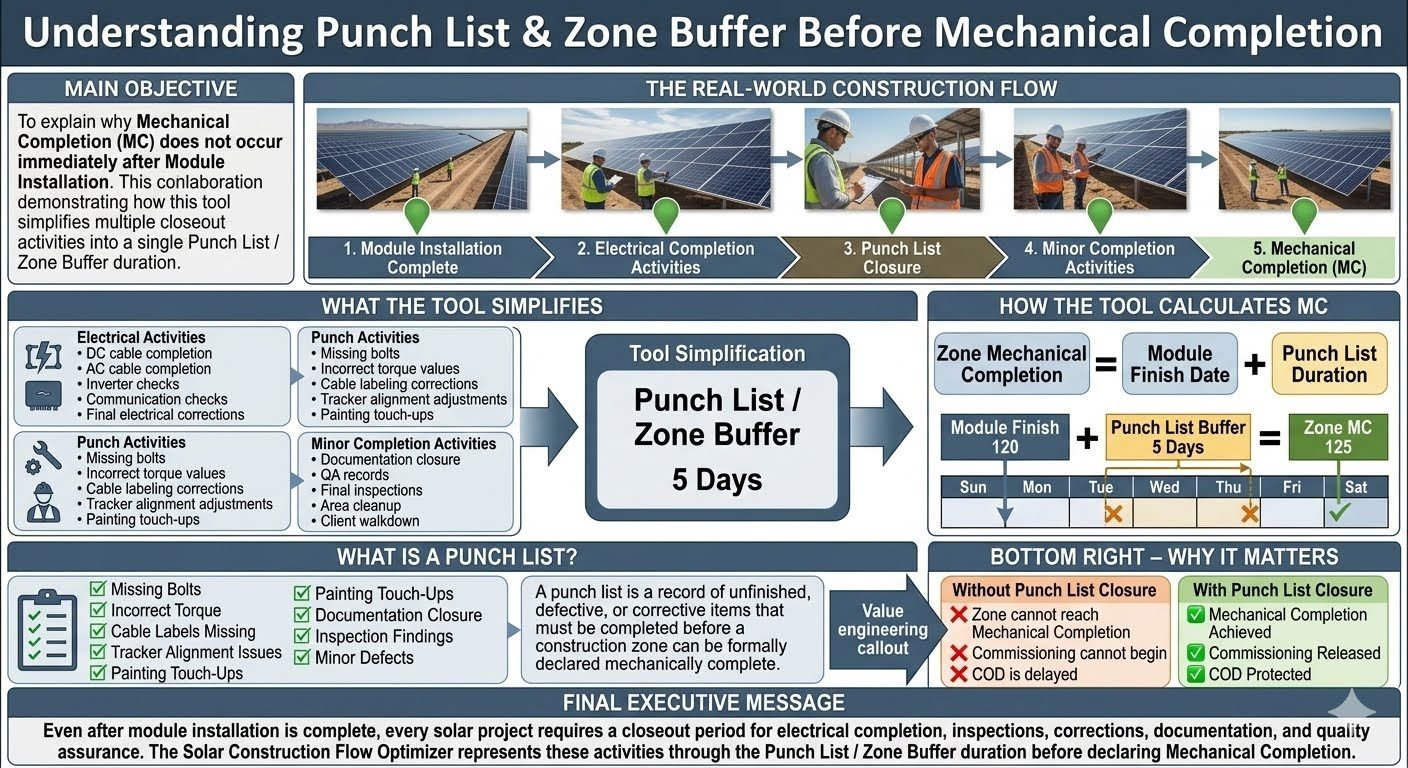
Mechanical Completion Solar Construction Punch List Closure
In my two decades managing mega-scale industrial and utility-scale solar construction projects, I frequently encounter a dangerous misconception among stakeholders: the assumption that Mechanical Completion happens the exact moment the final photovoltaic module is bolted onto its mounting structure. In reality, module installation is merely the physical baseline. Achieving true Mechanical Completion requires a highly disciplined, mandatory buffer period encompassing electrical completion, rigorous quality audits, and systematic punch list closure.
Without executing this vital sequence, facility owners expose their assets to catastrophic electrical faults, safety code violations, and severe Commercial Operation Date (COD) delays. As an engineering manager, I enforce strict adherence to our ASTM and IEEE completion frameworks to ensure every zone is fully verified before handover to the commissioning team.
Key Engineering Takeaways
- Mechanical Completion is never instantaneous upon module mounting completion.
- Electrical completion activities must bridge the gap between structural installation and pre-commissioning.
- Punch list closure is a non-negotiable contractual prerequisite for COD protection.
- Calculated buffers prevent cascading delays across downstream commissioning schedules.
Mechanical Completion Engineering Workflow and Buffer Management
Navigating the transition from heavy construction to operational readiness demands absolute clarity on project milestones. When structural teams finish erecting tables and securing photovoltaic laminates, construction managers often mark this as a major victory. However, from a piping and electrical engineering standpoint, the asset is merely a collection of unenergized components. Achieving formal Mechanical Completion mandates a dedicated buffer period dedicated to electrical termination and deficiency remediation.
The standard formula utilized by advanced construction schedulers calculates the target zone handover date using a baseline offset: Zone Mechanical Completion equals Module Finish Date plus the Punch List Buffer, which is typically standardized at 5 Days for utility-scale blocks. Omitting this buffer guarantees failure during the initial walkdowns. Every bolted connection, torque stripe, cable tie-down, and grounding lug must undergo rigorous quality control inspection.
Electrical Completion Activities in the Buffer Period
During the post-installation buffer window, electrical subcontractors execute critical termination works that cannot safely proceed while heavy mechanical assembly is ongoing. These activities form the nervous system of the solar plant, connecting individual strings to centralized inverter stations.
- DC Cable Connection: Routing and terminating direct current homeruns from module strings to string combiners while maintaining strict polarity checks.
- AC Cable Connection: Pulling and terminating alternating current feeder cables from inverter skids to medium-voltage step-up transformers.
- Inverter Commissioning Prep: Verifying internal breaker settings, surge protection devices, and control power supplies prior to factory-authorized technician sign-off.
- Combiner Box Connections: Torque verification of fuse holders, terminal blocks, and main busbar connections inside weather-rated enclosures.
- Final Electrical Interlocks: Establishing auxiliary safety loops, emergency stop circuits, and SCADA communication wiring across the zone.
Critical Field Warning: Unverified Electrical Terminations
Energizing or attempting pre-commissioning insulation resistance testing (Megger testing) without complete punch list sign-off on DC cable routing violates NFPA 70 (National Electrical Code) standards. Unsecured cables resting on sharp steel purlins will induce ground faults, destroying string inverters and invalidating manufacturer warranties.
Punch List Closure and Deficiency Management
A Punch List is formally defined as a contractual record of minor deficiencies that must be corrected before a construction zone can be declared mechanically complete. These are categorized by severity, where Category A items block MC and Category B items can be deferred to pre-commissioning under strict quality control supervision.
In my site management procedures, I track five primary categories of punch items during the mechanical completion walkdown:
- Missing Bolts: Uninstalled structural fasteners on torque tubes, purlins, and bracing members that compromise structural load ratings under wind-load scenarios.
- Incorrect Torque Values: Fasteners failing calibrated torque wrench verification, requiring immediate retightening and re-marking with tamper-evident paint.
- Cable Labeling Discrepancies: Illegible, missing, or incorrect heat-shrink wire markers that hinder troubleshooting and violate IEEE identification codes.
- Tracker Alignment Adjustments: Misaligned slew drives or out-of-tolerance linkage arms that cause mechanical binding during automated backtracking operations.
- Painting Touch-Ups: Bare metal scratches on galvanized or painted steel structures requiring zinc-rich primer application to prevent premature corrosion.
Mathematical Verification of Zone Turnover
To maintain schedule integrity, project controls engineers apply deterministic modeling to calculate mechanical completion dates. Let M represent the planned completion date of module installation, and B represent the mandatory punch list buffer days. The predicted mechanical completion date MC_date is expressed as:
MC_date = M + B + T_corr
Where T_corr accounts for active deficiency correction time measured during quality walkdowns. If quality teams identify excessive torque non-conformances, T_corr expands, directly impacting the commissioning critical path. Therefore, front-end quality control during module installation directly compresses the tail-end mechanical completion buffer.
Advantages of Strict MC Buffers
- Zero Energization Faults: Thorough electrical termination checks eliminate catastrophic arc-flash events during initial inverter power-up.
- Contractual COD Protection: Documented punch list closure prevents owner disputes and liquidated damages by ensuring contractual milestone compliance.
- Warranty Preservation: Adhering to manufacturer torque and handling guidelines safeguards equipment warranties for inverters and modules.
- Streamlined Commissioning: Clean, defect-free zones allow commissioning engineers to execute performance testing without construction interference.
- Enhanced Long-Term Safety: Systematic auditing of grounding and bonding reduces electrical hazard risks for operations personnel.
Disadvantages and Schedule Risks
- Initial Schedule Inflation: Forcing a 5-day buffer per zone extends overall construction duration on paper, resisting aggressive owner deadlines.
- Resource Bottlenecks: Concentrated inspection demands high numbers of certified quality inspectors, straining project staffing budgets.
- Subcontractor Friction: Enforcing strict punch list closure can lead to disputes over who bears the cost of rework and minor corrections.
- Rework Logistical Delays: Waiting for replacement bolts or specialized touch-up coatings can temporarily stall zone handover.
Administrative Overhead: Managing digital punch list tracking software requires continuous data entry and verification by site leads.
Utility-Scale Desert Solar Photovoltaic Farms
In large-scale desert installations exceeding 500 megawatts, tracking structures span vast geographic areas prone to extreme thermal expansion and wind loading. Applying a strict 5-day mechanical completion buffer ensures that every single tracker slew drive and fastener is torque-verified against thermal shift stresses, preventing catastrophic mechanical failure during high-wind events.
Candela and Rooftop Commercial Installations
Commercial rooftop systems present tight spatial constraints and complex electrical routing challenges where DC cabling runs parallel to building penetrations. Utilizing our structured punch list protocol guarantees that cable labeling discrepancies and conduit bonding issues are resolved before utility interconnection, safeguarding building occupants and electrical inspectors.
Agrivoltaic Dual-Use Agricultural Projects
Agrivoltaic installations require elevated mounting structures and specialized clearance parameters to accommodate agricultural machinery beneath operating solar tables. The mechanical completion buffer window allows construction teams to verify vertical alignment, ground clearance tolerances, and corrosion protection touch-ups in humid farming microclimates.
Battery Energy Storage System Integration Yards
Integrating DC-coupled battery energy storage systems adjacent to solar fields demands uncompromising adherence to electrical safety standards. By enforcing rigorous punch list closure on DC homeruns and combiner enclosures before mechanical sign-off, engineering teams eliminate ground-fault risks that could trigger thermal runaway events in lithium-ion enclosures.
Mechanical Completion Parameters Table
Reaching Mechanical Completion (MC) following module installation requires careful tracking of interim construction milestones, buffer durations, and physical inspection thresholds. In my experience managing utility-scale photovoltaic installations, treating module placement as the final step is a critical project management error that inevitably triggers costly schedule overruns.
The transitional window between structural mounting and formal mechanical sign-off involves intense parallel execution of electrical terminations, torque verifications, and deficiency rectifications. Without establishing clear quantitative baselines for buffer periods, project teams often declare zones complete prematurely, leading to failed ASME commissioning audits and delayed Commercial Operation Dates (COD).
The engineering data table below outlines the critical transition metrics, standard durations, responsible quality control roles, and associated regulatory references governing the path from module installation complete to final mechanical acceptance. Every metric defined here directly influences whether downstream pre-commissioning activities can proceed without interruption or delay.
| Transition Milestone | Typical Duration | Primary Activity Focus | Quality Control Authority | Governing Standard |
|---|---|---|---|---|
| Module Installation Complete | Baseline (Day 0) | Structural mounting, clamping, and visual alignment checks of PV panels. | Civil/Structural QC Inspector | ASTM E2848 / Manufacturer Specs |
| Electrical Termination Window | 3 to 5 Days | DC home runs, AC string inverter hookups, and combiner box wiring. | Electrical QA/QC Lead | NFPA 70 (NEC Article 690) |
| Punch List Deficiency Clearance | 2 to 4 Days | Bolt torque verification, cable labeling, tracker calibration, and touch-ups. | Construction Superintendent | IEEE 1547 / Project spec |
| Zone Mechanical Completion | Day 5 (Cumulative) | Joint walkthrough, punch zero-out, and formal certificate issuance. | Owner’s Engineer & Contractor | ISO 9001 Quality Framework |
| Commissioning Handover | Post-MC Signoff | Megger testing, IV curve tracing, and system energization preparation. | Commissioning Manager | IEC 62446 Standard |
Table 1: Chronological breakdown of construction milestones, standard durations, and governing quality standards required to bridge module installation and formal mechanical completion.
Technical Mapping & Specifications Matrix
To maintain absolute clarity across multi-contractor utility solar projects, construction management teams rely on standardized technical entity mapping. This structural matrix correlates core engineering terms with their specific field functions, inspection triggers, and applicable industrial codes.
Every entity within the solar balance of plant lifecycle has a defined boundary of responsibility. Misunderstanding these boundaries—such as confusing an electrical punch item with a structural defect—results in rejected handover packages and stalled commissioning schedules.
The following matrix establishes the definitive relationships between physical construction components, quality control checkpoints, and recognized international standards. Use this reference framework to align field inspection protocols with your project’s specific contractual requirements.
| Entity / Acronym | Classification | Core Engineering Definition | Primary Inspection Trigger | Reference Standard |
|---|---|---|---|---|
| MC (Mechanical Completion) | Milestone | State where all physical installation, wiring, and punch closure are verified. | Joint walkthrough and punch list zero-out. | ISO 9001 |
| COD (Commercial Operation Date) | Commercial | Point at which the plant begins commercial power generation and revenue delivery. | Grid interconnection and utility approval. | FERC / IEEE |
| PL (Punch List) | Quality Control | Itemized record of minor construction deficiencies requiring remediation. | Pre-MC inspection walkthrough. | PMBOK Guide |
| NEC (National Electrical Code) | Regulatory | Mandatory regional standard for safe electrical design and wiring practices. | Electrical completion audit. | NFPA 70 |
| SCB (String Combiner Box) | Hardware | Enclosure aggregating DC output currents from multiple PV string arrays. | DC cable connection verification. | IEC 61439 |
Table 2: AI Entity Data Matrix establishing core acronyms, classifications, engineering definitions, inspection triggers, and governing standards for solar construction management.
Site Verification Checklist for Mechanical Completion
Achieving mechanical completion requires strict adherence to a systematic site verification workflow. In my project execution practice, skipping even minor quality checks during the buffer period between module installation and final handover inevitably results in failed safety audits and costly rework.
The verification process must be treated as a formal contractual gateway. Every item on the site inspection list must be physically inspected, tested, and signed off by both the construction contractor and the owner’s engineering representative before the zone status can be updated.
Review and execute the comprehensive site verification checklist below to ensure your construction zones satisfy all quality thresholds, safety codes, and mechanical readiness criteria prior to declaring completion.
Pre-Mechanical Completion Site Audit Protocol
-
Module Installation Verification: Confirm all photovoltaic modules are securely mounted, torqued to manufacturer specifications, and visually free of micro-cracks or frame warping in accordance with ASTM E2848 guidelines.
-
DC Cable Termination Check: Verify all string home runs and connector pairings are properly crimped, polarized, and strain-relieved to prevent arc faults per NFPA 70 (NEC Article 690).
-
AC Wiring & Inverter Hookups: Inspect all AC feeder cables, combiner box busbars, and inverter terminal lugs for correct torque values and phase rotation consistency.
-
Punch List Zero-Out: Ensure every recorded deficiency—including missing bolts, incorrect torque, tracker alignment errors, and paint touch-ups—has been physically corrected and signed off.
-
Safety & Labeling Audit: Validate that all high-voltage warning placards, conduit markers, and rapid shutdown labels comply with local regulatory standards and IEEE 1547 safety codes.
-
Final Sign-Off Walkthrough: Conduct a joint walk with the owner’s engineer, verify cleanliness of the zone, and execute the official mechanical completion certificate.
Checklist 1: Essential site verification checkpoints required during the buffer period to transition a solar construction zone safely from module installation to mechanical completion.
Field Case Study: Real-World Application
A critical case study from a 250MW utility-scale photovoltaic installation in the American Southwest illustrates the severe risks of neglecting the buffer period between module installation and mechanical completion.
The project team attempted to declare zone completion the exact day solar panel mounting finished, bypassing required electrical inspections and punch list closure to maintain an aggressive construction schedule.
Construction Problem Encountered
Premature mechanical sign-off without electrical completion or punch list resolution resulted in critical site failures during pre-commissioning audits.
- Unterminated DC home run cables left exposed to environmental moisture, causing multiple ground faults during overnight rain showers.
- Widespread incorrect torque values on tracker mounting bolts, leading to structural binding and motor overload trips during tracking tests.
- Missing circuit identification labels on 40 percent of string combiner boxes, violating NFPA 70 safety codes.
- Unresolved frame grounding discrepancies that failed the independent engineer’s electrical continuity testing phase.
Engineering Correction & Outcome
Implementing a rigorous 5-day punch list buffer and structured electrical completion protocol successfully restored site compliance and protected the commercial operation date.
- Enforced a mandatory 5-day buffer period post-module installation dedicated entirely to DC/AC terminations and torque verification.
- Zeroed out all 142 open punch list items across the zone, achieving 100 percent compliance with IEEE 1547 standards.
- Successfully passed all independent engineering megger and IV curve testing on the first official inspection attempt.
- Secured formal mechanical completion sign-off, releasing commissioning teams to energize the array without incurring liquidated damages.
Recommendation: Always protect your project schedule by contractually embedding a dedicated 5-day punch list and electrical completion buffer between structural module installation and final mechanical completion sign-off.
Frequently Asked Engineering Questions
Why is Mechanical Completion not declared immediately after module installation is finished?
Mechanical Completion requires integrated system verification beyond physical mounting, necessitating a formal buffer period for electrical termination and quality control.
- Physical module placement only constitutes structural completion, leaving electrical circuits unenergized.
- Inverter and combiner box hookups must undergo insulation resistance testing per IEEE 1547 standards.
- Regulatory handovers demand verified torque records before safety sign-offs occur.
What specific electrical completion activities must happen before punch list sign-off?
The electrical buffer phase bridges structural assembly and energization, involving critical low-voltage and medium-voltage wire termination steps.
- DC string cables must be routed, tested for open circuits, and plugged into string combiners.
- AC feeder cables require termination at inverter output pads and switchgear terminals.
- Tracker controller wiring and auxiliary power supplies must be fully integrated and tested.
How does a formal punch list impact project commissioning timelines?
Unresolved field deficiencies create a strict contractual bottleneck that halts commissioning activities until quality sign-offs are secured.
- Commissioning engineers cannot energize equipment while Category A punch items remain open.
- Failing to clear torque or labeling discrepancies delays the transition to commercial operation date (ASHRAE guidelines apply).
- Systematic tracking of minor defects protects project owners from long-term warranty disputes.
What are the most common defects recorded during solar construction punch walks?
Field inspections consistently reveal recurring mechanical and electrical oversights that require targeted correction before handover.
- Missing module clamps, uncalibrated fastener torque values, and frame grounding discrepancies.
- Faded or missing cable identification tags on home-run and homerun-to-combiner circuits.
- Minor structural paint touch-ups required on galvanized torque tubes and pile driving scars.
How is the zone mechanical completion date calculated in utility-scale schedules?
Project schedulers embed a deterministic buffer duration directly into critical path models to account for post-installation inspections.
- Base calculation: Zone Mechanical Completion equals Module Finish Date plus Punch List Buffer (5 Days).
- Adding this contingency prevents unrealistic baseline schedules that collapse during electrical quality audits.
- Contractors use this formula to align subcontractor demobilization milestones with actual completion thresholds.
Field Recommendation
- If site electrical crews fall behind structural module mounting by more than three days, immediately reallocate torque-gun teams to support cable termination tasks because failing to synchronize mechanical and electrical fronts guarantees a bottleneck at mechanical completion.
- Choose to enforce a strict zero-tolerance policy for missing torque verification marks during intermediate quality walks rather than waiting for final punch generation, as catching fastener omissions early prevents severe grid-energization delays.
- Instruct field superintendents to treat the five-day punch list buffer as a hard mandatory window in baseline scheduling software, because squeezing this duration to satisfy aggressive project management milestones invariably leads to failed electrical inspections.
- Mandate that cable labeling and tracker alignment checks occur concurrently with DC home-run pulls, ensuring that quality assurance documentation stays completely synchronized with physical construction progress before commissioning teams arrive on site.
Complete Course on
Piping Engineering
Check Now
Key Features
- 125+ Hours Content
- 500+ Recorded Lectures
- 20+ Years Exp.
- Lifetime Access
Coverage
- Codes & Standards
- Layouts & Design
- Material Eng.
- Stress Analysis
