How to Select Metallic Pipe Materials for Industrial Piping Systems
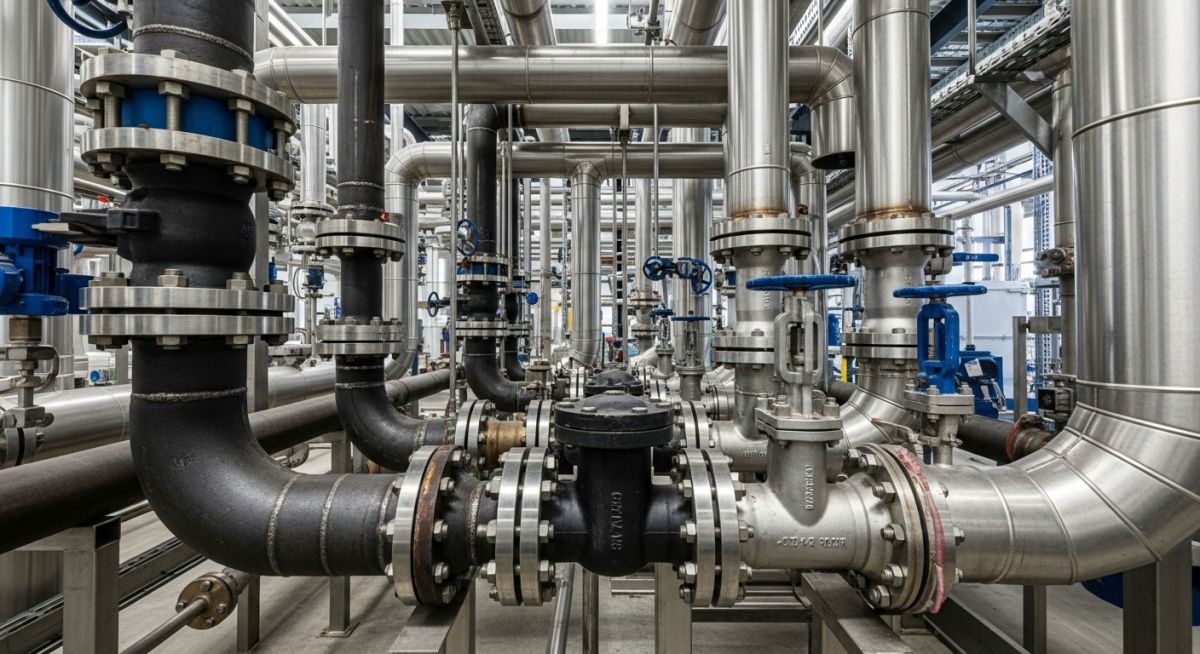
In my 20 years of working on heavy industrial piping systems, I have seen many projects suffer from catastrophic failures simply because someone chose the wrong grade of steel. Selecting the right piping material is not just about looking at a pressure-temperature rating chart; it requires a deep understanding of metallurgy, fluid chemistry, and mechanical stress. Whether you are dealing with high-temperature steam lines or highly corrosive chemical processes, your choice of metallic pipe materials determines the safety, longevity, and cost-effectiveness of your entire facility.
I wrote this guide to share the practical, field-tested knowledge I have accumulated over two decades. We will dive deep into the mechanical properties of carbon steel, stainless steel, and specialty alloys, and look at the exact calculations and standards you need to apply to make an informed engineering decision.
- Understand how carbon steel, stainless steel, and alloy steels behave under extreme temperatures and pressures.
- Learn the exact ASME B31.3 wall thickness calculation to prevent over-designing or under-designing your piping.
- Discover how to prevent common field failures like graphitization, sensitization, and stress corrosion cracking.
- Master the site verification protocols to ensure the materials delivered match your engineering specifications.
Key Criteria for Selecting Metallic Pipe Materials
When I evaluate metallic pipe materials for a new project, I always start with the design conditions: pressure, temperature, and fluid composition. These three factors dictate the minimum mechanical strength and corrosion resistance required. Under ASME B31.3 Process Piping, we must calculate the minimum required wall thickness to withstand internal pressure.
The standard formula for pressure design thickness of straight pipe under internal pressure is:
t = (P * D) / (2 * (S * E * W + P * Y))
Where:
- t = Pressure design thickness (inches or mm)
- P = Internal design gage pressure (psi or MPa)
- D = Outside diameter of the pipe (inches or mm)
- S = Allowable stress value for the material at design temperature from ASME B31.3 Table A-1 (psi or MPa)
- E = Quality factor from Table A-1A or Table A-1B
- W = Weld joint strength reduction factor
- Y = Coefficient from Table 304.1.1, which varies based on material and temperature
Once you calculate the pressure design thickness (t), you must add allowances for corrosion, erosion, and mechanical strength (such as thread depth), and then account for the manufacturer’s mill tolerance (typically 12.5% for seamless pipe) to select the nominal pipe schedule.
In my experience, using carbon steel (like ASTM A106 Grade B) above 800 degrees Fahrenheit (427 degrees Celsius) is a recipe for disaster. Prolonged exposure to high temperatures causes the carbide phase in carbon steel to convert into graphite. This process, known as graphitization, severely embrittles the steel, leading to sudden, catastrophic pipe ruptures along the heat-affected zones of welds. Always upgrade to alloy steels containing chromium and molybdenum (such as ASTM A335 Grade P11 or P22) for high-temperature service.
Let us look at the three primary categories of metallic pipe materials used in industrial plants:
1. Carbon Steel (CS)
Carbon steel is the workhorse of industrial piping. It is economical, widely available, and easy to weld. The most common specification is ASTM A106 Grade B for seamless pipe and ASTM A53 Grade B for welded pipe. Carbon steel is excellent for non-corrosive utility services like utility air, cooling water, and low-pressure steam. However, it is highly susceptible to atmospheric corrosion and chemical attack by acids.
2. Stainless Steel (SS)
When corrosion resistance is required, stainless steel is the standard choice. The addition of chromium (minimum 10.5%) creates a passive oxide layer that protects the metal from oxidation. The most common grades are austenitic stainless steels:
- Grade 304/304L: Standard 18-8 stainless steel, excellent for general corrosion resistance but susceptible to chloride stress corrosion cracking.
- Grade 316/316L: Contains molybdenum, which significantly improves resistance to pitting and crevice corrosion in chloride environments.
The “L” stands for low carbon (maximum 0.03% carbon). I always specify low-carbon grades for welded systems to prevent sensitization—a phenomenon where chromium carbides precipitate at the grain boundaries during welding, leaving the adjacent areas depleted of chromium and highly susceptible to intergranular corrosion.
3. Alloy Steels and Exotic Alloys
For extreme conditions, standard carbon and stainless steels are inadequate. Chrome-moly alloys (ASTM A335 P-grades) are used for high-temperature, high-pressure steam lines because chromium provides oxidation resistance while molybdenum increases creep strength. For highly corrosive chemical services, we turn to nickel alloys (like Monel, Inconel, and Hastelloy) or Duplex Stainless Steels, which offer a balanced microstructure of austenite and ferrite, providing high strength and exceptional resistance to stress corrosion cracking.
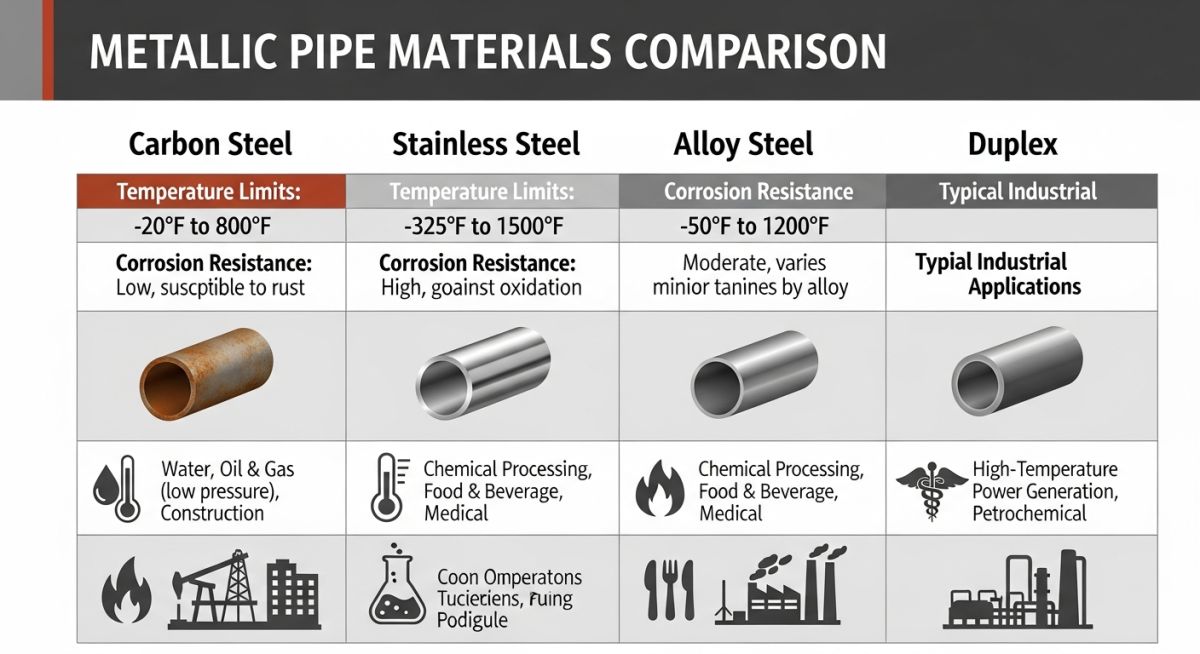
The table below summarizes the most common ASTM material specifications used in industrial piping systems, along with their typical temperature limits and primary applications.
| Material Group | ASTM Specification | Common Grade | Temperature Range | Primary Application |
|---|---|---|---|---|
| Carbon Steel | ASTM A106 | Grade B | -20 to 800 F (-29 to 427 C) | Steam, water, air, non-corrosive hydrocarbons |
| Low-Temp Carbon Steel | ASTM A333 | Grade 6 | -50 to 650 F (-45 to 343 C) | Low-temperature process piping, LPG, cold climates |
| Alloy Steel (Chrome-Moly) | ASTM A335 | Grade P11 / P22 | -20 to 1100 F (-29 to 593 C) | High-temperature steam, power plant piping |
| Stainless Steel (Austenitic) | ASTM A312 | TP304L / TP316L | -425 to 1500 F (-254 to 816 C) | Corrosive chemicals, food processing, cryogenic fluids |
| Duplex Stainless Steel | ASTM A790 | UNS S31803 (2205) | -50 to 600 F (-45 to 316 C) | Seawater, high-chloride environments, offshore oil & gas |
This matrix maps core technical entities, structural acronyms, and physical parameters to their corresponding standard references to assist in precise material specification.
| Entity / Acronym | Full Technical Name | Key Physical Parameter | Standard Reference |
|---|---|---|---|
| CS | Carbon Steel | Tensile Strength: 60,000 psi (415 MPa) | ASTM A106 |
| LTCS | Low-Temperature Carbon Steel | Charpy V-Notch Impact Test at -50 F (-45 C) | ASTM A333 |
| AS | Alloy Steel | Chromium content: 1.00% to 2.25% | ASTM A335 |
| SS | Stainless Steel | Chromium content: Minimum 16% (for 304/316) | ASTM A312 |
| DSS | Duplex Stainless Steel | Austenite-Ferrite ratio: 50/50 | ASTM A790 |
Site Verification Checklist for Metallic Pipe Materials
In my experience, material mix-ups at the construction site are a common cause of premature piping failures. Delivering carbon steel instead of low-temperature carbon steel, or standard stainless steel instead of low-carbon “L” grades, can lead to catastrophic failures once the plant is commissioned. Use this checklist to verify all metallic pipe materials before installation.
-
Mill Test Reports (MTRs) Verification: Cross-reference the heat numbers stamped on the pipes with the supplied MTRs to verify chemical composition and mechanical properties comply with ASTM standards.
-
Positive Material Identification (PMI): Perform PMI testing using a handheld XRF analyzer on all alloy and stainless steel piping components to confirm the elemental composition (especially chromium, nickel, and molybdenum content).
-
Visual Inspection for Defects: Inspect the pipe surface for laminations, cracks, deep pits, or mechanical damage. Ensure the pipe ends are properly beveled according to ASME B16.25 for welding.
-
Wall Thickness and OD Measurement: Use ultrasonic thickness gauges and calipers to verify that the actual wall thickness and outside diameter match the nominal pipe schedule specified in the piping isometric drawings.
-
Color Coding and Marking: Ensure the pipes are color-coded and marked continuously along their length with the manufacturer’s name, ASTM specification, grade, size, and heat number.
Field Case Study: Real-World Application
During a routine shutdown inspection at a petrochemical facility, I discovered severe cracking near the weld joints of a 304 stainless steel piping system carrying hot organic acids. The system had only been in service for 18 months. Metallurgical analysis revealed that standard ASTM A312 TP304 pipe had been installed instead of the specified low-carbon TP304L. During welding, the high heat input caused chromium carbides to precipitate at the grain boundaries (sensitization), depleting the surrounding metal of chromium and leaving it highly vulnerable to rapid intergranular corrosion by the organic acids.
I ordered the immediate replacement of the damaged piping sections with ASTM A312 TP316L stainless steel. The low carbon content (under 0.03%) prevented sensitization during welding, while the addition of molybdenum provided superior resistance to the organic acids. We also implemented a strict Positive Material Identification (PMI) program for all incoming stainless steel components. Over the next five years of operation, the system showed zero signs of cracking or localized corrosion.
My recommendation based on this event is clear: never rely solely on paper certificates. Always perform field PMI on critical alloy and stainless steel components to verify that the correct low-carbon or stabilized grades are installed.
Frequently Asked Engineering Questions
What is the difference between ASTM A106 Grade B and ASTM A53 Grade B?
Why is low-carbon stainless steel (L-grade) specified for welded systems?
When should I use alloy steel instead of carbon steel?
What causes chloride stress corrosion cracking (CSCC) in stainless steel?
How does mill tolerance affect pipe wall thickness selection?
What is Positive Material Identification (PMI) and why is it necessary?
===`
Complete Course on
Piping Engineering
Check Now
Key Features
- 125+ Hours Content
- 500+ Recorded Lectures
- 20+ Years Exp.
- Lifetime Access
Coverage
- Codes & Standards
- Layouts & Design
- Material Eng.
- Stress Analysis