What is Metal Grating? Types, Engineering Standards, and Industrial Uses
Key Article Takeaways
- Selection Criticality: Understanding the difference between welded bar and press-locked Metal Grating for load-bearing vs. architectural needs.
- Compliance: Adhering to NAAMM MBG 531-17 and ASTM A1011 standards to ensure structural safety.
- 2026 Trends: The rise of Serrated Safety Gratings in mitigating workplace slip-and-fall litigation.
What is Metal Grating?
Metal Grating is a structural framework of parallel, bearing bars connected by cross bars or reticulated bars, designed to provide high-strength flooring with open space for light, air, and liquid drainage. Common types include welded bar, expanded metal, and perforated sheets, governed by NAAMM and ASTM engineering standards.
Expert Perspective: The “Span” Trap
“In my 20 years of site inspections, the most common failure I see in Metal Grating installations is the ‘Span Trap.’ Engineers often specify a panel based on total weight capacity but forget the deflection limits. If your walkway bounces more than 1/4 inch, you’re looking at fatigue failure within 36 months.”
— Atul Singla, Founder of Epcland
Table of Contents
Complete Course on
Piping Engineering
Check Now
Key Features
- 125+ Hours Content
- 500+ Recorded Lectures
- 20+ Years Exp.
- Lifetime Access
Coverage
- Codes & Standards
- Layouts & Design
- Material Eng.
- Stress Analysis
Metal Grating Proficiency Quiz
Question 1 of 5According to NAAMM standards, what is the primary structural component of Metal Grating that carries the load between supports?
Understanding the Primary Metal Grating Types
In the engineering landscape of 2026, selecting the correct Metal Grating is no longer just about floor coverage; it is about structural optimization and lifecycle management. The architecture of a grating panel determines its load-bearing efficiency, drainage capacity, and slip resistance. Engineers must distinguish between various fabrication methods to ensure compliance with modern safety codes.
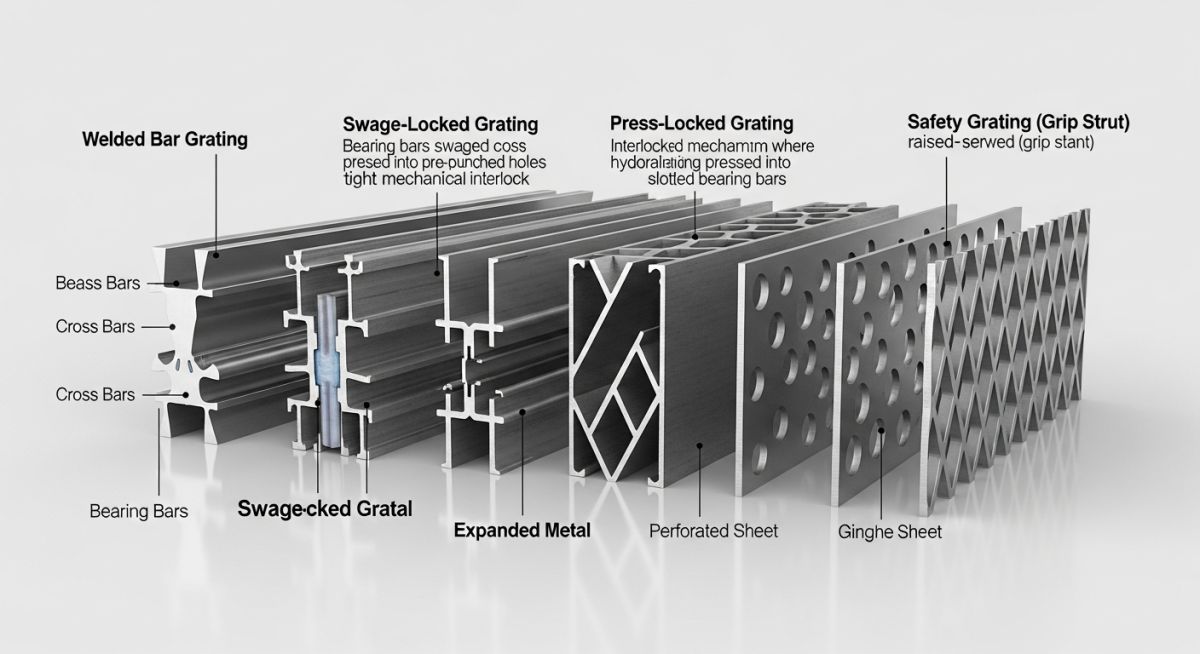
Expanded Metal Grating
Expanded Metal Grating is manufactured by simultaneously slitting and stretching a solid metal sheet. This process creates diamond-shaped openings without any waste of material. Unlike welded alternatives, expanded Metal Grating is a single piece of metal, providing excellent strength-to-weight ratios. In 2026, it is frequently specified for lightweight walkways and security partitions where high visibility and airflow are secondary to weight reduction.
Bar Metal Grating or Bar Grating
Standard Bar Metal Grating remains the backbone of industrial flooring. It consists of a series of bearing bars joined to perpendicular cross bars at various intervals. The most common method is forge-welding, which creates a permanent, high-strength joint. For environments requiring a cleaner aesthetic or where heat-affected zones must be avoided, press-locked bar Metal Grating is utilized.
Wire Mesh Metal Grating
Often referred to as industrial cloth, wire mesh Metal Grating is utilized for fine-particle filtration or safety guarding. While not typically used for heavy-duty pedestrian traffic, its application in 2026 has expanded into architectural facades due to its flexibility and variety of weave patterns.
Perforated Metal Grating
Perforated Metal Grating is produced by punching holes into a solid metal plate. The pattern of the holes (round, square, or slotted) can be customized to control the "open area" percentage. This type is ideal for acoustic dampening and decorative screening, offering a more "closed" feel than traditional bar Metal Grating while still allowing for fluid drainage.
Safety Grating (Grip Strut)
In high-risk industrial zones, safety Metal Grating features deeply serrated surfaces or "teeth" designed to bite into shoe soles. These are essential in 2026 for offshore rigs and food processing plants where oil, grease, or ice can create hazardous walking conditions.
Advanced Engineering Materials for Metal Grating Production
The longevity of Metal Grating is directly tied to its metallurgy. Carbon steel remains the most cost-effective choice for general industrial use, typically protected by hot-dip galvanizing to ASTM A123 standards. However, for specialized 2026 infrastructure projects, aluminum and stainless steel are becoming standard.
- Carbon Steel (ASTM A1011): Best for high-load, low-corrosion environments.
- Stainless Steel (304/316L): Critical for chemical plants and wastewater treatment where oxidation is a primary failure mode.
- Aluminum (6063-T6): The material of choice for marine environments and applications where "self-weight" must be minimized.
Industrial Applications of Metal Grating Systems
By 2026, the application of Metal Grating has transcended simple flooring. It is now a critical component in smart infrastructure and modular industrial skids. From high-capacity drainage trenches in municipal water works to the intricate mezzanines of automated logistics centers, the versatility of Metal Grating allows for rapid installation and long-term durability. In oil and gas refineries, serrated bar Metal Grating is mandatory for any elevated surface to ensure worker safety during maintenance cycles.
Critical Metal Grating Standards (NAAMM & ASTM)
Compliance with established engineering standards is the only way to guarantee the structural integrity of Metal Grating. The National Association of Architectural Metal Manufacturers (NAAMM) provides the MBG 531 code, which is the gold standard for bar grating specifications. Furthermore, ASTM standards ensure that the raw materials and finishes meet the rigorous demands of industrial use.
| Standard Code | Focus Area | Engineering Requirement |
|---|---|---|
| NAAMM MBG 531 | Metal Bar Grating Manual | Standardizes manufacturing tolerances and load-bearing calculations. |
| ASTM A123 | Zinc (Hot-Dip Galvanized) Coatings | Specifies thickness and adhesion of protective coatings on Metal Grating. |
| ASTM A1011 | Carbon Steel Sheet/Strip | Defines the tensile strength and chemical composition of the base steel. |
| ISO 14122-2 | Safety of Machinery | Governs the design of working platforms and walkways using Metal Grating. |
Manufacturing Processes: How Metal Gratings are Made
The manufacturing of Metal Grating involves three primary techniques. Forge-Welding utilizes a combination of high-voltage resistance and hydraulic pressure to fuse cross bars into bearing bars, creating a monolithic structure. Press-Locking, preferred for its clean lines, uses enormous hydraulic force to "lock" bars into pre-cut slots without heat. Lastly, Riveting—the oldest and most robust method—uses mechanical fasteners to join bars, making it ideal for heavy-duty Metal Grating used in bridge decking and high-impact zones.
Metal Grating Sheets vs. Custom Fabricated Panels
Purchasing Metal Grating usually falls into two categories: stock sheets or custom-fabricated panels. Stock sheets, often 3' x 20' or 3' x 24', are more economical for contractors who have the on-site capability to cut and band the edges. However, custom-fabricated Metal Grating is precision-cut in the factory to match specific layout drawings, including cutouts for piping and structural columns, ensuring a perfect fit and preserving the integrity of the protective galvanized coating.
Heavy-Duty Metal Grating Deck and Flooring Solutions
For 2026 infrastructure, Metal Grating decks are increasingly used for vehicular traffic. These heavy-duty systems use thicker bearing bars (up to 1/2 inch) to support the weight of forklifts, trucks, and even aircraft. When designing a Metal Grating deck, engineers must account for "dynamic loading"—the force applied by moving vehicles—which is significantly higher than static "live loads" used for pedestrian walkways.
Metal Grating Load & Deflection Estimator
Engineering tool for preliminary 2026 walkway design (Pedestrian Loads).
0.00"
Metal Grating Failure Case Study

The Scenario: Corrosive Degradation in a Desalination Plant
In 2026, a major desalination facility in the Middle East reported structural instability on its primary chemical dosing platform. The original installation utilized standard Hot-Dip Galvanized Carbon Steel Metal Grating. Within 48 months of operation, the platform exhibited severe oxidation and "thinning" of the bearing bars.
The Failure Point
The constant exposure to salt spray and sulfuric acid vapors breached the zinc coating of the Metal Grating. Once the carbon steel core was exposed, the galvanic protection was exhausted, leading to pitting corrosion that reduced the load-bearing capacity by 40%.
The 2026 Solution
The facility's engineering team replaced the failed sections with 316L Stainless Steel Serrated Bar Grating. This material offers superior molybdenum content for chloride resistance. Additionally, they moved from a 1-inch bar depth to a 1-1/4 inch depth to increase the structural safety factor.
Engineering Lessons Learned:
- Material Selection: Galvanized steel is insufficient for high-chloride/low-pH zones; always specify stainless steel or FRP for chemical dosing skids.
- Surface Safety: In wet environments, serrated surfaces on Metal Grating are non-negotiable to prevent worker injury.
- Inspection Frequency: High-corrosion zones require ultrasonic thickness (UT) testing on grating bearing bars every 24 months.
Expert Insights: Lessons from 20 years in the field
-
●
Banding is Structural: Never install Metal Grating with open ends in high-traffic areas. Load-carrying capacity is significantly enhanced when the bar ends are "banded" with a flat bar, which distributes the load across multiple bearing bars.
-
●
The "Trip Hazard" Rule: Ensure that the gap between adjacent Metal Grating panels does not exceed 1/4 inch. In 2026, safety audits strictly penalize irregular spacing that could catch the heel of a safety boot.
-
●
Avoid Field Welding: Whenever possible, use mechanical clips (like G-Clips or Saddle Clips) to secure Metal Grating. Field welding destroys the protective galvanized coating and creates a focal point for premature corrosion.
Frequently Asked Questions (FAQ)
What is the standard spacing for bearing bars in Metal Grating? ▼
The most common spacing for industrial Metal Grating is 19-W-4, which denotes bearing bars spaced 1-3/16 inches (19/16") apart on center, with cross bars spaced 4 inches apart.
How do I choose between serrated and smooth Metal Grating? ▼
Smooth Metal Grating is standard for dry indoor environments. Serrated surfaces are mandatory for outdoor walkways, oily environments, or inclined ramps where slip resistance is the primary safety concern.
Can Metal Grating be used for vehicular loads? ▼
Yes, but it must be specifically engineered as "Heavy-Duty" Metal Grating. Standard pedestrian grating will fail under the point loads of a vehicle.
Why is my galvanized grating rusting at the edges? ▼
This is likely due to field cutting. When Metal Grating is cut on-site, the raw steel edge is exposed. These edges must be immediately treated with a cold-galvanizing zinc-rich spray to prevent oxidation.
Is stainless steel grating worth the extra cost? ▼
In 2026, the Life Cycle Cost (LCC) analysis often favors stainless steel for food processing or chemical plants. While the upfront cost is 3x higher than carbon steel, the elimination of replacement cycles makes it more economical over a 20-year span.
What does "Clear Span" mean in grating design? ▼
Clear Span refers to the distance between the edges of the structural supports. The Metal Grating panel must be slightly longer than the clear span to ensure it has adequate "bearing" (typically at least 1 inch) on each support.
References & Standards
📚 Recommended Resources: Metal Grating
Read these Guides

Related posts:
![High-grade industrial Wing Nut Types and Applications for mechanical assemblies.]()
Wing Nut Types and Applications: The 2026 Engineering Guide
![Industrial Monorail Crane Systems installed in a modern manufacturing plant 2026.]()
Monorail Crane Systems: Design, Types & 2026 Standards Guide
![Lead engineer performing a Factory Acceptance Test FAT on an industrial skid system 2026]()
Factory Acceptance Test FAT: The 2026 Engineering Guide to Zero-Defect Delivery
![Professional engineering workspace showing a Basis of Design document layout for a 2026 project.]()
Basis of Design: How to Write a BOD for Engineering Projects in 2026
![Industrial Flare Knockout Drum Sizing and installation in a refinery relief system.]()
Flare Knockout Drum Sizing: Design & API 521 Standards (2026 Guide)
![Advanced Reboiler Control Systems in a modern petrochemical refinery 2026.]()
Reboiler Control Systems: Engineering Guide to Precision Control 2026