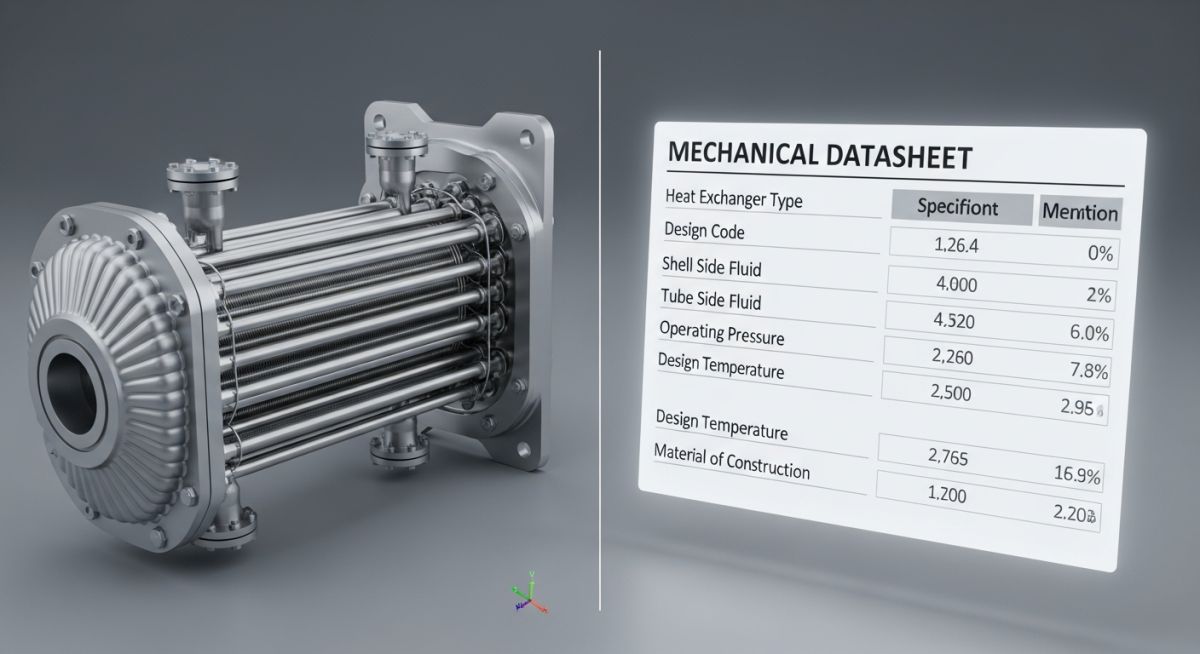
What is a Mechanical Datasheet? Comprehensive Guide for 2026
A Mechanical Datasheet is the definitive technical document used in Engineering, Procurement, and Construction (EPC) to translate process requirements into physical equipment specifications. It serves as the primary communication link between design engineers and equipment manufacturers, ensuring that every pump, vessel, or heat exchanger meets stringent safety and performance codes.
Mechanical Datasheet Definition
A Mechanical Datasheet is a formal document that specifies the physical, material, and structural requirements of a piece of equipment. Unlike a process datasheet which focuses on fluid behavior, the mechanical version defines Materials of Construction (MOC), dimensions, nozzle schedules, design codes (like ASME Section VIII), and fabrication tolerances.
Technical Proficiency Quiz
Question 1 of 5Which engineering code is most commonly referenced on a Mechanical Datasheet for a Pressure Vessel?
Complete Course on
Piping Engineering
Check Now
Key Features
- 125+ Hours Content
- 500+ Recorded Lectures
- 20+ Years Exp.
- Lifetime Access
Coverage
- Codes & Standards
- Layouts & Design
- Material Eng.
- Stress Analysis
Fundamental Definition: What is a Mechanical Datasheet?
The Mechanical Datasheet is a multi-purpose technical specification that defines the physical attributes and construction requirements of industrial equipment. In the 2026 engineering landscape, this document acts as the legal and technical basis for procurement. While a process engineer defines “what the fluid does,” the mechanical engineer uses this datasheet to define “what the machine is made of” to survive those process conditions.
Specifically, it bridges the gap between conceptual design and fabrication. It incorporates Engineering Codes such as ASME Section VIII for pressure vessels, API 610 for centrifugal pumps, or API 650 for storage tanks. Every entry on the sheet must be verified for compliance with international safety standards to prevent catastrophic failures in high-pressure or corrosive environments.
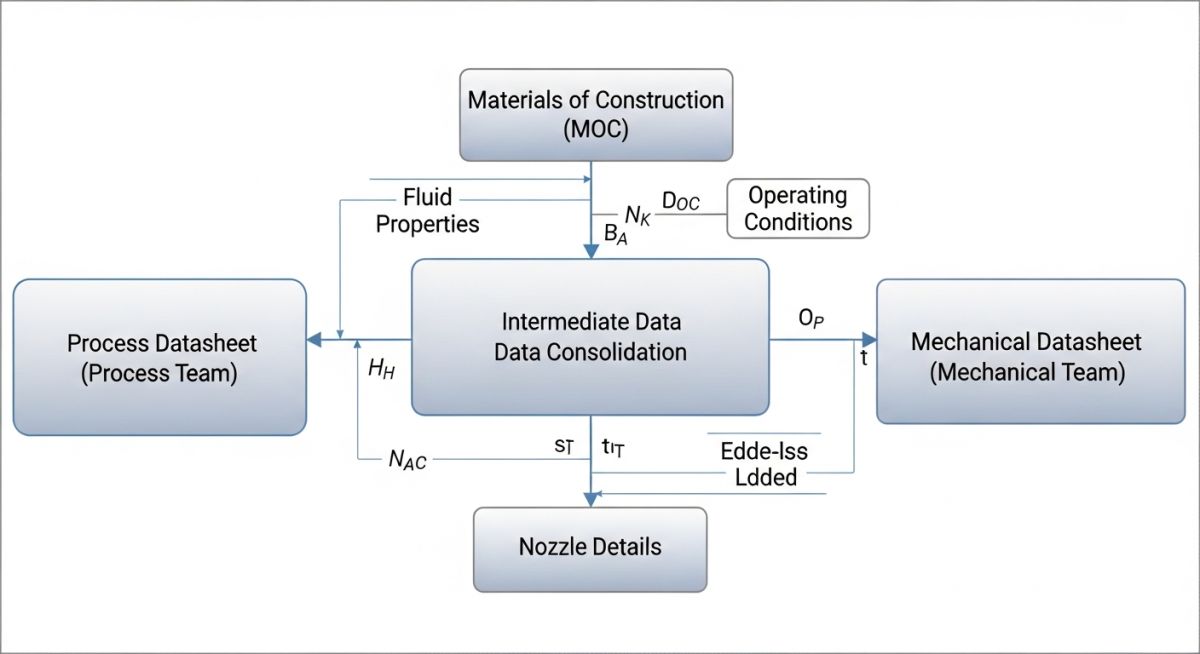
Critical Items Requiring a Mechanical Datasheet in EPC Projects
In large-scale Engineering Procurement Construction (EPC) projects, not every component requires a custom datasheet. However, “Tagged Equipment” or “Capital Equipment” must have a dedicated Mechanical Datasheet to ensure quality control. The following categories are non-negotiable:
Static Equipment Specifications
- Shell and Tube Heat Exchangers (ASME Section VIII / TEMA)
- Pressure Vessels and Columns
- Storage Tanks (API 650 / 620)
- Reactors and Spheres
Rotating Equipment Specifications
- Centrifugal Pumps (API 610)
- Reciprocating Compressors (API 618)
- Steam Turbines (API 612)
- Gas Engines and Mixers
Material of Construction (MOC) and Corrosion Allowance
One of the most vital sections of a Mechanical Datasheet is the Material of Construction (MOC). Engineers must specify the exact metallurgical grade, such as ASTM A516 Gr. 70 for carbon steel vessels or SS316L for stainless steel applications. Furthermore, a Corrosion Allowance (typically 1.5mm, 3mm, or 6mm) is added to the minimum required thickness to account for wall thinning over the equipment’s 20 to 30-year design life.
Standard Equipment Datasheet in Oil and Gas Applications
In the Oil and Gas sector, the Mechanical Datasheet must account for extreme variables such as Sour Service (H2S), cryogenic temperatures, or high-pressure hydrogen service. For 2026, many operators are now requiring Technical Bid Evaluation (TBE) data to be integrated directly into the digital datasheet format to facilitate “Digital Twin” transitions.
Design Pressure and Temperature Limitations
While the process team provides the “Operating” values, the mechanical engineer calculates the Design Pressure and Temperature. Typically, the design pressure is set at 10 percent or 1.7 bar (whichever is greater) above the maximum operating pressure. These values are the “Hard Limits” listed on the Mechanical Datasheet that dictate the hydro-test pressure and the final thickness of the equipment walls.
Strategic Advantages of a Mechanical Datasheet for Engineering Accuracy
Utilizing a robust Mechanical Datasheet ensures that all stakeholders—from procurement teams to maintenance crews—operate from a single source of truth. In 2026, the integration of these sheets into Automated Engineering Workflows reduces human error by ensuring that Equipment Specifications are synchronized with the latest Engineering Codes.
Precision in Data Sheet Procurement
The primary advantage is during Data Sheet Procurement. By specifying exact nozzle orientations, allowable flange ratings, and internal coating requirements, the owner-operator eliminates the risk of receiving “off-the-shelf” equipment that fails to meet site-specific safety standards. This precision is vital for achieving a successful Technical Bid Evaluation (TBE).
Industry-Standard Examples of Mechanical Datasheets
To understand the depth of a Mechanical Datasheet, one must look at the specific data points required for different equipment types. Below is a comparison of the critical data fields found in the most common Oil and Gas equipment specifications.
| Data Field | Pressure Vessel (Static) | Centrifugal Pump (Rotating) |
|---|---|---|
| Primary Code | ASME Section VIII Div 1 | API 610 |
| Critical MOC | Shell, Head, and Nozzles | Casing, Impeller, and Shaft |
| Design Focus | Wall Thickness / Stress | NPSHr / Performance Curve |
| Loading Info | Wind and Seismic Loads | Allowable Nozzle Loads |
Process Datasheet vs Mechanical Datasheet: Key Differences
The confusion between a Process Datasheet and a Mechanical Datasheet often leads to project delays. While both describe the same asset, they serve completely different phases of the EPC lifecycle.
The Mathematical Transition: P to M
Engineers must calculate the “Mechanical Design Condition” from the “Process Operating Condition.” For example, the minimum wall thickness (t) of a cylinder under internal pressure is calculated using the ASME formula:
t = (P * R) / (S * E – 0.6 * P)
Where: t = thickness, P = Design Pressure, R = Inside Radius, S = Max Allowable Stress, E = Joint Efficiency.
The process datasheet provides P and the fluid chemistry that helps select S. However, the Mechanical Datasheet is where t and E are finalized for fabrication. Without this transition, the equipment cannot be safely manufactured.
Don’t miss this video related to Mechanical Datasheet

Summary: Process Data sheets incorporate information about the selected components, usually with input from vendors after purchase….
Mechanical Datasheet Thickness Calculator
Estimate the required wall thickness for a cylindrical pressure vessel shell per ASME Section VIII Div 1.
Calculation Result:
0.000 inches
Note: This is the code-required minimum. Mechanical Datasheets must also include corrosion allowance (e.g. 0.125 in) and mill tolerance.
Engineering Case Study: Mechanical Datasheet Errors in Pressure Vessel Design
Project Data & Context
In a 2026 refinery expansion project, a vertical HP Amine Flash Drum was procured based on a preliminary Mechanical Datasheet. The vessel was designed to ASME Section VIII Div 1 standards but initially lacked specific nozzle load requirements for the heavy 12-inch inlet piping.
Failure Analysis
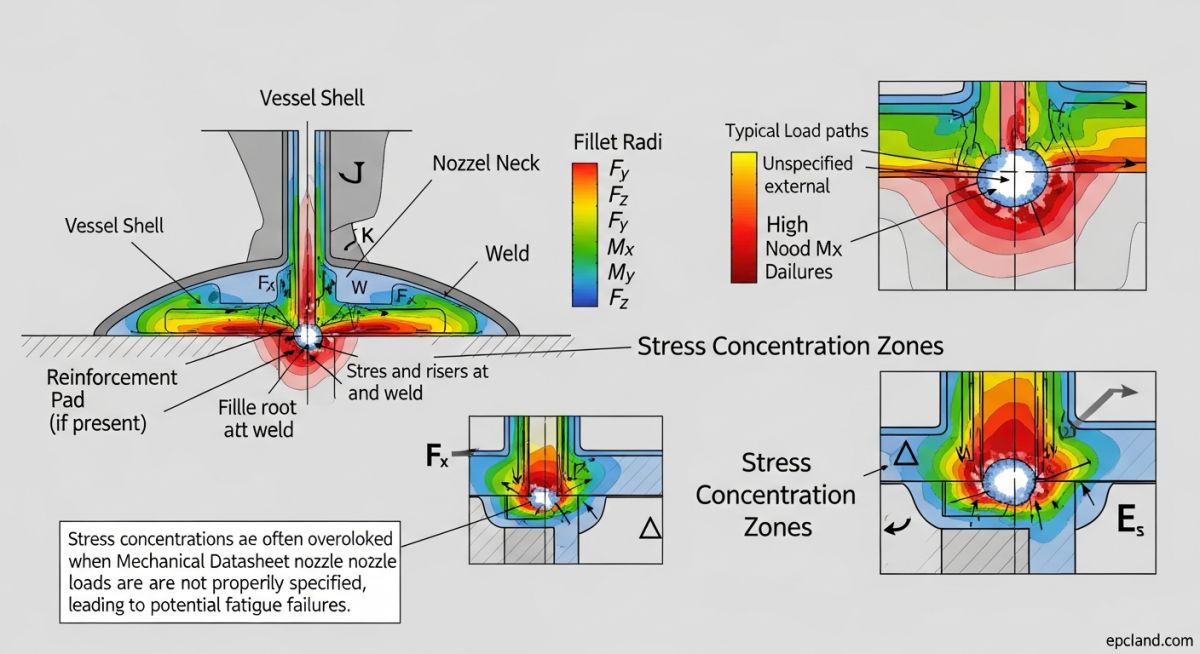
During the construction phase, the piping stress analysis revealed that the forces and moments at the inlet nozzle exceeded standard industry "Thumb Rules" by 40 percent. Because the Mechanical Datasheet did not specify these high loads, the vessel manufacturer had not included reinforcing pads or increased the shell thickness at the nozzle junction. This led to local shell overstressing and potential fatigue cracking during hydro-test.
Engineering Fix
The engineering team revised the Mechanical Datasheet to include a custom Nozzle Load Table. The manufacturer added a 25mm thick reinforcing pad (Repad) and used an integral "Long Weld Neck" nozzle to distribute the stress safely into the vessel wall.
Lessons Learned
- Never issue a Mechanical Datasheet for procurement without validated nozzle loads.
- Ensure the Equipment Specification is cross-checked by the Piping Stress department.
- Materials of Construction (MOC) must be verified for compatibility with the welding of reinforcement pads.


