Ultimate Guide to Material Test Certificate (Mill Test Certificate): EN 10204 Type 2.1, 2.2, 3.1, 3.2

A Material Test Certificate is the foundational document of industrial quality assurance, providing a verifiable record of a material physical and chemical properties. In 2026, maintaining absolute traceability through standardized Mill Test Certificates is non-negotiable for engineering compliance in high-pressure oil, gas, and power generation systems.
What is a Material Test Certificate?
A Material Test Certificate (MTC) is a formal document that verifies a material chemical composition, mechanical properties, and compliance with specific manufacturing standards like EN 10204. It ensures traceability from the raw heat to the finished product, confirming the material meets the engineering requirements for its intended application.
Table of Contents
Engineering Knowledge Check
Question 1 of 5Quiz Completed!
Complete Course on
Piping Engineering
Check Now
Key Features
- 125+ Hours Content
- 500+ Recorded Lectures
- 20+ Years Exp.
- Lifetime Access
Coverage
- Codes & Standards
- Layouts & Design
- Material Eng.
- Stress Analysis
What is a Material Test Certificate (MTC)?
In the global engineering landscape of 2026, a Material Test Certificate serves as the birth certificate for industrial components. It is a mandatory document for any pressurized system governed by standards such as ASME Section VIII or API 5L. This document provides technical assurance that the material supplied matches the purchase order requirements and meets specific chemical and mechanical thresholds. Without a valid certificate, the integrity of a piping system or pressure vessel cannot be verified, leading to potential safety risks and regulatory non-compliance.
Essential Contents of a Material Test Certificate
To maintain total traceability, every Material Test Certificate must contain specific data points that link the physical item to its metallurgical origin. These typically include:
- Manufacturer Information: The name, logo, and location of the mill where the material was smelted or manufactured.
- Standard Specification: References to ASTM, ASME, or ISO standards (e.g., ASTM A105 or ASME SA240).
- Heat Number: A unique tracking code assigned during the melting process in the furnace.
- Chemical Composition Analysis: Percentage of elements like Carbon, Manganese, Silicon, Phosphorus, and Sulfur.
- Mechanical Property Testing: Results for Yield Strength, Tensile Strength, and Elongation percentages.
EN 10204 Standards: Types of Material Test Certificate
The European standard EN 10204 is the primary regulation used to classify Material Test Certificate types. It defines the level of inspection and the degree of independence of the person performing the tests. Understanding these levels is critical for Procurement and Quality Engineers to ensure the right documentation is requested for specific service conditions.

Material Test Certificate Type 2.1 (Declaration of Compliance)
A Type 2.1 certificate is the simplest form of documentation. It is a statement by the manufacturer confirming that the supplied products are in compliance with the order. However, it does not include actual test results. This type is generally used for non-critical components where the risk of failure is minimal.
Material Test Certificate Type 2.2 (Test Report)
The Type 2.2 Mill Test Report (MTR) includes results based on non-specific inspection. This means the test results provided do not necessarily come from the exact batch of material delivered to the customer, but rather from a representative sample produced using the same manufacturing route.
Material Test Certificate Type 3.1 (Inspection Certificate)
Type 3.1 is the industry standard for most oil and gas piping and structural steel projects. It requires specific inspection, meaning the results on the Material Test Certificate are derived from the actual products supplied. Crucially, the certificate must be validated by an authorized inspection representative who is independent of the manufacturing department.
Material Test Certificate Type 3.2 (Inspection Certificate with Third-Party)
For critical offshore and subsea applications, a Type 3.2 certificate is mandatory. This document provides the highest level of assurance, as it is validated by both the manufacturer authorized representative and an independent third-party inspection agency (e.g., Lloyd Register, Bureau Veritas, or DNV). It confirms that the inspector witnessed the testing process directly.
Step-by-Step Guide: How to Read a Material Test Certificate
Interpreting a Material Test Certificate requires a systematic approach to ensure every engineering parameter aligns with the project design. In 2026, automated OCR verification tools are common, but manual validation remains the gold standard for site QA/QC engineers.
1. Name of the Manufacturer and Inspector
Identify the origin mill and verify that the inspector signature matches the EN 10204 requirement level (Internal vs. Independent Third-Party).
2. Traceability: Heat Number, Cast Number, and Lot Number
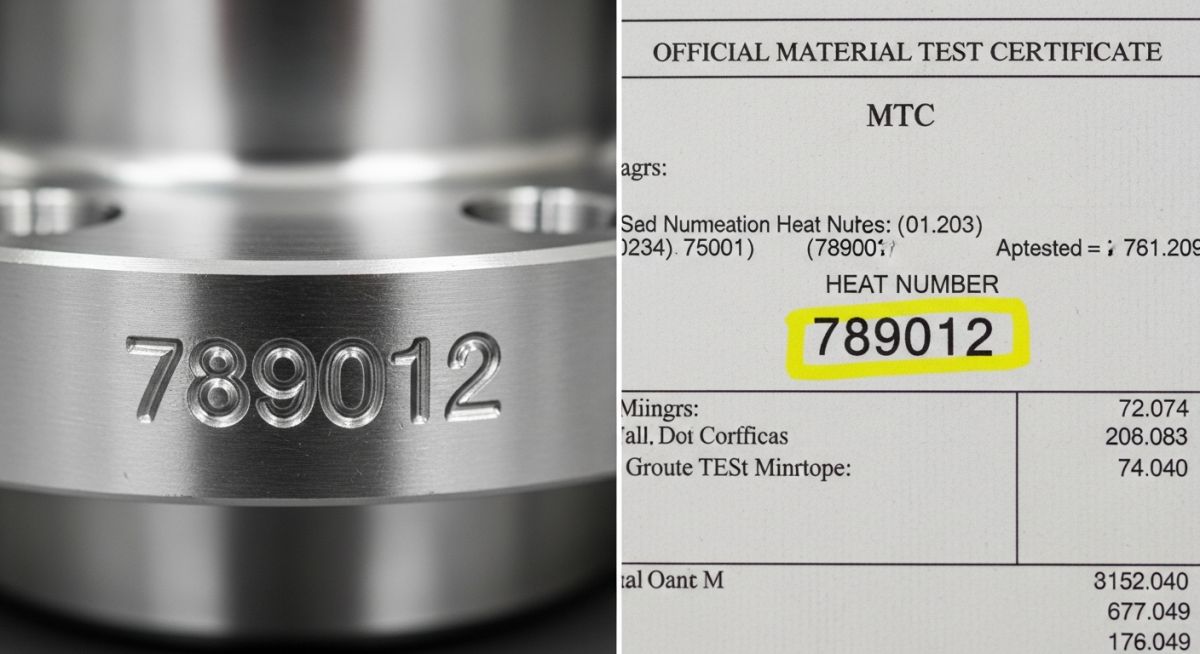
The Heat Number is the most critical alphanumeric code. It must be hard-stamped on the material and match the Material Test Certificate exactly to ensure the chemical results belong to that specific batch.
3. Compliance: Material Grade and ASME/ASTM Specification
Check the grade (e.g., Grade B, Grade 316L) against the design code. For pressure vessels, this usually refers to ASME Section II Part A or B.
4. Delivery Condition and Heat Treatment Details
Common conditions include Normalized (N), Quenched and Tempered (Q+T), or Solution Annealed. These processes significantly alter the grain structure and performance.
5. Physical Data: Material Dimensions and Weight
Verify the outer diameter (OD), wall thickness (WT), and length. Discrepancies here often indicate a documentation mix-up at the warehouse.
6. Mechanical Properties (Yield, Tensile, Elongation)
The Material Test Certificate lists the results of physical destruction tests. The Yield Strength is the point where permanent deformation begins, while Tensile Strength is the maximum stress the material can withstand.
7. Chemical Analysis (Carbon Equivalent)
Weldability is often determined by the Carbon Equivalent (CE). Engineers calculate this from the Material Test Certificate using the IIW formula:
Note: All values (C, Mn, Cr, etc.) represent the percentage of that element as recorded in the chemical composition section.
8. Non-Destructive Testing (NDT) and Hydrotest Results
Look for confirmation of Ultrasonic Testing (UT), Magnetic Particle Inspection (MPI), or Radiography (RT) if the project specification demands it for high-integrity components.
Material Test Certificate Type 3.1 vs Type 3.2: Key Differences
Choosing between a 3.1 and 3.2 Material Test Certificate is a balance between cost and risk mitigation. Below is a direct comparison of their technical requirements.
| Feature | EN 10204 Type 3.1 | EN 10204 Type 3.2 |
|---|---|---|
| Inspection Type | Specific (Actual products) | Specific (Actual products) |
| Authorized by Manufacturer | Yes | Yes |
| Authorized by Purchaser/TPI | No | Yes |
| Traceability Level | High | Absolute (Witnessed) |
| Common Application | Standard Piping, Structural Steel | Subsea, High-Pressure Vessels |
The Critical Purpose of Material Test Certificate in Engineering
Beyond mere paperwork, the Material Test Certificate is a safety instrument. In the event of a structural failure or pipeline leak, the MTC is the primary forensic document used to determine if the material met the design intent. It provides:
- Verification of Product Quality: Ensures the mill did not supply "commercial grade" steel when "pressure vessel grade" was paid for.
- Improved Transparency: Eliminates the risk of using scrap metal in critical infrastructure.
- Legal Protection: Acts as a liability shield for EPC contractors by proving compliance with global standards at the point of handover.
Don't miss this video related to Material Test Certificate
Summary: Unlock the secrets of Material Test Certificates (MTC) and ensure 100% compliance in your welding projects. This comprehensive ......
Material Test Certificate Calculator
Use this Carbon Equivalent (CE) calculator to verify the weldability of the steel listed on your Material Test Certificate. Input the chemical percentages directly from the Mill Test Report.
Calculated Carbon Equivalent (IIW)
Case Study: Verification of Material Test Certificate in a 2026 LNG Expansion Project
Project Data
In early 2026, a major liquefied natural gas (LNG) terminal expansion required the installation of over 500 high-pressure cryogenic flanges. The project specifications mandated EN 10204 Type 3.1 documentation for all pressure-containing components to ensure low-temperature toughness.
Failure Analysis
During the pre-commissioning phase, a routine Positive Material Identification (PMI) check revealed a discrepancy. A batch of flanges, documented on a Material Test Certificate as Stainless Steel Grade 316L, was actually identified as a lower-grade carbon steel. Upon closer forensic audit, the heat numbers hard-stamped on the flanges did not perfectly match the numbers listed on the provided certificates. The error was traced to a warehouse documentation mix-up where the wrong Material Test Certificate was paired with the physical shipment.
Engineering Fix
The engineering team immediately issued a "Stop Work" order for the affected piping spool. Every component in the batch was quarantined. The EPC contractor implemented a 100 percent PMI and visual inspection sweep to cross-reference physical heat numbers against the mill original digital database. Components without a verifiable and matching Material Test Certificate were rejected and replaced.
Lessons Learned
- Visual Link: Never accept a Material Test Certificate without visually confirming the heat number on the physical material.
- Digital Verification: In 2026, always use the manufacturer online portal to verify the authenticity of the certificate QR code or digital signature.
- Redundancy: Supplemental PMI testing should be used as a secondary verification tool to back up the data provided in the Mill Test Certificate.
Frequently Asked Questions
Can an EN 10204 Type 3.1 Material Test Certificate be upgraded to Type 3.2?
What is the difference between a Mill Test Report (MTR) and a Material Test Certificate?
Is a digital Material Test Certificate legally valid for ASME projects?
Why is the Chemical Composition Analysis section critical?
Conclusion: Ensuring Reliability through Documentation
The Material Test Certificate is the ultimate safeguard in modern engineering. Whether you are dealing with a simple Type 2.1 declaration or a complex Type 3.2 inspection with third-party witness, the goal remains the same: ensuring that the physical material matches the engineering design intent.
As industrial projects become more complex in 2026, mastering the nuances of the EN 10204 standard is a requirement for any QA/QC professional. By strictly enforcing traceability through Heat Numbers and verifying Mechanical Property Testing results, we ensure the safety and longevity of the global energy infrastructure.
Master Your Quality Control
Stay ahead of the curve with our 2026 Engineering Standards Newsletter.
Subscribe to Epcland


