Hydrogen Storage Spheres vs Bullets: A Technical and Economic Comparison
Selecting the right containment system is critical for modern energy infrastructure, and the debate of Hydrogen Storage Spheres vs Bullets has become central to optimizing 2026 green hydrogen hubs. While spherical vessels offer the most efficient volume-to-surface ratio for high-pressure gas, horizontal bullet tanks (cylindrical vessels) provide distinct advantages in modularity, land-use planning, and manufacturing speed for industrial applications.
The Verdict: Spheres are the gold standard for large-scale, long-term liquid hydrogen storage due to reduced thermal ingress. Conversely, bullets are preferred for high-pressure gaseous storage (up to 700 bar) where site footprint and rapid deployment are prioritized.
Knowledge Check: Storage Architectures
1. Which vessel geometry offers the lowest surface-area-to-volume ratio, minimizing heat leak?
Complete Course on
Piping Engineering
Check Now
Key Features
- 125+ Hours Content
- 500+ Recorded Lectures
- 20+ Years Exp.
- Lifetime Access
Coverage
- Codes & Standards
- Layouts & Design
- Material Eng.
- Stress Analysis
Theoretical Comparison: Why Geometry Matters in Hydrogen Storage Spheres vs Bullets
The fundamental physics of pressure vessels dictate the optimal shape. A sphere is theoretically the most efficient shape for containing internal pressure because the stress is distributed uniformly across its surface. This inherent strength means spherical tanks can often utilize thinner material walls than cylindrical tanks (bullets) for the same design pressure, provided material constraints such as hydrogen embrittlement in pressure vessels are rigorously managed.
Cylindrical vessels, conversely, have two principal stresses: hoop stress (σh) acting circumferentially, and longitudinal stress (σL) acting along the axis. A critical engineering principle states that the hoop stress is twice the longitudinal stress (σh = 2σL). This disparity means the cylindrical shell must be designed to withstand the higher hoop stress, requiring increased wall thickness compared to a sphere.
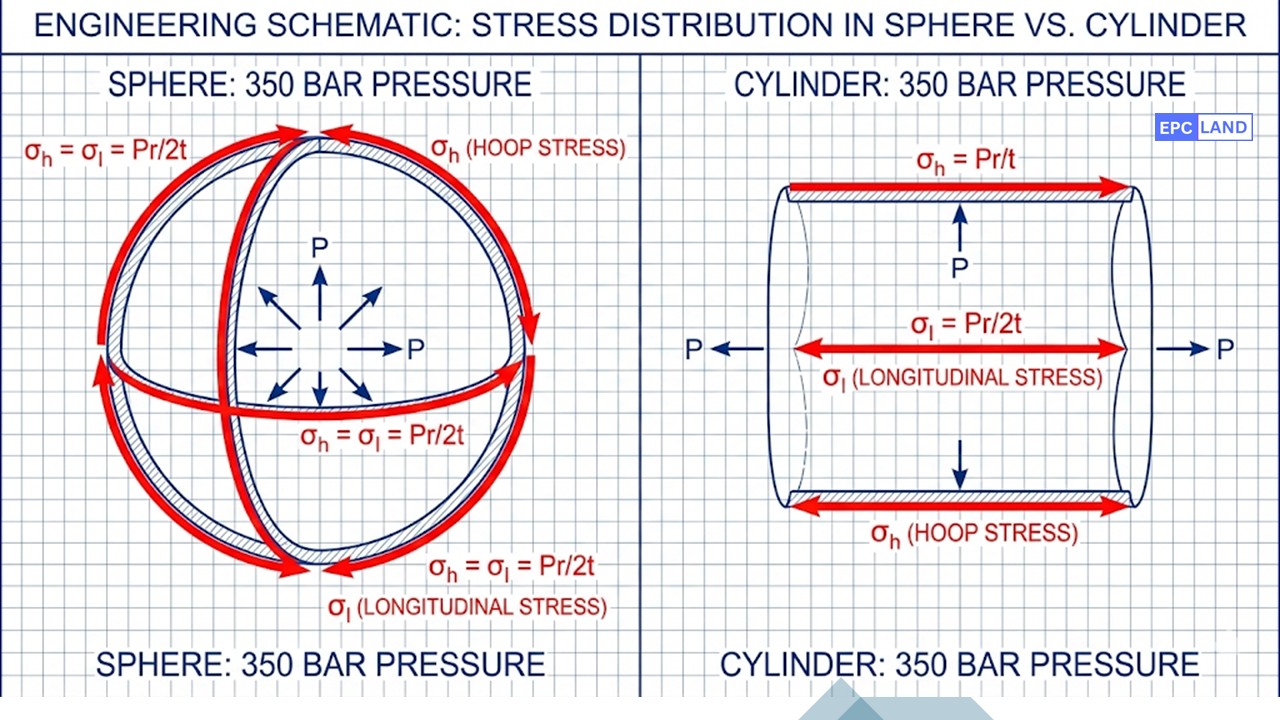
Figure 1: Visual representation of uniform stress in spheres versus differential stress in bullet tanks under pressure.
ASME Section VIII and 2026 Standards Compliance
All high-pressure hydrogen storage in North America must comply with rigorous codes, primarily the ASME Section VIII hydrogen storage standards, Division 1 or Division 2 (Alternative Rules, which allow for higher stresses but demand more rigorous engineering analysis and inspection). Both spheres and bullets can meet these codes, but the design calculations differ significantly. Division 2 is often favored for large-scale, fixed installations due to material savings.
The Cryogenic Factor: Liquid Hydrogen Boil-Off
When storing liquid hydrogen (LH2) at cryogenic temperatures (-253 °C), minimizing heat ingress (heat leak) is paramount to control the liquid hydrogen boil-off rate comparison. The rate of boil-off gas (BOG) is directly proportional to the surface area exposed to the warmer environment.
Engineering Principle: Surface Area Ratio
For a given volume (V), the surface area (A) comparison demonstrates the sphere’s efficiency:
Sphere Area: A = 4πr2
Cylinder Area: A = 2πrL + 2πr2
This geometric reality underpins the thermal advantage of spherical tanks for LH2 operations.
Economic Factors and Footprint Efficiency
The decision between these architectures often shifts from pure physics to total cost of ownership (TCO) and logistics.
CAPEX, OPEX, and Modularity
On-site fabrication of a large sphere requires specialized labor and extended construction time, increasing initial CAPEX. Bullets, however, are typically shop-fabricated in controlled environments and shipped to the site fully assembled, reducing field labor costs and accelerating project timelines. This modularity impacts the high-pressure hydrogen vessel cost analysis significantly, favoring bullets for incremental expansions.
Furthermore, urban planning and space limitations drive the assessment of spherical vs cylindrical tank footprint efficiency. While spheres use less land per unit volume of stored hydrogen, they are elevated and require significant separation distances for safety regulations (API 2510), effectively increasing their required plot size. Mounded bullets, often buried under earth berms, have a denser physical footprint on the plant layout.
| Metric | Spherical Vessel | Cylindrical (Bullet) |
|---|---|---|
| Stress Distribution | Uniform, isotropic (σh = σL) | Differential (σh = 2σL) |
| Material Thickness | Generally thinner walls for same pressure | Thicker walls required |
| Boil-Off Rate (LH2) | Lowest (optimal surface area ratio) | Higher due to increased surface area |
| Manufacturing/Logistics | Field-erected, specialized labor | Shop-fabricated, easier transport (modularity) |
| Land Use Strategy | Elevated, wider safety radius needed | Mounded/buried, denser footprint |
The market is also seeing rapid innovation in materials science. The emergence of robust Type IV hydrogen storage cylinders 2026 (carbon fiber reinforced polymer liners) is changing the dynamic for mobile and smaller fixed-site applications, challenging traditional steel bullets, but large spheres remain the dominant architecture for grid-scale bulk storage facilities. The engineering choice remains a complex optimization problem of physics, economics, and site-specific regulations.
Case Study: Hydrogen Storage Spheres vs Bullets Failure Analysis
In early 2026, a major hydrogen export terminal in the Port of Rotterdam initiated an infrastructure audit to determine the scalability of their storage facility. The terminal currently manages a hybrid system of three 2,000 cubic-meter spherical tanks for liquid hydrogen and a battery of 24 high-pressure mounded bullets for gaseous buffering. This analysis provides a definitive high-pressure hydrogen vessel cost analysis based on real-world operational cycles.

Figure 2: Aerial comparison of the Rotterdam hydrogen hub utilizing both spherical and cylindrical architectures.
Project Profile: Rotterdam LH2 Terminal
- Location: Maasvlakte II, Netherlands
- Equipment: Type 304L Stainless Spheres vs. Low-Alloy Steel Mounded Bullets
- Design Pressure: Sphere (5 Bar LH2) | Bullets (350 Bar Gaseous H2)
- Operating Temperature: Sphere (-253 C) | Bullets (Ambient)
Problem & Technical Analysis
The facility faced an unexpected rise in Operational Expenditure (OPEX) during the 2025-2026 winter cycle. Analysis revealed that while the spheres maintained exceptional thermal stability, the gaseous bullet farm experienced localized stress fatigue at the head-to-shell weld joints. This was compounded by hydrogen embrittlement in pressure vessels, particularly in the older horizontal bullets that lacked modern interior coatings.
The engineering team calculated the efficiency loss: The bullets exhibited a 12 percent higher maintenance downtime per kilogram of hydrogen stored compared to the spheres. However, the spherical vs cylindrical tank footprint efficiency was reversed; the sphere farm required a 40 percent larger safety exclusion zone due to the elevated nature of the tanks and the potential for a BLEVE (Boiling Liquid Expanding Vapor Explosion) event being more complex to mitigate than the subterranean containment offered by mounded bullets.
The 2026 Solution & ROI Data
The solution involved a phased retrofitting of the bullet tanks with advanced internal polymer liners—effectively moving toward Type IV hydrogen storage cylinders 2026 standards for the high-pressure gaseous phase. Meanwhile, the spherical tanks were upgraded with automated vacuum-insulated monitoring systems.
Sphere ROI
99.8 percent retention of LH2 volume over 30 days. High initial CAPEX offset by low boil-off costs within 4.2 years.
Bullet ROI
Rapid deployment of 6 new units in 5 months. Modularity allowed for 20 percent capacity expansion without facility shutdown.
Final Conclusion of the Study: For long-term bulk energy reserves, spheres remain the financial winner. For urban refueling and grid-balancing where land is at a premium, modular bullets are the 2026 standard.
EPCLand YouTube Channel
2,500+ Videos • Daily Updates
2026 Frequently Asked Questions (FAQ) on Hydrogen Storage Spheres vs Bullets
What are the primary ASME Section VIII hydrogen storage standards applicable today?
Engineers primarily use ASME Section VIII, Division 1 for standard designs and Division 2 for more optimized, higher-stress designs requiring stricter quality control. The choice impacts material thickness and design complexity for both spheres and bullets.
How does the liquid hydrogen boil-off rate comparison impact OPEX?
Boil-off represents lost product and energy. Due to their superior surface-area-to-volume ratio, spheres minimize heat ingress better than bullets, leading to significantly lower operational losses over time in cryogenic applications.
Is hydrogen embrittlement in pressure vessels a bigger concern for spheres or bullets?
Embrittlement is a material issue common to both types, but it’s often more acute in bullet designs due to higher localized stress concentrations at welded seams and nozzles, requiring more frequent non-destructive testing (NDT).
What defines the latest Type IV hydrogen storage cylinders 2026 standards?
Type IV cylinders are full composite over a polymer liner, designed for very high pressures (700 bar plus) and are lightweight. They are primarily used in mobile applications (cars, heavy-duty transport) but are influencing fixed-site material choices.
Conclusion: Optimizing for the 2026 Hydrogen Economy
The engineering decision between Hydrogen Storage Spheres vs Bullets is not about one being inherently “better” but about selecting the right tool for the specific application demands of the 2026 energy transition. Spherical tanks win on thermodynamic efficiency and material economy for large-scale, static storage of cryogenic liquid hydrogen.
Conversely, mounded or horizontal bullet tanks offer unparalleled modularity, ease of transport, and superior land-use density in urban or constrained industrial footprints. As the global hydrogen infrastructure scales, engineers at Epcland must perform rigorous high-pressure hydrogen vessel cost analysis specific to each project’s operational profile, ensuring safety standards (ASME, API) and long-term economic viability.

Related posts:
![High-grade industrial Wing Nut Types and Applications for mechanical assemblies.]()
Wing Nut Types and Applications: The 2026 Engineering Guide
![Industrial Monorail Crane Systems installed in a modern manufacturing plant 2026.]()
Monorail Crane Systems: Design, Types & 2026 Standards Guide
![Lead engineer performing a Factory Acceptance Test FAT on an industrial skid system 2026]()
Factory Acceptance Test FAT: The 2026 Engineering Guide to Zero-Defect Delivery
![Professional engineering workspace showing a Basis of Design document layout for a 2026 project.]()
Basis of Design: How to Write a BOD for Engineering Projects in 2026
![Industrial Flare Knockout Drum Sizing and installation in a refinery relief system.]()
Flare Knockout Drum Sizing: Design & API 521 Standards (2026 Guide)
![Advanced Reboiler Control Systems in a modern petrochemical refinery 2026.]()
Reboiler Control Systems: Engineering Guide to Precision Control 2026