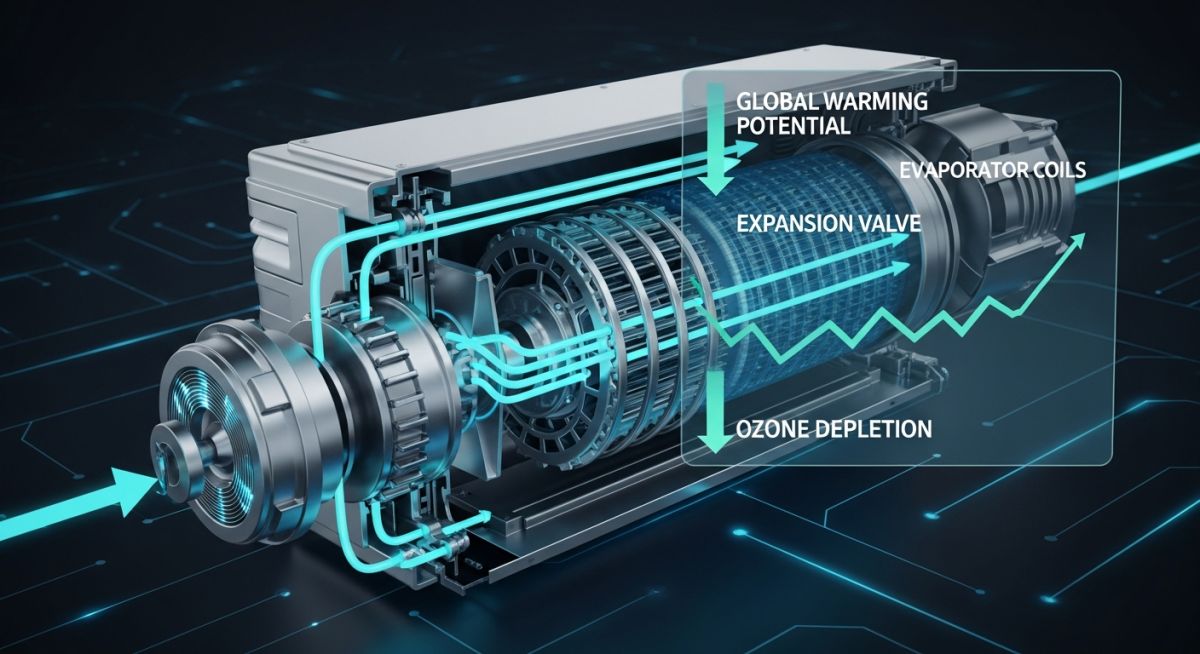
HFO Refrigerants: Low GWP, Superior Performance, and 2026 Applications.
The shift towards environmentally responsible cooling solutions has made **HFO Refrigerants** (Hydrofluoroolefins) the cornerstone of modern HVACR design. These compounds are unsaturated organic molecules that represent the latest generation of refrigerants, engineered specifically to address the stringent regulatory demands for substances with extremely low Global Warming Potential (GWP) while maintaining optimal system performance. Unlike their predecessors, HFCs (Hydrofluorocarbons), HFOs offer a critical pathway to **2026** compliance and sustainable operation in automotive, commercial, and industrial sectors globally.
Key Definition: HFO Refrigerants
HFO Refrigerants are a class of hydrofluoroolefins characterized by at least one carbon-carbon double bond. This chemical structure causes them to break down quickly in the atmosphere, resulting in an ultra-low Global Warming Potential (GWP) of less than 4, and an Ozone Depletion Potential (ODP) of zero. They are the mandated replacement for high-GWP HFCs like R-134a, enabling engineers to meet global environmental regulations like the Kigali Amendment and F-Gas.
To fully understand their impact, explore the detailed performance properties and application mandates in the sections below.
Quick Navigation (Table of Contents)
- HFO Refrigerants Explained: Definition and Chemical Structure.
- Unrivaled Environmental Benefits (ODP, GWP, and Compliance).
- Performance and Technical Properties: Efficiency, Safety, and Compatibility.
- Key HFO Refrigerant Codes and Composition Table.
- Comprehensive HFO Applications Across HVACR Industries.
- Conclusion and The Future of Fluorocarbon Refrigerant Replacement.
Test Your HFO Refrigerant Knowledge
Complete Course on
Piping Engineering
Check Now
Key Features
- 125+ Hours Content
- 500+ Recorded Lectures
- 20+ Years Exp.
- Lifetime Access
Coverage
- Codes & Standards
- Layouts & Design
- Material Eng.
- Stress Analysis
HFO Refrigerants Explained: Definition and Chemical Structure.
**HFO Refrigerants**, or Hydrofluoroolefins, are characterized by their unique chemical structure: they are fluorinated alkenes. Crucially, they contain a carbon-carbon double bond, which is the key differentiator from the older generation of Hydrofluorocarbons (HFCs), such as R-134a. This double bond provides the molecular instability required for rapid decomposition.
The Molecular Difference: HFC vs. HFO
- HFCs (R-134a): Saturated compounds. High atmospheric lifetime (e.g., R-134a lasts ~13 years), leading to high GWP (Global Warming Potential).
- HFOs (R-1234yf): Unsaturated compounds. Low atmospheric lifetime (typically days to weeks), resulting in ultra-low GWP.
This structural change, driven by advancements in **Hydrofluoroolefin Chemistry**, ensures that when HFOs are released into the atmosphere, they break down into inert compounds long before they can contribute significantly to the greenhouse effect, aligning with future environmental legislation.
Unrivaled Environmental Benefits (ODP, GWP, and Compliance).
The primary motivation for the global transition to HFO technology is the need to minimize the environmental footprint of refrigeration and air conditioning. HFOs offer superior metrics compared to all prior generations of fluorocarbon refrigerants.
Ozone Depletion Potential (ODP): Zero Impact
Like HFCs, **HFO Refrigerants** contain no chlorine or bromine atoms in their structure. Therefore, they have an Ozone Depletion Potential (ODP) of exactly zero. This means they pose no threat to the stratospheric ozone layer, fully satisfying the requirements of the original Montreal Protocol.
Low Global Warming Potential (GWP): The Key Advantage
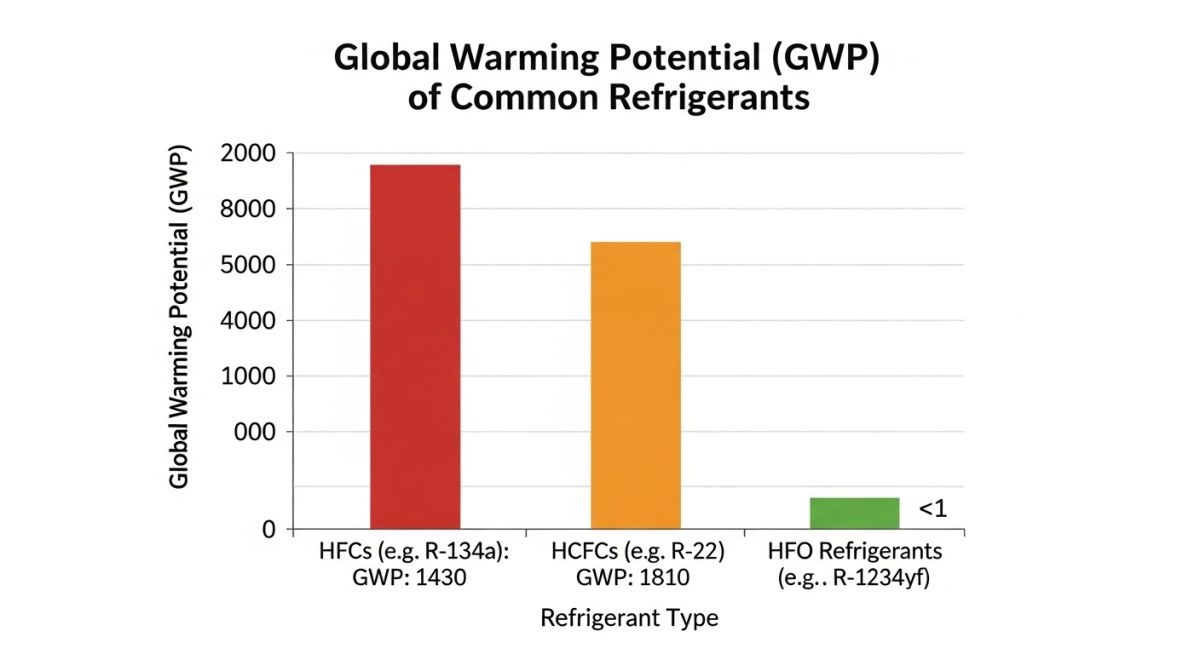
The most significant benefit is their ultra-low GWP. The majority of pure HFOs have a GWP of less than 4 (e.g., R-1234yf GWP is 4, R-1234ze GWP is less than 1). This is drastically lower than the phase-down targets set by international treaties. This makes them the definitive category of **Low GWP Refrigerants** for the coming decade.
Regulatory Compliance: Meeting F-Gas and Kigali Mandates
HFOs are specifically designed to enable compliance with the world’s most aggressive climate regulations, including the European Union’s F-Gas Regulation and the Montreal Protocol’s Kigali Amendment. These regulations mandate significant, staged reductions in the consumption and production of HFCs based on their GWP-weighted consumption (CO2 equivalent). Choosing HFOs future-proofs engineering projects against further regulatory tightening, well into **2026** and beyond.
Performance and Technical Properties: Efficiency, Safety, and Compatibility.
Environmental metrics are critical, but for system engineers, the thermodynamic and physical properties of the refrigerant are paramount. HFOs are formulated to be drop-in or near-drop-in replacements, minimizing the need for extensive equipment overhauls.
Energy Efficiency: Coefficient of Performance (COP)
Many HFOs and HFO blends exhibit a Coefficient of Performance (COP) and capacity comparable to, or slightly better than, the HFCs they replace. For example, R-1234yf operates at a thermal efficiency very close to R-134a. This is crucial as the total climate impact is a function of both direct emissions (GWP) and indirect emissions from energy consumption.
Compatibility: Oils and Materials
A primary design goal for HFOs was material compatibility. They are generally compatible with the Polyolester (POE) and Polyalkylene Glycol (PAG) lubricants used with HFCs. For retrofitting existing equipment, this limits the scope of necessary changes, often only requiring minor component replacements (e.g., seals, expansion valves) and new operational safety protocols.
Safety Considerations (Toxicity and Flammability: A2L)
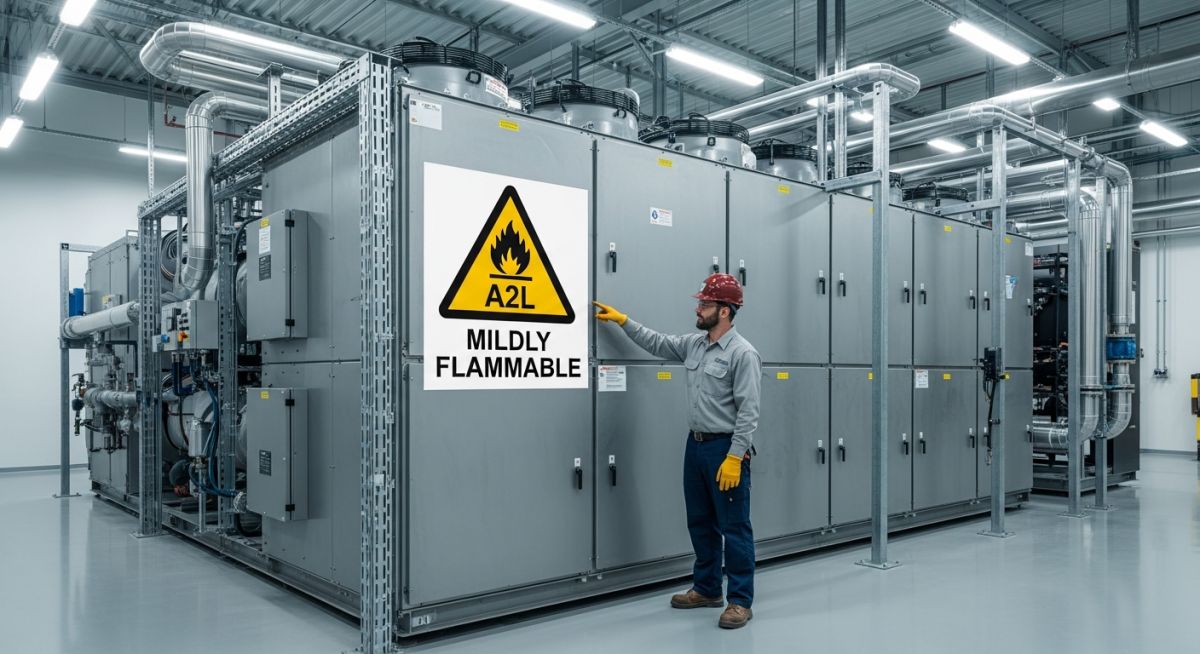
The transition to HFOs introduces a new safety consideration: flammability. While HFCs were predominantly non-flammable (A1), most pure HFOs (like R-1234yf and R-1234ze) and many HFO blends are classified as **A2L Safety Classification** refrigerants.
Comparison with HFCs and HCFCs (The Retrofit Perspective)
For engineers managing legacy systems, the choice of HFO or HFO blend often depends on the required retrofit effort. The key comparison points are listed below:
- System Pressure: HFOs generally have operating pressures similar to the HFCs they replace (e.g., R-1234yf vs R-134a), often allowing the retention of core components like compressors.
- Heat Transfer: Heat transfer coefficients can be slightly lower than HFCs, sometimes requiring a marginal increase in heat exchanger surface area for optimal performance.
- Global Warming Impact: **HFO Refrigerants** offer a GWP reduction of over 99% compared to high-GWP HFCs (like R-404A or R-507A), providing the necessary compliance headroom for the next two decades.
Key HFO Refrigerant Codes and Composition Table.
HFOs exist as pure fluids and as components in blends, tailored for specific thermodynamic properties. The table below lists the most common pure HFOs and their primary HFO-containing blend applications, focusing on the specific product code, like **R-1234yf**.
| Refrigerant Code (LSI) | Chemical Formula (LSI) | GWP (AR5) | Safety Classification (A2L) | Primary Application/Replacement |
|---|---|---|---|---|
| R-1234yf | CF3CF=CH2 | 4 | A2L | Automotive A/C (R-134a replacement) |
| R-1234ze(E) | CF3CH=CHF | < 1 | A2L | High Temp Chillers, Heat Pumps (R-134a) |
| R-513A | R-1234yf/R-134a (56/44%) | 631 | A1 | Commercial Refrigeration (Lower GWP R-134a drop-in) |
| R-454B | R-32/R-1234yf (68/32%) | 466 | A2L | Air Conditioning/Heat Pumps (R-410A replacement) |
Thermodynamic Calculation: Isentropic Efficiency
When evaluating HFO performance, engineers rely on the efficiency metrics calculated from the vapor compression cycle. The isentropic efficiency ($\eta_{isen}$) of the compressor is a crucial factor, comparing the ideal (isentropic) work to the actual work required.
$$\eta_{isen} = \frac{\text{W}_{\text{isen}}}{\text{W}_{\text{actual}}} = \frac{h_{2s} – h_{1}}{h_{2a} – h_{1}}$$
Where: h1 is the enthalpy at the compressor inlet, h2a is the actual enthalpy at the outlet, and h2s is the ideal (isentropic) enthalpy at the outlet. Proper selection of an HFO based on its Pressure-Enthalpy (P-H) diagram is essential to maximize $\eta_{isen}$ and overall system COP.
Comprehensive HFO Applications Across HVACR Industries.
The versatility and low GWP of HFOs have led to their adoption across virtually every sector of the HVACR (Heating, Ventilation, Air Conditioning, and Refrigeration) industry.
Air Conditioning and Heat Pump Systems:
Blends like R-454B and R-452B (containing HFO-1234yf) are replacing R-410A in new residential and commercial AC units and heat pumps to meet increasingly strict GWP limits. Their low flammability (A2L) is manageable in these environments with appropriate charge limits and safety interlocks.
Commercial and Industrial Refrigeration:
For supermarket refrigeration, HFO blends are vital for both medium- and low-temperature applications. Systems often use HFO/HFC blends (e.g., R-448A, R-449A) as direct expansions or in cascading systems, allowing supermarkets to comply with the F-Gas Regulation Compliance phase-down targets.
Automotive Air Conditioning: The R-1234yf Standard
**R-1234yf** has become the de facto standard for all new vehicle A/C systems worldwide. Due to its GWP of 4, it completely satisfies the EU’s Mobile Air Conditioning (MAC) directive and other international mandates, ensuring automotive manufacturers meet their environmental obligations globally.
Domestic Refrigeration:
While hydrocarbons (R-600a, R-290) dominate this sector in many regions, HFOs are a viable, ultra-low GWP alternative in specific markets and specialty appliances, often as components in proprietary blends.
Chillers:
Both centrifugal and positive-displacement chillers are rapidly adopting pure HFOs like R-1234ze(E) and R-1233zd(E) for large-scale, low-pressure applications, offering excellent thermodynamic efficiency and extremely low environmental impact.
Heat Recovery Systems:
HFOs are excellent working fluids in high-temperature heat pump and heat recovery systems, where their critical properties allow for efficient heat lift and energy transfer with minimal pressure drop.
Transport Refrigeration:
In cold-chain logistics, HFO blends are replacing R-404A (GWP: 3922) to drastically cut the environmental risk associated with refrigerant leaks from movable, shock-prone equipment, improving fleet sustainability.
Water Heating Heat Pumps:
High-temperature HFO fluids allow for the production of hot water exceeding 60°C, making them an ideal, energy-efficient, and low-GWP solution for both commercial and residential hot water generation.
EPCLand YouTube Channel
2,500+ Videos • Daily Updates
HFO Refrigerants A2L Charge Limit Calculator
Calculate the maximum allowable refrigerant charge (mmax) for an HFO (A2L) based on the room’s volume and the refrigerant’s Lower Flammability Limit (LFL), as per safety standards (e.g., simplified ASHRAE 15 / EN 378 concept).
Input Parameters
Factor C₀ is typically 0.5 (kg/m³) or lower for A2L systems in public areas.
Calculation Results
Maximum Allowable Refrigerant Charge (mmax):
Formula Used:
Where mmax is the charge limit (kg), C₀ is the safety factor, LFL is the Lower Flammability Limit (kg/m³), and V is the room volume (m³).
Note: This simplified formula represents the fundamental principle of A2L safety. Real-world standards (EN 378, ASHRAE 15) involve additional, more complex formulas for different zones and equipment types.
Case Study: Managing A2L Safety for Low-GWP HFO Chiller Systems
This E-E-A-T case study details the engineering controls implemented for a major pharmaceutical manufacturing plant in response to a mandate to replace high-GWP R-404A cooling systems with **HFO Refrigerants** to ensure **F-Gas Regulation Compliance** by **2026**.
Project Data & Initial Challenge
- Location: Tier-1 Pharmaceutical Production Facility, EU.
- Refrigerant Transition: R-404A (GWP 3922) to R-455A (HFO Blend, GWP 146).
- System Type: Two 500-ton industrial process chillers.
- Primary Concern: R-455A is classified as A2L (Lower Flammability). The chiller room volume dictated a charge exceeding the standard safety limit for a non-vented space.
Engineering Analysis & Solution
The engineering team's solution focused on active mitigation strategies mandated by EN 378 to permit the higher A2L charge limit. The key engineering interventions included:
- Continuous Mechanical Ventilation: A dedicated exhaust system was installed, interlocked with the chiller operation. It is capable of achieving 4-6 air changes per hour (ACH) under normal conditions.
- Refrigerant Leak Detection System: Low-level refrigerant sensors were placed at the lowest points in the chiller room (as HFOs are heavier than air).
- Emergency Ventilation Override: Upon detection of a leak above 25% of the LFL (Lower Flammability Limit), the system automatically triggers a high-speed emergency ventilation purge (12+ ACH) and shuts down all non-explosion-proof electrical sources.
- Component Material Review: All non-metallic components (seals, gaskets) were verified for compatibility with the **Hydrofluoroolefin Chemistry** to prevent premature degradation and subsequent leaks.
Results and Return on Investment (ROI)
- GWP Reduction: Successfully achieved a 96% reduction in potential direct GWP impact for the cooling load (3922 down to 146).
- Operational Safety: The redundant leak detection and ventilation system successfully mitigated the flammability risk, maintaining a continuous safety factor well above the required threshold.
- Compliance: The client is fully compliant with the **2026** F-Gas service ban requirements for refrigerants with GWP > 2500.
Conclusion and The Future of Fluorocarbon Refrigerant Replacement.
The development of HFO Refrigerants marks a pivotal achievement in environmental engineering. Their ultra-low Global Warming Potential (GWP) and zero Ozone Depletion Potential (ODP) provide the essential performance characteristics needed for sustainable cooling solutions across the globe. From the automotive sector standardized on R-1234yf to large-scale industrial chillers, HFOs and their blends are the mandated pathway for engineers to achieve the stringent international **Refrigerant Replacement** targets for the current decade.
While the A2L Safety Classification requires rigorous design protocols, particularly concerning leak detection and ventilation, the environmental imperative and long-term compliance benefits far outweigh the implementation challenges. Understanding the unique **Hydrofluoroolefin Chemistry** and adherence to evolving safety standards (like ASHRAE 15 and EN 378) are now core competencies for all HVACR professionals moving toward **2026** and beyond.
Frequently Asked Questions (FAQ)
What is the key difference between HFO refrigerants and HFC refrigerants?
Is R-1234yf a safe refrigerant, considering its A2L safety classification?
How do HFO refrigerants help engineers meet the F-Gas Regulation Compliance targets?
Are HFOs a direct "drop-in" replacement for older refrigerants in existing equipment?

Related posts:
![High-grade industrial Wing Nut Types and Applications for mechanical assemblies.]()
Wing Nut Types and Applications: The 2026 Engineering Guide
![Industrial Monorail Crane Systems installed in a modern manufacturing plant 2026.]()
Monorail Crane Systems: Design, Types & 2026 Standards Guide
![Lead engineer performing a Factory Acceptance Test FAT on an industrial skid system 2026]()
Factory Acceptance Test FAT: The 2026 Engineering Guide to Zero-Defect Delivery
![Professional engineering workspace showing a Basis of Design document layout for a 2026 project.]()
Basis of Design: How to Write a BOD for Engineering Projects in 2026
![Industrial Flare Knockout Drum Sizing and installation in a refinery relief system.]()
Flare Knockout Drum Sizing: Design & API 521 Standards (2026 Guide)
![Advanced Reboiler Control Systems in a modern petrochemical refinery 2026.]()
Reboiler Control Systems: Engineering Guide to Precision Control 2026