What is a Pipe Union Fitting? Materials, Parts, Types, and Coupling Differences
A Pipe Union Fitting is a specialized type of piping equipment designed to allow the safe and easy disconnection of pipes without causing any horizontal movement in the piping string. Unlike standard permanent joints, the Pipe Union Fitting provides a semi-permanent mechanical connection that is essential for maintenance, instrument calibration, and equipment replacement in high-pressure systems.
Quick Definition
A Pipe Union Fitting is a three-piece mechanical joint consisting of a nut, a female end, and a male end. It allows for the easy assembly and disassembly of piping systems without disturbing the rest of the line, making it superior to couplings for equipment maintenance and repairs.

Table of Contents
- Fundamental Parts of a Pipe Union Fitting
- Primary Applications of Pipe Union Fitting
- Common Types of Pipe Union Fitting Designs
- Materials Used for Pipe Union Fitting
- Pipe Union Fitting Manufacturing Standards
- Key Features and Benefits
- Engineering Specifications
- Difference Between Coupling and Union
- Possible Causes of Leakage
Engineering Knowledge Check
Question 1 of 5Quiz Completed!
Complete Course on
Piping Engineering
Check Now
Key Features
- 125+ Hours Content
- 500+ Recorded Lectures
- 20+ Years Exp.
- Lifetime Access
Coverage
- Codes & Standards
- Layouts & Design
- Material Eng.
- Stress Analysis
Fundamental Parts of a Pipe Union Fitting
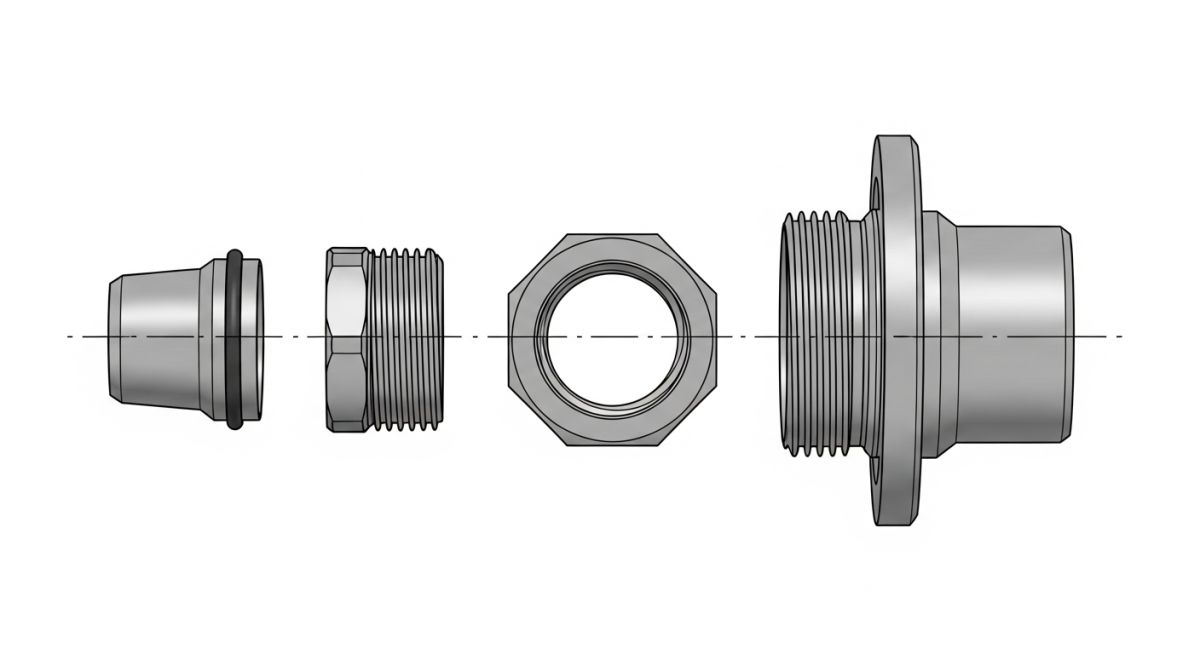
An engineering Pipe Union Fitting is defined by its unique three-piece separable design. Unlike a permanent coupling, the assembly of a Pipe Union Fitting allows for mechanical disconnection without rotating the attached pipes. This is achieved through three critical components:
- The Male Tailpiece: This component features external threads (or a socket-weld end) on one side and a precision-machined sealing face on the other. It fits into the center nut.
- The Female Thread Piece: Similar to the tailpiece, but it contains the internal seat where the male tailpiece rests. The outer diameter of this piece is threaded to receive the center nut.
- The Center Nut (Union Nut): The driving mechanism of the Pipe Union Fitting. As the nut is tightened, it draws the male and female pieces together, applying axial compression to create a leak-proof seal.
Primary Applications of Pipe Union Fitting in Industrial Piping
The Pipe Union Fitting is a staple in systems governed by ASME B31.3 (Process Piping) and ASME B31.1 (Power Piping). Its application is mandatory in scenarios where frequent maintenance or equipment isolation is required.
Equipment Manifolds
Used around pumps, meters, and control valves to allow for rapid removal without dismantling entire piping runs.
Residential Plumbing
Crucial for water heater installations and water softener loops where future replacement is certain.
Steam Systems
Employed in steam trap stations to facilitate testing and replacement of failed traps.
Small Bore Piping
Standard for instrument air lines and hydraulic systems where space for flanges is limited.
Common Types of Pipe Union Fitting Designs
Selecting the correct Pipe Union Fitting depends on the fluid properties, pressure class, and temperature. The three most common engineering designs include:
1. Ground Joint Union (Metal-to-Metal)
This Pipe Union Fitting features a spherical or conical seat. Often, one side is made of a softer material like brass to ensure a tight seal against the harder iron or steel seat when compressed.
2. Flange Union Connection
Used in larger diameters, these consist of two flanges bolted together. While technically a flange pair, in small-bore contexts, they serve the same function as a Pipe Union Fitting.
3. Dielectric Union Fitting
Specifically designed to prevent galvanic corrosion, this Pipe Union Fitting incorporates an insulating gasket and sleeve to separate two dissimilar metals (e.g., copper and galvanized steel).
Materials Used for Pipe Union Fitting Construction
Material selection for a Pipe Union Fitting is governed by the ASTM and ASME material specifications. The choice depends on the fluid's corrosivity, the operating temperature, and the pressure rating of the system.
| Material Category | Common Specification | Primary Use Case |
|---|---|---|
| Carbon Steel | ASTM A105 / A105N | High-pressure steam and oil/gas process lines. |
| Stainless Steel | ASTM A182 F316/F304 | Corrosive chemical environments and food grade systems. |
| Malleable Iron | ASTM A197 | Low-pressure water, gas, and plumbing systems. |
| Brass/Bronze | ASTM B62 | Marine applications and residential potable water. |
Pipe Union Fitting Manufacturing Standards (ASME/API)
To ensure interchangeability and safety, every Pipe Union Fitting must adhere to rigorous manufacturing standards. The most critical standard is ASME B16.11, which covers forged fittings for both socket-welding and threaded applications.
For pressure ratings, a Pipe Union Fitting is typically classified into "Classes" (e.g., Class 2000, 3000, and 6000). The maximum allowable working pressure (MAWP) is calculated based on the material's yield strength and the operating temperature. For instance, the stress area of the union nut must withstand a force (F) calculated as:
Where: P is the internal design pressure, and Ap is the projected area of the internal seal.
Engineering Specification of a Pipe Union Fitting
When drafting a Piping Material Specification (PMS), the Pipe Union Fitting must be clearly defined by the following parameters to ensure procurement accuracy:
- Nominal Pipe Size (NPS): Range typically from 1/8 inch to 4 inches.
- End Connections: Female NPT (National Pipe Thread) or Socket Weld (SW).
- Pressure Class: Standard rating for 2026 industrial projects is usually 3000# for forged steel.
- Seat Material: Integral (same as body) or inserted (e.g., Stainless Steel seat in a Carbon Steel body).
Difference Between Pipe Coupling and Pipe Union Fitting
While both components join two pipes, the Pipe Union Fitting and the pipe coupling serve distinct roles in mechanical design.
1. Mechanical Pipe Connection Logic
A coupling is a simple sleeve that requires at least one pipe to be rotated or the entire line to be shifted for assembly. In contrast, the Pipe Union Fitting uses a nut-and-tailpiece mechanism that requires zero pipe rotation, making it the preferred Piping Mechanical Joint for tight spaces.
2. Joining Method and Thread Engagement
Couplings typically utilize straight or tapered threads (NPT) for a permanent seal. The Pipe Union Fitting uses these threads only for the pipe-to-fitting connection, while the internal seal is achieved via the Ground Joint Union surface, providing a repeatable, separable interface.
Don't miss this video related to Pipe Union Fitting
Summary: A Pipe Coupling, used in piping or plumbing, is a very short length of pipe or tube with either socket or female pipe threads at one ......
Pipe Union Fitting Weight & Pressure Estimator
Estimate the approximate weight and safe working pressure for a standard Forged Steel Pipe Union Fitting (Class 3000) based on Nominal Pipe Size (NPS).
Values are based on ASME B16.11 approximations for 2026 engineering standards.
Case Study: Reducing Downtime with Pipe Union Fitting Implementation
Project Data
- Facility: Chemical Processing Plant (2026 Retrofit)
- Media: 98 percent Sulfuric Acid
- Operating Pressure: 450 PSI
- Initial Design: All-welded piping with standard couplings
Failure Analysis
The facility faced excessive downtime during control valve maintenance. Because the system used standard couplings and welded joints, technicians were forced to cut the piping and re-weld joints every time a valve required calibration. This resulted in 12 hours of downtime per incident and increased the risk of heat-affected zone (HAZ) corrosion.
The Engineering Fix
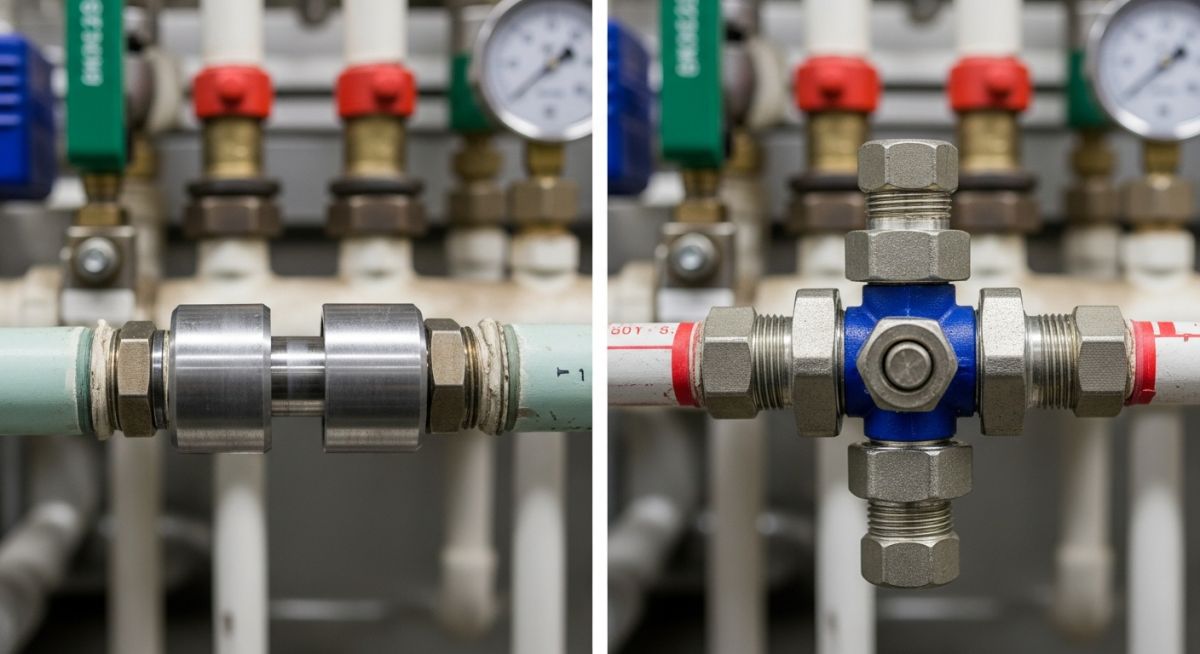
The engineering team replaced the fixed couplings with ASTM A182 F316 Pipe Union Fitting units on both sides of the control valve manifold. This transitioned the system to a Piping Mechanical Joint design, allowing for "drop-out" section capability.
Lessons Learned
- Maintenance Speed: Valve removal time was reduced from 12 hours to 45 minutes by utilizing the Pipe Union Fitting design.
- Safety: Eliminated the need for "Hot Work" permits in a hazardous chemical area during routine maintenance.
- Cost Efficiency: While the initial Pipe Union Fitting procurement was 40 percent higher than couplings, the ROI was achieved in a single maintenance cycle through labor savings.
Frequently Asked Questions: Pipe Union Fitting
Can a Pipe Union Fitting be reused after disassembly? ▼
What is the pressure limit for a Threaded Union Connection? ▼
Why use a Dielectric Pipe Union Fitting in plumbing? ▼
Is a Pipe Union Fitting allowed in flammable gas service? ▼
Summary of Engineering Value
The Pipe Union Fitting remains an indispensable component in modern piping design for 2026. By providing a reliable Piping Mechanical Joint that facilitates rapid maintenance without the need for pipe rotation or cutting, it significantly reduces operational expenditure (OPEX) in industrial facilities.
Whether you are specifying an ASTM A182 Stainless Steel union for a chemical header or a Ground Joint Union for a steam loop, understanding the material standards and mechanical differences compared to couplings is the key to a leak-free, maintainable system.
📚 Recommended Resources: Pipe Union Fitting
Read these Guides
- 📄 Piping Systems: Properties of fluid, Fluid flows, Pressure losses in pipes & components
- 📄 Structural Design: Engineering Principles, Objectives, and Stages (2026)
- 📄 ASME B31.3 2024 Changes: Summary, Key Updates & Compliance Guide (2026)
- 📄 What are Codes, Standards & Specifications, Major Differences & Advantages




Related posts:
![High-grade industrial Wing Nut Types and Applications for mechanical assemblies.]()
Wing Nut Types and Applications: The 2026 Engineering Guide
![Industrial Monorail Crane Systems installed in a modern manufacturing plant 2026.]()
Monorail Crane Systems: Design, Types & 2026 Standards Guide
![Lead engineer performing a Factory Acceptance Test FAT on an industrial skid system 2026]()
Factory Acceptance Test FAT: The 2026 Engineering Guide to Zero-Defect Delivery
![Professional engineering workspace showing a Basis of Design document layout for a 2026 project.]()
Basis of Design: How to Write a BOD for Engineering Projects in 2026
![Industrial Flare Knockout Drum Sizing and installation in a refinery relief system.]()
Flare Knockout Drum Sizing: Design & API 521 Standards (2026 Guide)
![Advanced Reboiler Control Systems in a modern petrochemical refinery 2026.]()
Reboiler Control Systems: Engineering Guide to Precision Control 2026