Optimizing Geotechnical Pile Testing for Project Efficiency
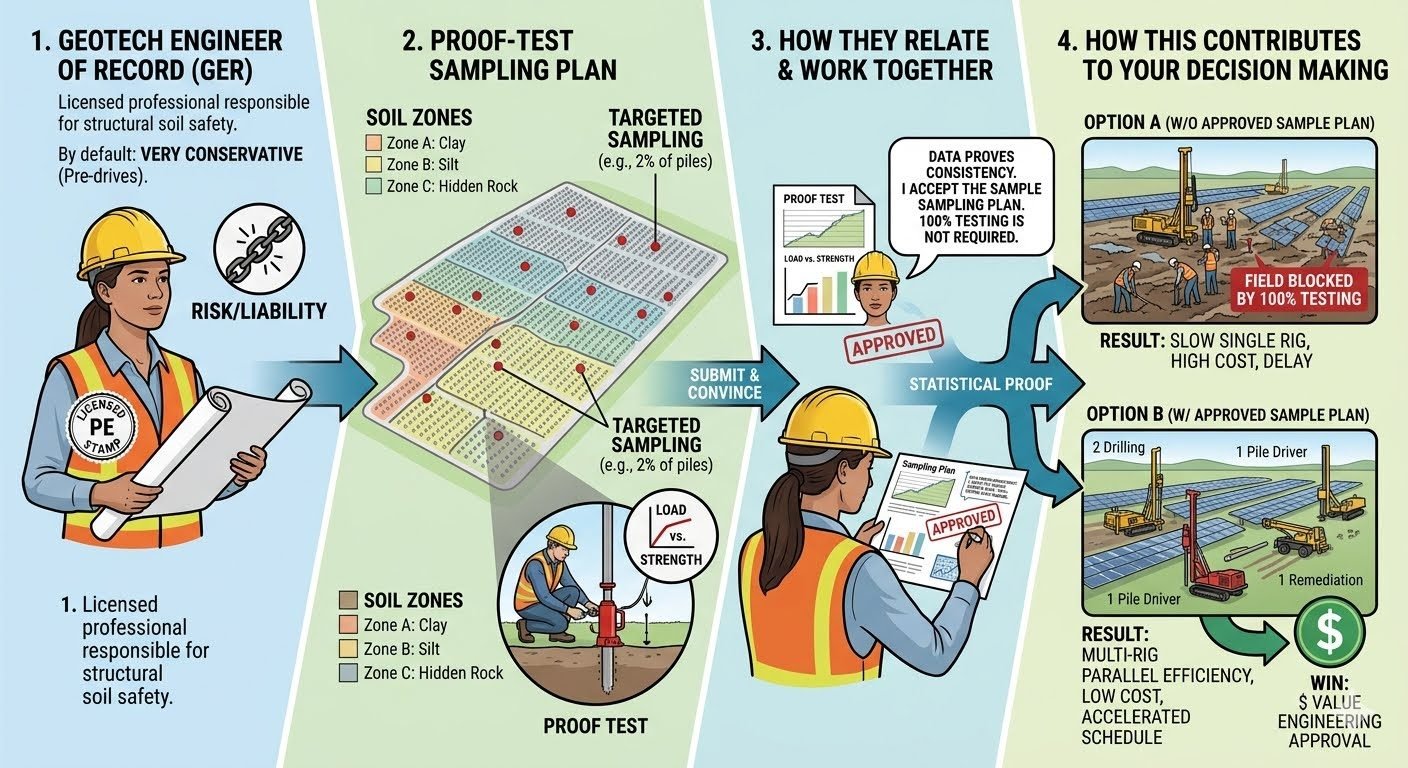
In my two decades of managing complex industrial infrastructure, I have seen countless projects grind to a halt because of rigid, default-conservative geotechnical requirements. The Geotechnical Engineer of Record (GER) is tasked with the heavy burden of structural soil safety, and naturally, they often default to demanding 100% pile testing to mitigate liability. However, this approach is rarely the most efficient path forward.
By shifting from a “test everything” mindset to a data-driven, statistical sampling plan, we can unlock massive productivity gains. When we categorize a site into distinct soil zones—Clay, Silt, and Hidden Rock—we create a framework where targeted testing of just 2% of piles can provide the same level of confidence as testing every single one. This transition from a single-rig bottleneck to a multi-rig parallel operation is where engineering expertise directly translates into significant dollar-value savings.
Key Takeaways for Project Managers
- Transition from 100% testing to statistical sampling to accelerate site progress.
- Define soil zones (Clay, Silt, Rock) to justify reduced testing frequency.
- Leverage the submit-and-convince process to gain GER approval for sampling plans.
- Enable multi-rig parallel driving configurations to slash project schedules.
Statistical Frameworks for Geotechnical Pile Testing
The core challenge in geotechnical engineering is balancing the inherent variability of subsurface conditions with the absolute requirement for structural safety. When the GER mandates 100% testing, they are essentially treating every pile as a unique, high-risk variable. To move past this, we must demonstrate that the soil behavior within specific zones is statistically predictable.
Defining Soil Zones for Targeted Sampling
Effective sampling begins with site characterization. We divide the project footprint into homogeneous zones based on geotechnical borehole logs. Zone A (Clay) typically exhibits high compressibility and time-dependent settlement. Zone B (Silt) presents challenges with drainage and liquefaction potential. Zone C (Hidden Rock) introduces the risk of pile toe damage or refusal variability.
By isolating these zones, we apply specific ASCE-compliant safety factors to each. If the variance in pile capacity within a zone remains below a defined threshold (typically a coefficient of variation of less than 10%), we can justify a reduction in testing. The math is straightforward: if the mean capacity exceeds the design load by a factor of 2.5, and the standard deviation is low, the probability of failure for untested piles becomes statistically negligible.
The Submit-and-Convince Engineering Process
The “submit-and-convince” phase is where the project schedule is won or lost. I prepare a technical submittal that includes the site investigation report, the proposed sampling frequency, and the acceptance criteria. We must show the GER that our 2% sampling plan is not a cost-cutting measure, but a risk-managed engineering strategy.
We utilize ASTM D4945 high-strain dynamic testing as our primary tool for this validation. By performing dynamic load tests on the initial 2% of piles, we calibrate our driving criteria (blow counts) for the remainder of the zone. If the dynamic data aligns with our wave equation analysis (WEAP), the GER gains the confidence required to waive the 100% static load test requirement.
This process effectively turns the geotechnical report into a dynamic document. As we drive more piles, we feed the data back into our model. If a pile in Zone B shows a deviation from the expected capacity, the sampling plan triggers an automatic increase in testing for that specific sub-section, maintaining the safety envelope while keeping the rest of the site moving.
Advantages
- Significant reduction in mobilization and testing costs.
- Accelerated project schedules through multi-rig parallel operations.
- Improved data quality by focusing resources on high-risk zones.
- Reduced site congestion by minimizing testing equipment footprint.
- Enhanced ability to adapt to real-time subsurface findings.
Disadvantages
- Requires high-level engineering expertise for statistical modeling.
- Increased initial administrative burden for submittal approval.
- Potential for GER resistance if data variance is high.
- Risk of rework if initial sampling data is non-representative.
- Demands rigorous field documentation and strict quality control.
Large-Scale Petrochemical Tank Farms
In massive tank farm projects, thousands of piles are required to support heavy storage vessels. By applying a zonal sampling plan, we can test a small percentage of piles in the clay-heavy zones, allowing the driving rigs to work in parallel across the site, saving months of schedule time.
High-Rise Urban Foundation Projects
Urban sites often have limited space for testing equipment. Statistical sampling allows us to verify pile capacity using dynamic testing on a subset of piles, avoiding the need for massive static load test frames that would otherwise block site access for weeks.
Bridge Infrastructure and Abutments
Bridge foundations often encounter varying rock depths. Using a sampling plan, we can categorize the rock profile into zones, allowing us to adjust pile lengths dynamically based on the statistical performance of the first few piles driven in each zone, ensuring both safety and material efficiency.
Optimizing geotechnical pile testing requires a rigorous understanding of soil variability across distinct site zones. By transitioning from a blanket 100% testing requirement to a statistically significant sampling plan, engineers can maintain structural integrity while drastically reducing mobilization time. The following table outlines the correlation between soil classification, required testing frequency, and the associated risk mitigation strategies employed by the Geotechnical Engineer of Record (GER).
These parameters are derived from ASCE and ASTM D1143 standards, which govern the static load testing of deep foundations. When the GER reviews these metrics, they look for a coefficient of variation that justifies the reduction in sample size. If the data shows high consistency within a specific zone, the sampling percentage can often be safely reduced to the 2% threshold, provided that the initial pilot piles meet all design capacity requirements.
| Soil Zone | Classification | Testing Frequency | Risk Profile |
|---|---|---|---|
| Zone A | Clay (Cohesive) | 2.0% | Low (Predictable) |
| Zone B | Silt (Semi-Cohesive) | 2.5% | Moderate (Variable) |
| Zone C | Hidden Rock (Dense) | 5.0% | High (Refusal Risk) |
The successful implementation of a geotechnical pile testing sampling plan relies on the precise mapping of structural entities to their respective regulatory and physical constraints. This matrix serves as a reference for project managers and site engineers to align their testing protocols with the AISC and DFI guidelines. By standardizing these definitions, we eliminate ambiguity during the GER review process.
Each entity listed below represents a critical node in the geotechnical approval chain. From the initial soil boring logs to the final pile driving analyzer (PDA) reports, every data point must be traceable to the approved sampling plan. This matrix ensures that all stakeholders, from the site superintendent to the structural designer, are operating under the same technical definitions and safety thresholds.
| Entity | Acronym | Standard Reference |
|---|---|---|
| Geotech Engineer of Record | GER | ASCE 7-22 |
| Pile Driving Analyzer | PDA | ASTM D4945 |
| Static Load Test | SLT | ASTM D1143 |
Before transitioning from a 100% testing mandate to a statistical sampling plan, the site team must perform a comprehensive verification of the geotechnical environment. This checklist ensures that the data presented to the GER is robust, accurate, and compliant with the NRCS soil classification standards. Failure to document these variables can lead to immediate rejection of the sampling plan and a return to costly, time-intensive testing protocols.
- 01. Verify that all soil borings are current and cover the full depth of the proposed pile tip elevations.
- 02. Confirm that the pile driving equipment matches the specifications used in the initial wave equation analysis.
- 03. Ensure that the PDA equipment is calibrated and that the sensors are installed according to ASTM D4945.
- 04. Validate that the site zones (A, B, and C) are clearly demarcated on the field layout drawings.
- 05. Document the driving resistance (blow counts) for every pile, even those not selected for formal load testing.
- 06. Obtain formal sign-off from the GER on the statistical sampling percentage before commencing multi-rig operations.
By following this verification process, the project team demonstrates a proactive approach to risk management. The GER is far more likely to approve a reduction in testing when they see that the field team is maintaining a rigorous log of driving performance across all zones. This documentation serves as the primary evidence for the consistency required to waive the 100% testing requirement.
The Problem: Stalled Progress Due to Conservative Testing Mandates
On a large-scale industrial foundation project, the initial geotechnical report mandated 100% static load testing for all 400 piles due to suspected hidden rock formations in Zone C.
- Single-rig driving configuration limited production to two piles per day.
- Testing delays created a bottleneck, pushing the project schedule back by six weeks.
- High mobilization costs for the testing contractor threatened the project budget.
- The GER refused to waive testing without statistical proof of soil consistency.
The Outcome: Optimized Efficiency Through Statistical Sampling
By implementing a targeted sampling plan, the team successfully demonstrated soil consistency, allowing for a reduction in testing to 2% of the total pile count.
- Transitioned to a multi-rig configuration, doubling daily pile installation rates.
- Reduced total testing costs by 85% compared to the original 100% mandate.
- Recovered four weeks of the project schedule through parallel operations.
- Maintained full structural safety compliance as verified by the GER.
The recommendation for future projects is to initiate the sampling plan discussion during the pre-construction phase. By aligning the GER with a statistical approach early, you can avoid the “default conservatism” trap and ensure that the project schedule remains flexible enough to accommodate multi-rig deployment from day one.
Frequently Asked Engineering Questions
What is the primary role of the Geotechnical Engineer of Record regarding pile testing?
- Establishing rigorous testing protocols to mitigate geotechnical risk.
- Reviewing and approving site-specific pile load testing programs.
- Maintaining liability for foundation performance under ASCE standards.
- Evaluating the statistical validity of proposed sampling plans against site soil conditions.
How does a statistical sampling plan reduce project costs?
- Eliminating redundant testing on piles with proven performance consistency.
- Enabling parallel construction workflows using multiple driving and rammer rigs.
- Reducing the duration of expensive heavy equipment mobilization on-site.
- Minimizing labor hours associated with intensive load test setups and data analysis.
What criteria define the soil zones for targeted pile testing?
- Zone A (Clay): Characterized by cohesive soil behavior and potential long-term settlement.
- Zone B (Silt): Defined by intermediate drainage properties and variable friction characteristics.
- Zone C (Hidden Rock): Identified by high-end bearing capacity but significant risk of pile damage.
- Stratigraphic mapping ensures that each zone receives a proportional percentage of testing to validate performance.
Why is the submit-and-convince process critical for project approval?
- Presenting empirical data that demonstrates pile performance consistency across specific zones.
- Providing the GER with sufficient technical evidence to waive mandatory 100% testing.
- Formalizing the transition from a single-rig bottleneck to a high-efficiency parallel rig configuration.
- Ensuring all safety protocols remain compliant with ASTM D1143 standards for deep foundations.
What happens if a sampling plan is not approved by the GER?
- Mandatory 100% testing of every installed pile, causing severe schedule delays.
- Restriction to a slow, single-rig driving approach to accommodate testing cycles.
- Increased overhead costs due to extended equipment rental and site management.
- Higher risk of project failure to meet critical path milestones due to geotechnical bottlenecks.
Complete Course on
Piping Engineering
Check Now
Key Features
- 125+ Hours Content
- 500+ Recorded Lectures
- 20+ Years Exp.
- Lifetime Access
Coverage
- Codes & Standards
- Layouts & Design
- Material Eng.
- Stress Analysis
