FRP vs CS Pipes Thermal Expansion: Technical Comparison and 2026 Design Standards
Understanding the differences between FRP vs CS Pipes Thermal Expansion is a critical requirement for modern process piping engineers designing resilient infrastructure. While Carbon Steel (CS) has historically been the industry standard, the 2026 shift toward corrosion-resistant composite materials requires a deeper look at how FRP (Fiberglass Reinforced Plastic) responds to temperature fluctuations. This guide analyzes mechanical behavior, ASME B31.3 compliance, and the thermal stress limitations that define long-term plant reliability.
Key Engineering Insight
FRP piping typically exhibits a coefficient of thermal expansion approximately 2.5 times higher than carbon steel. However, because FRP has a much lower axial modulus of elasticity, it transfers nearly 90% less thermal load to supports compared to steel under identical temperature changes.
Quick Navigation
Technical Knowledge Check
1. According to 2026 design standards, how does the axial thermal expansion of FRP compare to Carbon Steel (A106 Gr. B)?
Complete Course on
Piping Engineering
Check Now
Key Features
- 125+ Hours Content
- 500+ Recorded Lectures
- 20+ Years Exp.
- Lifetime Access
Coverage
- Codes & Standards
- Layouts & Design
- Material Eng.
- Stress Analysis
Thermal Expansion Theory: FRP vs CS Pipes
The fundamental difference in FRP vs CS Pipes Thermal Expansion stems from their molecular structures. Carbon Steel (CS) is an isotropic metallic crystalline structure, whereas Fiberglass Reinforced Plastic (FRP) is an anisotropic composite. This means that FRP properties, specifically its FRP thermal conductivity vs carbon steel, vary significantly depending on the glass-to-resin ratio and the filament winding angle.
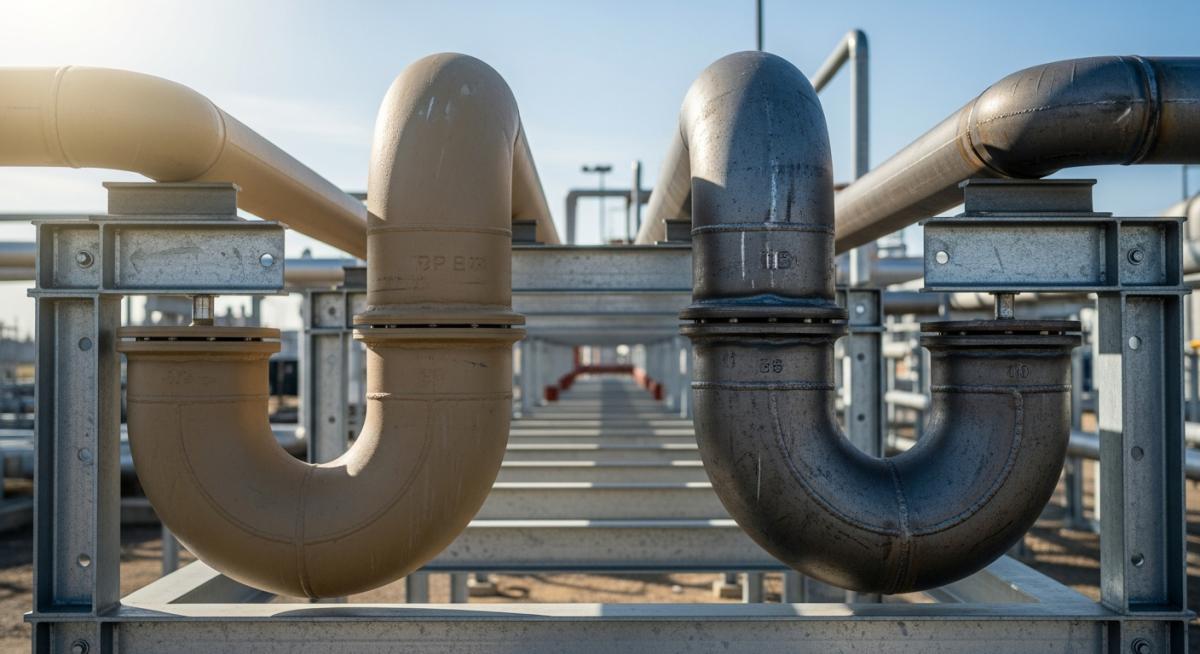
Figure 1: Thermal gradient simulation in metallic vs. composite piping systems.
The Physics of Expansion
In 2026 engineering projects, the coefficient of thermal expansion comparison table is the first point of reference for stress engineers. Steel expands linearly at a predictable rate, but FRP expands significantly more in the axial direction. However, because the modulus of elasticity for FRP (approx. 1 Mpsi) is much lower than steel (29 Mpsi), the resulting "thermal load" on anchors is actually lower for FRP.
Thermal Force Calculation (Fixed Ends)
F = A * E * alpha * Delta T
- F = Thermal Force
- A = Cross-sectional Area
- E = Modulus of Elasticity
- alpha = Coeff. of Thermal Expansion
- Delta T = Temperature Change
Note: Even though alpha is higher for FRP, the dramatically lower E value results in a lower F.
Coefficient of Thermal Expansion Comparison Table (2026)
| Material Property | Carbon Steel (CS) | FRP (Vinyl Ester) |
|---|---|---|
| Thermal Expansion (in/in/°F) | 6.5 x 10^-6 | 14.0 - 18.0 x 10^-6 |
| Thermal Conductivity (BTU/hr/ft/°F) | 25 - 35 | 0.12 - 0.18 |
| Modulus of Elasticity (psi) | 29,000,000 | 1,000,000 - 1,500,000 |
| Max Operating Temp (Typical) | 800°F (Limited by Oxidation) | 210°F - 250°F (Resin Limit) |
ASME B31.3 Piping Expansion Loops & Support
Designing for 2026 reliability requires strict adherence to ASME B31.3 piping expansion loops criteria. For FRP systems, loops must be larger than steel counterparts to accommodate the increased displacement. Furthermore, FRP piping support spacing guidelines 2026 mandate shorter spans because the material is less rigid and prone to sagging at elevated glass reinforced polymer pipe temperature limits.

Figure 2: Comparison of expansion loop geometry for metallic vs non-metallic piping.
When performing thermal stress analysis in metallic vs non-metallic piping, engineers must account for the secondary stresses at the joints. In CS, welding maintains nearly 100% strength; in FRP, the bell-and-spigot or butt-and-strap joints can become the weak point if thermal expansion is not properly guided by directional anchors.
2026 Strategic Value: Beyond Mechanical Expansion
While the physical behavior of FRP vs CS Pipes Thermal Expansion is the primary design hurdle, the 2026 engineering landscape prioritizes long-term operational efficiency. Beyond expansion loops, engineers must now weigh the FRP thermal conductivity vs carbon steel in the context of energy preservation and sustainability targets.
💡 Energy Efficiency & Insulation
FRP has a thermal conductivity of approximately 0.2 W/m·K, which is roughly 225 times lower than carbon steel (45 W/m·K). In 2026, this "Self-Insulating" property often eliminates the need for external cladding, reducing CAPEX by 15-20% and ensuring personnel protection without additional materials.
🌿 2026 Carbon Footprint Mandates
Life Cycle Assessments (LCA) indicate that FRP production emits up to 60% less CO2 than steel. With 2026 "Green Steel" star ratings becoming a procurement standard, the lower energy footprint of non-metallic composites provides a significant advantage in Environmental, Social, and Governance (ESG) reporting.
Thermal Management in Hybrid Jointing
Connecting these two dissimilar materials requires specialized transition management. The 2026 approach utilizes Key-lock and Butt-and-wrap joints to manage the mismatched expansion at the interface.
| Joint Type | Thermal Capability | 2026 Recommendation |
|---|---|---|
| Mechanical Flange | Low (Rigid) | Use with high-expansion gaskets in CS-FRP transitions. |
| Butt-and-Wrap | High (Monolithic) | Standard for 100% leak-proof thermal cycling in FRP runs. |
| Key-Lock Coupling | Moderate (Floating) | Preferred for rapid assembly where some axial movement is permitted. |
PRO TIP: 2026 Digital Twin Integration
Modern piping systems now utilize Digital Twins to monitor thermal strain in real-time. By embedding fiber-optic sensors in the FRP laminate during filament winding, engineers can detect "thermal creep" or support misalignment before they reach the failure levels seen in Scenario B.
Detailed Mathematical Comparison: Alpha (α) and Elastic Modulus (Ea)
Coefficient of Axial Thermal Expansion (α)
Thermal elongation is directly proportional to the coefficient of thermal expansion (α). In 2026 piping design, FRP vs CS Pipes Thermal Expansion assessments rely on the fundamental elongation formula:
According to latest industry benchmarks on Ezoic, FRP pipes exhibit α values between 18 x 10^-6 to 22 x 10^-6 mm/mm/°C. In contrast, CS pipes (A106 Gr. B) maintain a much lower 11.5 x 10^-6 mm/mm/°C.
RESULT: FRP Elongates ~2x more than CSAxial Elastic Modulus (Ea)
As stated in AWWA M45, the Ea for FRP materials is significantly lower than steel, typically ranging from 1.5% to 10% of the metallic value. This is the critical factor in thermal stress analysis in metallic vs non-metallic piping.
While FRP expands more (higher α), its "softness" (lower Ea) means the thermal load (F) transferred to supports is dramatically lower than CS.
RESULT: FRP Loads are <10% of CS Loads2026 Engineering Example: Load Comparison
Data based on Biaxial GRP Pipe Datasheet vs. A106 Gr. B Steel.
Design Parameters
Pipe OD: 219.075 mm
Thickness: 8.1788 mm
Delta T: 60°C
Length (L): 50,000 mm
Area (Ac): 5419.5 mm²
Material Properties
Ea: 203.46 GPa
α: 11.95 x 10^-6
Ea: 12 GPa
α: 22 x 10^-6
Thermal Elongation (∆L)
FRP expands 1.84x more than CS, but generates significantly less stress on the ASME B31.3 piping expansion loops due to the 17x difference in Elastic Modulus.
EPCLand YouTube Channel
2,500+ Videos • Daily Updates
Case Study: FRP vs CS Pipes Thermal Expansion Failure Analysis
In this 2026 industrial forensic review, we examine a chemical processing facility that transitioned its acid transport lines from Carbon Steel to FRP (Fiberglass Reinforced Plastic) to eliminate corrosion. While the material selection was chemically sound, the system experienced a catastrophic failure during a standard maintenance steam-out procedure. This case highlights why FRP vs CS Pipes Thermal Expansion must be the primary consideration during "Management of Change" (MOC) workflows.

Figure 3: Severe delamination and axial "bird-caging" observed at the failure site.
The Problem: Thermal Overstress
The facility attempted a steam-out procedure to clear residual acid. However, the system was designed for an ambient operating temperature of 90°F. Because the glass reinforced polymer pipe temperature limits were exceeded by the 250°F steam, the resin matrix reached its Glass Transition Temperature (Tg).
Unlike Carbon Steel, which would have expanded predictably against its anchors, the FRP pipe lost its structural rigidity. The rigid metallic anchors, placed according to legacy steel standards, prevented the pipe from moving. This resulted in extreme compressive forces, leading to axial stress failure and localized buckling.
Analysis & 2026 Mitigation Strategy
Post-failure thermal stress analysis in metallic vs non-metallic piping revealed that the expansion loops were sized for steel (minimal growth) rather than FRP. The 100-foot run attempted to expand by 4.5 inches under steam conditions, but the supports only allowed for 1.2 inches.
The 2026 Engineering Fix:
- Redesign: Installation of low-friction slide plates and larger Z-bends to accommodate the high axial growth.
- Control: Implementation of a hard temperature lockout on the steam utility station to prevent exceeding the resin Tg.
- ROI: Despite the $45k redesign cost, the facility avoided an estimated $2.2M in potential environmental cleanup and production downtime.
Frequently Asked Questions
How does FRP thermal conductivity vs carbon steel affect insulation requirements?
Are ASME B31.3 piping expansion loops mandatory for FRP?
How do FRP piping support spacing guidelines 2026 differ from steel?
Can I use a standard coefficient of thermal expansion comparison table for all FRP?

Related posts:
![High-grade industrial Wing Nut Types and Applications for mechanical assemblies.]()
Wing Nut Types and Applications: The 2026 Engineering Guide
![Industrial Monorail Crane Systems installed in a modern manufacturing plant 2026.]()
Monorail Crane Systems: Design, Types & 2026 Standards Guide
![Lead engineer performing a Factory Acceptance Test FAT on an industrial skid system 2026]()
Factory Acceptance Test FAT: The 2026 Engineering Guide to Zero-Defect Delivery
![Professional engineering workspace showing a Basis of Design document layout for a 2026 project.]()
Basis of Design: How to Write a BOD for Engineering Projects in 2026
![Industrial Flare Knockout Drum Sizing and installation in a refinery relief system.]()
Flare Knockout Drum Sizing: Design & API 521 Standards (2026 Guide)
![Advanced Reboiler Control Systems in a modern petrochemical refinery 2026.]()
Reboiler Control Systems: Engineering Guide to Precision Control 2026