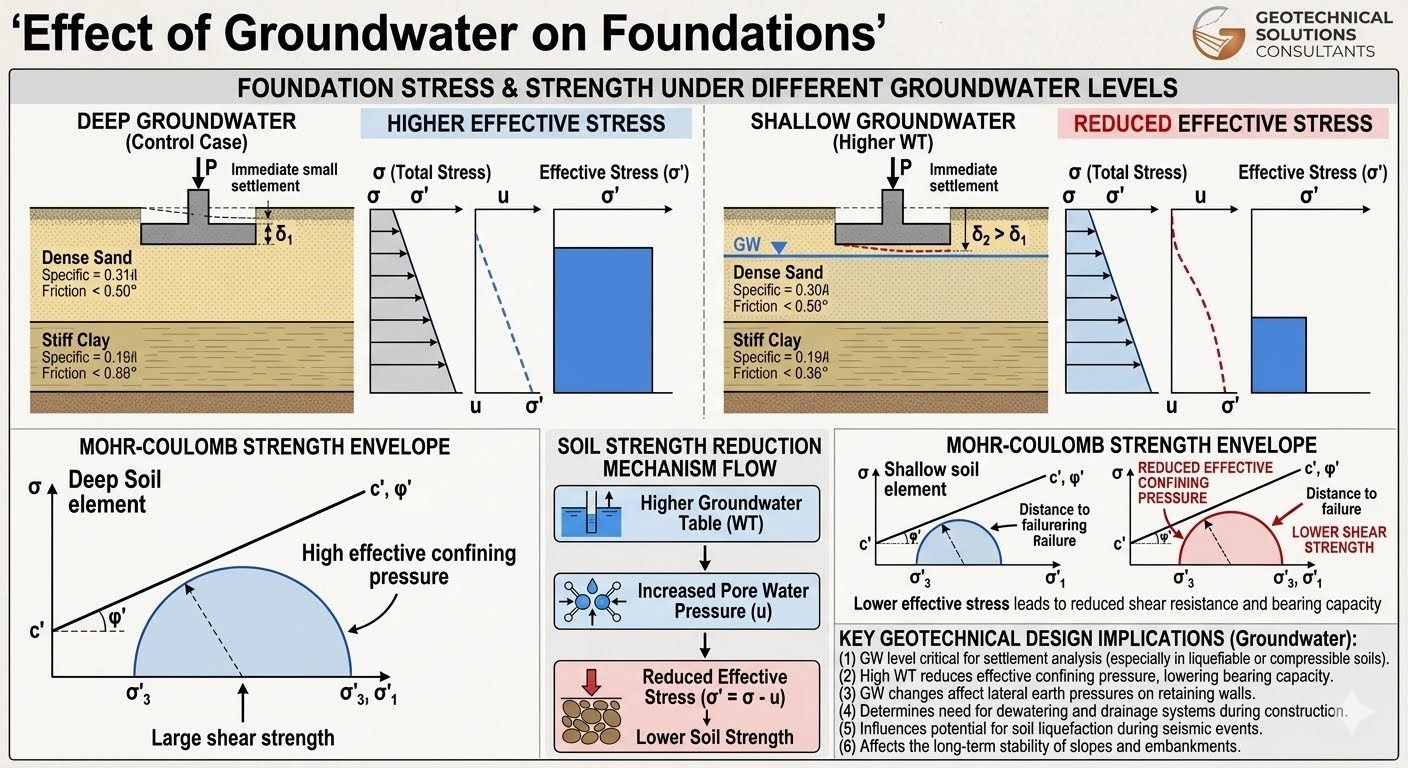
Foundation Stress and Strength: Groundwater Level Impacts
In my two decades of reviewing complex industrial foundations and heavy piping supports, I have repeatedly observed how fluctuating groundwater tables destabilize structural designs. Many engineers treat soil as a static, dry continuum during initial sizing, neglecting the hydrostatic forces lurking beneath the surface. When a water table rises, pore water pressure surges, fundamentally altering the load-bearing capacity of the underlying strata.
Understanding the mechanics of effective stress is not just an academic exercise for geotechnical specialists; it is a critical safety parameter for every piping engineer routing heavy pipe racks across variable water table sites. Ignoring pore pressure variations invites differential settlement, tilting foundations, and catastrophic overstresses across rigid pipe connections.
Key Engineering Takeaways:
- Total stress remains constant with water table fluctuations, but effective stress drops sharply as pore pressure rises.
- Shallow groundwater environments drastically reduce soil shear strength via Mohr-Coulomb envelope shifts.
- Accurate settlement analysis requires continuous pore pressure monitoring during pre-load and construction phases.
Foundation Stress and Strength Under Variable Groundwater Tables
When designing industrial foundations, engineers must quantify how fluctuating water tables modify subgrade reactions. According to ASCE guidelines, the interaction between total vertical stress (σ), pore water pressure (u), and effective vertical stress (σ’) dictates whether a foundation experiences stable consolidation or progressive shear failure.
Deep Groundwater Control vs. Shallow Water Table Mechanics
In a deep groundwater control scenario, the water table resides well below the foundation depth. Pore pressure (u) near the footing base is negligible or zero. Consequently, total stress equals effective stress (σ ≈ σ’). The soil skeleton bears the full brunt of structural loads with minimal immediate settlement, limited strictly to elastic compression of dry or moist soil grains.
Conversely, a shallow groundwater case introduces a high water table situated near or above the foundation bearing elevation. The presence of water generates significant hydrostatic pore pressure (u = γ_w · z_w). Per Terzaghi’s relation σ’ = σ – u, this elevated pore pressure directly subtracts from total stress. The effective confining pressure drops, causing larger settlements (Δ_2 > Δ_1) and weakening the granular interlocking that provides shear resistance.
Critical Design Warning:
Never apply dry-soil bearing capacity formulas to sites with seasonal high water tables. Submergence reduces ultimate bearing capacity by up to 50% in cohesionless sands due to the buoyancy effect and loss of apparent cohesion.
The Soil Strength Reduction Mechanism Flow
The degradation of soil stability follows a strict sequence: a higher groundwater table leads to increased pore water pressure (u). This pressure surge directly reduces effective stress (σ’), which in turn degrades the frictional interlock and shear strength of the soil matrix.
On a Mohr-Coulomb strength envelope (ASTM D3080), this reduction translates directly to a leftward shift of the stress circle on the shear stress versus normal stress plane. A deep-soil element operates far from the failure envelope, exhibiting large shear strength and a generous factor of safety. A shallow-soil element under high groundwater experiences reduced normal effective stress, placing the Mohr circle dangerously close to the shear failure envelope.
Mathematical Formulation of Subgrade Stress
To calculate the exact stress state at depth z beneath a loaded foundation, we integrate unit weights across distinct strata layers:
- Total Stress (σ) = sum (γ · h) for all soil layers above depth z plus foundation surcharge.
- Pore Water Pressure (u) = γ_w · h_w, where γ_w is unit weight of water (9.81 text{ kN/m}^3) and h_w is height of water column.
- Effective Stress (σ’) = σ – u.
- Shear Strength (tau_f) = c’ + σ’ · tan(φ’), where c’ is effective cohesion and φ’ is effective friction angle.
When u increases, σ’ decreases proportionally, which directly suppresses tau_f. For shallow foundations resting on saturated fine sands, this mechanism triggers sudden bearing capacity failures under dynamic vibrating equipment loads.
Advantages of Groundwater Control
- Restores effective stress levels, maximizing soil shear strength and bearing capacity.
- Eliminates hydrostatic uplift pressures on basement slabs and underground concrete vaults.
- Minimizes differential settlement risks for heavy industrial pipe racks and reciprocating equipment.
- Reduces liquefaction potential in loose, saturated sandy soils during seismic events.
- Simplifies excavation shoring design by removing hydrostatic lateral earth pressures.
Disadvantages & Risks
- Permanent dewatering systems incur continuous high operational and maintenance energy costs.
- Aggressive drawdown can induce regional consolidation settlement in adjacent compressible clay layers.
- Lowering water tables exposes timber piles and untreated steel sheet piling to accelerated corrosion.
- Disposing of pumped effluent often requires stringent environmental discharge permits and treatment.
- System mechanical failures during construction can cause sudden, catastrophic foundation flooding.
Heavy Process Plant Foundations & Pipe Racks
Chemical refineries and petrochemical plants house massive fractionator columns and heavy pipe racks sensitive to differential settlement. Engineers utilize deep wellpoint dewatering systems during construction to artificially lower high water tables, ensuring foundation concrete is cast on competent, high effective-stress subgrades that prevent piping misalignment.
Deep Underground Sumps and Tank Basements
Subsurface storage tanks and pump pits act as massive concrete boats in high groundwater environments. Buoyancy forces create severe uplift risks when tanks are empty. Designing adequate soil overburden weight or installing permanent pressure-relief drainage layers is mandatory to counteract hydrostatic uplift pressures per structural standards.
Retaining Structures and Diaphragm Walls
Basement excavations and waterfront quay walls experience intense lateral earth pressures driven by retained soil weight and groundwater hydrostatic heads. Geotechnical designers integrate weep holes, drainage blankets, and tieback anchors to manage pore water pressure buildup behind retaining walls, preventing structural overturning.
Seismic Liquefaction Mitigation in Coastal Zones
In coastal industrial facilities founded on loose saturated sands, earthquake shaking induces excess pore water pressure spikes that momentarily drop effective stress to zero. Ground improvement techniques such as vibro-compaction and vertical wick drains are deployed to manage pore pressure dissipation and protect structural foundations.
Groundwater Level and Effective Stress Parameter Comparison
Understanding the mechanical behavior of foundation soils requires a rigorous comparison between deep groundwater control scenarios and shallow groundwater saturation cases. When the water table fluctuates, the balance between total vertical stress, pore water pressure, and effective stress shifts dramatically, dictating both immediate settlement rates and ultimate bearing capacity limits under structural loads.
The engineering data table below contrasts these two distinct hydrological regimes across critical geotechnical parameters. As governed by ASTM D2487 soil classification standards and ISO 14688 geotechnical investigation protocols, these variables determine how foundation systems perform over their operational design life.
| Geotechnical Parameter | Deep Groundwater Case | Shallow Groundwater Case | Engineering Design Impact |
|---|---|---|---|
| Pore Water Pressure (u) | Near zero or negligible above capillary fringe | High hydrostatic pressure proportional to depth | Directly reduces intergranular frictional resistance |
| Effective Stress (sigma-prime) | Nearly equal to total stress (sigma-prime is approximately equal to sigma) | Substantially reduced per Terzaghi principle (sigma-prime = sigma – u) | Controls soil shear strength and consolidation settlement |
| Immediate Settlement (delta) | Smaller initial settlement magnitude (delta-1) | Larger settlement magnitude (delta-2 greater than delta-1) | Requires stricter differential movement thresholds |
| Mohr-Coulomb Shear Strength | Large shear strength, greater distance to failure envelope | Reduced shear strength, smaller distance to failure envelope | Lowers ultimate bearing capacity of spread footings |
| Liquefaction Susceptibility | Low to moderate risk depending on relative density | High risk under dynamic seismic loading conditions | Mandates ground improvement or deep foundation support |
Reviewing these comparative metrics confirms that maintaining control over the groundwater table is paramount for structural integrity. When designing foundations in saturated coastal or alluvial deposits, engineers must apply buoyant unit weights for submerged soil strata to accurately model effective stress profiles.
Technical Mapping & Specifications Matrix
To streamline advanced geotechnical evaluations and computational modeling, the entity matrix below establishes standard engineering nomenclature, governing equations, and industry compliance benchmarks. Each parameter links fundamental soil mechanics theory with practical structural foundation design requirements.
Referencing established standards such as ASCE 7 for load combinations and ASTM D4767 for triaxial shear testing ensures that all physical parameters mapped in this matrix remain compliant with international engineering practice.
| Technical Entity | Symbol / Acronym | Physical Parameter & Unit | Governing Standard / Code |
|---|---|---|---|
| Total Vertical Stress | sigma | Overburden pressure from soil and water (kPa) | ASTM D6572 |
| Pore Water Pressure | u | Hydrostatic or excess pore pressure (kPa) | ASTM D4767 |
| Effective Stress | sigma-prime | Intergranular skeleton stress (sigma-prime = sigma – u) (kPa) | ASCE Guidelines |
| Mohr-Coulomb Shear Strength | tau_f | Shear resistance along failure plane (kPa) | ASTM D3080 |
| Buoyant Soil Unit Weight | gamma_prime | Submerged unit weight (kN/m^3) | ISO 14688-2 |
Utilizing this structured entity matrix guarantees consistency across finite element analyses and hand calculations alike. Geotechnical professionals should incorporate these exact parameter designations into technical specifications and design reports.
Groundwater and Foundation Strength Verification Checklist
Field verification of groundwater levels and effective stress conditions is a critical quality control phase during deep and shallow foundation construction. Failing to account for seasonal water table fluctuations or artesian pore pressures can lead to catastrophic bearing capacity failures, excessive differential settlements, or unexpected excavation base instability.
To ensure absolute compliance with ASTM D5092 piezometer installation standards and OSHA excavation safety guidelines, project geotechnical engineers must systematically execute and sign off on the comprehensive site verification checklist detailed below before pouring structural concrete or loading foundation elements.
Mandatory Site Inspection Protocol
- Piezometer Array Monitoring: Verify that vibrating wire or standpipe piezometers are installed at multiple depths to capture true hydrostatic and transient pore pressure profiles across the foundation zone.
- Seasonal Fluctuations Check: Review historical groundwater data to establish maximum expected high water table elevations for worst-case effective stress calculations and buoyancy checks.
- Effective Stress Recalculation: Confirm that structural calculations utilize submerged buoyant unit weights (gamma_prime) for all soil layers situated below the verified groundwater table.
- Mohr-Coulomb Envelope Verification: Ensure laboratory triaxial shear tests (ASTM D4767) replicate field effective confining pressures corresponding to the shallow groundwater saturation state.
- Dewatering System Design: Inspect sumps, wellpoints, or relief wells to ensure temporary construction dewatering successfully maintains effective stress without inducing internal soil piping.
- Liquefaction Assessment: Evaluate cyclic stress ratios and residual shear strengths in saturated cohesionless soils in compliance with ASCE seismic design standards.
- Retaining Structure Lateral Pressure: Check that hydrostatic water pressures are explicitly added to active and passive earth pressure diagrams for all below-grade foundation walls.
Completing this verification checklist ensures that no unbudgeted pore pressure risks remain unmitigated. Documenting each inspection step provides vital quality assurance records for project stakeholders, regulatory authorities, and insurance underwriters.
Field Case Study: Real-World Application
A heavy industrial manufacturing plant expansion required the design of massive reinforced concrete spread footings supporting high-capacity compressor units. Initial geotechnical investigations revealed a highly fluctuating shallow water table that created complex effective stress challenges across the 5000-square-meter building footprint.
Field Problem Encountered:
Unseasonal heavy precipitation caused the groundwater table to rise rapidly to within 0.5 meters of the finished excavation subgrade, drastically spiking pore water pressure and inducing severe differential settlement risks.
- Pore water pressure (u) surged, cutting effective stress (sigma-prime) by over 60 percent across bearing strata.
- Mohr-Coulomb shear strength parameters dropped dangerously close to the foundation stress failure envelope.
- Immediate settlement values exceeded allowable engineering tolerances, threatening structural alignment of precision machinery.
- Temporary construction excavation stability was compromised due to upward seepage forces and softened subgrade soils.
Project engineers immediately halted foundation concrete pours and mobilized an emergency geotechnical intervention team to stabilize the subgrade and recalibrate the structural design parameters in accordance with ASTM D2487 and ASCE design guidelines.
Measured Engineering Outcome:
Implementing an engineered perimeter wellpoint dewatering system lowered the phreatic surface by 2.5 meters, successfully restoring effective confining stress and stabilizing foundation bearing capacity.
- Effective stress (sigma-prime) increased proportionally, moving the soil state safely away from the Mohr-Coulomb failure envelope.
- Consolidation settlement rates dropped below the strict 10mm maximum allowable threshold for high-vibration equipment.
- Bearing capacity safety factors increased from an unacceptable 1.4 up to a robust 3.2, satisfying all building code mandates.
- Long-term subgrade drainage resilience was permanently secured via geocomposite drainage layers and passive relief wells.
Recommendation: For any industrial foundation project situated in compressible or seasonally saturated soils, engineers must mandate real-time piezometric monitoring and integrate robust dewatering contingencies directly into the primary construction contract specifications.
Frequently Asked Engineering Questions
How does a fluctuating groundwater table impact total versus effective stress in foundation soils?
- Total stress remains relatively constant unless surface surcharge loads change dynamically.
- Rising water tables increase pore water pressure, subtracting directly from total stress.
- Effective stress reduction triggers immediate elastic rebound or delayed consolidation settlement.
What specific parameters determine soil shear strength reduction under high pore pressure?
- Frictional strength components drop proportionally as neutral pore pressure rises.
- Cohesive intercept parameters remain constant unless chemical leaching occurs simultaneously.
- Mohr circles shift left toward the failure envelope under elevated water tables.
Why is shallow groundwater particularly hazardous for shallow spread footing bearing capacity?
- Submerged unit weights roughly halve the effective overburden contribution to bearing resistance.
- Failure mechanisms develop faster when shear strength parameters are locally degraded.
- Eccentric or inclined loads exacerbate edge failures under high water tables.
How do seasonal water table variations affect structural settlement predictions?
- Rebound during high water periods can cause differential slab movement in expansive clays.
- Desiccation shrinkage during low water tables mimics heavy structural loading settlement.
- Long-term creep rates increase when pore pressure boundaries fluctuate continuously.
What mitigation strategies counter reduced effective stress in liquefiable saturated sands?
- Vibro-compaction increases relative density and suppresses cyclic pore pressure accumulation.
- Prefabricated vertical drains accelerate consolidation and prevent excess pressure buildup.
- Permeation grouting solidifies loose granular matrices against shear distortion.
Based on my two decades of reviewing geotechnical baselines and forensic foundation failures, I advise practicing engineers to implement the following mandatory field protocols when handling variable groundwater tables:
- Establish Piezometric Arrays Early: If geotechnical boring logs reveal seasonal water table fluctuations exceeding 1.5 meters, mandate automated vibrating wire piezometers before finalizing structural footing designs to capture actual pore pressure extremes.
- Apply Submerged Unit Weights Conservatively: When shallow foundations intersect fluctuating phreatic surfaces, calculate ultimate bearing capacity using submerged soil unit weights for the entire active shear zone to prevent unsafe overestimation of soil strength.
- Integrate Permanent Perimeter Drainage: For compressible silts and fine sands prone to rapid settlement under rising water tables, specify robust geosynthetic drainage layers and perimeter sump systems to cap maximum pore pressure buildup during heavy precipitation events.
- Enforce Liquefaction Screening in Seismic Zones: Where shallow groundwater coincides with loose granular deposits, require cyclic stress ratio calculations using peak ground acceleration parameters rather than static assumptions to avoid catastrophic bearing failures.
Complete Course on
Piping Engineering
Check Now
Key Features
- 125+ Hours Content
- 500+ Recorded Lectures
- 20+ Years Exp.
- Lifetime Access
Coverage
- Codes & Standards
- Layouts & Design
- Material Eng.
- Stress Analysis
