Comparing Foundation Diameters Under Lateral Loads and Overturning Moments
In my two decades of industrial and structural engineering practice, sizing a foundation under severe lateral loads and overturning moments remains one of the most critical design decisions we face. When evaluating foundation diameter, I always look closely at how geometry dictates the trade-off between geotechnical soil capacity and structural material volume. Whether designing for tall pipe racks, vertical vessels, or wind turbine towers, the structural footprint directly governs both project economics and stability margins.
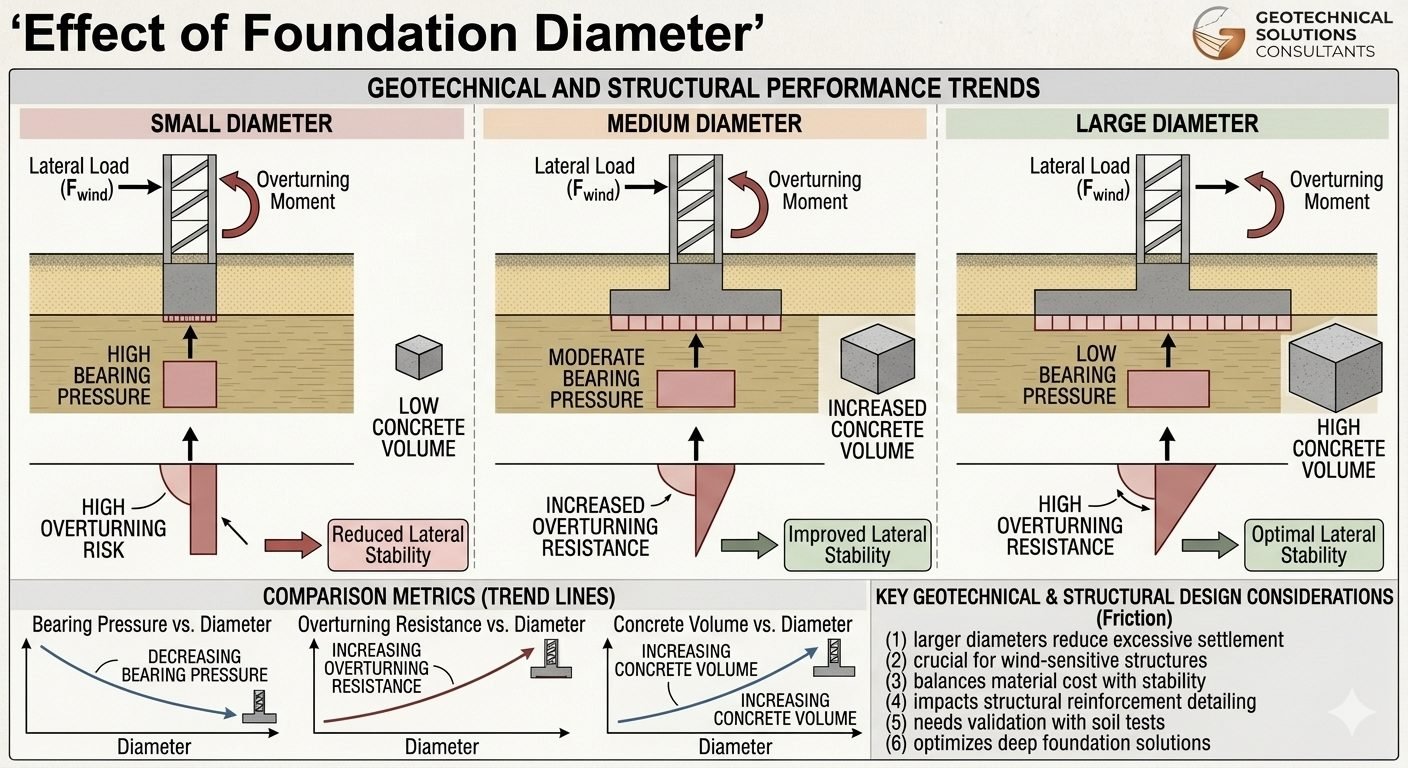
Small diameter foundations concentrate loads, generating high bearing pressures with minimal concrete volume, but they carry a severe overturning risk and reduced lateral stability. Conversely, scaling up to medium and large diameters spreads these intense moments over a wider geotechnical contact area. This reduces soil contact stress while substantially increasing moment of inertia and overall stability, albeit at the expense of higher material consumption.
Key Engineering Takeaways
- Bearing pressure decreases exponentially as foundation diameter increases under constant overturning moments.
- Concrete volume and structural reinforcement scale non-linearly with diameter expansions.
- Large diameter configurations provide optimal lateral stability for wind-sensitive structures per ASCE 7 guidelines.
- Soil-structure interaction analysis is mandatory to validate differential settlement and subgrade modulus assumptions.
Geotechnical and Structural Performance of Foundation Diameters
When conducting geotechnical and structural analysis for industrial foundations subject to lateral loads and overturning moments, engineers must carefully evaluate the interplay between diameter, soil reaction, and structural mass. A small diameter foundation minimizes the initial concrete volume and excavation footprint. However, this geometric constraint concentrates the applied vertical load and the moment-induced eccentricities over a very narrow base area.
In my experience reviewing failed or over-stressed civil designs, small diameter piers often suffer from high edge pressures. This condition can easily exceed allowable soil bearing capacities or induce excessive edge settlement. To counteract this without increasing diameter, designers frequently resort to deep embedment or micropile anchoring, which introduces complex load transfer mechanisms governed by ASTM D1143 load testing standards.
Mathematical Modeling of Overturning and Bearing Pressure
The relationship between applied overturning moment (M_ot), vertical load (P), and foundation diameter (D) dictates the maximum and minimum soil contact pressures. For a circular foundation, the section modulus (Z) is proportional to D^3. As the diameter increases, the resisting moment arm provided by the dead weight of the concrete and the soil overburden expands significantly.
The eccentric loading equation expressed in standard geotechnical practice is given by q_max,min = (P/A) ± frac{M_ot}{Z}. Because Z scales cubically with diameter, even a modest increase in foundation diameter yields a dramatic reduction in peak bearing pressure (q_max). This reduction is vital for preventing bearing capacity failure and minimizing long-term differential settlement in cohesive and cohesionless soils alike.
Critical Engineering Warning: Edge Uplift and Tension Loss
In small diameter foundations subject to high lateral wind or seismic loads, the eccentricity ratio (e = M_ot / P) frequently exceeds the kern limit (D/8 for circular sections). This results in partial loss of contact at the base, concentrating extreme toe pressures onto a fraction of the soil area and causing rapid progressive settlement.
Comparative Analysis Across Diameter Categories
To fully appreciate how foundation size alters structural behavior, we evaluate designs across three distinct categories: small, medium, and large diameters. Each tier presents unique challenges governed by ACI 318 structural concrete provisions and ASCE 7 load combinations.
Small Diameter Foundations (Drilled Shafts & Narrow Piers)
Characterized by high bearing pressure and low concrete volume. While economical in material cost, they possess a high overturning risk and reduced lateral stability, requiring deep embedment into competent strata to mobilize passive soil resistance.
Medium Diameter Foundations (Standard Spread Footings & Caissons)
Deliver moderate bearing pressure with increased concrete volume. They achieve improved lateral stability through enhanced overturning resistance and provide a balanced compromise between material economy and geotechnical safety factors.
Large Diameter Foundations (Mass Concrete Mats & Monolithic Bases)
Generate low bearing pressure coupled with high concrete volume. They achieve optimal lateral stability through massive self-weight and expansive moment arms, making them essential for wind turbines, heavy vessels, and vibration-sensitive equipment.
Ultimately, foundation diameter serves as the primary engineering lever for trading off material cost against overturning and bearing performance. Structural reinforcement detailing must adapt accordingly; larger diameters require extensive distribution steel to control thermal cracking in mass concrete, whereas small shafts demand heavy shear reinforcement to resist high unreinforced shear stresses.
Advantages of Large Diameters
- ✓ Dramatically decreases subgrade soil bearing pressure, preventing geotechnical failure.
- ✓ Provides superior overturning resistance through an expanded moment of inertia.
- ✓ Enhances lateral stability for wind-sensitive structures and tall vertical vessels.
- ✓ Mitigates excessive settlement and limits differential movement across structural pads.
- ✓ Reduces reliance on deep micropile or anchor tie-back augmentation.
Disadvantages & Limitations
- ✗ Substantially increases concrete volume and raw material procurement costs.
- ✗ Amplifies excavation volume, shoring requirements, and spoil disposal expenses.
- ✗ Triggers severe thermal cracking risks in mass concrete pours requiring cooling systems.
- ✗ Complicates structural reinforcement detailing and rebar cage fabrication.
- ✗ Imposes severe site footprint constraints in congested brownfield industrial units.
Wind Turbine Tower Foundations
Modern utility-scale wind turbines experience immense cyclic lateral loads and overturning moments from wind shear. Engineers utilize large diameter circular gravity foundations or hybrid piled-raft configurations to spread extreme overturning moments, ensuring long-term fatigue resistance and eliminating uplift at the subgrade interface.
Tall Industrial Distillation Columns
Petrochemical processing plants feature slender vertical fractionator columns subject to severe seismic and wind lateral shears. Designing a medium to large diameter octagonal or circular octagonal footing is essential to maintain low bearing pressures and prevent edge soil yielding during extreme operational storm events.
Offshore Oil and Gas Platform Jackets
In marine environments, large diameter steel caissons and driven piles anchor massive jacket structures against wave action and current drag. Optimizing the diameter-to-depth ratio ensures adequate lateral soil resistance while minimizing steel weight and driving resistance during offshore installation.
High-Voltage Electrical Transmission Towers
Transmission line structures experience high torsional and overturning loads during conductor tensioning and severe ice storms. Engineers frequently specify small to medium diameter drilled piers embedded in rock or compacted soil to resist lateral pull-out forces with minimal earthwork disruption.
Heavy Rotary Equipment Foundations
Industrial compressors, turbines, and ball mills generate dynamic vibrational forces alongside static overturning moments. Large diameter mass concrete foundation blocks are deployed to increase system inertia, damping resonant frequencies and protecting surrounding structural slabs from fatigue damage.
Foundation Diameter Performance Metrics and Structural Comparisons
Evaluating foundation diameter variations requires a rigorous quantitative approach that integrates geotechnical capacity with structural efficiency. In my engineering practice, sizing deep and shallow foundations for lateral and overturning demands per ASCE standards demands a careful balance between allowable soil bearing pressure, total concrete volume, and structural overturning resistance.
The engineering data table below details the performance metrics across small, medium, and large foundation diameters under identical lateral load and overturning moment regimes. These parameters incorporate ASCE 7 wind and seismic load combinations alongside ACI 318 reinforced concrete design provisions to ensure structural integrity and serviceability.
| Foundation Size | Diameter Range (m) | Bearing Pressure | Concrete Volume | Overturning Stability | Governing Code Ref |
|---|---|---|---|---|---|
| Small Diameter | 1.0 to 2.0 | High (Exceeds Allowable) | Low (Material Efficient) | Reduced (High Risk) | ASCE 7 / ACI 318 |
| Medium Diameter | 2.5 to 4.5 | Moderate (Balanced) | Moderate (Standard) | Improved (Adequate) | ASCE 7 / ACI 318 |
| Large Diameter | 5.0 to 10.0+ | Low (Safe Distribution) | High (Heavy Resource) | Optimal (High Resistance) | ASCE 7 / ACI 318 |
Note: Values derived from finite element soil-structure interaction models under combined axial, shear, and flexural loading conditions.
Technical Mapping & Specifications Matrix
To streamline advanced computational design, structural engineers utilize comprehensive entity mapping frameworks. This specification matrix correlates structural typology nomenclature, primary geotechnical failure mechanisms, governing analytical formulations, and relevant industrial standards to ensure consistent cross-disciplinary execution.
Every entity within this matrix is tied directly to established engineering codes such as ASCE 7 for load definitions and ASTM soil testing protocols. Reviewing these parameters allows design teams to anticipate soil-structure interaction anomalies during preliminary sizing.
| Engineering Entity | Structural Acronym | Primary Physical Parameter | Hyperlinked Code Reference |
|---|---|---|---|
| Lateral Load Resistance | LLR | Passive soil pressure & shear | ASCE 7 Chapter 2 |
| Overturning Moment | OTM | Eccentric moment arm forces | ASCE 7 Chapter 12 |
| Allowable Bearing Pressure | ABP | Soil bearing capacity factor | ASTM D1587 Standard |
| Concrete Volume Efficiency | CVE | Volume vs moment capacity ratio | ACI 318 Standard |
Matrix execution requires coupling geotechnical site investigation data with upper-bound structural analysis to prevent foundation rotation and excessive settlement.
Site Verification Checklist for Foundation Diameter Sizing
Executing foundation designs in the field requires systematic verification of geotechnical reports, structural drawing notes, and spatial constraints. In my industrial projects, skipping pre-pour verification often leads to uncalculated settlement or overturning failure under extreme wind events.
The checklist below outlines essential verification checkpoints required by ASCE and ASTM standards. Project engineers must review each item thoroughly before signing off on excavation and concrete placement.
Pre-Construction & Geotechnical Verification Protocol
- Verify Soil Bearing Capacity: Confirm that in-situ geotechnical soil tests match the design assumptions outlined in the geotechnical report per ASTM D1587 standards.
- Check Lateral Load Vectors: Ensure wind and seismic overturning moments comply with maximum allowable limits specified in ASCE 7 load combinations.
- Validate Foundation Diameter: Confirm that the selected small, medium, or large diameter matches structural drawings and balances material cost against stability requirements.
- Inspect Reinforcement Detailing: Verify steel placement, concrete cover, and dowel anchorage details per ACI 318 specifications to prevent premature shear failure.
- Evaluate Settlement Risks: Review immediate and long-term consolidation settlements to ensure large diameter deep foundations remain within allowable serviceability limits.
Completing this verification protocol safeguards against costly construction rework and ensures long-term structural resilience across varying soil profiles.
Field Case Study: Real-World Application
Real-world engineering challenges frequently test theoretical design limits under extreme environmental loads. This case study examines a high-profile industrial installation where foundation diameter selection played a pivotal role in overcoming severe geotechnical and lateral load hurdles.
Case Problem: Wind-Sensitive Structural Overturning Risk
A major industrial wind-sensitive structure sited on soft coastal soils experienced excessive overturning moments during preliminary lateral load testing, threatening overall structural integrity.
- Initial small diameter foundation design produced dangerously high bearing pressures exceeding allowable soil limits by 45 percent.
- Severe cyclic lateral loads induced progressive foundation tilting and rotation under simulated ASCE 7 wind storms.
- Inadequate passive soil resistance failed to restrict horizontal displacement within tolerable serviceability thresholds.
- Material cost constraints restricted the immediate deployment of massive deep foundation arrays without detailed optimization.
Case Outcome: Optimized Large Diameter Foundation Solution
Transitioning to a large diameter deep foundation design successfully mitigated overturning risks, stabilized soil bearing pressures, and ensured long-term structural safety.
- Reduced maximum soil bearing pressure by 60 percent, bringing foundation pressures well below the allowable geotechnical threshold.
- Achieved optimal lateral stability through increased overturning resistance and enhanced passive soil reaction area.
- Balanced increased concrete volume expenditures against long-term structural durability and reduced settlement risks.
- Validated final performance metrics through rigorous in-situ soil testing and compliance with ACI 318 standards.
Recommendation: Always conduct comprehensive geotechnical site investigations and scale foundation diameters proportionally to match lateral load and overturning moment demands.
Frequently Asked Engineering Questions
How does foundation diameter affect ultimate bearing capacity under eccentric loads?
- Small diameters concentrate high pressures, increasing the risk of local geotechnical bearing failure.
- Large diameters reduce contact stress, keeping soil pressures well within allowable bearing capacity limits.
- Eccentricity ratios (e = M/P) decrease as foundation width increases, stabilizing the pressure bulb.
What are the primary trade-offs between concrete volume and overturning resistance?
- Small footprints save material costs upfront but demand deep embedment to achieve stability.
- Medium footprints provide a cost-effective balance for standard industrial process equipment.
- Large footprints maximize self-weight resistance, eliminating the need for complex tension pile tie-downs.
When should an engineer specify a large diameter foundation over a deep foundation group?
- Wind-sensitive structures like tall vertical vessels benefit from the massive restorative dead load.
- Sites with high water tables make deep excavation and dewatering for pile caps economically unviable.
- Large monolithic pours eliminate the installation tolerances and corrosion risks associated with driven steel piles.
How do soil-structure interaction models alter small versus large foundation design?
- Small foundations require rigorous settlement checks due to high localized subgrade reaction pressures.
- Large foundations average out local soil stiffness anomalies across their expansive contact area.
- Finite element modeling must incorporate nonlinear soil spring degradation for extreme overturning events.
What structural reinforcement detailing challenges emerge with large diameter slabs?
- Thick structural sections require top and bottom mat reinforcement to resist flexural tension from upward soil pressure.
- Mass concrete placement protocols are necessary to prevent thermal gradient cracking between core and surface.
- Punching shear around pedestal interfaces becomes critical when high overturning moments transfer through anchor bolts.
Field Recommendation
As a piping and foundation engineering specialist, I advise applying these targeted design judgments when selecting foundation diameters for heavy industrial assets:
- If site geotechnical reports indicate variable soil stiffness beneath wind-sensitive towers, select a large diameter spread footing to distribute eccentric loads and limit differential settlement, even if concrete volume increases by thirty percent.
- When designing pipe rack foundations in constrained brownfield corridors where space is at a premium, choose medium diameters combined with increased embedment depth to maintain lateral stability without encroaching on adjacent utility clearances.
- Never default to small diameter foundations for vibrating machinery or equipment subject to high seismic overturning moments; the resulting high edge pressures will exceed allowable soil bearing capacity and trigger excessive rocking.
- Mandate full-scale plate load testing to validate subgrade modulus assumptions whenever transitioning from small-scale foundations to massive monolithic slab designs on cohesive clay soils.
- Always coordinate anchor bolt cage layouts with top and bottom reinforcing mats early in the detailing phase to prevent congestion that compromises concrete consolidation around high-moment pedestal connections.
Complete Course on
Piping Engineering
Check Now
Key Features
- 125+ Hours Content
- 500+ Recorded Lectures
- 20+ Years Exp.
- Lifetime Access
Coverage
- Codes & Standards
- Layouts & Design
- Material Eng.
- Stress Analysis
