Floor Gratings: Engineering Types, Material Standards, and Selection Guide
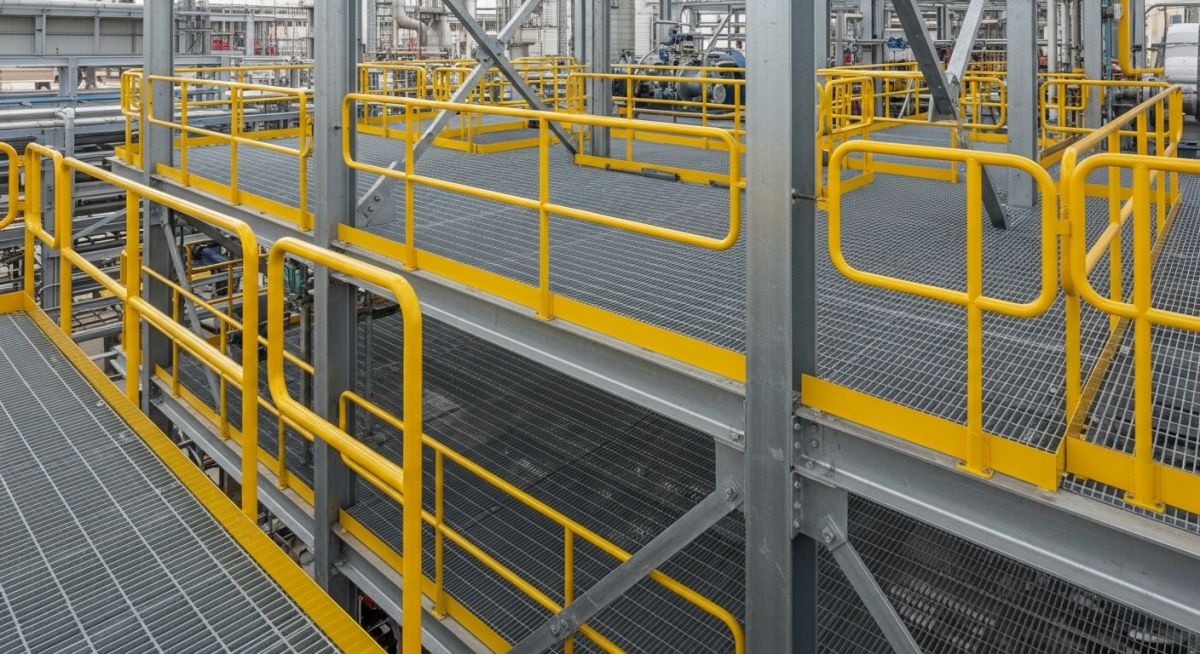
Selecting the correct Floor Gratings is a fundamental safety requirement for any industrial facility, from offshore oil rigs to chemical processing plants. These structural elements must provide adequate load-bearing capacity while allowing for the passage of light, air, and liquids. Modern engineering standards, such as those provided by the NAAMM (National Association of Architectural Metal Manufacturers), dictate the fabrication and installation of gratings to ensure they withstand rigorous environmental stressors and heavy pedestrian or vehicular traffic.
What are Industrial Floor Gratings?
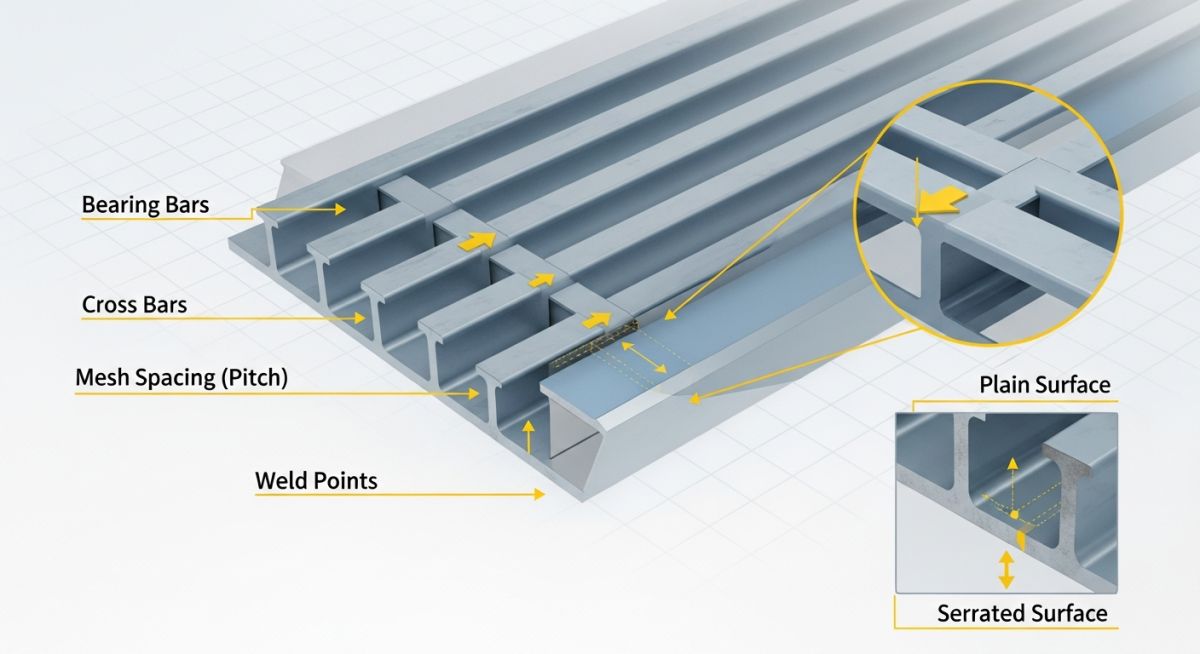
Industrial Floor Gratings are structural frameworks consisting of parallel, load-bearing bars intersected by perpendicular cross bars. They are used to create open-grid surfaces for walkways, platforms, and drainage covers. The most common types include Welded Steel Grating, Press-Locked Grating, and Fiberglass (FRP) Grating, each selected based on corrosion resistance and weight requirements.
Table of Contents
- Primary Technical Types of Floor Gratings
- Material Selection for Various Floor Gratings
- Engineering Advantages of Industrial Gratings
- Load-Bearing Capability of Steel Floor Gratings
- Structural Applications of Floor Gratings in 2026
- Interactive Calculator: Load and Span Tool
- Case Study: Failure Analysis of Undersized Gratings
- Frequently Asked Questions
Test Your Knowledge: Grating Fundamentals
Complete Course on
Piping Engineering
Check Now
Key Features
- 125+ Hours Content
- 500+ Recorded Lectures
- 20+ Years Exp.
- Lifetime Access
Coverage
- Codes & Standards
- Layouts & Design
- Material Eng.
- Stress Analysis
Primary Technical Types of Floor Gratings
The industrial classification of Floor Gratings is determined by the method used to join the bearing bars and cross bars. This fabrication method directly impacts the structural rigidity, aesthetic appeal, and load-bearing performance of the final panel. In 2026, engineering specifications increasingly reference the NAAMM MBG 531 manual to define these technical variations.
Welded Steel Floor Gratings (NAAMM Standards)
Welded steel is the most common and economical of all Floor Gratings. In this process, the cross bars are forge-welded to the bearing bars using high heat and intense pressure. This creates a single-unit construction where the bars are fused together, providing exceptional lateral stability. These are typically manufactured from carbon steel (ASTM A1011) and are ideal for industrial walkways and conveyor systems.
Press-Locked and Swage-Locked Floor Gratings
Press-locked Floor Gratings utilize hydraulic pressure to “lock” the cross bars into pre-punched slots in the bearing bars. Because this method does not use heat, it preserves the material’s metallurgical properties and results in a clean, architectural finish. Swage-locked variations are particularly popular for Aluminum Floor Gratings, where the cross bars are mechanically expanded within the bearing bars to create a permanent, rattle-free joint.
Fiberglass (FRP/GRP) Floor Gratings for Corrosive Environments
For environments where traditional metal would fail, Fiberglass Reinforced Plastic (FRP) Floor Gratings offer the ultimate solution. These are manufactured using a composite of continuous glass fiber strands and various resins (Polyester, Vinylester, or Phenolic). FRP gratings are lightweight, non-conductive, and immune to rust, making them mandatory for chemical processing plants and offshore oil platforms.
Material Selection for Various Floor Gratings
Choosing the right material for Floor Gratings requires balancing structural load requirements against the corrosivity of the installation environment. A mismatch here can lead to premature structural failure or excessive maintenance costs.
| Material Type | Standard Spec | Best Use Case |
|---|---|---|
| Carbon Steel | ASTM A1011 | General industrial use; must be galvanized for outdoor use. |
| Stainless Steel | ASTM A666 (304/316) | Food processing, pharmaceutical, and cleanroom environments. |
| Aluminum | ASTM B221 (6063-T6) | Wastewater treatment plants and architectural applications. |
| Fiberglass (FRP) | ASTM D635 | Highly corrosive chemical plants and subsea applications. |
In 2026, Hot-Dip Galvanizing remains the gold standard for protecting carbon steel Floor Gratings. This process (ASTM A123) provides a sacrificial zinc coating that can protect the underlying steel for over 25 years in most industrial atmospheres.
Engineering Advantages of Industrial Floor Gratings
Beyond simple pedestrian support, the structural design of Floor Gratings offers several technical advantages over solid plate flooring. These benefits are critical for maintaining safety and operational efficiency in high-stakes engineering environments.
Self-Draining and Ventilation
The open area of Floor Gratings (typically 70% to 80%) prevents the accumulation of hazardous liquids, snow, or debris. This open-grid design also facilitates the natural passage of light and air, reducing the need for artificial lighting and complex HVAC ducting in multi-level structures.
High Strength-to-Weight Ratio
Compared to solid steel checkered plates, Floor Gratings provide equivalent load-bearing capacity at a fraction of the weight. This reduction in “Dead Load” allows engineers to design lighter supporting steelwork, significantly lowering overall project material costs.
Load-Bearing Capability of Steel Floor Gratings
The engineering of Floor Gratings is centered around the Moment of Inertia (I) of the bearing bars. To ensure a safe walking surface, engineers must calculate the maximum allowable span based on the intended load—whether it be Uniform (U) or Concentrated (C). In 2026, the industry standard for maximum deflection is typically limited to L/240 or 1/4 inch, whichever is smaller.
Basic Load Calculation for Floor Gratings
The Maximum Stress (S) on a bearing bar under a uniform load can be estimated using the standard beam formula. For a simply supported grating panel:
Where:
- M: Maximum Bending Moment (w × L2 / 8)
- c: Distance from neutral axis to extreme fiber (h / 2)
- I: Moment of Inertia of the bearing bar (b × h3 / 12)
Note: “h” represents the height of the bearing bar, and “b” represents its thickness.
Structural Applications of Floor Gratings in 2026
As industrial design trends toward modularity and rapid assembly, Floor Gratings have found applications far beyond simple catwalks. Their versatility makes them a staple in civil, mechanical, and architectural projects.
| Industrial Application | Recommended Grating Type | Key Design Consideration |
|---|---|---|
| Mezzanine Floors | Welded Steel Grating | Point loads from heavy machinery. |
| Trench Covers | Heavy-Duty Bar Grating | H-20 Truck loading requirements. |
| Stair Treads | Serrated Grating with Nosing | Slip resistance and visibility. |
| Sunshades/Facades | Aluminum Swage-Locked | Corrosion resistance and aesthetics. |
EPCLand YouTube Channel
2,500+ Videos • Daily Updates
Floor Gratings Load and Span Calculator
Estimate the Safe Uniform Load capacity for standard steel Floor Gratings based on bearing bar dimensions and span length.
Calculation based on an allowable bending stress of 18,000 PSI and a maximum deflection of L/240.
Case Study: Structural Failure Analysis and Replacement of Floor Gratings

1. Project Data and Background
In early 2026, an integrity audit of a 15-year-old offshore production platform revealed critical safety hazards regarding the existing Floor Gratings. The original installation utilized hot-dip galvanized carbon steel. Due to continuous exposure to salt spray and chemical washdowns, the zinc coating had depleted, leading to severe exfoliation corrosion on the bearing bar undersides.
2. Failure Analysis: Loss of Load Path
Forensic engineering measurements showed that the bearing bars had lost approximately 35 percent of their cross-sectional area. This reduction in the Moment of Inertia meant the Floor Gratings no longer met the NAAMM MBG 531 safety factor of 1.67. Several panels exhibited permanent plastic deformation (bowing), and two sections had completely detached from their saddle clips, creating an immediate fall risk for personnel.
3. Engineering Fix: Transition to FRP Systems
The remediation team opted for a complete structural upgrade rather than a like-for-like replacement. The following engineering changes were implemented:
- Material Upgrade: Replacement of all steel with Isophthalic Polyester FRP Floor Gratings. These composites offer total immunity to chloride-induced corrosion.
- Surface Safety: Selection of a Gritted Anti-Slip Surface, which provides a higher coefficient of friction than traditional serrated steel, even when covered in drilling mud or oil.
- Weight Reduction: The transition reduced the total mezzanine dead load by 60 percent, effectively extending the fatigue life of the primary supporting steel members.
Lessons Learned for Maintenance Engineers
When specifying Floor Gratings for high-salinity environments, the “Life Cycle Cost” (LCC) should take precedence over initial procurement price. While the FRP system had a 20 percent higher upfront cost, it eliminated the need for biennial coating repairs and is projected to last 30 years without structural degradation, saving the operator over 500,000 USD in long-term maintenance labor and material costs.
Frequently Asked Questions about Floor Gratings
What is the difference between serrated and plain surface floor gratings?
How do NAAMM standards influence the selection of industrial floor gratings?
What are the load-bearing capacity requirements for vehicular floor gratings?
How does galvanization extend the service life of steel floor gratings?
Summary of Floor Gratings Engineering
In summary, the correct selection of Floor Gratings is a technical decision that impacts facility safety, structural lifespan, and project budgets. Whether specifying heavy-duty welded steel for high-load trench covers or choosing fiberglass composites for chemical immunity, engineers must prioritize NAAMM-compliant fabrication and accurate load analysis. By understanding the mechanical advantages of different grating types and finishes, industrial facilities can ensure a safe and durable working surface for the next several decades.
