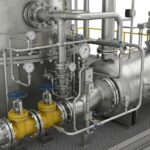
Flare Knockout Drum Sizing: The Ultimate API 521 Guide
Flare Knockout Drum Sizing is the single most critical process safety calculation in refinery relief systems. Without a properly dimensioned vessel, liquid carryover can reach the flare tip, creating “burning rain” and catastrophic safety hazards. This guide breaks down the API 521 methodology, ensuring your design achieves the necessary liquid droplet removal efficiency to protect personnel and assets.
What is a Flare Knockout Drum?
A Flare Knockout (KO) Drum is a pressure vessel designed to separate liquid from gas in a relief system. Its primary sizing objective is to reduce gas velocity sufficiently to allow liquid droplets (typically 300-600 microns) to settle out by gravity before the gas exits to the flare stack.
Quick Navigation
Test Your Knowledge: API 521 Basics
Question 1 of 51. What is the primary API standard governing Flare Knockout Drum design?
1. Theory: API 521 Knockout Drum Design Principles
The primary objective of Flare Knockout Drum Sizing is to separate liquid droplets from the relief gas stream before it enters the flare stack. According to API 521 knockout drum design standards, failing to remove these droplets can lead to “flaming rain”—a scenario where burning liquid is ejected from the flare tip, posing a severe risk to personnel and the facility.

Physics of Separation: Stokes’ Law
The design relies on reducing the velocity of the gas stream. When the gas velocity drops below a critical threshold, gravity overcomes the drag force acting on the liquid droplets. This process is governed by the Liquid droplet removal efficiency, which dictates that the vessel must be large enough to allow a specific droplet size (typically 300 to 600 microns) to fall out of the gas stream before the gas exits the vessel.
Vertical vs Horizontal Knockout Drum
Selecting the right orientation is the first step in Flare Knockout Drum Sizing. The choice depends on the liquid load:
- Horizontal Drums: Preferred for large liquid loads. They provide a larger surface area for vapor disengagement and can accommodate significant liquid surge volumes. This is often the default for main plant flares.
- Vertical Drums: Used when liquid load is low or plot space is restricted. They are less efficient for high liquid surge scenarios but effective for “dry” gas streams with occasional condensation.
2. Calculation: Sizing Formulas & Methodology
The core of Flare Knockout Drum Sizing involves calculating the maximum allowable vapor velocity (Critical Velocity). This ensures that the gas moves slow enough for droplets to settle. While similar to a 3-phase separator sizing calculation, the KO drum focuses primarily on the Gas-Liquid separation limit.

Critical Vapor Velocity (Vc)
Vc = K × √ [ ( ρL – ρg ) / ρg ]
• Vc = Critical Vapor Velocity (ft/s or m/s)
• K = Sizing Parameter (typically 0.27 for vertical, varies for horizontal)
• ρL = Liquid Density (lb/ft³ or kg/m³)
• ρg = Gas Density (lb/ft³ or kg/m³)
KO Drum Flare Retention Time
Once the diameter is set by the gas velocity, the length (for horizontal vessels) is often determined by the liquid hold-up requirement. The KO drum flare retention time is the time available for operators to intervene before the drum overfills.
API 521 recommends a minimum retention time of 20 to 30 minutes for emergency relief scenarios. This ensures that even during a major upset, there is sufficient buffer volume to prevent liquid carryover into the flare header.
Table 1: Recommended K-Values for Sizing (API 521)
| Vessel Orientation | Flow Condition | K-Value (Imperial) | K-Value (SI) |
|---|---|---|---|
| Vertical | Standard Separator | 0.18 – 0.24 | 0.055 – 0.073 |
| Vertical | With Demister Pad | 0.35 | 0.107 |
| Horizontal | Standard Separator | 0.40 – 0.50 | 0.122 – 0.152 |
| Horizontal (Flare KO) | Emergency Relief | Variable* | Variable* |
*Note: For horizontal drums, K-values vary significantly based on the liquid level depth relative to the drum diameter. Refer to GPSA or API 521 charts for exact coefficients.
Complete Course on
Piping Engineering
Check Now
Key Features
- 125+ Hours Content
- 500+ Recorded Lectures
- 20+ Years Exp.
- Lifetime Access
Coverage
- Codes & Standards
- Layouts & Design
- Material Eng.
- Stress Analysis
Core Architecture: The API 521 Ecosystem
Primary Functions
- • Liquid Separation: Strips droplets (300-600μm) from the gas stream.
- • Capacity Management: Handles massive liquid surges during process upsets.
- • Pressure Relief: Provides expansion volume to manage backpressure.
Why It Matters
- • Flame Stability: Prevents liquid from extinguishing the flare pilot.
- • Equipment Protection: Prevents thermal shock damage to sensitive flare tip material (e.g., Inconel/Alloys).
- • Environmental: Ensures full combustion to meet EPA/emission norms.
Operational Roles
- • Emergency Scenarios: Critical buffer during power failures or fire cases.
- • Depressurization: Safely contains rapid gas expansion events.
- • Liquid Recovery: Recycles valuable condensate back to the process.
3. The 4-Step Flare Knockout Drum Sizing Process
Designing a compliant vessel involves more than just plugging numbers into a formula. A robust API 521 knockout drum design follows a structured workflow to ensure both liquid droplet removal efficiency and mechanical integrity during surge events.
Determine Flow Rates
Analyze the worst-case relief scenarios (e.g., blocked discharge, fire case). You must quantify the maximum mass flow of gas (W) and liquid (WL) to determine the required cross-sectional area.
Select Droplet Size
Define the separation criteria. Per API 521, the standard target is typically 300 to 600 microns. Tighter limits (e.g., 150 microns) may be needed for specific smokeless flare tips.
Calculate Dimensions
Calculate the vessel Diameter (D) using the Critical Velocity (Vc) formula. Then, calculate Length (L) to satisfy the KO drum flare retention time (20-30 mins) for liquid hold-up.
Incorporate Internals
Select internals to enhance separation. Adding a demister pad allows for a higher K-value (smaller vessel), but requires careful maintenance to prevent fouling.

Why Sizing Matters
- ➤ Flame Stability: Liquid carryover disrupts the combustion zone, causing flame instability and potential extinguishing.
- ➤ Equipment Protection: Prevents “burning rain” damage to the flare tip, refractory, and surrounding ground equipment.
- ➤ Environmental Compliance: Ensures complete combustion, preventing the release of unburned liquid pollutants to the atmosphere.
Key Operational Roles
- ✔ Buffer for Surge: Acts as a temporary storage tank during emergency depressurization events.
- ✔ Liquid Recovery: Allows for the recovery of valuable hydrocarbons (condensate) that would otherwise be flared.
- ✔ Pressure Relief: Ensures the backpressure on relief valves remains within allowable limits by providing a large expansion volume.
EPCLand YouTube Channel
2,500+ Videos • Daily Updates
Flare KO Drum Sizing Calculator
Estimate Critical Velocity & Diameter per API 521
Process Inputs (SI Units)
Estimation Results
Max Critical Vapor Velocity (Vc)
0.00 m/s
Min. Cross-Sectional Area
0.00 m²
Estimated Minimum Diameter (D)
0.00 meters
Disclaimer: Preliminary sizing only. Does not account for nozzle loss, liquid hold-up surge volume, or specific nozzle loads. Consult API 521 for final design.
4. Design Considerations & Operational Best Practices
Beyond the basic sizing formulas, a functional flare knock out drum requires careful material selection and robust safety features to handle the harsh realities of refinery operations.
🛠 Material Selection
- Carbon Steel: The industry standard for general non-corrosive applications. Requires strict corrosion allowance monitoring.
- Stainless Steel: Mandatory for “wet” sour gas services (H2S presence) or low-temperature cryogenic designs.
- Alloys: Used for highly corrosive or extreme high-temperature relief streams.
🌡 Rating Limits
- Design Pressure: Must exceed the maximum backpressure calculated during the worst-case simultaneous relief scenario.
- Temp Limits: Low-temperature embrittlement is a key risk during rapid depressurization (Joule-Thomson effect).
🛡 Safety Devices
- Level Indicators: Redundant LT (Level Transmitters) are critical to trigger high-level alarms before carryover occurs.
- Access Manways: Essential for confined space entry to inspect internals and remove sludge buildup.
Table 2: Key Parameters for Sizing Flare Knockout Drums
| Parameter | Description | Typical Unit |
|---|---|---|
| Gas Flow Rate | Maximum flow during emergency relief (Fire/Blocked Outlet) | Nm³/h or Scfm |
| Liquid Flow Rate | Maximum liquid surge volume required | m³/h or GPM |
| Target Droplet Size | Cut-point size for removal (API 521 standard) | 300 – 600 Microns |
| Allowable Velocity | Terminal velocity limit to prevent re-entrainment | m/s or ft/s |
| Residence Time | Operator response time buffer (Hold-up) | 20 – 30 Minutes |
⚠ Troubleshooting Common Issues
Issue 1: Liquid Carryover (Burning Rain)
Symptoms: Visible flaming droplets falling from the flare tip.
Issue 2: Inadequate Separation
Symptoms: High liquid levels in the drum despite normal drain operation.

Figure 4: Routine inspection of internals is vital to prevent clogging.
Operational Best Practices
Case Study: Failure Analysis of Undersized Flare Knock Out Drums
In engineering, theory often meets harsh reality during upset conditions. This case study examines a “Burning Rain” incident at a Gulf Coast refinery, directly caused by errors in the initial Flare Knockout Drum Sizing assumptions. The failure highlights why reliance on steady-state simulation data often proves fatal during dynamic relief scenarios.

Facility Type
Mid-Sized Refinery (150k BPD)
Failure Scenario
Compressor Trip + Liquid Slug
Original Vessel
Vertical KO Drum (Undersized)
Consequence
Offsite Liquid Fallout
PROBLEM Root Cause Analysis
The facility experienced a simultaneous trip of the Wet Gas Compressor and the Crude Tower Overhead system. This generated a massive two-phase flow relief load. The existing vertical drum was sized correctly for gas velocity but failed to account for the massive liquid surge volume.
The Engineering Gap: The original design calculation assumed a “misty” gas stream. However, the upset condition pushed a solid slug of liquid into the header. The vertical vessel’s cross-sectional area was too small to handle the surge, and the KO drum flare retention time was less than 3 minutes—far below the API 521 recommended 20-30 minutes. This caused the drum to fill completely, forcing liquid out the top nozzle and into the flare stack.
SOLUTION The Retrofit Strategy
To rectify this, the engineering team performed a new API 521 knockout drum design assessment. The solution involved converting the system from a single vertical drum to a large horizontal vessel.
- Dimensional Change: Installed a 12ft diameter x 40ft length Horizontal Drum.
- Physics Update: The horizontal orientation maximized the gas-liquid interface area, significantly improving separation.
- Capacity Upgrade: The new vessel provided a 25-minute liquid hold-up time, allowing operators sufficient time to close upstream isolation valves before the drum overfilled.
Result: During a subsequent power failure simulation in 2025, the new system successfully contained 100% of the liquid surge, with zero carryover to the flare tip.
Downstream Impact: Protecting the Refinery Flare Stack
The flare knockout drum is not an isolated vessel; it is the primary shield for the entire disposal system. Sizing errors here propagate downstream, causing catastrophic damage to the vertical refinery flare stack.
Flare Tip Material Damage
Liquid droplets hitting the flare tip at high velocity cause “thermal shock.” The sudden cooling effect on hot metal can crack expensive flare tip material (typically high-nickel alloys like Inconel 625), requiring a plant shutdown for replacement.
Structural Vibration
Two-phase flow (slugging) entering the header creates massive mechanical vibration. Undersized drums that fail to capture these slugs transfer kinetic energy directly to the flare stacks, risking structural fatigue or guy-wire failure.
Frequently Asked Questions: Flare KO Drum Design
What is the required liquid droplet removal efficiency per API 521?
For standard flare knock out drums, API 521 typically requires the removal of liquid droplets ranging from 300 to 600 microns in diameter. Removing droplets larger than this threshold is critical to prevent “burning rain” from occurring at the flare tip. For smokeless flares or specific burner designs, tighter restrictions (e.g., 150 microns) may apply.
How do I choose between a Vertical vs horizontal knockout drum?
The choice largely depends on the expected liquid load. A Vertical knockout drum is generally used when the liquid load is light (vapor-dominated flow) and plot space is limited. Conversely, a Horizontal knockout drum is essential for high liquid loads or large surge volumes because it offers a larger surface area for separation and greater liquid storage capacity.
What is the standard KO drum flare retention time?
For emergency relief scenarios, API 521 recommends a liquid hold-up (retention) time of 20 to 30 minutes. This provides operators with sufficient time to diagnose the upset, identify the source of the liquid, and take corrective action (such as closing valves or stopping pumps) before the drum completely fills and overflows into the flare header.
How does this differ from a 3-phase separator sizing calculation?
While the physics (Stokes’ Law) are similar, the objectives differ. A 3-phase separator sizing calculation focuses on continuous process separation (Oil/Water/Gas) for production quality. In contrast, Flare Knockout Drum Sizing is a safety-critical design focused purely on preventing liquid carryover during worst-case intermittent relief scenarios, often prioritizing surge capacity over oil/water interface quality.
Final Engineering Note
Proper Flare Knockout Drum Sizing is not just a compliance exercise; it is the last line of defense against catastrophic onsite fires. By strictly adhering to API 521 knockout drum design principles—specifically regarding critical velocity and retention time—engineers ensure that relief systems function safely when they are needed most.
Review Sizing Formulas
Related posts:
![High-grade industrial Wing Nut Types and Applications for mechanical assemblies.]()
Wing Nut Types and Applications: The 2026 Engineering Guide
![Industrial Monorail Crane Systems installed in a modern manufacturing plant 2026.]()
Monorail Crane Systems: Design, Types & 2026 Standards Guide
![Lead engineer performing a Factory Acceptance Test FAT on an industrial skid system 2026]()
Factory Acceptance Test FAT: The 2026 Engineering Guide to Zero-Defect Delivery
![Professional engineering workspace showing a Basis of Design document layout for a 2026 project.]()
Basis of Design: How to Write a BOD for Engineering Projects in 2026
![Industrial Flare Knockout Drum Sizing and installation in a refinery relief system.]()
Flare Knockout Drum Sizing: Design & API 521 Standards (2026 Guide)
![Advanced Reboiler Control Systems in a modern petrochemical refinery 2026.]()
Reboiler Control Systems: Engineering Guide to Precision Control 2026