Factory Acceptance Test FAT: The Definitive 2026 Engineering Guide

Imagine a 20-ton chemical injection skid arriving at an offshore platform 200 miles from the coast, only for the commissioning team to discover that the PLC communication protocols are incompatible with the central control system. The cost of such an oversight isn’t just the repair—it is the catastrophic surge in project downtime and specialized labor mobilization.
The Factory Acceptance Test FAT is your final firewall against these project-killing defects. In this guide, we dive deep into the 2026 standards for FAT execution, ensuring your equipment leaves the shop floor only when it meets 100% of the design specifications.
Key Takeaways
- ✔ The Factory Acceptance Test FAT serves as a risk-mitigation tool to verify equipment functionality at the vendor’s site before final shipment.
- ✔ Unlike the SAT, the FAT allows for immediate rectification of mechanical or software issues using the manufacturer’s own tools and personnel.
- ✔ Compliance with ISPE and ASME guidelines is essential for a legally defensible FAT report in 2026.
What is a Factory Acceptance Test (FAT)?
A Factory Acceptance Test FAT is a comprehensive functional and quality inspection conducted at the manufacturer’s facility. It verifies that equipment, such as skids or pressure vessels, meets design specifications, safety standards, and contract requirements through documented testing before the asset is approved for shipment to the project site.
Founder’s Insight
“In my 20 years of EPC management, I’ve seen that a ‘passed’ FAT is only as good as the punch list it generates. If your Factory Acceptance Test FAT doesn’t identify at least three minor improvements, your test protocol likely lacks the necessary depth for 2026’s complex automation standards.”
— Atul Singla
Complete Course on
Piping Engineering
Check Now
Key Features
- 125+ Hours Content
- 500+ Recorded Lectures
- 20+ Years Exp.
- Lifetime Access
Coverage
- Codes & Standards
- Layouts & Design
- Material Eng.
- Stress Analysis
Engineering Knowledge Check: FAT Protocols
Validate your expertise in 2026 Factory Acceptance Testing standards.
Question 1 of 5
What is the primary objective of a Factory Acceptance Test FAT?
What Is a Factory Acceptance Test FAT and Why It Is Critical?
The Factory Acceptance Test FAT is a rigorous functional assessment conducted at the manufacturer’s facility to prove that the equipment meets all contractual and technical specifications before it leaves the shop floor. In the 2026 engineering landscape, where modular construction and global procurement are standard, the Factory Acceptance Test FAT acts as the ultimate quality gate. It is not merely a “check-the-box” exercise; it is a legally binding verification process that ensures complex systems—ranging from centrifugal pump skids to sophisticated Distributed Control Systems (DCS)—perform exactly as engineered.
Failing to execute a proper Factory Acceptance Test FAT can lead to “project paralysis.” When defects are discovered only after site delivery, the cost of rectification skyrockets due to the lack of specialized tools, limited vendor personnel availability, and the high cost of site labor. By conducting the Factory Acceptance Test FAT at the source, engineers leverage the vendor’s controlled environment to troubleshoot and optimize performance under the direct supervision of the design team.
Core Objectives: The Purpose of a Factory Acceptance Test FAT
The primary objective of a Factory Acceptance Test FAT is risk mitigation. According to the International Society for Pharmaceutical Engineering (ISPE), a well-structured FAT should confirm both the physical integrity and the operational logic of the asset. The 2026 standards emphasize three critical pillars:
- Safety and Compliance Verification: Ensuring that all emergency shutdown (ESD) systems, pressure relief valves, and structural welds meet ASME or API standards.
- Functional Performance: Running the equipment through its full operational cycle—including “unhappy path” testing (error handling)—to ensure the software and hardware interact seamlessly during the Factory Acceptance Test FAT.
- Documentation Audit: Confirming that the Manufacturer’s Data Report (MDR), material test reports (MTRs), and calibration certificates are complete and accurate before the asset is “released for shipment.”
Technical Comparison: Factory Acceptance Test FAT vs. Site Acceptance Test (SAT)
Engineers often confuse the Factory Acceptance Test FAT with the Site Acceptance Test (SAT). While they share similar testing procedures, their timing and environments create a massive difference in project impact. The Factory Acceptance Test FAT focuses on the equipment in isolation (or “simulated” integration), whereas the SAT tests the equipment after it has been integrated with the site’s utility headers, power grids, and master control networks.
| Feature | Factory Acceptance Test (FAT) | Site Acceptance Test (SAT) |
|---|---|---|
| Location | Vendor/Manufacturer Workshop | Final Project Site / Facility |
| Primary Goal | Verify design and build quality | Verify site integration and utilities |
| Rectification | Fast; using shop tools/spare parts | Slow; requires mobilization of crews |
| Logic Testing | Simulated I/O signals | Real-world process conditions |
In essence, a successful Factory Acceptance Test FAT ensures that the SAT becomes a mere formality, rather than a frantic troubleshooting session.
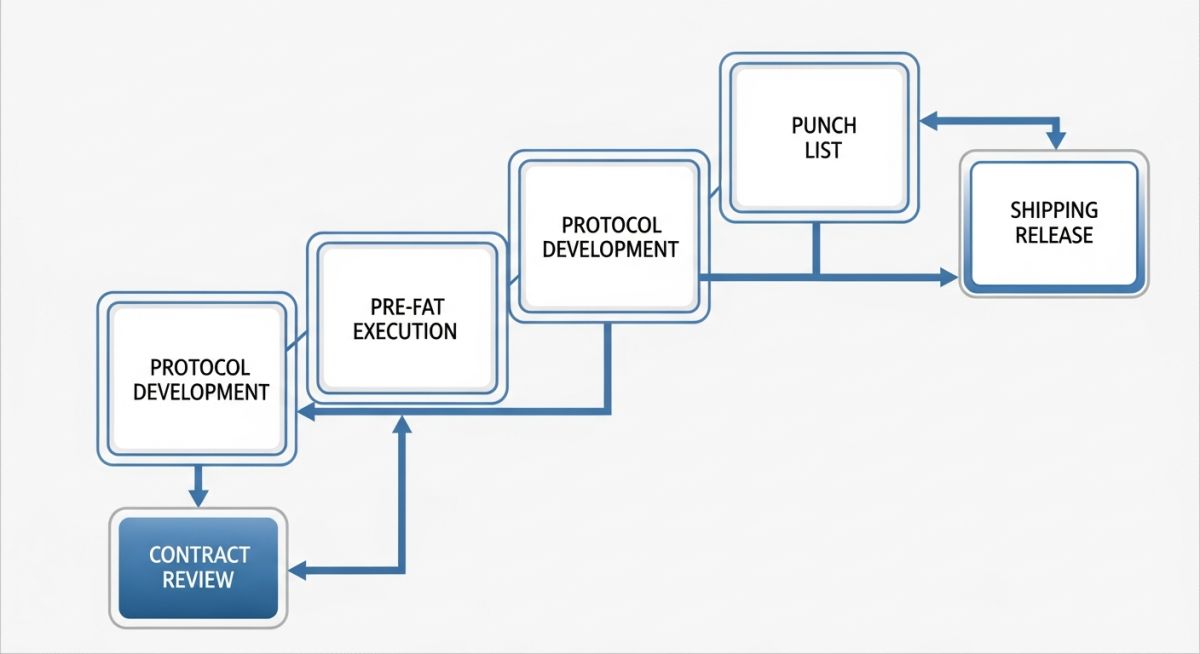
The 2026 Standard Protocol: Steps for Factory Acceptance Test FAT
Executing a Factory Acceptance Test FAT in 2026 requires a digitized, step-by-step approach to ensure data integrity and traceability. The process is no longer just a physical inspection; it is a synchronized technical audit. Following ASME BPE (Bioprocessing Equipment) and GAMP 5 principles, the Factory Acceptance Test FAT protocol must follow these critical phases:
1. Planning and Protocol Approval
Before any testing begins, the Factory Acceptance Test FAT Protocol—a document detailing every test case, expected result, and acceptance criteria—must be reviewed and signed off by the lead project engineer. This document acts as the legal “rulebook” for the Factory Acceptance Test FAT.
2. The Pre-FAT Execution
A common pitfall is arriving at a vendor site only to find the equipment unpowered. In 2026, best practices mandate a “Pre-FAT” where the vendor runs all tests internally. This ensures that the formal Factory Acceptance Test FAT attended by the client is a demonstration of success, not a debugging session.
3. Formal Testing and Data Recording
During the Factory Acceptance Test FAT, the equipment is subjected to:
- Static Testing: Dimensional checks, P&ID walk-downs, and material verification.
- Dynamic Testing: Power-up sequences, software logic loops, and emergency stop (E-Stop) triggers.
- Interlock Verification: Ensuring safety interlocks perform as per the Cause and Effect matrix.
Evaluating the Factory Acceptance Test FAT Results and Reports
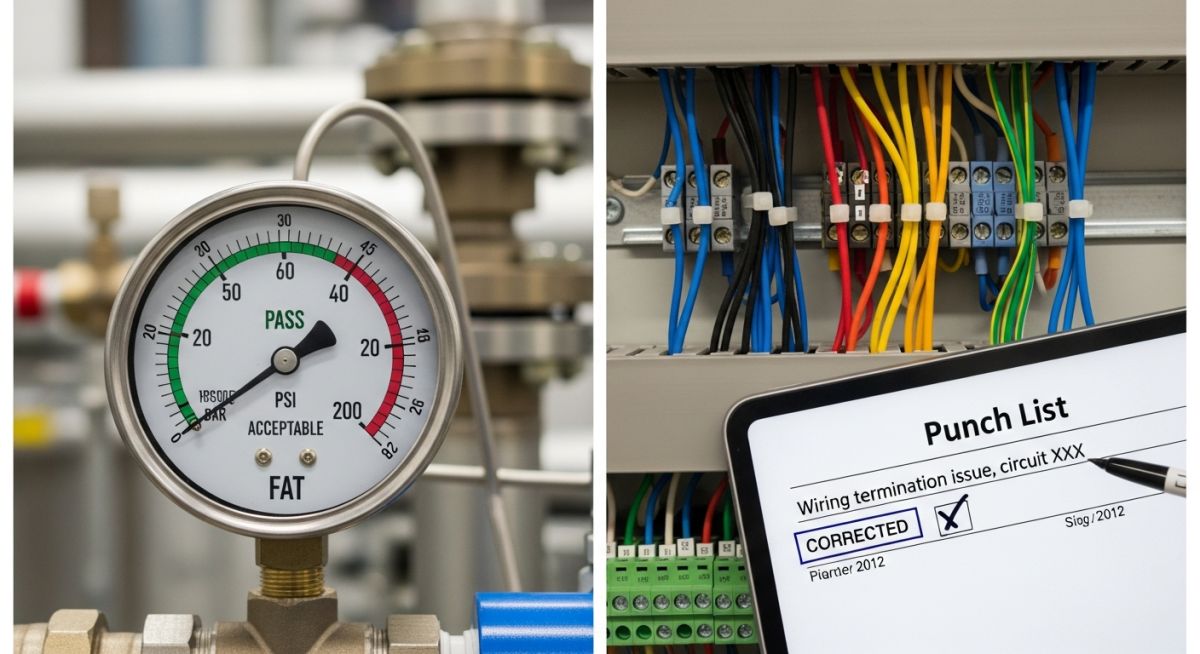
A Factory Acceptance Test FAT result is categorized into three states: Accepted, Accepted with Comments (Punch List), or Rejected. In modern EPC (Engineering, Procurement, and Construction) workflows, 90% of tests fall into the “Accepted with Comments” category.
The 2026 Reporting Standard
The final Factory Acceptance Test FAT report must include timestamped digital photos of nameplates, calibration certificates for all test gauges (traceable to NIST or ISO/IEC 17025), and a signed-off Punch List. Without these, the “Release for Shipment” certificate should not be issued.
Roles and Responsibilities: Who Governs the Factory Acceptance Test FAT?
Successful Factory Acceptance Test FAT execution relies on a clear RACI (Responsible, Accountable, Consulted, Informed) matrix. According to ISO 9001:2015 quality management standards, the following stakeholders must be present:
| Role | Responsibility in Factory Acceptance Test FAT |
|---|---|
| Vendor/Manufacturer | Providing the facility, calibrated tools, and performing the tests. |
| Project Engineer (Client) | Witnessing tests and ensuring alignment with the original design basis. |
| Quality Control (QA/QC) | Verifying documentation, MTRs, and compliance with ASME/API. |
| Automation Engineer | Validating PLC code, HMI screens, and communication protocols. |
FAT Risk & Readiness Calculator (2026 Edition)
Use this engineering tool to determine if your equipment is ready for a formal Factory Acceptance Test FAT or if the risk of failure is too high for mobilization.
Case Study: The $1.2M Logic Failure Recovery
Project Scenario
A major offshore operator ordered a custom Produced Water Treatment Skid for a North Sea platform. The delivery schedule was aggressive, with a fixed “window of opportunity” for heavy-lift crane mobilization.
The FAT Discovery
During the Factory Acceptance Test FAT, the lead automation engineer initiated a “Loss of Power” simulation. The redundant PLC failed to hand over control within the mandated 500ms, which would have caused a total platform shutdown in a real scenario.
Resolution & Impact
Because this was caught during the Factory Acceptance Test FAT at the vendor’s shop in Houston, the software team was able to rewrite the failover logic and re-test within 48 hours.
- ● Estimated Site Repair Cost: $1,200,000 (Vessel standby + Offshore labor).
- ● Actual FAT Rectification Cost: $4,500 (Software engineering hours).
- ● Key Lesson: Never waive the “Dynamic Load” portion of a Factory Acceptance Test FAT to save schedule time.
This case study highlights why 2026 procurement contracts mandate a “Successful FAT” prior to any progress payments related to shipping.
EPCLand YouTube Channel
2,500+ Videos • Daily Updates
Expert Insights: Lessons from 20 years in the field
Simulate Real-World Loads: Many vendors try to perform a Factory Acceptance Test FAT using “dry runs.” In 2026, always insist on using actual fluids or simulated electrical loads. A pump may spin perfectly with air, but mechanical seal leaks or vibration harmonics only appear under hydraulic load.
The “Ghost in the Machine” Rule: For automated systems, conduct an “Unannounced E-Stop” test. Triggering an emergency stop at the most inconvenient part of a sequence—such as during a data write or high-speed rotation—reveals how robust the recovery logic truly is during a Factory Acceptance Test FAT.
Remote FAT (rFAT) Security: If performing a remote Factory Acceptance Test FAT via AR or streaming, ensure the vendor uses a calibrated, timestamped overlay. It is easy to miss a slight pressure drop or a flickering HMI alarm on a low-resolution video feed.
