DN vs NPS vs PN: Demystifying Piping Standards for 2026
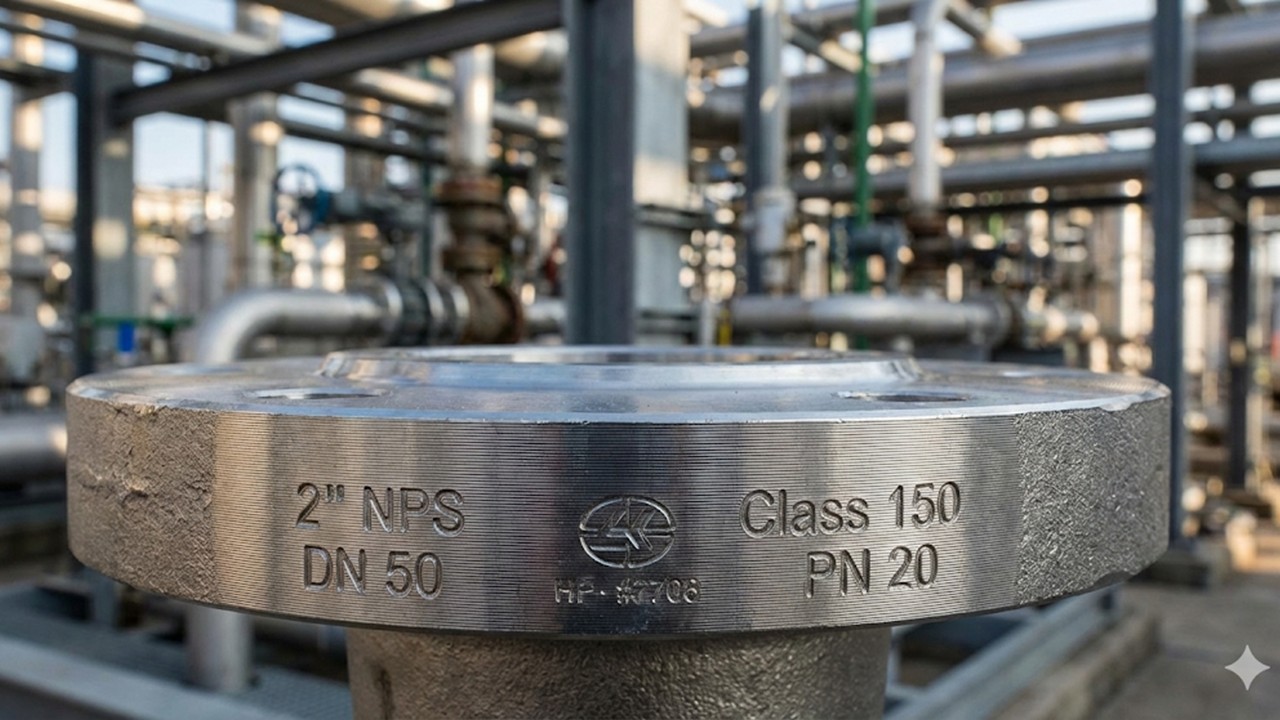
The battle between DN vs NPS vs PN is essentially the engineering version of “Metric vs. Imperial,” but with significantly higher stakes involving pressure containment and leak prevention. For any piping engineer or procurement officer, understanding the correlation between Nominal Pipe Size (NPS), Diameter Nominal (DN), and Pressure Nominal (PN) is mandatory. A single misunderstanding—like assuming a PN 16 flange mates perfectly with an ASME Class 150 flange—can lead to costly bolt misalignment or catastrophic joint failure. In this guide, we translate these acronyms into actionable site knowledge.
The Three Pillars of Sizing
These terms define the “Name” of the pipe, not necessarily its exact physical dimension.
- USA NPS (Nominal Pipe Size): The Imperial standard (Inches). Governed by ASME B36.10. Example: NPS 2.
- ISO DN (Diameter Nominal): The Metric equivalent (Millimeters). Governed by ISO 6708 Nominal Diameter. Example: DN 50.
- BAR PN (Pressure Nominal): The Metric pressure rating (Bar) at 20°C. Governed by EN 1092. Example: PN 16.
⚡ Piping Standards Check: 2026
Loading Quiz…
Complete Course on
Piping Engineering
Check Now
Key Features
- 125+ Hours Content
- 500+ Recorded Lectures
- 20+ Years Exp.
- Lifetime Access
Coverage
- Codes & Standards
- Layouts & Design
- Material Eng.
- Stress Analysis
The 2026 Procurement Guide: DN vs PN vs NPS
Accurate material requisition requires a precise understanding of technical abbreviations. When specifying PN in HDPE Pipes, engineers must also define the DN meaning to ensure compatibility with valves, fittings, and existing infrastructure. Misinterpreting the DN full form versus the PN full form is a leading cause of sizing errors in modern hydraulic projects.
DN Full Form
Diametre Nominal (Metric)
Refers to the Nominal Diameter. In HDPE, this indicates the outer diameter (OD) in millimeters.
PN Full Form
Pressure Nominal (Bar)
The PN meaning establishes the maximum pressure rating at 20 degrees Celsius.
NPS Definition
Nominal Pipe Size (Imperial)
The North American standard measured in inches, often requiring conversion to DN.
Correlation Matrix: Dimensions vs Ratings
| Parameter | Context | Engineering Rule |
|---|---|---|
| DN Meaning | Sizing & Layout | DN remains constant regardless of wall thickness changes. |
| PN Meaning | Safety & Strength | Higher PN ratings require thicker walls, reducing the internal flow area. |
| NPS Logic | Interchangeability | Requires ISO 4427 piping standards lookup for exact SDR/OD matching. |
2026 Design Tip
When ordering for large-scale effluent systems, always specify the full string: Material – DN – PN – Standard.
Example: PE100 DN 315 PN 16 ISO 4427.
This eliminates ambiguity between the DN full form (315mm OD) and the pressure capability (16 Bar).
The Sizing Code: Nominal Pipe Size to DN Conversion
The confusion in DN vs NPS vs PN typically starts with the physical dimension of the pipe. Engineers often ask, “Is a 2-inch pipe actually 2 inches wide?” The answer is: Sometimes.
Under ISO 6708 Nominal Diameter (DN), the size is expressed in millimeters. Under ASME B36.10, it is expressed in inches (NPS). The critical concept to master is that for pipe sizes from NPS 1/8 to NPS 12, the Nominal Size is strictly a name—it is smaller than the actual Outside Diameter (OD).

The “14-Inch Breakpoint” Rule
This is the golden rule of piping dimensions:
- NPS 12 and Smaller: Actual OD is greater than the Nominal Size. (e.g., NPS 2 is 2.375″ OD).
- NPS 14 and Larger: Actual OD is exactly the Nominal Size. (e.g., NPS 14 is 14.000″ OD).
Pressure Class Wars: ASME Class vs PN Rating
While sizing (DN/NPS) usually aligns physically (a DN 50 flange fits a 2″ pipe), pressure ratings do not always align perfectly. The debate of ASME Class vs PN rating is about Pressure-Temperature (P-T) limits.
PN (Pressure Nominal) is a designation roughly indicating the maximum working pressure in Bars at ambient temperature (20°C). ASME Class (often called “Pound Rating” or lb) is an arbitrary dimensionless number that correlates to pressure via material tables (ASME B16.5).
Rough Equivalency Formula
Class ≈ PN × 7.5 (Very Rough Rule of Thumb)
- Class 150 ≈ PN 20 (approx. 20 Bar)
- Class 300 ≈ PN 50 (approx. 50 Bar)
- PN 16 ≈ Class 100 (Non-standard)
- PN 40 ≈ Class 250 (Non-standard)
*Warning: DN vs NPS vs PN comparisons fail at high temperatures. PN ratings drop drastically as heat rises, whereas ASME Classes have robust high-temp tables.
The Missing Link: Pipe Schedule Wall Thickness
Knowing the DN or NPS only gives you the outer diameter. To handle pressure, you must define the “Schedule” (Wall Thickness). When specifying DN vs NPS vs PN components, the schedule ensures the pipe won’t burst.
Just like NPS, the “Schedule Number” (e.g., SCH 40, SCH 80) is dimensionless.
- The Constant: For a given NPS, the Outer Diameter (OD) is fixed, regardless of Schedule.
- The Variable: As Schedule increases (thicker wall), the Inside Diameter (ID) decreases.
- Keyword Check: This is why the Pipe schedule wall thickness calculation is vital for flow rate analysis, as a SCH 160 pipe has significantly less flow area than a SCH 40 pipe.
Quick Reference: 2026 Conversion Tables
Use these tables to instantly translate between the American (ASME) and European (ISO/EN) systems commonly encountered in DN vs NPS vs PN specifications.
Table 1: NPS to DN Conversion
| NPS (Inches) | DN (mm) | Actual OD (mm) |
|---|---|---|
| 1/2″ | DN 15 | 21.3 |
| 3/4″ | DN 20 | 26.7 |
| 1″ | DN 25 | 33.4 |
| 1.5″ | DN 40 | 48.3 |
| 2″ | DN 50 | 60.3 |
| 3″ | DN 80 | 88.9 |
| 4″ | DN 100 | 114.3 |
| 6″ | DN 150 | 168.3 |
Table 2: ASME Class to PN Mapping
| ASME Class | Nearest PN Rating | Compatibility Note |
|---|---|---|
| Class 150 | PN 20 | Generally Interchangeable* |
| Class 300 | PN 50 | Generally Interchangeable* |
| Class 600 | PN 100 / PN 110 | Check Bolt Holes |
| Class 900 | PN 150 | Rarely Interchangeable |
| Class 1500 | PN 250 | Strictly Non-Compatible |
*Note: “Interchangeable” refers to pressure capacity. Flange bolt hole compatibility must always be verified using dimensional standards (ASME B16.5 vs EN 1092).
Site Engineering Report
Case Study: The “Class 150 vs. PN 16” Bolt Circle Trap
Project Profile
- Location: Chemical Processing Plant (Germany)
- Interface: New US-made Skid Tie-in
- Line Size: 4-inch / DN 100
- Fluid: Cooling Water (Low Pressure)
The Conflict
- Site Standard: PN 16 (EN 1092)
- Skid Standard: Class 150 (ASME B16.5)
- Issue: Mechanical Fit-up Failure
The Challenge: “It’s Close, But Not Close Enough”
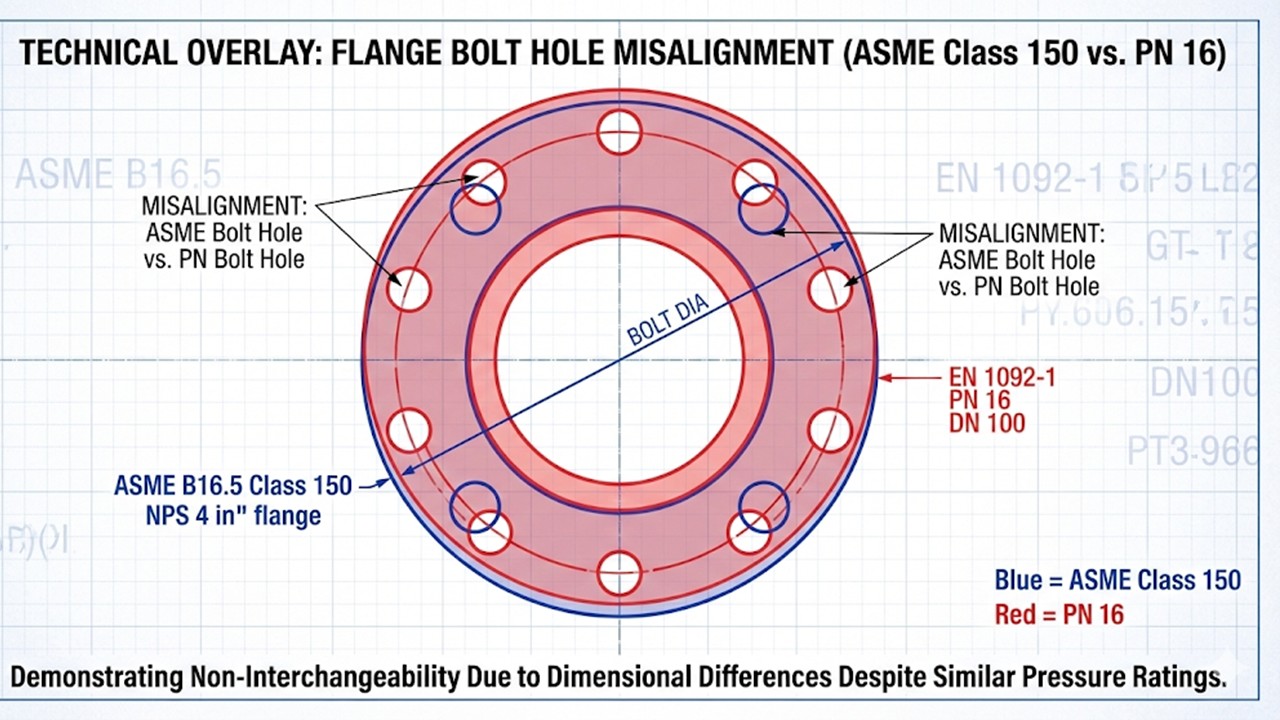
During the commissioning phase of a plant expansion in Germany, the piping team attempted to connect a locally sourced DN 100 (PN 16) cooling water line to the suction flange of a new pump skid imported from the United States. The pump nozzle was specified as NPS 4 Class 150.
The Site Engineer assumed that because the pressure ratings were compatible (PN 16 is roughly 16 bar, and Class 150 is roughly 20 bar), the flanges would mate. However, upon lifting the spool into place, the fitters discovered a critical issue: the bolts would not pass through the holes.
This illustrates the danger of ignoring flange bolt hole compatibility. While both flanges use 8 bolts, their geometry is governed by different standards:
- ANSI B16.5 (Class 150): Pitch Circle Diameter (PCD) is 190.5 mm. Bolt hole is 19 mm.
- EN 1092 (PN 16): Pitch Circle Diameter (PCD) is 180.0 mm. Bolt hole is 18 mm.
The 10mm difference in PCD meant the holes were offset by 5mm per side—impossible to force without damaging the flange faces.
The Solution: Converter Flanges
The team briefly considered slotting the holes (a dangerous and often illegal practice) but rejected it due to code violations. The engineering solution involved fabricating a “Converter Spool” (or Transition Spool).
They took a short length of pipe and welded a DN 100 PN 16 Slip-On Flange on one end (to match the site piping) and an NPS 4 Class 150 Slip-On Flange on the other end (to match the pump). This spool acted as the adapter between the ANSI B16.5 vs EN 1092 worlds.
Lesson Learned
This delay cost the project 3 days of downtime. The key takeaway for 2026 engineers is clear: DN vs NPS vs PN is not just about pressure ratings; it is about dimensional geometry. Never assume interchangeability based on nominal pressure alone. Always verify the Bolt Circle Diameter (BCD) or PCD when crossing between Metric and Imperial boundaries.
EPCLand YouTube Channel
2,500+ Videos • Daily Updates
Frequently Asked Questions: Piping Standards
What is the definition of DN in piping?
DN stands for Diameter Nominal. It is a dimensionless designation used in the metric system to describe pipe sizes, standardized under ISO 6708 Nominal Diameter. It roughly corresponds to the internal diameter of the pipe in millimeters, but like NPS, it is a “name,” not an exact measurement.
How do you perform a Nominal Pipe Size to DN conversion?
The standard Nominal Pipe Size to DN conversion rule is to multiply the NPS (inches) by 25. For example, NPS 4 × 25 = DN 100. However, this is an approximation for naming conventions. Always check standard tables for sizes like NPS 1.5, which converts to DN 40 (not 37.5).
Does the wall thickness change with DN or PN?
Neither directly dictates thickness. The DN/NPS defines the outside diameter. To find the thickness, you must specify the “Schedule” (e.g., Sch 40, Sch 80). The pipe schedule wall thickness determines the pressure capacity of the pipe itself, while PN/Class determines the pressure capacity of the flanges and valves.
Can I bolt an ASME Class 150 flange to a PN 20 flange?
Often yes, but with caution. Class 150 and PN 20 are generally considered identical in dimensions and pressure ratings. However, matching Class 150 to PN 16 (a common European standard) will result in bolt hole misalignment, as seen in our case study.
