✅ Edited and Verified by the Epcland Engineering Team
Corrosion Allowance in Piping: Calculation Logic & Common Pitfalls
Imagine ordering 2 kilometers of Seamless Carbon Steel pipe, only to fail the final design review because the calculation sheet was technically “upside down.” A common error among Junior Engineers is subtracting the Corrosion Allowance (c) after selecting the schedule, or confusing it with Mill Tolerance.
In ASME B31.3, Corrosion Allowance is a critical variable in the equation tm = t + c. It is the sacrificial layer of material added to the pressure design thickness ($t$) to ensure the pipe remains safe throughout its entire design life, despite chemical attack, erosion, or mechanical threading. If you get the order of operations wrong, you aren’t just failing a calculation—you are specifying an unsafe pipe.
⚡ Quick Check: Are your basics clear?
1. In the formula tm = t + c, what does ‘c’ represent?
2. Does Corrosion Allowance contribute to the pressure-holding strength of the pipe?
3. What is the standard Mill Tolerance for seamless pipe (ASTM A106/A53)?
4. When should the Mill Tolerance be applied?
5. If corrosion allowance is high (e.g., 6mm), what happens to the pipe weight?
Table of Contents
Complete Course on
Piping Engineering
Check Now
Key Features
- 125+ Hours Content
- 500+ Recorded Lectures
- 20+ Years Exp.
- Lifetime Access
Coverage
- Codes & Standards
- Layouts & Design
- Material Eng.
- Stress Analysis
🧮 Corrosion Allowance (CA) Calculator
Calculate total required allowance based on rate, life, and mechanical depth.
Ref: NACE or Historical Data
Optional: For threading or grooving.
Total Corrosion Allowance (c):
0.00 mm
Use this value for ‘c’ in the ASME B31.3 formula.
📊 Typical Corrosion Allowance Values (Rules of Thumb)
While specific projects require calculation, these are common industry defaults for Carbon Steel:
| Service Type | Typical CA (mm) | Typical CA (inch) | Notes |
|---|---|---|---|
| General Utility (Air, Water) | 1.5 mm | 1/16″ | Standard minimum for CS. |
| Hydrocarbons (Sweet) | 3.0 mm | 1/8″ | Common for process lines. |
| Sea Water / Corrosive | 3.0 – 6.0 mm | 1/8″ – 1/4″ | Depends on lining/coating. |
| Steam (Dry) | 1.5 mm | 1/16″ | Erosion may require more. |
| Stainless Steel | 0.0 mm | 0″ | Assumed corrosion resistant. |
*Always consult project-specific Piping Material Specifications (PMS).
🔩 Mechanical Allowance: Thread Depths (ASME B1.20.1)
When using threaded pipe, you must add the thread height (h) to your minimum thickness requirement.
| NPS (Size) | Threads Per Inch | Thread Height (h) [mm] | Thread Height (h) [in] |
|---|---|---|---|
| 1/2″ – 3/4″ | 14 | 1.45 mm | 0.057″ |
| 1″ – 2″ | 11.5 | 1.76 mm | 0.069″ |
| 2 1/2″ & up | 8 | 2.54 mm | 0.100″ |
Engineering Note: If you specify a 1.5mm Corrosion Allowance on a 1.5mm deep thread, you have effectively zero allowance for actual corrosion. Always calculate: Total c = Corrosion + Thread Depth.
What is ‘c’ in ASME B31.3?
In the context of ASME B31.3 (Process Piping), the variable ‘c’ is often colloquially referred to as “Corrosion Allowance,” but this is a dangerous oversimplification. Per paragraph 304.1.1, the value ‘c’ is the sum of mechanical allowances, not just chemical degradation.
The code explicitly defines ‘c’ as the sum of:
- Corrosion & Erosion: The estimated material loss over the design life (e.g., 1.6mm or 3.0mm).
- Mechanical Depth: The depth of threads, grooves, or other mechanical cuts into the pipe wall.
If you are designing a threaded pipe, the depth of the thread (usually defined in ASME B1.20.1) MUST be added to your corrosion allowance to find the total ‘c’. Failing to do this results in a root wall thickness that is too thin to hold the pressure.
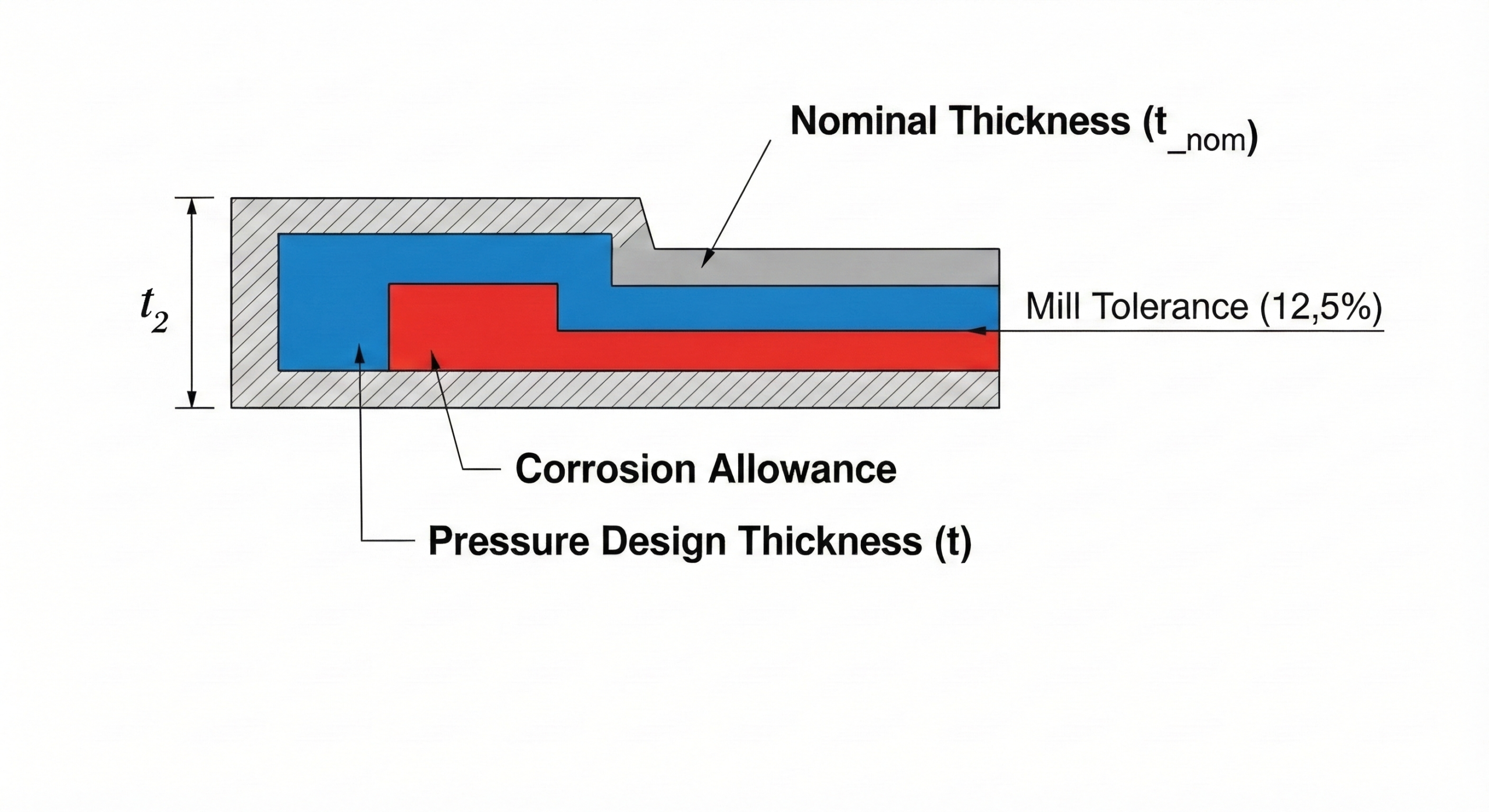
The Formula Logic: t vs. tm
The most common mistake Junior Engineers make is applying the mill tolerance to the pressure design thickness ($t$) alone. This is mathematically incorrect. You must build the wall thickness from the inside out.
Step 1: Calculate Pressure Design Thickness ($t$).
Step 2: Add the total ‘c’ to get Minimum Required Thickness ($t_m$).
Step 3: Adjust for Mill Tolerance to find the Nominal Order Thickness ($T_{nom}$).
“Corrosion Allowance is not a safety factor. It is borrowed time. A pipe with 3mm of corrosion allowance is designed to be exactly 3mm thinner at the end of its life. Never use ‘c’ to justify pressure containment.”
The Mill Tolerance Trap (12.5%)
Seamless pipes (ASTM A106, A53) are manufactured with a standard undertolerance of 12.5%. This means if you order a wall thickness of 10.0mm, the manufacturer is legally allowed to deliver a pipe that is only 8.75mm thick at certain spots.
Therefore, your calculated $t_m$ must fit inside that remaining 87.5% of the pipe wall. The formula to find the required Schedule is:
Solved Calculation Example
Scenario: High Pressure Steam Line
Given:
Pipe: NPS 8 (OD = 8.625″)
Material: A106 Gr B (S = 20,000 psi)
Pressure (P): 1000 psig
Corrosion Allowance (c): 0.125″ (3.2mm)
Mill Tolerance: 12.5%
Step 1: Calculate Pressure Design Thickness ($t$)
Using B31.3 Eq 3a (Assuming E=1.0, W=1.0, Y=0.4):
t = (1000 * 8.625) / (2 * (20000 + 1000*0.4))
t = 8625 / 40800
t = 0.211 inches
Step 2: Calculate Minimum Required Thickness ($t_m$)
Add the corrosion allowance ($c$):
tm = 0.211 + 0.125
tm = 0.336 inches (This is the absolute minimum wall required at the mill)
Step 3: Account for Mill Tolerance
Find the Nominal Wall required ($T_{nom}$):
T_nom = 0.336 / 0.875
T_nom = 0.384 inches
Conclusion:
Check Pipe Schedules for NPS 8:
– Schedule 40: Wall = 0.322″ (FAIL – 0.322 < 0.384)
– Schedule 80: Wall = 0.500″ (PASS – 0.500 > 0.384)
Note: If you ignored the tolerance and just looked at tm (0.336″), you might have mistakenly thought Sch 40 (0.322″) was “close enough” or only slightly failed, but in reality, it fails significantly once tolerance is applied.
EPCLand YouTube Channel
2,500+ Videos • Daily Updates
Frequently Asked Questions
1. Does Mill Tolerance apply to the corrosion allowance?
Mathematically, yes. Because you purchase the pipe by Nominal thickness, the 12.5% under-tolerance applies to the entire wall. This is why we divide the sum $(t + c)$ by $(1 – \text{tolerance})$ rather than just adding tolerance to $t$. The physical metal loss for corrosion is fixed, but the pipe you buy must be thick enough to house that fixed allowance after the mill removes their allowable variation.
2. Can the Corrosion Allowance be zero in ASME B31.3?
Yes. If the fluid is non-corrosive (e.g., dry air, certain hydrocarbons) and the material is resistant, ‘c’ can be 0. However, mechanical allowances (thread depth) must still be added if applicable. Always verify the Material Selection Diagram (MSD) before assuming zero.
3. What is the standard corrosion allowance for Carbon Steel?
There is no “standard” in the code itself. However, many Engineering Procurement Construction (EPC) companies use a default of 1.6 mm (1/16″) for general utility service and 3.0 mm to 6.0 mm for corrosive sour service. This is project-specific data, not a code rule.
4. Do I add corrosion allowance for threaded pipe?
You must add both. The variable ‘c’ in the formula is the sum of corrosion allowance PLUS the thread depth (e.g., the height of the thread cut). For standard NPT threads, this can significantly increase the required schedule.
Conclusion
Calculating wall thickness in ASME B31.3 is less about complex calculus and more about the correct Order of Operations. The Corrosion Allowance ($c$) is a specific, fixed value that guarantees the pipe’s longevity.
Remember the “Golden Rule”:
$T_{nominal} \geq \frac{t + c}{0.875}$
By adding ‘c’ to your pressure design thickness before accounting for mill tolerance, you ensure that the pipe delivered to the site is safe, code-compliant, and ready for its full design life.
🚀 Master Piping Engineering?
Don’t just read about it. Get the full industry-ready training.
View Complete CourseEpcland Engineering Team
We are a collective of Senior Piping Engineers and Stress Analysts dedicated to simplifying complex ASME/API codes for the next generation. Our content is peer-reviewed to ensure accuracy and practical field application.

Related posts:
![High-grade industrial Wing Nut Types and Applications for mechanical assemblies.]()
Wing Nut Types and Applications: The 2026 Engineering Guide
![Industrial Monorail Crane Systems installed in a modern manufacturing plant 2026.]()
Monorail Crane Systems: Design, Types & 2026 Standards Guide
![Lead engineer performing a Factory Acceptance Test FAT on an industrial skid system 2026]()
Factory Acceptance Test FAT: The 2026 Engineering Guide to Zero-Defect Delivery
![Professional engineering workspace showing a Basis of Design document layout for a 2026 project.]()
Basis of Design: How to Write a BOD for Engineering Projects in 2026
![Industrial Flare Knockout Drum Sizing and installation in a refinery relief system.]()
Flare Knockout Drum Sizing: Design & API 521 Standards (2026 Guide)
![Advanced Reboiler Control Systems in a modern petrochemical refinery 2026.]()
Reboiler Control Systems: Engineering Guide to Precision Control 2026