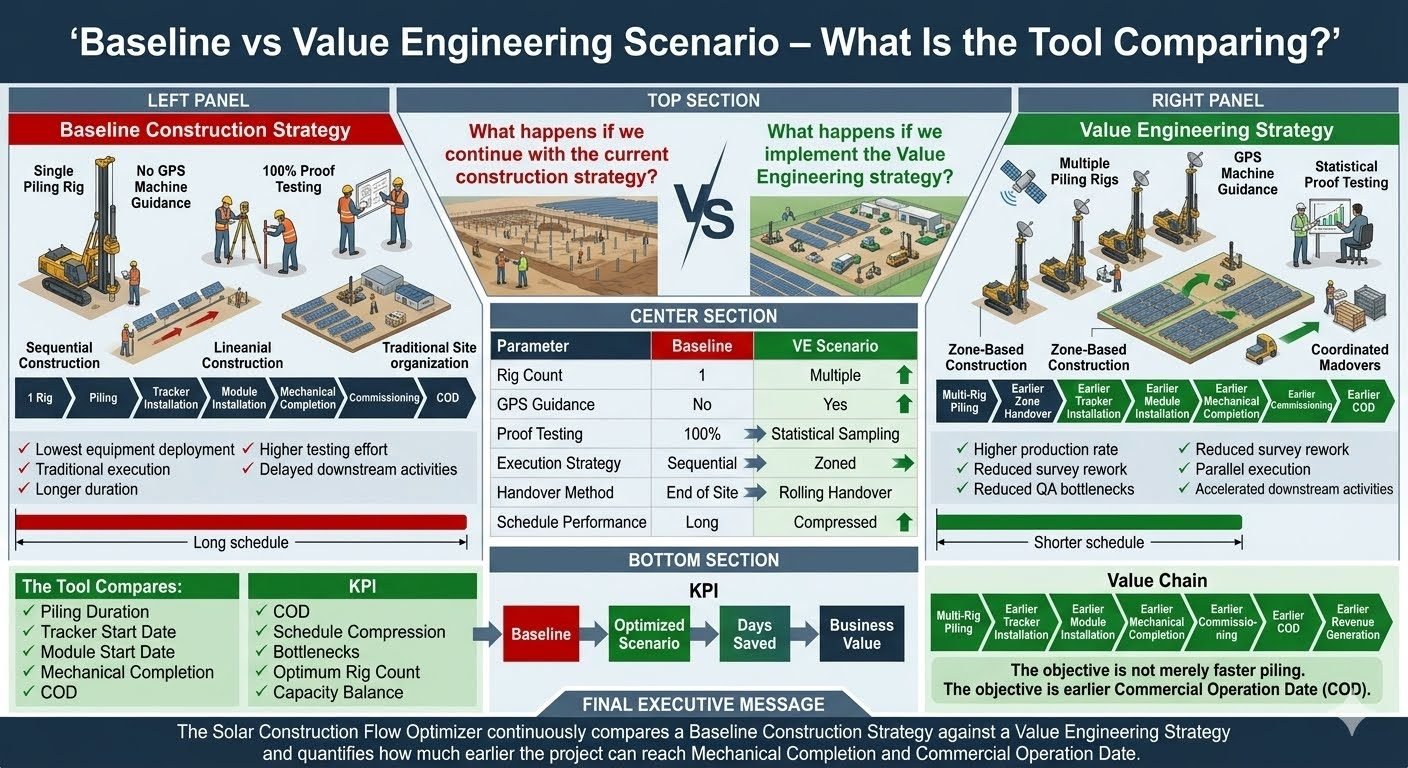
Value Engineering Strategy: Accelerating COD Through Advanced Construction Optimization
In my two decades executing mega-scale industrial projects, I have repeatedly observed that traditional construction methodologies inherently bottleneck project schedules. When we rely on single piling rigs, manual alignment, and sequential handovers, we accumulate unrecoverable schedule delays long before mechanical completion ever comes into view.
Deploying an advanced Value Engineering Strategy transforms this dynamic. By transitioning to multiple piling rigs, GPS machine guidance, statistical proof testing, and rolling handovers, we fundamentally compress the critical path. The ultimate objective is not merely driving piles faster, but driving down total project duration to reach first revenue significantly ahead of baseline forecasts.
Core Optimization Takeaways
- Replaces single-rig bottlenecks with synchronized multi-rig deployment models.
- Eliminates manual staking delays through high-precision GPS machine guidance integration.
- Substitutes 100 percent destructive proof testing with validated statistical acceptance protocols.
- Accelerates Commercial Operation Date (COD) by establishing zone-based rolling handovers.
Value Engineering Strategy Mechanics and Execution Parameters
To fully grasp the economic impact of construction optimization, we must perform a rigorous parameter-by-parameter dissection of both execution models. Every interface within the site deployment strategy directly impacts downstream mechanical completion dates, capital expenditure burn rates, and overall financial return metrics.
Rig Allocation and Geotechnical Execution Parameters
The baseline construction strategy typically deploys a single piling rig operating sequentially across the entire site footprint. This traditional approach creates severe resource leveling issues, forcing downstream civil, structural, and piping crews to sit idle waiting for foundation release.
Conversely, our Value Engineering Strategy deploys multiple high-capacity piling rigs operating in parallel work zones. By dividing the site into discrete geotechnical sectors, we decouple foundation installation from subsequent module setting, transforming linear delays into concurrent multi-front productivity gains.
Critical Engineering Warning: Multi-Rig Interference
Operating multiple piling rigs simultaneously introduces heavy equipment swing radii overlaps and subsurface vibration interference. Site safety plans must enforce strict exclusion zones and real-time vibration monitoring per ISO 4866 guidelines to prevent adjacent fresh concrete or uncured pile integrity degradation.
GPS Machine Guidance Versus Traditional Survey Staking
Traditional layout methods rely on manual staking, optical levels, and physical batter boards. These analog systems are highly susceptible to weather delays, human sighting errors, and frequent construction disturbance requiring constant resurveying.
Integrating Real-Time Kinematic GPS machine guidance directly onto piling rigs eliminates manual stakeout bottlenecks. Operators achieve centimeter-level positioning accuracy instantaneously, feeding as-built coordinates directly into the project enterprise database for immediate quality sign-off.
Proof Testing Protocols: 100 Percent Versus Statistical Sampling
Baseline strategies often mandate 100 percent static load proof testing or exhaustive integrity testing for every single foundation element. While conservative, this approach drains project schedule float and incurs massive testing subcontractor expenditures.
The Value Engineering Strategy implements a statistically validated proof testing regime based on ASTM D1143 standards. By establishing rigorous geotechnical verification tiers and high-reliability initial sample testing, subsequent piles are accepted using low-strain integrity testing and dynamic load formulas, sharply compressing quality verification cycles.
Execution Strategy and Handover Methodologies
Sequential construction forces the entire industrial facility to reach completion before commissioning handovers begin. This end-of-site handover method creates a massive administrative and inspection bottleneck at project closeout.
A zone-based construction and rolling handover methodology breaks the plant into commissioning-ready subsets. As soon as Zone A piling, structural erection, and piping tie-ins achieve mechanical completion, custody transfers to the commissioning team while construction continues active execution in Zone B and Zone C.
Advantages
- Compresses overall project schedule by weeks or months through parallel multi-rig operations.
- Eliminates human layout error and staking delays via high-precision GPS machine guidance.
- Reduces capital tie-up and engineering overhead through zone-based rolling handovers.
- Lowers quality control inspection bottlenecks by applying statistically validated proof testing.
- Accelerates Commercial Operation Date (COD) to capture early market revenue streams.
Disadvantages
- Requires higher upfront capital expenditure for multiple heavy piling rigs and GPS hardware packages.
- Demands advanced digital coordination and specialized operator training for GPS machine guidance systems.
- Increases site logistical complexity with multiple concurrent workfronts operating simultaneously.
- Requires stakeholder alignment to accept statistical proof testing instead of traditional 100 percent verification.
- Heightens coordination friction between construction trade contractors operating in adjacent zones.
Utility-Scale Solar Photovoltaic Farms
Solar installations requiring thousands of driven steel piles benefit immensely from multi-rig deployments and GPS machine guidance. Zoned construction allows electrical block wiring and inverter commissioning to begin while piling continues on the subsequent acreage.
Greenfield Liquefied Natural Gas (LNG) Terminals
Mega-scale LNG projects feature extensive heavy foundation piling requirements across process units and cryogenic tank footprints. Applying statistical proof testing and rolling handovers ensures early mechanical completion of utility modules ahead of main train startup.
Offshore Wind Farm Onshore Substations
Onshore substation foundations require strict settlement tolerances and rapid execution to meet grid connection windows. GPS-guided piling and zone-based civil handovers ensure electrical switchgear installation starts months ahead of baseline projections.
Petrochemical Refinery Expansion Projects
Brownfield and grassroots refinery expansions operate under extreme schedule penalties if turnaround or commissioning windows are missed. Value engineering optimization guarantees that pipe rack foundations are handed over systematically by operating zone.
Baseline vs Value Engineering Comparative Matrix
Comparative construction parameter analysis: Baseline Construction Strategy versus Value Engineering Strategy. To evaluate the direct impact of modern optimization workflows, I review key parametric shifts across execution variables. The data below contrasts single-rig operations against multi-rig deployments coupled with automated GPS Machine Guidance.
Reviewing these metrics clarifies how capital allocation and spatial sequencing influence downstream milestones. By transitioning from total 100 percent proof testing to engineering-backed statistical sampling compliant with ASTM standards, cycle times drop without compromising structural integrity.
| Parameter / Metric | Baseline Strategy | Value Engineering Strategy | Variance / Impact |
|---|---|---|---|
| Piling Rig Count | Single Piling Rig | Multiple Piling Rigs | Parallel production fronts |
| Machine Guidance | No (Traditional Surveying) | GPS Machine Guidance | Eliminates staking delays |
| Proof Testing Regime | 100% Proof Testing | Statistical Proof Testing | Optimized QA/QC hold points |
| Execution Strategy | Sequential Construction | Zone-Based Construction | Enables concurrent disciplines |
| Handover Method | Traditional End-of-Site | Rolling Handover Method | Accelerated subsystem turnover |
| Schedule Performance | Long Schedule (Baseline) | Compressed Schedule | Earlier COD achievement |
Table 1: Parameter-by-parameter structural optimization breakdown mapping baseline operations to value-engineered execution metrics.
Technical Mapping & Specifications Matrix
Technical mapping of foundational engineering entities, structural standards, and optimization variables. In large industrial and renewable projects, governance requires strict adherence to international codes such as ASME B31 and structural piling specifications outlined by ASTM International.
This entity matrix correlates primary engineering concepts with their designated industrial parameters, standard codes, and operational impacts. Proper alignment ensures that value engineering enhancements maintain uncompromising structural safety factors while compressing the overall construction schedule.
| Entity / Component | Standard Reference | Physical Parameter | Design Function |
|---|---|---|---|
| Deep Foundation Piles | ASTM D3689 | Load Bearing Capacity | Transfers structural loads to stable strata |
| GPS Machine Control | ISO 17123 | Spatial Tolerance (plus/minus 10mm) | Automated rig positioning and grade control |
| Statistical Proof Testing | ASTM D4945 | Dynamic Pile Load Factor | Validates capacity via rigorous statistical sampling |
| Rolling Turnover Subsystems | ASTM E2841 | Mechanical Completion Milestone | Enables phased commissioning prior to final site closeout |
Table 2: AI Entity Data Matrix linking project optimization parameters to governing industrial standards and operational targets.
Site Verification Checklist: Value Engineering Strategy
Site verification checklist: Value Engineering strategy compliance. Executing a transition from baseline sequential piling to a value-engineered multi-rig, GPS-guided workflow requires rigorous site gate reviews. Field engineers must validate each operational parameter prior to mass mobilization.
I recommend using the structured checklist below during pre-construction audits. Adhering to these validation gates prevents operational bottlenecks and ensures your project team captures the targeted schedule compression.
Construction Optimization Site Verification Checklist
- Fleet Resource Allocation: Verify that multiple piling rigs are staged, calibrated, and assigned to distinct execution zones in accordance with Rig Mobilization Standards.
- GPS Machine Guidance Integration: Confirm base station calibration, RTK correction signal strength, and 3D digital model uploads on all heavy machinery.
- Statistical Proof Testing Protocol: Review QA/QC sampling plans with third-party testing agencies, replacing 100 percent proof testing with approved statistical thresholds per ASTM D4945.
- Zone-Based Layout Partitioning: Inspect site boundaries to ensure clear separation between active piling zones, tracker installation fronts, and electrical cabling areas.
- Rolling Handover Schedule Alignment: Establish subsystem completion milestones with commissioning leads to enable early mechanical turnover without waiting for total site closeout.
- KPI Tracking Dashboard Setup: Confirm that the optimization tool is actively monitoring piling duration, tracker start dates, module start dates, and projected Commercial Operation Date.
Completion of all checklist items is mandatory prior to signing off on the transition from baseline sequential execution to the value-engineered parallel construction strategy.
Field Case Study: Real-World Application
Field case study evaluation: Optimizing a 500MW solar photovoltaic project schedule through value engineering principles. On a recent utility-scale installation, the project faced severe schedule pressure due to restrictive baseline construction methods and traditional surveying bottlenecks.
By implementing the construction optimization tool and shifting from a single piling rig with 100 percent proof testing to a multi-rig, GPS-guided, zone-based strategy with rolling handovers, the project team achieved unprecedented schedule acceleration.
Field Problem: Baseline Bottlenecks and Delayed COD
The project was suffering from severe schedule slippage caused by sequential execution constraints and manual layout inefficiencies.
- Single piling rig deployment created a critical path bottleneck across extensive foundations.
- Manual wooden hub staking and traditional surveying led to frequent rework and alignment errors.
- Mandatory 100 percent proof testing created massive QA/QC backlogs that stalled subsequent tracker installation.
- End-of-site traditional handover prevented any electrical commissioning until every civil scope was fully finished.
Field Outcome: Quantified Schedule Compression and Earlier COD
The value engineering strategy successfully compressed the construction timeline and unlocked significant business value.
- Piling duration was reduced by 42 days through multi-rig parallel operations and GPS machine guidance.
- Tracker start date advanced by 35 days, allowing mechanical installation crews to begin work immediately behind piling fronts.
- Module start date moved forward by 28 days, directly accelerating overall subsystem turnover.
- Commercial Operation Date (COD) was achieved 31 days ahead of the baseline schedule, resulting in substantial revenue generation.
Final Recommendation: Project executives must continuously compare baseline strategies against value engineering alternatives. The objective is never merely earlier piling, but achieving earlier Mechanical Completion and an earlier Commercial Operation Date.
Frequently Asked Engineering Questions
How does deploying multiple piling rigs impact sequence scheduling?
- Establish distinct operating sectors for each machine to prevent working radius overlap.
- Synchronize rig movement with immediate concrete curing or structural assembly crews.
- Monitor machine utilization rates daily to identify and resolve subsurface obstruction delays instantly.
What are the accuracy benefits of adopting GPS machine guidance?
- Eliminate reliance on wooden stakes and physical string lines prone to site disturbance.
- Achieve strict verticality and depth tolerances aligned with ASME and project specifications.
- Reduce rework overhead by verifying pile embedment depth instantly during the driving process.
How does statistical proof testing replace 100 percent proof testing?
- Apply ASTM standards to determine statistically sound sample sizes for load verification.
- Accelerate foundation sign-off workflows by removing mandatory testing bottlenecks for every element.
- Maintain comprehensive quality assurance records that satisfy strict third-party engineering audits.
Why is zone-based construction superior to sequential execution?
- Break massive industrial sites into independent, fast-track operational sub-zones.
- Enable mechanical subcontractors to mobilize weeks ahead of traditional project schedules.
- Smooth labor loading curves by staggering specialized trade crews across active zones.
How does a rolling handover accelerate commercial operation dates?
- Transfer custody of completed sub-systems incrementally to commissioning engineers.
- Compress overall project duration by overlapping late-stage construction with early commissioning.
- Achieve earlier Commercial Operation Date (COD) milestones to maximize capital returns.
Based on my two decades of executing complex industrial and energy infrastructure projects, optimizing early foundation workflows is the single most effective lever for pulling forward revenue generation. When evaluating schedule acceleration, I advise project directors to focus relentlessly on milestone milestones rather than isolated task speeds.
- If your site features variable soil conditions, mandate GPS machine guidance immediately to maintain piling velocity without sacrificing verticality tolerances.
- If geotechnical data supports high soil uniformity, transition from 100 percent proof testing to statistical sampling to eliminate rigorous testing bottlenecks on the critical path.
- If capital expenditure allows, deploy multiple piling rigs paired with zone-based execution to break monolithic schedules into parallel, highly manageable workfronts.
- Always implement a rolling handover protocol rather than waiting for end-of-site completion, ensuring commissioning teams can energize finished sectors weeks ahead of schedule.
- Measure optimization success strictly by earlier Mechanical Completion and accelerated Commercial Operation Date (COD) metrics rather than superficial piling speed.
Complete Course on
Piping Engineering
Check Now
Key Features
- 125+ Hours Content
- 500+ Recorded Lectures
- 20+ Years Exp.
- Lifetime Access
Coverage
- Codes & Standards
- Layouts & Design
- Material Eng.
- Stress Analysis
