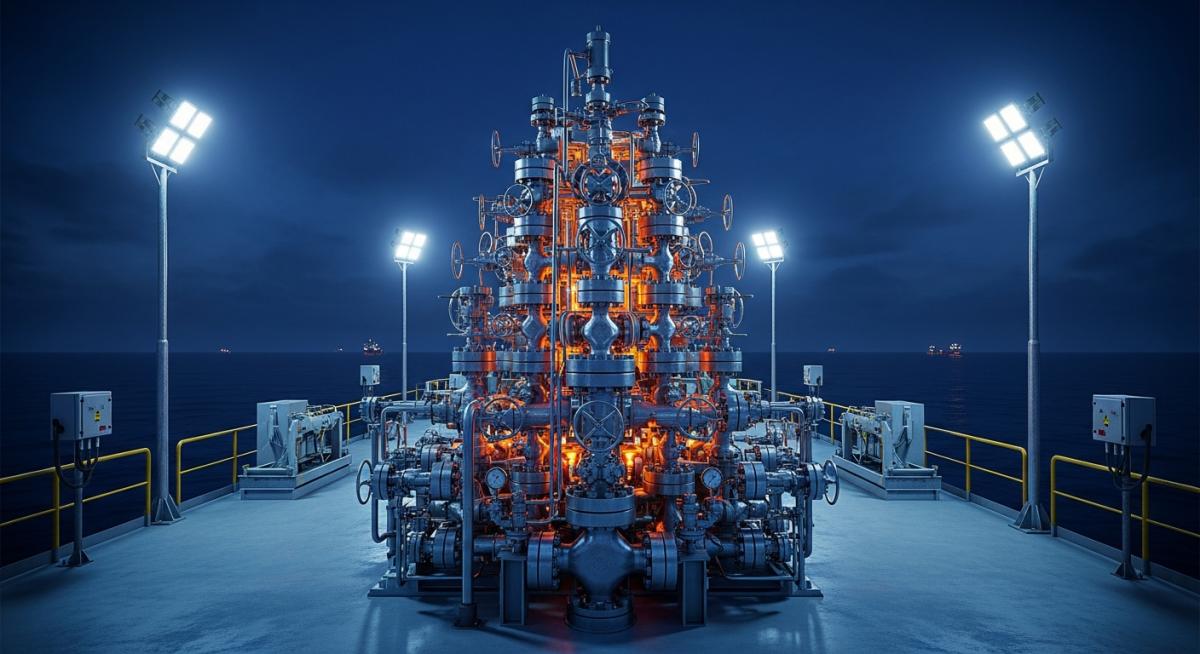
The Essential Guide to the Christmas-Tree-In-Oil-Gas Assembly
In modern petroleum extraction, the christmas-tree-in-oil-gas configuration serves as the primary pressure control interface between the wellbore and the production facility. This complex assembly of valves, spools, and fittings is critical for regulating the flow of hydrocarbons, ensuring safety during high-pressure operations, and providing access for well intervention activities in 2026.
What is a Christmas Tree in Oil and Gas?
A Christmas Tree (production tree) is a series of specialized valves and gauges installed on a wellhead after drilling and completion. Its primary purpose is to control the flow of oil, gas, or water out of the well and to manage chemical injection or well monitoring via the Master valve and wing valve functions.

Quick Navigation
Knowledge Check: Tree Engineering
1. What is the primary difference between a wellhead and a christmas tree?
Complete Course on
Piping Engineering
Check Now
Key Features
- 125+ Hours Content
- 500+ Recorded Lectures
- 20+ Years Exp.
- Lifetime Access
Coverage
- Codes & Standards
- Layouts & Design
- Material Eng.
- Stress Analysis
What is a Christmas Tree?
In the context of energy extraction, a christmas-tree-in-oil-gas refers to a complex arrangement of equipment installed at the surface of an oil or gas well. The primary role of this assembly is to manage the flow of hydrocarbons from the well, ensuring safe and efficient production. It serves as the critical interface between the subsurface reservoir and the surface transport infrastructure.
Core Components of a Christmas Tree
The assembly consists of various Surface production tree components that serve distinct functions to maintain well integrity in 2026:
Valves
Mechanical barriers used to control the flow of oil or gas and provide emergency shut-in capabilities.
Gauges
Sensors that monitor pressure and temperature within the wellbore for real-time safety analysis.
Chokes
Orifices used to regulate the flow rate, preventing excessive pressure surges and reservoir damage.
Connectors
Flanges and hubs that facilitate connections to production pipelines and intervention equipment.
Engineering Theory: The Physics of christmas-tree-in-oil-gas
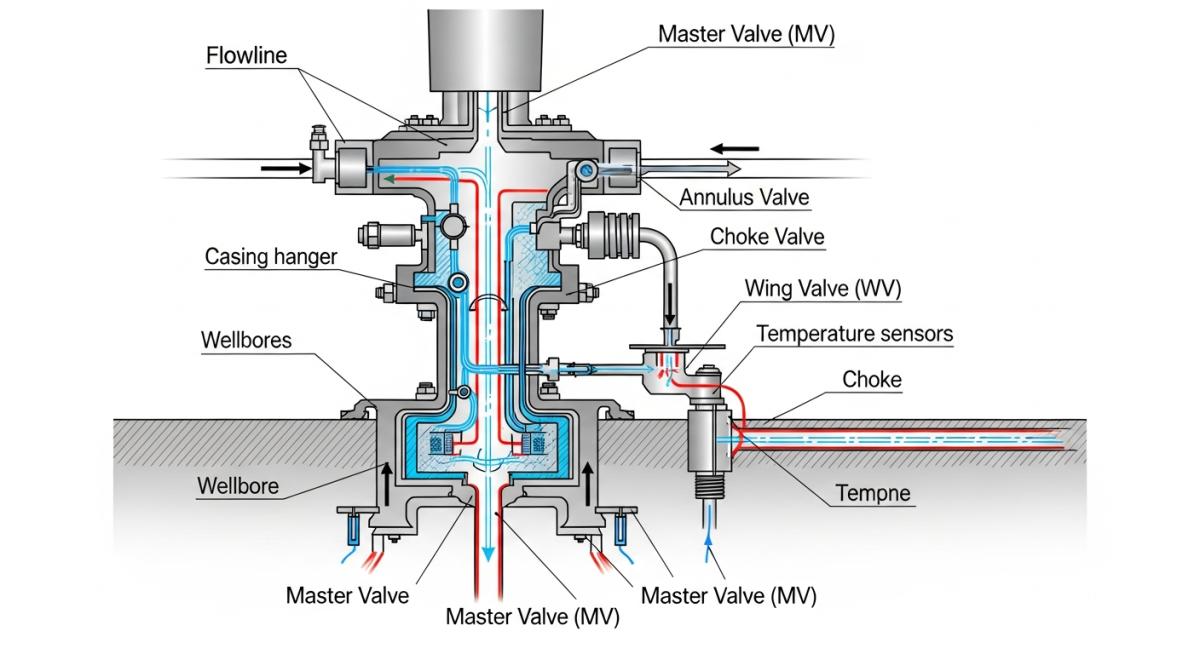
The design of a christmas-tree-in-oil-gas system is governed by fluid mechanics and high-pressure metallurgy. Its primary role is to provide a mechanical barrier that manages the transition from reservoir pressure to flowline pressure. Unlike the wellhead, which provides structural integrity, the tree is an active control system that regulates flow rates through Master valve and wing valve functions.
Core Surface Production Tree Components
A standard 2026 assembly consists of vertically stacked gate valves. The “Master Valve” (Lower and Upper) provides the main conduit, while the “Wing Valves” (Production and Kill) facilitate fluid exit and maintenance. For vertical entry, the “Swab Valve” sits at the top. Understanding these Surface production tree components is vital for any completions engineer managing high-pressure environments.
Pressure and Flow Calculations
Calculation: Pressure Drop Across Choke Valve
The pressure drop (dP) across the tree’s choke is calculated using the formula:
dP = P1 – P2
Where:
P1 = Upstream Wellhead Pressure (PSI)
P2 = Downstream Flowline Pressure (PSI)
Note: In 2026, real-time telemetry integrates these calculations to prevent hydrate formation in Subsea christmas tree applications.
API 6A Equipment Standards (2026 Update)
Compliance with API 6A equipment standards is mandatory for ensuring the material class and temperature ratings of the tree match the specific reservoir conditions. The following table outlines the Material Class specifications commonly used in 2026.
| Material Class | Service Environment | Typical Material |
|---|---|---|
| AA – General | Non-Corrosive (Sweet) | Carbon or Low Alloy Steel |
| DD – Sour | H2S Present (Sour) | NACE MR0175 Alloy Steel |
| EE – Corrosive | CO2 and H2S (Highly Corrosive) | Stainless Steel / Inconel Clad |
| HH – Extreme | High CO2/H2S + High Temperature | Full Duplex/Nickel Alloys |
The Wellhead vs Christmas Tree Differences
It is a common misconception in early-career engineering to conflate these two systems. However, Wellhead vs christmas tree differences are distinct: the wellhead is a permanent fixture providing a pressure seal for casing strings, while the christmas-tree-in-oil-gas is a modular assembly for flow management. The tree is often removed during workovers, whereas the wellhead remains fixed for the life of the well.
EPCLand YouTube Channel
2,500+ Videos • Daily Updates
Visual Representation of Equipment Functions
To maintain operational safety in 2026, engineers must distinguish between the physical hardware and the functional objectives of the christmas-tree-in-oil-gas. The following table summarizes the primary Surface production tree components and their critical roles in the production lifecycle.
| Component | Primary Function | 2026 Tech Integration |
|---|---|---|
| Valves | Control flow & Pressure Isolation | Smart Actuators |
| Gauges | Monitor well conditions (P/T) | Wireless Telemetry |
| Chokes | Regulate flow rate & dP | Automated Choke Control |
| Connectors | Connect to pipelines & Manifolds | Metal-to-Metal Seals |
Engineer’s Note: While the components above define the physical tree, the Master valve and wing valve functions are what allow for the dynamic regulation required during well testing and production ramps.
How Do Christmas Trees Work?
The operational mechanics of a christmas-tree-in-oil-gas depend heavily on the extraction environment. Whether deployed in the high-wind deserts of onshore fields or the crushing depths of the ocean, these assemblies function as the “brain” of well control. Understanding their operation involves recognizing the critical differences between surface trees and subsea trees in 2026.
Surface Trees
Surface trees are installed above ground on land-based drilling sites. They are highly visible and accessible, allowing for manual Christmas tree maintenance procedures 2026. These assemblies are equipped with various Surface production tree components that facilitate direct flow control, pressure monitoring, and safe operator access during peak production phases.
Onshore / PlatformSubsea Trees
In offshore drilling, Subsea christmas tree units are deployed beneath the water’s surface. These can be designed in vertical or horizontal orientations, depending on the valve configuration. They must endure harsh deep-sea environments, requiring specialized API 6A equipment standards to withstand external hydrostatic pressure and low temperatures that trigger hydrate formation.
Deepwater / SubsurfacePro Tip: When analyzing Subsea christmas tree vs surface tree performance, always account for the signal latency in hydraulic control lines for subsea units, which often necessitates the use of Subsea Accumulator Modules (SAMs) for rapid Master valve and wing valve functions during an emergency.
The Crucial Role of the christmas-tree-in-oil-gas in Extraction
A christmas-tree-in-oil-gas serves multiple essential functions throughout the lifecycle of a well, acting as the primary control mechanism for managing the flow of hydrocarbons from the reservoir to the surface facilities.
Key Functions in 2026 Production
-
Flow Regulation:
They control the flow of oil and gas using chokes and valves, ensuring optimal and safe production rates while preventing excessive velocity.
-
Pressure Monitoring:
Integrated gauges constantly monitor the pressure and temperature within the well to prevent catastrophic blowouts or equipment failures, ensuring compliance with API 6A equipment standards.
-
Injection Management:
The kill wing valve allows for the injection of fluids (like water, gas, or MEG for hydrate prevention) to enhance recovery rates through secondary recovery methods.
-
Maintenance & Testing:
The swab valve provides access for wireline or coiled tubing intervention, enabling Christmas tree maintenance procedures 2026 to sustain long-term efficiency.
Safety & Efficiency
The design of the christmas-tree-in-oil-gas inherently includes crucial safety features to minimize risks:
- Blowout Preventers (BOPs): Installed during the drilling phase (not part of the tree itself) to control annular pressure until the tree is set.
- Pressure Relief Valves: Safety mechanisms integrated into the flow loops to automatically release excess pressure and prevent catastrophic failures.
- Automated Control Systems: Modern systems monitor and manage flow and pressure without constant human intervention, especially critical for Subsea christmas tree operations.
Wellhead vs Christmas Tree Differences
Although the Christmas Tree is installed atop the wellhead, these two components are distinctly different in function and timing of installation. Understanding these Wellhead vs christmas tree differences is fundamental engineering knowledge:
Wellhead (Foundation)
The structural component that supports the weight of the casing strings and tubing hanger. It houses the BOP during drilling and is permanent.
Christmas Tree (Control)
Installed after drilling is complete, focused entirely on production management, flow control via Master valve and wing valve functions, and intervention access.
Fast Facts on Christmas Trees (2026 Data)
- The first **Subsea christmas tree** was installed in 1961, revolutionizing offshore extraction.
- Christmas Trees can be customized for both shallow and deep-water projects (vertical vs horizontal designs).
- These trees withstand extreme pressures and depths, with the deepest installations reaching over 9,500 feet in ultra-deepwater basins such as offshore Brazil and the Gulf of Mexico in 2026.

Types of Christmas Trees in Modern Engineering
The selection of a christmas-tree-in-oil-gas depends on the reservoir pressure, fluid composition, and environmental depth. In 2026, trees are classified into three primary categories based on their operational architecture.
Conventional Trees
Used primarily in traditional drilling applications, these Surface production tree components typically consist of standard mechanical gate valves and manual gauges for monitoring stable, low-risk wells.
Subsea Trees
Specifically designed for underwater installations, the Subsea christmas tree is engineered to withstand extreme hydrostatic pressure and is crucial for offshore drilling operations in 2026.
Enhanced Trees
These “Smart Trees” include advanced 2026 features, such as automated monitoring systems and enhanced safety mechanisms, to improve efficiency and reduce the risk of structural failures.
Maintenance and Operation of Christmas Trees
Maintaining a christmas-tree-in-oil-gas involves rigorous inspections and servicing of all moving parts. This process is essential to ensure that the Master valve and wing valve functions remain responsive throughout the well’s lifespan, preventing leaks or pressure excursions.
Key Maintenance Practices (2026)
Regular Inspections
Routine physical and digital checks to identify wear or potential corrosion issues before they lead to failure.
Component Replacement
Timely replacement of valves, seals, and gauges as needed to maintain compliance with API 6A equipment standards.
Automated Monitoring
Using real-time telemetry to track performance and detect pressure anomalies in Subsea christmas tree vs surface tree setups.
Conclusion
In summary, the christmas-tree-in-oil-gas serves as the vital control center for managing hydrocarbon extraction. Understanding its complex components, varied types, and the necessity of Christmas tree maintenance procedures 2026 is crucial for ensuring safe and environmentally responsible operations.
As technology advances, the design and functionality of these trees will continue to evolve, integrating digital twins and autonomous robotics to enhance their importance in the global energy sector for decades to come.
Case Study: christmas-tree-in-oil-gas Failure Analysis
Location
Deepwater Gulf of Mexico
Equipment Type
15k PSI Subsea Tree
Condition
Hydrate Blockage (HPHT)
In early 2026, a major operator experienced a total production shutdown on a deepwater asset due to a catastrophic hydrate plug formation within the christmas-tree-in-oil-gas assembly. The blockage occurred during a cold-start restart procedure when the internal temperature dropped below the hydrate formation curve (approx. 15-18 degrees Celsius at 5,000 PSI).

The Problem: Thermodynamic Instability
The failure was traced to a malfunction in the automated methanol injection system. Without active inhibition, the gas-water mixture formed solid crystalline structures similar to ice, completely obstructing the flow through the production wing valve. Traditional pressure surging failed to dislodge the plug, posing a risk of “projectile” hydrate movement which could damage the Master valve and wing valve functions downstream.
The Solution: Targeted Chemical Injection
Engineers deployed a specialized ROV-led intervention. By utilizing the Subsea christmas tree vs surface tree flexibility, the team accessed the tree’s dedicated chemical injection mandrel. A high-concentration Monoethylene Glycol (MEG) “soak” was initiated over 72 hours. This lowered the hydrate dissociation temperature, allowing the plug to melt naturally without mechanical intervention.
Result & ROI:
- Production Restored: 25,000 BOEPD recovered.
- Avoided Costs: Estimated 12 million USD in potential workover expenses.
- Prevention: Implemented a redundant digital sensor array for 2026 real-time hydrate monitoring.
This scenario highlights why Subsea christmas tree maintenance requires highly specialized chemical injection protocols compared to surface-level production.
Engineering FAQ: Christmas Tree Operations
What are the primary Christmas tree maintenance procedures 2026 for offshore wells? ▼
In 2026, maintenance focuses on digital valve signature analysis and automated leak detection. Standard Christmas tree maintenance procedures 2026 include routine function testing of the emergency shutdown (ESD) valves, ultrasonic thickness gauging to monitor erosion, and greasing of gate valves to ensure smooth operation under HPHT conditions.
How does a Subsea christmas tree vs surface tree design differ? ▼
The primary difference lies in the control system and environment. A Subsea christmas tree vs surface tree is designed for ROV intervention and utilizes electro-hydraulic control pods for remote operation. Surface trees are accessible for manual intervention and are typically simplified in comparison to the “modular” and “template” configurations used in subsea manifolds.
Can you explain the Wellhead vs christmas tree differences in simple terms? ▼
Wellhead vs christmas tree differences are structural versus functional. Think of the wellhead as the foundation of a building (holding the weight and sealing the casing), while the christmas-tree-in-oil-gas is the plumbing system (valves and pipes) that controls the actual flow of the fluids entering and leaving that building.
What role do Master valve and wing valve functions play in emergency shutdowns? ▼
The Master valve and wing valve functions provide redundant layers of protection. In an emergency shutdown (ESD), the Surface Safety Valve (SSV), often a wing valve or upper master valve, is actuated by a hydraulic or pneumatic signal to fail-close, stopping the flow immediately and isolating the reservoir from the production facility.
Final Engineering Summary
The christmas-tree-in-oil-gas assembly remains one of the most critical pieces of equipment in the field. From adherence to API 6A equipment standards to the management of Surface production tree components, precision in selection and maintenance directly impacts the safety and profitability of a well. As we progress through 2026, the integration of “smart” sensors into these assemblies is set to redefine how we manage pressure control and hydrate remediation globally.
Primary Objective
Pressure Control & Flow Regulation
Regulatory Framework
API 6A / NACE MR0175
2026 Trend
Digital Twins & Remote Intervention
Technical Article by Epcland Dev Architect • Engineering Series 2026

Related posts:
![High-grade industrial Wing Nut Types and Applications for mechanical assemblies.]()
Wing Nut Types and Applications: The 2026 Engineering Guide
![Industrial Monorail Crane Systems installed in a modern manufacturing plant 2026.]()
Monorail Crane Systems: Design, Types & 2026 Standards Guide
![Lead engineer performing a Factory Acceptance Test FAT on an industrial skid system 2026]()
Factory Acceptance Test FAT: The 2026 Engineering Guide to Zero-Defect Delivery
![Professional engineering workspace showing a Basis of Design document layout for a 2026 project.]()
Basis of Design: How to Write a BOD for Engineering Projects in 2026
![Industrial Flare Knockout Drum Sizing and installation in a refinery relief system.]()
Flare Knockout Drum Sizing: Design & API 521 Standards (2026 Guide)
![Advanced Reboiler Control Systems in a modern petrochemical refinery 2026.]()
Reboiler Control Systems: Engineering Guide to Precision Control 2026